
Top Custom Software Development Technologies to Use in 2026
Planning your 2026 tech stack? This guide covers the best custom software development technologies across frontend, backend, AI, cloud, and mobile platforms.
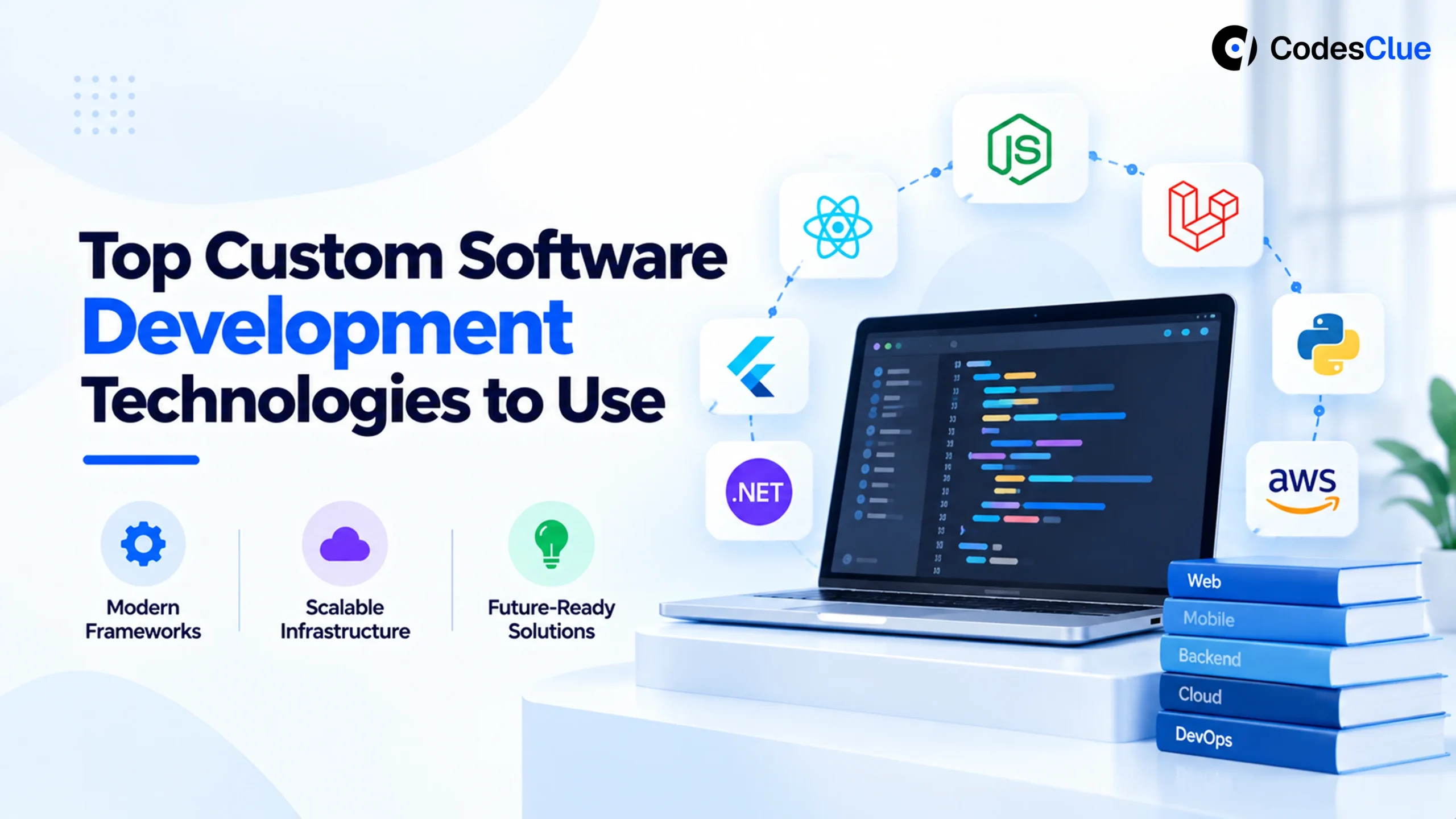
In 2026, a website hasn’t remained just a website with static pages, a contact form, and a blog. It is the time of standard web development surrounded by an intelligent ecosystem comprising a blend of UI, backend logic, AI agents, and real-time data pipelines working in harmony.
Choose the right tech stack and build your dream digital business that stands in 2026 and ahead. This is what this blog is going to cover to let you understand that shifting to top software development technologies 2026 is important for survival in the trending software development market.
Frontend: Building Immersive & High-Performance UIs
You want to make your modern frontend look pretty, it’s not enough though. Here, you should work on the performance, SEO, and user experience of your website that feels instant.
React 19+ and Next.js
Opt for React 19+ and Next.js. It will fix things for you well. Despite new challengers, React.js + Next.js continues to dominate the best tech stack for custom software, always for good reason. They facilitate
- Server-side rendering (SSR) & static generation = SEO dominance
- Lightning-fast page loads
- Massive ecosystem = rarely falls short
In 2026, Next.js has more of a full-stack platform than just a framework. This combo fits best and is a smart move to go with if your goals is SEO + scalability of your business.
The Rise of WebAssembly (WASM)
WebAssembly (WASM) is the silent performance beast. It allows you to run languages like C++ and Rust directly in the browser, which means you get:
- Near-native performance
- Complex applications (think video editing, CAD tools) in-browser
- Reduced dependency on heavy backend processing
In short, WASM can be your option, if it is combined with JavaScript.
SolidJS & SvelteKit
SolidJS & SvelteKit are the rebels when you are tired of virtual DOM overhead. SolidJS offers fine-grained reactivity and blazes fast, whereas SvelteKit compiles away frameworks entirely.
These are gaining traction in trending frontend and backend frameworks discussions because of their smaller bundle sizes, faster rendering, and simpler mental model. This option is perfect for startups chasing speed without sacrificing performance.
Backend: Scalability, Speed, and Agentic Logic
Software systems are having new brains in the new era. When the front-end is understood as the “face”, the backend is the “brain” of the software programs and the brain is getting smarter by 2026.
Node.js & Go (Golang)
Node.js & Go (Golang) are best for scalable systems and microservices. Node.js is best to use in real-time applications like chat, streaming etc, whereas Go (Golang) is built for performance, concurrency, and simplicity. The use cases of this combination cover SaaS platforms, high-traffic applications, and distributed systems. These technologies dominate when discussing most secure backend technologies for fintech 2026 (especially Go).
Python (FastAPI): The AI Backbone
Python is well-known for awesome product development. If your product involves AI, Python is unavoidable. Due to fastAPI feature, it comes with built-in async support and is perfect for ML/AI integrations.
Python + AI = rapid prototyping on steroids. IT is where the impact of AI-assisted coding on development speed becomes obvious.
.NET 10: Enterprise-Grade Powerhouse
Enter .NET 10 to deal with the mission-critical running systems. It offers strong security, excellent performance, and seamless legacy integration, which is perfect for banks, government systems, and large enterprises. .NET always quietly wins when stability matters more than hype.
The “Intelligence Stack of 2026”: AI + Data
AI + Data is a trending combination. This is where software evolves beyond simple automation and stops being reactive. This combo makes the software become intelligent, autonomous, and context-aware. In 2026, applications don’t just respond to inputs; they anticipate needs, learn from data, and make decisions in real time, turning technology into a true strategic partner rather than just a tool.
Agentic AI: From Chatbots to Digital Employees
Remember old-aged chatbots coming in with some basic recorded features. Those basic chatbots were struggling with context at that time. Agentic AI (multi-agent systems) is redefining automation by acting more like digital employees than assistants. These systems can:
- Execute tasks autonomously
- Coordinate across multiple tools and systems
- Make context-aware decisions in real time
You can think of it as less of an “assistant” and more of a team member who works 24/7, without coffee breaks or context loss.
Vector Databases (Pinecone / Milvus)
Traditional databases store structured data, but AI needs meaning, not just data. That’s where vector databases come in. They store embeddings instead of rows, enable semantic (meaning-based) search, and power RAG (Retrieval-Augmented Generation) systems. Remember, your AI will hardly be intelligent without vector databases, feeling like you are just guessing with impressive confidence.
Edge Computing: Speed Matters
Edge computing makes data transfer faster. It brings processing power nearer to the source by reducing latency significantly, enhancing real-time user experiences, and enabling faster, localized decision-making.
Edge computing is especially critical for IoT, gaming, and real-time analytics, where milliseconds can define success or failure.
Cloud 3.0 & Infrastructure: Beyond AWS and Azure
Cloud 3.0 refers to the next evolution of cloud computing, where infrastructure evolves beyond basic scalability into something smarter, leaner, and more sustainable. In this new era, cloud systems are not just hosting applications; they are optimizing performance, reducing costs, and minimizing environmental impact, all while enabling faster, more resilient digital experiences.
Serverless & Managed Backends
Tools like Supabase and Vercel are best for server less and managed backends. They redefine speed by no server management, iInstant deployment, and built-in scalability. They are also ideal for MVPs and startups exploring the best tech stack for SaaS startups in 2026.
Confidential Computing
Security is not just about storing data safely, it’s about protecting data while it’s being used. Confidential computing encrypts data during processing, reduces insider threats, and enhances compliance.
Green IT: Code That Saves the Planet (and Money)
It is true that your code now has a carbon footprint. In 2026, it is no longer just a technical detail, it’s a business concern. Every inefficient query, unused resource, or over-provisioned server translates into higher energy consumption and higher costs.
When we talk about sustainable technology (Green IT), it focuses on building smarter systems through energy-efficient algorithms, optimized infrastructure, and reduced cloud waste. The result? Lower operational expenses and a smaller environmental impact.
Today, Green IT is a core part of ESG (Environmental, Social, and Governance) strategies, making sustainability not just a “nice to have,” but a competitive and regulatory advantage.
Mobile: One Code base to Rule Them All
The best thing in 2026 is to get a one codebase for all apps. As maintaining two separate apps today feels a bit like owning two flip phones, technically possible, but unnecessarily complicated. Modern businesses are embracing cross-platform development to build once and deploy everywhere. Here are some best examples.
Flutter vs. React Native
Two frameworks dominate the cross-platform landscape: Flutter and React Native. They both enable businesses to build high-performance apps for multiple platforms using a single codebase.
- Flutter delivers a highly consistent UI across platforms and offers faster rendering with its own graphics engine.
- React Native is backed by a larger ecosystem and community and is easier to hire developers due to widespread adoption.
Both are powerful choices, enabling businesses to reduce development time and cost while maintaining near-native performance.
PWAs: The Underrated Power Move
Progressive Web Apps (PWAs) offer a lightweight alternative by combining the reach of the web with app-like functionality. They work offline or in low-network conditions, can be installed directly via the browser, and eliminate dependency on app stores.
For cost-conscious businesses or rapid deployments, PWAs are a strategic shortcut to reach users without the overhead of full app development.
Conclusion: How to Choose Your Perfect Stack?
Technology choices are not about trends, they are about strategic alignment with business objectives. The ideal tech stack is one that balances performance, scalability, and cost while remaining adaptable to future innovation.
In essence, the right stack doesn’t just support your product, it enables sustainable growth, competitive advantage, and long-term technological resilience.
So, before you decide, ask yourself if you:
- Need speed? → Go serverless + React
- Are on a budget? → Use managed services to reduce infrastructure and maintenance costs
- Want to scale fast? → Choose Go + microservices for performance and flexibility
- Introducing AI-driven products? → Use Python + vector databases for intelligent systems
At the end of the day, the real challenge is not choosing tools, it’s balancing budget, speed, and scalability without overengineering or under building.
Want a deeper breakdown?
Explore our core tech stack guide on software development to architect your system the right way.
Frequently Asked Questions
Which tech stack is best for a startup in 2026?
There is no one-size-fits-all stack, but modern startups benefit from technologies that balance speed, scalability, and cost-efficiency. A well-chosen stack should enable rapid MVP development while remaining flexible enough to support future growth and evolving user demands.
Is AI replacing traditional coding languages?
AI is not replacing programming languages; it is transforming how developers use them. By automating repetitive tasks and enhancing productivity, AI allows developers to focus more on problem-solving, architecture, and innovation.
Why is Green IT or Sustainable Software important?
Sustainable software reduces energy consumption and operational costs while improving system performance. It also aligns with ESG goals, making it a strategic priority for businesses aiming for long-term efficiency and environmental responsibility.
Should I choose native or cross-platform app development?
The choice depends on business priorities, where native development offers maximum performance and control, while cross-platform enables faster development and broader reach. In most cases, businesses prioritize efficiency and scalability, making cross-platform a practical choice.
How do I future-proof my technology decisions?
Future-proofing involves selecting scalable architectures, adaptable technologies, and modular systems that can evolve with changing requirements. The goal is to ensure your software remains relevant, maintainable, and competitive over time.