
iOS vs Android App Development: Which Should You Choose?
Comparing iOS vs Android app development? Discover which platform suits your goals, budget, and target audience before you start building.
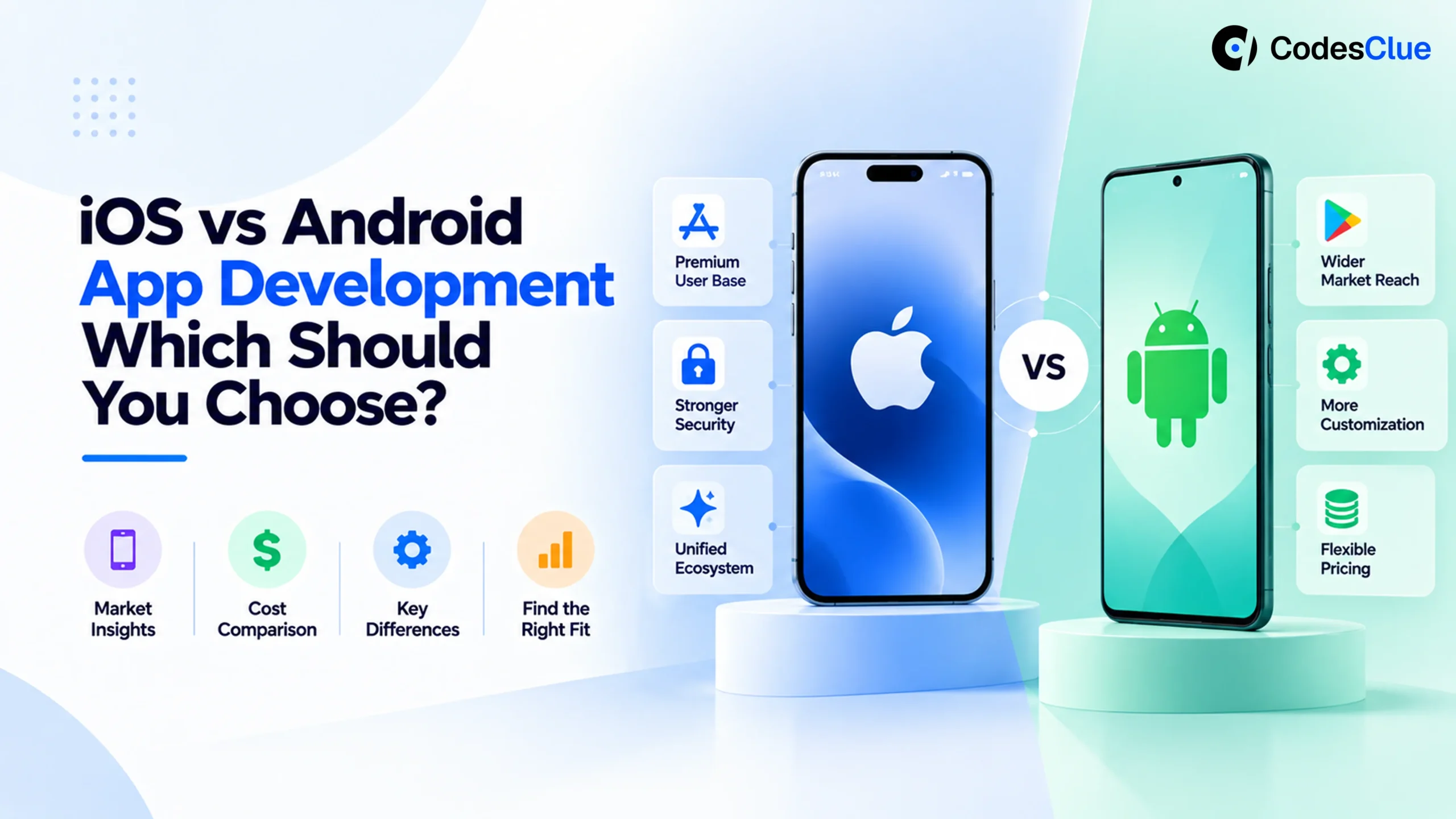
You are an inspiring startup founder, caffein-fueled and knee-deep dreaming apps with a killer idea to conquer the mobile world. But iOS vs Android app development looms like a fork in the road. What would you choose – Google’s gadget zoo or Apple’s gated gala?
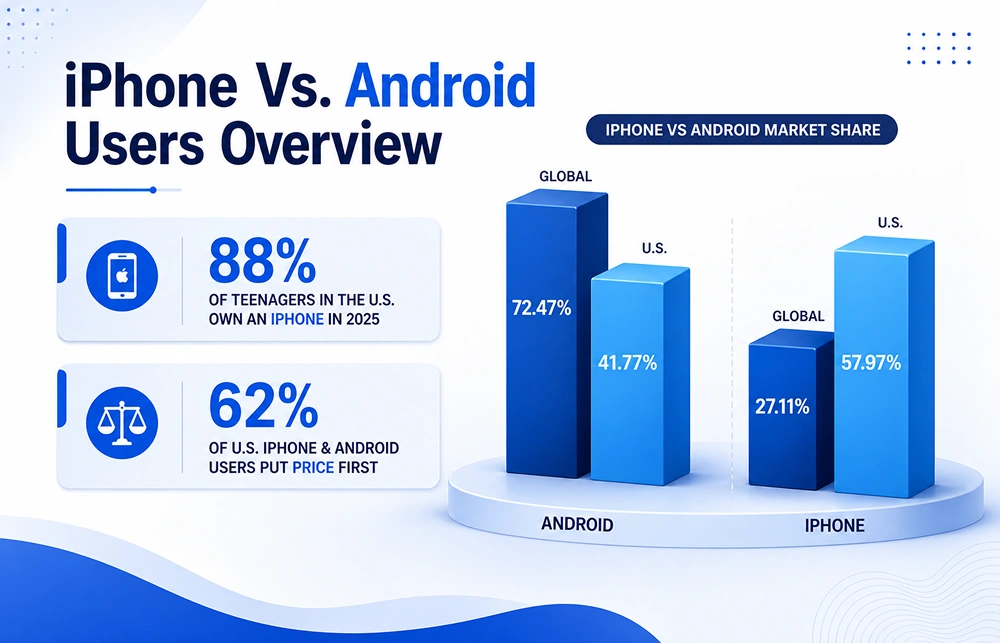
2026 has brought a year of exploding AI super-apps and foldables, boiling the discussion down to “revenue vs. reach.” Android vs iOS development 2026 is the most talked-about discussion in tech-fraternity, where iOS is favorite of US startups (57% share) and Android is admired globally (72%). This CodesClue’s blog will arm you with stats, information, and decision matrix to analyze which platform to choose for the best of your mobile app development venture.
Quick Platform Overview
iOS, It is the premium members’ club.
Built by Apple, iOS is the digital equivalent of a velvet-rope experience. It is exclusive, polished, and meticulously controlled because Apple believes too many cooks spoil the UX.
- Ecosystem: Closed and tightly controlled
- Languages: Swift / Objective-C
- Development Tool: Xcode
- Device Range: Limited (iPhones, iPads, etc.)
- Security: Industry-leading app security and strict App Store guidelines
- Audience: High-income users, especially in United States, United Kingdom, Canada, and Australia
The vibe: You are building iOS devices for the users who are more likely to pay for premium features, subscriptions, and “whatever works best” experience. Fewer devices means fewer headaches for developers covering less testing chaos and more consistency. It is like tailoring a suit for a known client base rather than guessing sizes in bulk.
Android: The Global Giant
Powered by Google, Android is the open-world RPG of mobile platforms. It is vast, flexible, and available to pretty much everyone with a smartphone and that’s both its superpower and its biggest challenge.
- Platform: Open-source
- Languages: Kotlin / Java
- Development Tool: Android Studio
- Device Range: Thousands of devices
- Reach: Massive global penetration across price segments
- Audience: Everyone, everywhere, from budget users to premium buyers
The vibe: Android is where scale lives. If iOS is a curated art gallery, Android is a bustling global marketplace. You get unmatched reach, but you will also juggle multiple screen sizes, OS versions, and device capabilities. It is powerful, when you use those Android-based smart devices, you will earn every bit of that power.
Android vs iOS Development 2026: Market Share & Global Reach
Let’s talk about the numbers because while opinions are great for panel discussions, data is what actually pays the bills.
According to Backlinko’s (opens in a new tab) industry reports:
- Android constitutes 70–72% global market share
- iOS constitutes 28–30% global market share
What Does This Actually Mean?
Powered by Google, Android dominates across India, Southeast Asia, Africa, and Latin America. This is where volume lives.
If your app strategy is about reaching millions (or billions) of users, Android is your best friend. It’s the platform that ensures your app is accessible whether someone is using a flagship device or a budget phone bought during a festive sale.
iOS is built by Apple, quietly holding a smaller, but most expensive part of the process. iOS dominates in high-value markets like the United States, United Kingdom, Canada, and Australia.
This is where users are more likely to:
- Pay for apps without hesitation
- Subscribe to premium features
- Expect (and demand) a flawless experience
The Revenue Reality Check
The reality check makes things interesting as well as a bit ironic. Despite having fewer users, iOS consistently outperforms Android in revenue generation. According to Business of Apps, iOS users spend 2–2.5x (opens in a new tab) more on apps than Android users.
When considered reach or revenue, the classic dilemma kicks in:
- Android = Reach
Think: “Let’s get this app into as many hands as possible.” - iOS = Revenue
Think: “Let’s make every download count.”
Or, in slightly more humorous terms:
- Android users will download your app in bulk.
- iOS users will actually pay for it and maybe even enjoy doing so.
Strategic Takeaway
In 2026, choosing between Android and iOS is not about which platform is “better”. It’s about what your business needs more right now:
- Do you want rapid adoption and global visibility? – Android leads
- Do you want higher ROI per user? – iOS wins
- Or else, want both? – Congratulations, you are thinking like a product strategist.
Because in reality, the smartest brands don’t pick sides. They sequence their strategy. Launch where it matters most first, then expand where it scales best.
After all, in the world of app development, it is not just about building an app. It is about building the right app for the right audience on the right platform.
iOS App Development vs Android App Development: Cost Breakdown (2026)
Let’s address the question everyone politely avoids in front of a crowd, but secretly calculates in spreadsheets alone: “How much is this going to cost me?” It is because the great UX may win hearts, but budgets decide the timelines.
iOS Development Cost: The Streamlined Investment
Developing for iOS is often like working in a well-organized workshop where you need fewer equipment, parts, or workflows, and you significantly face less chaos.
- Development Speed: Faster, thanks to a limited number of devices
- Testing Complexity: Lower (fewer screen sizes, OS variations)
- Estimated Cost: $20,000 – $120,000+
Why is it more efficient?
Apple devices are developed under the tightly controlled ecosystem means developers don’t have to worry about whether the app works on a five-year-old device with a cracked screen and a questionable OS version. Everything is predictable in case of iOS devices and in software development, predictability = savings.
In simple terms:
Less time debugging → lower development cost → happier CFO
Android Development Cost: Flexible as well as Demanding
On the other hand, the Android platform, which is powered by Google, is like producing for a global customer base. Here, you are not just serving one customer; instead, you are presenting the same kind of product to many people.
- Development Time: Longer due to device diversity
- Testing Complexity: High (multiple devices, OS versions, screen sizes)
- Estimated Cost: $25,000 – $150,000+
Why it costs more:
Android welcomes you to the world of device fragmentation, where your app needs to behave perfectly on everything from premium flagships to budget smartphones with all the “creative” hardware configurations.
That demands more QA cycles, more bug fixing, and more “it works on my phone” moments. Here, flexibility comes at a price and that price is extra development hours.
Maintenance Cost: The Hidden Budget Line
Post-launch costs are the part many businesses underestimate. We cannot build them one and forget.
- Android Maintenance: Costs 15–22% higher annually
- iOS Maintenance: Lower, thanks to controlled updates and uniform devices
Why the difference?
- Android requires ongoing adjustments for new devices, OS updates, and edge cases.
- iOS updates are centralized, and users adopt new versions faster.
Thus, Android keeps your dev team busy. iOS lets them breathe (occasionally). According to insights from Clutch and GoodFirms (opens in a new tab), iOS apps generally cost less to build and maintain. Android apps demand higher upfront and ongoing investment due to complexity.
Native App Performance: Smooth vs Scalable
When talking about the performance, the iOS vs Android debate feels like we are comparing a luxury sedan to an all-terrain SUV. One glides effortlessly on smooth roads; the other is built to handle everything.
iOS: The Smooth Operator
Powered by Apple, iOS delivers predictability which most developers love.
- Performance: Consistent and reliable operating system across devices
- Integration: Tight hardware-software synergy (because Apple builds both)
- Optimization: Easier to fine-tune due to limited device variations
Why does it shine?
Apple’s vertically integrated ecosystem ensures that apps behave almost identically across devices. Whether it’s an iPhone from last year or the latest release, performance remains smooth, responsive, and, most importantly, predictable.
In developer terms, it brings up fewer surprises, fewer bugs, fewer late-night debugging sessions. In terms of the user, the feedback received is “It just works.” (And yes, Apple has built an empire on that sentence.)
Android: The Scalable Powerhouse
On the other side, Android is backed by Google and it is built for scaling and diversifying.
- Performance: Varies depending on device and hardware
- Optimization: Requires testing across multiple configurations
- Flexibility: Works on everything from budget phones to flagship devices
Why is it complex?
The strength of Android is its presence across thousands of devices, but this makes it a biggest challenge too. Different processors, RAM capacities, screen sizes, and OS versions mean developers must optimize apps for a wide range of scenarios.
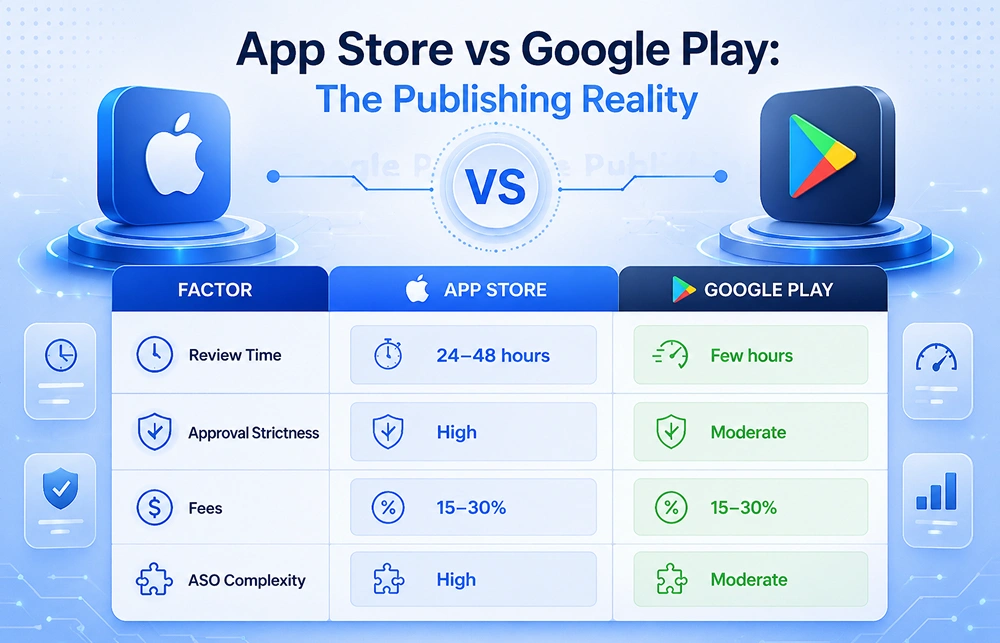
| Factor | App Store | Google Play |
|---|---|---|
| Review Time | 24–48 hours | Few hours |
| Approval Strictness | High | Moderate |
| Fees | 15–30% | 15–30% |
| ASO Complexity | High | Moderate |
App Monetization Strategy: Where’s the Money?
- iOS users → subscriptions, in-app purchases
- Android users → ads, freemium models
iOS generates higher revenue despite lower market share.
UI/UX Design Differences: iOS vs Android
If performance is the engine and security is the lock, then UI/UX reflect the personality of your app. It is the most important part users fall in love with. Or they uninstall within 10 seconds. And here’s where iOS and Android start to show very different design philosophies.
iOS: Minimal, Clean, Consistent
iOS follows a philosophy best described as: “Keep it simple, keep it elegant, and please don’t reinvent the back button.”
- Design Style: Minimalist and polished
- Consistency: High (thanks to strict Human Interface Guidelines)
- User Experience: Predictable and intuitive
- Tooling: iOS SDK
Why does it work?
Apple’s design standards are very strict, which means apps tend to look and behave in a familiar way. Users don’t have to “learn” your app, they just use it. iOS apps come with clean layouts, smooth animations, and uniform navigation patterns. One thing that makes the iOS platform different from all others is, if you try to get too experimental, Apple might politely say, “That’s cute, but no.”
Android: Flexible, Customizable
Google-powered, Android takes a more open-minded approach: “Here are the guidelines, but go ahead, surprise us.”
- Design Style: Flexible and adaptable
- Customization: High (Material Design, but with room to experiment)
- User Experience: Varies across devices and brands
- Tooling: Android app framework
Why it stands out?
Using Android apps, you can design unique interfaces tailored to different user segments, devices, or brand identities. It permits more control over UI components, greater personalization options, and ability to stand out visually.
UI/UX Verdict
- iOS: Clean, consistent, user-friendly iOS is a perfectly curated Instagram feed.
- Android: Creative, flexible, customizable Android is a creative Pinterest board.
Both are beautiful, just very different vibes.
Who Should Choose iOS?
Choosing iOS isn’t just a technical decision, it is a strategic business move. If your goal is to build a polished, premium experience for users who don’t mind paying for quality, iOS is your stage.
Choose iOS if you:
- Target high-value markets: These markets are like the United States, United Kingdom, Canada, and Australia. These regions consistently show higher in-app spending and subscription adoption. In simple terms: fewer users, but fuller wallets.
- Want to build a premium app experience: iOS users expect sleek design, smooth performance, and zero nonsense. If your app is meant to feel like a luxury product, iOS is where it belongs.
- Need a faster MVP (Minimum Viable Product): With fewer devices and standardized environments, development and testing are quicker. Perfect if you want to launch fast, validate your idea, and impress stakeholders before your competitors finish their wire-frames.
- Operate in industries like fintech, healthcare, or luxury eCommerce app development: These sectors demand high security, performance, and user trust, showcasing areas where Apple’s ecosystem excels.
- Care about higher ROI per user: iOS users are more likely to pay for apps, subscriptions, and premium features. So while your audience may be smaller, your revenue per user is significantly higher.
So, if your app is going to be a business asset, iOS would be the boutique store in a prime location, where there is less foot traffic, but every visitor is ready to buy.
Who Should Choose Android?
Android is the platform for those who think big or really big. If your goal is to reach the widest possible audience and scale rapidly, Android is your playground.
Choose Android if you:
- Target emerging and high-population markets: These markets are like India, Southeast Asia, and Africa. This is where Android dominates, making it the obvious choice for apps aiming for global reach and accessibility.
- Want mass adoption: If your success metric is downloads, user acquisition, or market penetration, Android delivers at scale, often faster than any other platform.
- Rely on ad-based revenue models: More users = more impressions = more ad revenue. It’s simple math, and Android gives you the biggest audience to work with.
- Need hardware-level customization: Android’s flexibility allows deeper integration with device features, making it ideal for apps that require custom hardware interactions or unique functionalities.
- Want to reach a broader demographic: From budget users to premium buyers, Android covers the entire spectrum. Your app can serve students, professionals, small businesses, and enterprises – all on the same platform.
If iOS is a boutique store, Android is a massive global marketplace, crowded, diverse, and full of opportunity (if you know how to stand out).
iOS vs Android Development: The Technical Reality
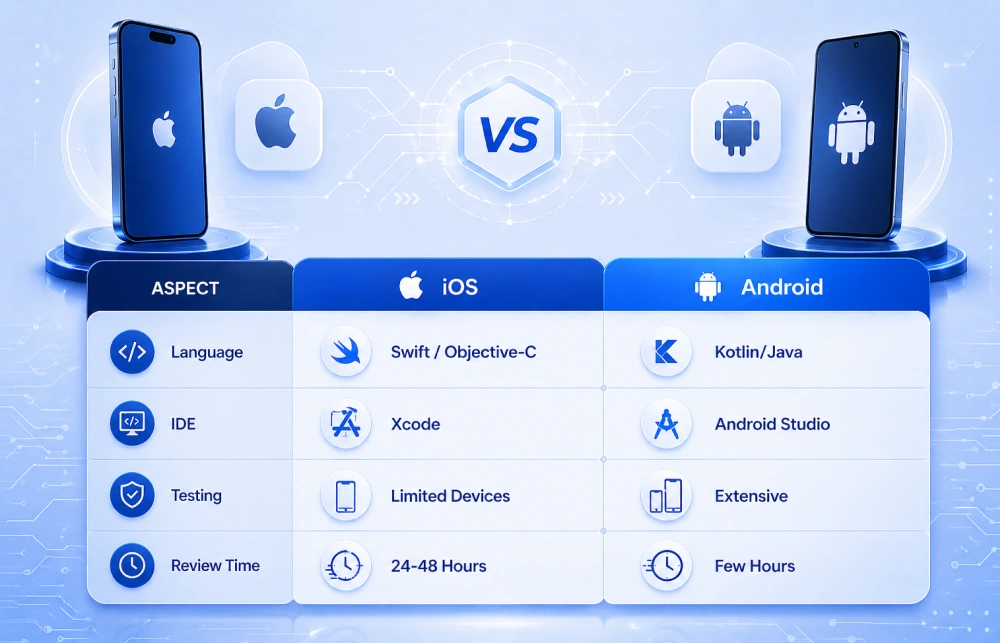
| Aspect | iOS | Android |
|---|---|---|
| Language | Swift / Objective-C | Kotlin/Java |
| IDE | Xcode | Android Studio |
| Testing | Limited Devices | Extensive |
| Review Time | 24-48 Hours | Few Hours |
Decision Framework: How to Choose Between iOS and Android for Mobile App
Choosing between iOS and Android can feel like standing at a crossroads with two equally promising roads, where one leads to premium users, the other to massive scale. The trick is not guessing, it’s asking the right questions.
Let’s simplify this into a practical decision framework you can actually use.
Ask Yourself These 5 Questions
1. Who is your target audience geographically?
The location of your users can make this decision for you.
- If you are targeting markets like the US, UK, or Canada, then go with the iOS.
- If you are targeting regions like India, Southeast Asia, or Africa, then go with Android.
2. What’s your monetization strategy?
- Subscriptions / Paid apps?: iOS users typically spend more
- Ads / Freemium model?: Android’s larger user base wins
3. What’s your budget and timeline?
- Tight budget + need speed? Then go with iOS (faster MVP, lower testing complexity)
- Larger budget + long-term scale? Then go with Android or both
4. Do you need deep device integration?
- Advanced hardware features, customization, or integrations?: Android would be better to choose.
- Standardized, smooth performance without surprises?: iOS would be better to choose.
5. Is this an MVP or a full-scale product?
- MVP (Minimum Viable Product): Focus on speed, validation, and cost-efficiency
- Full-Scale Product: Focus on reach, performance, and long-term growth
When to Build for Both Platforms?
At some point in your app journey, the question stops being “iOS or Android?” and becomes: “Why not both?”
You can go dual-platform if You:
- Have a validated product: If your app already has traction, users are engaging, revenue is coming in, and your idea has survived real-world testing. Then, congratulations, you have earned the right to scale. At this stage, limiting yourself to one platform is like running a successful restaurant but refusing to open a second branch.
- Have the budget to scale: Let’s be honest! Building and maintaining two separate native apps is not cheap. You are essentially doubling development, testing, and maintenance efforts. But if your ROI metrics look healthy, expanding to both platforms becomes an investment, not an expense.
Cross-Platform to the Rescue
Now here’s where things get interesting and significantly more budget-friendly.
Instead of building two completely separate apps, many businesses are turning to cross-platform frameworks like:
- Flutter
- React Native
Why is Cross-Platform Winning in 2026?
Cross Platform are like the multitaskers of app development: efficient, flexible, and surprisingly powerful.
- Reduce development time by 40–50%: Write once, deploy on both platforms. Your developers will thank you, and your deadlines might finally be realistic.
- Lower overall costs: One codebase = fewer resources, less duplication, and more savings.
- Near-native performance: Modern frameworks have come a long way. Unless you are building a graphics-heavy game or highly complex system, users won’t even notice the difference.
CodesClue’s Recommendation
At the end of the day, choosing between iOS and Android isn’t about picking sides, it’s about picking the right strategy for your business goals. And that’s exactly where CodesClue steps in.
We don’t just build apps, we help you make the right platform decision before a single line of code is written. Because a great app on the wrong platform is like launching a luxury yacht in a swimming pool: technically impressive, but not very useful.
How CodesClue Helps You Win?
Whether you are a startup validating an idea or an enterprise scaling globally, CodesClue offers for mobile app development:
- iOS App Development: Premium, high-performance apps tailored for high-value users.
- Android App Development: Scalable, flexible apps designed for global reach.
- Cross-Platform Solutions using Flutter and React Native: Faster development, reduced costs, and near-native performance.
Our Approach
We do not believe in one-size-fits-all. Instead, we:
- Analyze your target audience & geography
- Align with your budget and timeline
- Recommend the right platform strategy (iOS, Android, or both)
- Build scalable apps that grow with your business
Because the real goal isn’t just about launching an app, it’s launching the right app in the right place at the right time.
Not sure which platform is right for you? Get a free consultation with CodesClue and turn your app idea into a scalable success.
FAQs on iOS vs Android App Development
Is iOS or Android development cheaper in 2026?
iOS development is slightly more cost-effective due to fewer devices and lower testing complexity. Android can cost more because of device fragmentation and higher QA efforts.
Which platform is better for startups?
For startups choosing the platform based on your goal is important. iOS is great for startups targeting premium markets and faster MVP launches. Android works well for startups aiming for rapid user acquisition and global reach.
Can I launch on both iOS and Android at the same time?
Yes, you can either build separate native apps for each platform, or use cross-platform frameworks like Flutter or React Native to launch simultaneously. The choice depends on your budget, timeline, and performance requirements.
How long does iOS vs Android development take?
iOS apps are typically faster to develop due to a controlled ecosystem. Whereas, Android apps may take longer because of testing across multiple devices. On an average, app development can range from 2 to 6+ months, depending on complexity.
What language is used for iOS and Android development?
iOS uses Swift and Objective-C, and Android uses Kotlin and Java. For cross-platform development, frameworks like Flutter (Dart) and React Native (JavaScript) are commonly used.