
Imagine you shopped for a business software online at 2 AM, confident that you did everything for a productive start the next day. But reality differs when you use it – it doesn’t fit your business needs. You feel the features are mismatched, workflows forced and what seems to be your perfect solution turns into a daily frustration.
What would you do next?
Would you continue adjusting to the existing one or invest in a customized one that is specifically tailored for your business?
Frankly speaking, the latter proves far more effective in most cases.
Even a research by McKinsey reveals that companies relying on digital technologies witness 20% to 30% increase in efficiency and 15% to 20% reduction in cost. It means better use of technology in a customized manner yields expected results.
Custom software solutions are really better than the off-the-shelf ones. We’ll highlight this “custom software vs off the shelf” debate in this blog and let you understand why customized solutions often outperform ready-made tools, backed by proven concepts and practical insights. So, let’s begin.
What Is Custom Software vs Off-the-Shelf Software?
Before we start comparing, let’s come to the basics and understand what custom software and off-the-shelf software solutions are.
Custom Software (Bespoke Solution)
Custom software is designed according to your business needs. Hence, it is regarded as a bespoke solution. The best thing is, this kind of software is developed keeping your workflows, processes, and long-term goals of your business aligned.
It is a kind of tailored suit that perfectly fits your needs as it covers the following features:
- Built using structured software development lifecycle practices
- Developed through agile development for flexibility
- Offers complete software ownership
- Designed for workflow automation and scalability
Off-the-Shelf Software (COTS / Packaged Software)
Off-the-shelf software is commercial off-the-shelf software (COTS). It is pre-built and designed for mass usage. They are like you buy ready made clothing as a convenient move, but not always fit you perfectly. Here are the features generally possessed by the off-the-shelf software solutions:
- Delivered via SaaS subscription model
- Uses per-seat pricing or monthly billing
- Includes predefined features
- Comes with software licensing fees
The Core Difference: Flexibility vs Convenience
There are two core factors that play a significant role while analyzing the difference between a custom vs. commercial off-the-shelf software. They are flexible and speed & convenient.
Note that off-the-shelf software would work if you own a standard business with no additional specifications. Whereas, things will get interesting if you have a unique business, demanding you to customize the software according to your business’s needs.
Build vs Buy Software: A Practical Decision Framework
It is an important point to discuss whether to buy your software or get it built by someone who knows well what your professional requirements are. Let’s simplify the build vs buy software decision with a practical lens.
You can buy off-the-shelf tools for immediate usage like if you are an early-stage startup and need some effective SaaS tools like HR or accounting platforms to handle your business operations. Here are the conditions you can buy these tools when:
- You need quick deployment
- Your workflows are standard (e.g., payroll, CRM)
- Budget is limited
- You don’t need heavy customization
On the other hand, a logistics company needs real-time tracking + ERP customization + analytics. Hence, opts to build or get build your custom software when:
- Your workflows are unique or complex
- You require deep software integration across systems
- You’re aiming for competitive advantage through technology
- You’re scaling rapidly and need flexibility
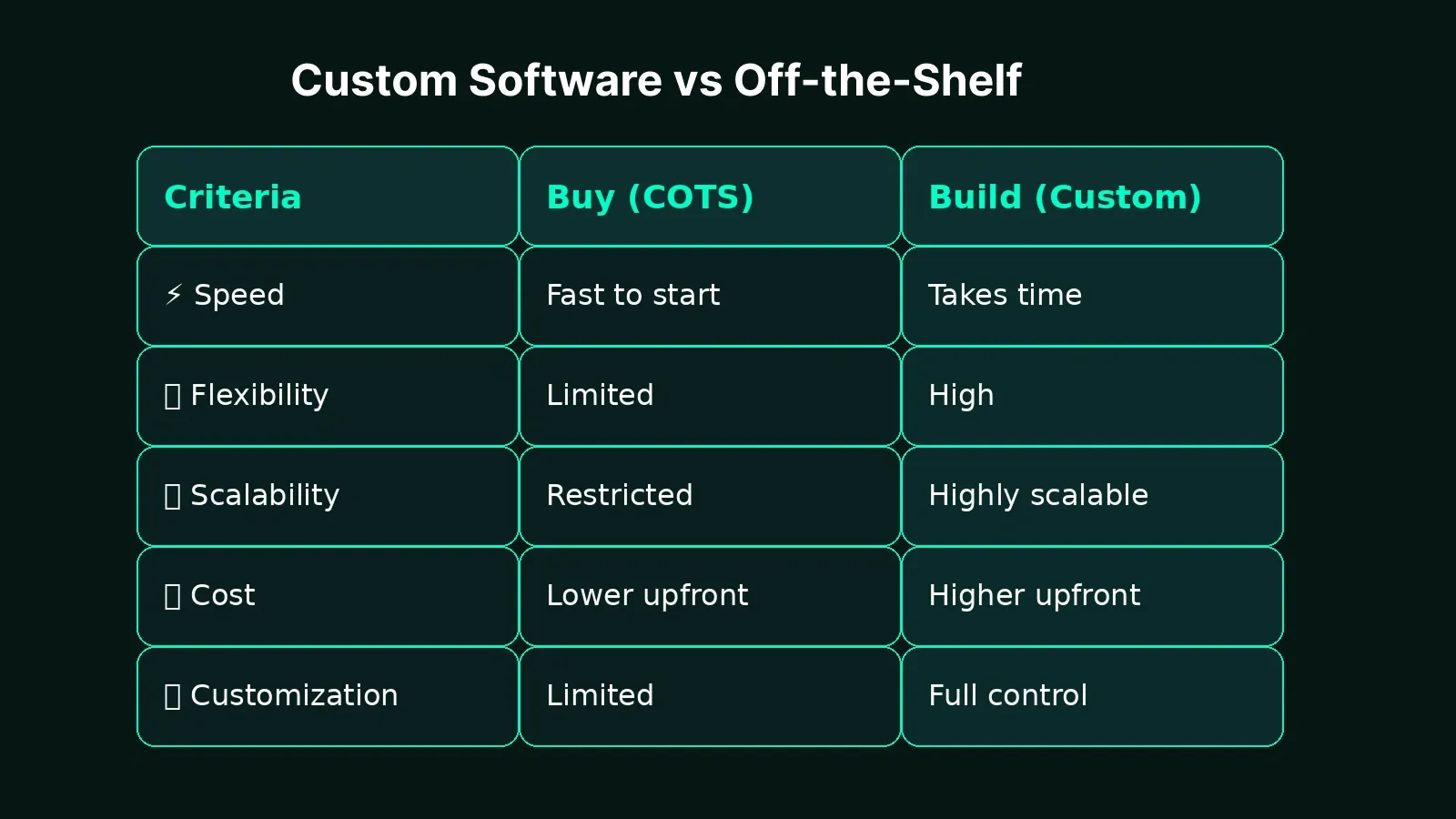
Quick Comparison
A quick comparison brings a high-level snapshot in front of you that helps to understand the difference between custom software vs off-the-shelf solutions. Check out the basic but most significant comparison factors to evaluate and choose which option aligns better with your business needs and growth plans.
Total Cost of Ownership (TCO): The Truth Behind Pricing
When talking about both types of software solutions, the cost may vary conditionally. At a glance, off-the-shelf software looks cheaper, but it may contain a lot of hidden factors that sometimes you fail to identify.
According to a Flexera report, 32% of money spent on SaaS tools is wasted on unused licenses. For example, a SaaS subscription model often hides long-term expenses:
- Monthly or annual subscription fees
- Per-seat pricing (cost increases as your team grows)
- Add-ons and premium features
- Software licensing fees
- Integration costs
- Switching costs due to vendor lock-in
Custom Software Costs (The Smart Investment)
Investing in a custom software solution is a smart move. It is not a “cheap” option, but it proves the theory better that ‘why need to pay the rent forever for the thing you do not own’.
Obtaining a custom software generally includes:
- An initial development investment (your digital asset, built your way)
- Ongoing maintenance (like servicing a high-performance engine)
- Infrastructure costs (cloud or on-premise)
But the things will become more interesting when you need not to:
- Pay per-user pricing surprises as your team grows
- Pay for 50 features when you only use 10
- Get stuck in those “upgrade to unlock basic functionality” traps
Real-World Perspective
Imagine using a SaaS CRM that charges $50/user/month:
- 50 employees = $2,500/month
- That’s $30,000/year
- Over 5 years = $150,000+
And that’s before add-ons, integrations, and premium features
Now compare that with custom software:
- One-time build: say $60K–$100K
- Annual maintenance: ~15–20%
Over 3–5 years, you often break even, or win big.
TCO Insight
It is where the magic happens. When you calculate Total Cost of Ownership (TCO):
- Off-the-shelf tools = recurring costs + limitations + scaling pain
- Custom software = higher upfront, but long-term control + better ROI
Custom software is like:
- Renting → SaaS
- Owning → Custom
Thus, any smart business will choose ownership that builds equity. Whereas, renting builds expenses.
Scalability & Performance: Why Off-the-Shelf Software Doesn’t Scale?
Growth feels amazing. When your software inputs its calibrations, it makes your workload reduced while optimizing your overall performance. The problem persists when you expect that everything is going fine and you are succeeding in your lifelong dream and suddenly, your software demands a ‘coffee break’. For example, it falls short of breath when your traffic is increasing. Nothing is more exasperating than this.
Off-the-Shelf Limitations for Enterprises
Believe me, most of the packaged tools are built for the “average business.” But if you really want to go beyond the average level, you would have to maintain your standard higher.
So what happens when you scale using off-the-shelf software?
- Performance bottlenecks: Your system slows down exactly when demand peaks (great timing, right?)
- Limited customization: You adapt your business to the software, instead of the other way around.
- Rigid architecture: Adding new features feels like trying to renovate a rented apartment.
- Feature overload: You pay for 100 features but actively use, maybe 15.
Real-World Scenario
International Data Corporation reports that 80% of enterprises face growth challenges due to legacy systems. This problem is huge as the majority of scaling businesses are hitting the wall.
For example, imagine an eCommerce business during a sale:
- Traffic spikes 5x
- Orders increase rapidly
- Customers are ready to buy
It is the time when you have to act smart, but your SaaS platform says – “Please wait! Processing!” Thus, the result is lost revenue, frustrated users, and a very unhappy CEO.
Therefore, an off-the-shelf software is like buying a “one-size-fits-all” suit. It looks fine until you actually need to run in it. On the other hand, custom-built systems are tailored to your exact measurements, and are designed to stretch, adapt, and perform under pressure. It is because when your business scales, your software shouldn’t slow you down. In fact, it should accelerate you.
Advantages of a Custom Software (Built to Grow, Not Break)
Custom software acts as a personal trainer for your business. It protects you from unnecessary jobs and helps you grow stronger. It is designed with scalability from day one only and thus, it benefits more than the off-the-shelf software tools.
- Its architecture is built for growth. It can handle 100 users today, 100,000 tomorrow. So, no panic mode needed.
- It offers optimized performance without any lagging, drama during the peak traffic.
- It is best for modular development. Features are facilitated to support and not to break the walls.
- It assures easy expansion. New ideas don’t require “switching platforms,” just upgrading is enough.
In simple terms, your software accepts the challenges, instead of leaving you troubled in the middle of your operations.
Also modern businesses use a range of software solutions to operate their business such as ERP, CRM, analytics, and various marketing and research platforms. The most significant benefit of a custom-made software application is that it runs all the programs together, instead of letting them just co-exist awkwardly.
Off-the-Shelf Challenges
- Limited API integrations: These tools sometimes come with limited integrations and get aligned with selected APIs only.
- Vendor dependency: Off-the-shelf tools lock you into their ecosystem and pricing is also higher than usual.
- Complex workarounds: These tools come with a lot of complexity. You have to be very careful using them as you cannot integrate them with unrelated systems.
- Data sovereignty concerns: Here you have to be concerned about your data security. Universally applicable tools can share your data universally.
Real-World Example
10 tabs open, 3 exports, 2 breakdowns, and 1 existential crisis – it happens when you are using multiple SaaS tools without proper integration. It treats your business as your sales team uses one system, marketing uses another, and finance uses Excel.
At last, you all juggle to make a unified report. So, better have control over your systems as, “control over your systems = control over your growth.”
The Power of Custom Software Solutions
Custom software establishes a unified, well-integrated technology ecosystem where disparate systems operate cohesively through standardized architectures, seamless integrations, and centralized data flow. Simple, it stops your entire tech stack from arguing and lets them work as a team.
With custom systems, you get:
- Seamless software integration: Custom software solutions actually let all your tools work in sync without leaving “Can you hear me now?” moments.
- Full control over data: These systems let your data remain yours forever avoiding any scope for vendor lock-ins or involvement of mystery locations.
- Smooth legacy system replacement: These tools operate smoothly without shutting everything down or starting from scratch.
- Tailored ERP customization: They are built around your workflows, well-tailored to your needs and are not forced into someone else’s template.
Studies show employees spend 20–30% of their time just searching for or reconciling data across systems. This accounts for a full workday per week due to bad integration.
But with a custom software system, you can use multiple applications in a single tool where CRM syncs with marketing, automatic data supply to financial application, and due to regular updation, it operates on the latest systems. So, here you best play with a unified system, real-time data, and can make decisions in minutes.
Custom software replaces chaos with clarity. They come with no more duct-taping tools together and no more temporary fixes that last forever. Instead, they just showcase clean, connected, and scalable systems.
Competitive Advantage & Digital Transformation
One of the most important features of a custom software tool is that it should be unique. If you and your competitors are using the same tool, then you are basically competing on price, not innovation.
Off-the-shelf tools are like everyone is using the same playbook. They have similar features, same workflows, and same limitations. The innovation depends on vendor updates and customization is restricted due to rigid architecture.
Custom Software = Differentiation
Deloitte’s study reveals that digitally mature companies are 2–3x more likely to outperform competitors. It means if you use the right strategy combining the right technology stack, your product will succeed.
Off-the-shelf software may arrive with the features you already have, but customized software comes with unique features that you actually want.
Your custom software acts as your secret weapon to conquer the market. Such kind of tools are supported by some technology-led competitive advantages as:
- Unique workflow automation – Optimize operations with business-specific logic.
- Tailored customer experiences – Personalization driven by real-time data pipelines.
- Faster innovation cycles – Build, test, and deploy features without vendor dependency.
- Strategic digital transformation – Align technology with long-term business goals.
The technical edge where you can use these custom solutions are:
- Microservices architecture – Offer independent, scalable components for faster releases.
- API-first integrations – Seamless connectivity across CRM, ERP, and third-party tools.
- Cloud-native infrastructure (AWS, Azure, GCP) – Elastic scalability and high availability.
- AI/ML models – Predictive insights, automation, and intelligent decision-making.
In short, this makes your tech stack a growth engine and not a limitation.
When Should a Business Invest in Custom Software?
Are you still wondering if it is the right time to go for a custom software? Follow a simple rule: “change your tool if it slows down more than helping”.
Growing companies often hit a tipping point where:
Operational inefficiencies + SaaS costs > Custom software investment
That’s when switching becomes not just smart, but necessary.
Here is the reality-based checklist to go with:
- Your workflows are unique: Custom software lets you encode business-specific logic, rules engines, and workflows instead of forcing compromises.
- You are outgrowing SaaS tools: SaaS tools often struggle with performance bottlenecks, limited scaling, and restricted configurations.
- Integration is becoming messy: You need API-first architecture, microservices, and centralized data pipelines for seamless integration.
- Costs are rising with scale: At scale, SaaS pricing becomes exponential, while custom systems offer predictable TCO and better ROI.
- You need better data control: Custom solutions give you data ownership, governance frameworks, and secure cloud/on-prem deployment.
- You want a competitive edge: Custom software enables AI/ML integration, automation pipelines, and unique feature innovation.
Conclusion: It’s Not About Software, It’s About Strategy
The debate around custom software vs off-the-shelf isn’t really about technology. It’s about how you want your business to grow.
Remember, use the off-the-shelf software only if you are optimizing your business for short-term convenience. But for long-term scalability and differentiation, custom software wins. The smartest companies choose capability, control, and competitive advantage and thus, go for uniqueness.
If you are ready to move beyond limitations and build something tailored to your business, explore our custom software development services and see how we can turn your ideas into scalable digital solutions.