


In 2026, mobile apps will become the most significant business assets. They have proved to be an inevitable part of today’s intelligent digital ecosystems, from bringing AI-powered customer experiences to real-time logistics and fintech automation.
But not all apps are the same – some are generic, whereas some are expensive depending upon numerous factors affecting their cost. So, if you are also in the same boat of researching how your mobile app development will cost your business in 2026, this post is for you and many others who need a detailed overview on this topic.
Technically, it ranges between $10,000 to $300,000+, but all the ‘hows’ and ‘whys’ will get deeply answered in this blog. So, keep reading.
What Factors Determine Mobile App Development Cost?
You have to plan a realistic budget for your mobile app and avoid unexpected or hidden expenses, then understanding the factors that influence mobile app development cost is essential. From the complexity of your app and the features you choose to the platform, tech stack, and development team you hire: every single decision directly impacts the final cost. By evaluating these elements early, businesses can prioritize what truly matters, optimize resources, and ensure a smoother development process without costly revisions or delays.
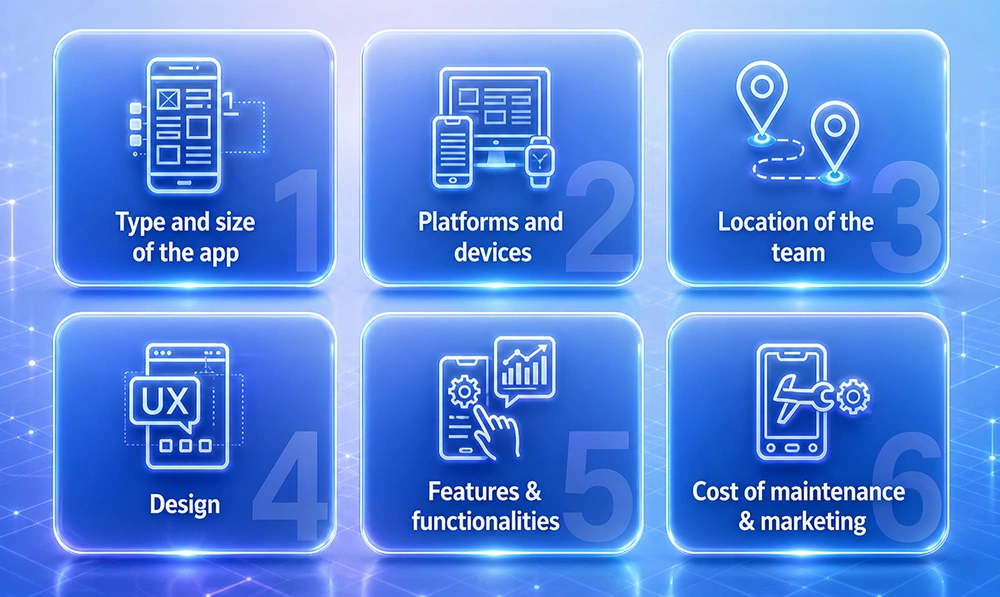
1. App Complexity
App complexity is the primary cost driver. The more complex your app, the more time, expertise, and resources it requires. Of course, higher complexity directly increases development hours and overall cost.
- Simple apps: Basic UI, limited functionality (e.g., calculators, static apps)
- Mid-level apps: APIs, dashboards, user accounts, moderate backend logic
- Complex apps: AI/ML features, real-time syncing, third-party integrations, high scalability
2. Features & Functionality
Every new feature adds to the scope of development scope and the budget. Common cost-driving features include user authentication, payment gateway integration, push notifications, real-time chat, GPS/location tracking, and AI/ML capabilities.
A feature-rich app (like ride-sharing or fintech apps) costs significantly more than a basic app with limited functionality.
3. Platform Choice
iOS vs Android vs Cross-Platform:
Your platform decision impacts cost and development time, both. However, cross-platform app development can reduce duplication and speed up the process.
- Native apps (iOS & Android separately): Higher cost due to separate codebases
- Cross-platform (Flutter, React Native): Lower cost by sharing a single codebase
- Single platform launch: More budget-friendly for MVPs
4. Development Team Location
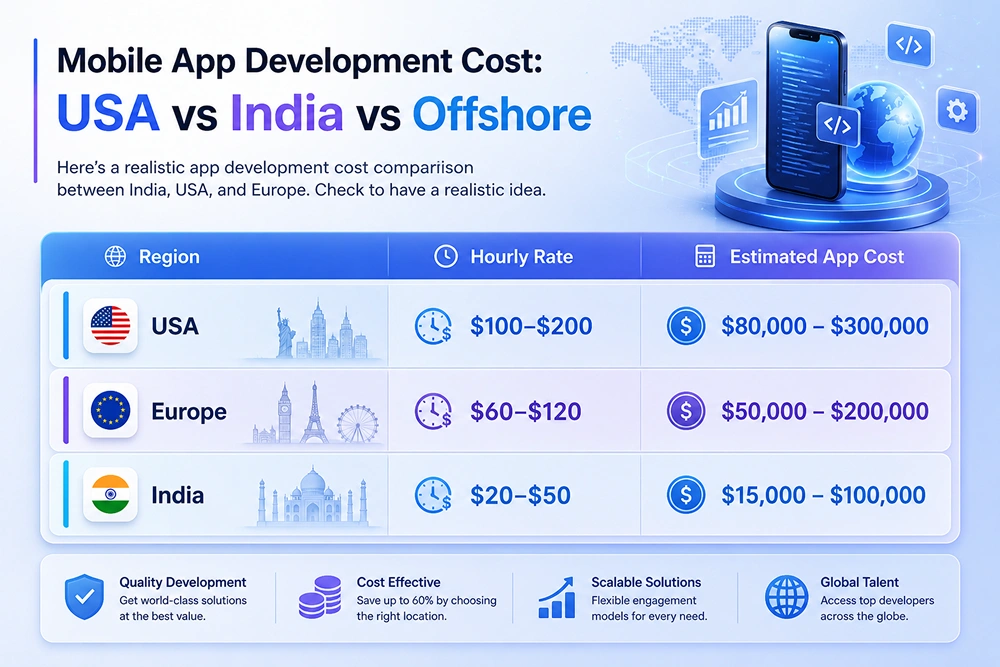
Geographical locations matter highly to decide upon the rates of the development projects. Outsourcing to regions like India can substantially reduce development costs, without compromising quality.
- USA: $100–$200/hour
- Europe: $60–$120/hour
- India: $20–$50/hour
5. Tech Stack
The technologies you adopt for developing mobile applications for your customers affect scalability, performance, and cost of the apps. A modern, scalable tech stack may cost more upfront but saves money long-term.
- Native: Swift (iOS), Kotlin (Android)
- Cross-platform: Flutter, React Native
- Backend: Node.js, Python, Firebase
6. Engagement Model
Your company’s engagement model reflects the quality of the development team you have to bring impacting results. Always select the right model based on your project clarity and flexibility needs.
- Fixed price: Best for well-defined projects
- Dedicated team: Ideal for long-term, evolving apps
- Hourly model: Flexible but can increase costs if scope expands
Mobile App Development Cost by App Type & Complexity
Confirm your app type and break down your mobile app costs. This will help you better align your budget with your business goals and technical requirements. Apps with different genres incur different development costs.
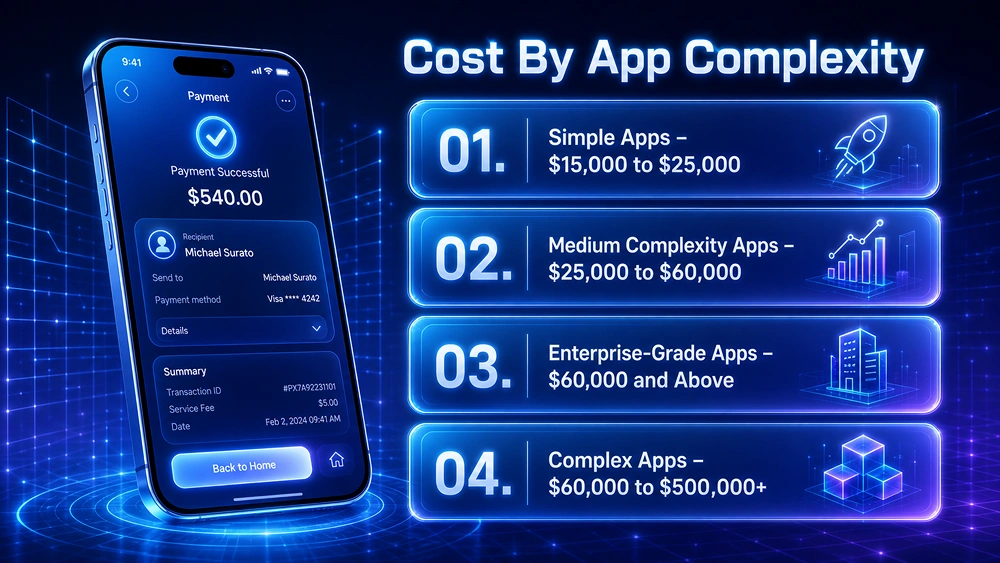
Simple App Cost:
It may cost approximately between $10,000 – $40,000. Simple apps are straightforward apps, with minimal logic and limited interactivity. They are quicker to develop and ideal for basic use cases or early-stage ideas. They are best suited for small businesses or proof-of-concept projects with tight budgets.
Features:
- Basic UI/UX design
- Static or limited dynamic content
- Simple forms or input fields
Examples:
- Calculator apps
- Informational or brochure-style apps
Mid-Level App Cost:
It may cost between $40,000 – $120,000 and offer more functionality and user interaction, requiring backend integration and structured data handling. It is best for startups looking to launch a functional product with meaningful user engagement.
Features:
- User authentication (login/signup)
- API integrations
- Admin dashboard and user management
Examples:
- Fitness tracking apps
- Basic food delivery apps
Complex / Enterprise App Cost:
These highly sophisticated apps cost between $120,000 – $300,000+. They are specifically designed for scalability, performance, and advanced user experiences. Costs for this range can increase based on scale, integrations, and compliance requirements.
Features:
- Real-time data syncing
- AI/ML capabilities
- Advanced security protocols
- Scalable cloud architecture
Examples:
- Ride-sharing apps like Uber
- Fintech platforms
- Enterprise SaaS applications
MVP App Development Cost:
It estimates between $15,000 – $60,000 to develop an MVP and validate your idea in the market.
iOS vs Android vs Cross-Platform App Development Cost
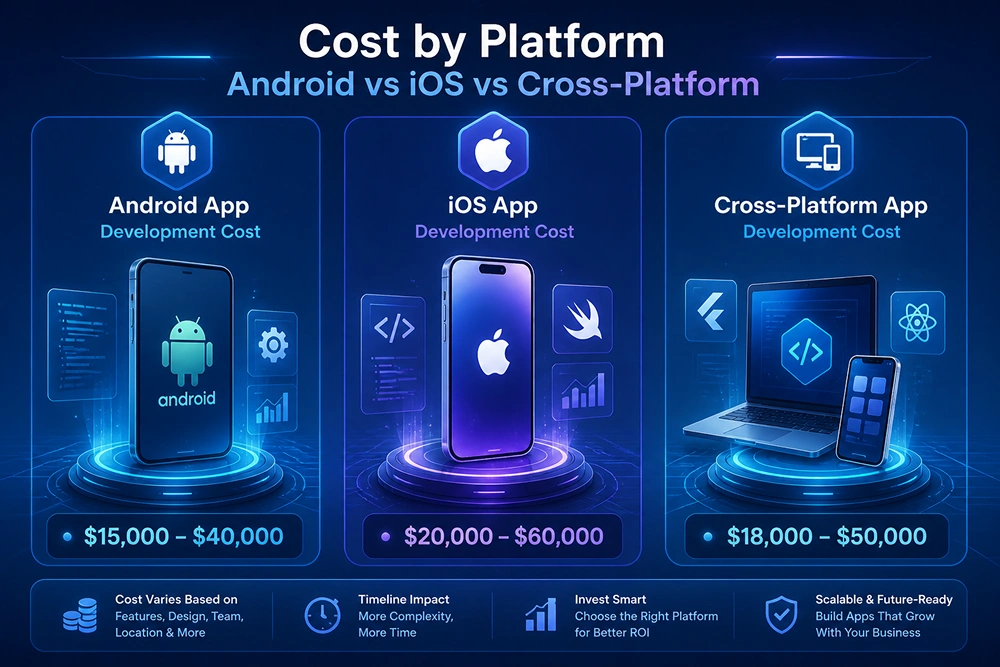
Your choice between native and cross-platform development plays a major role in determining overall cost, performance, and scalability.
Native App Development Cost
- iOS app: $40,000 – $150,000
- Android app: $40,000 – $150,000
Native apps are developed specifically for a single platform using dedicated technologies, either for iOS or Android, which ensures a highly optimized and seamless user experience.
These apps offer superior performance and speed, high security and stability, and full access to device-specific features. Whereas, the loopholes they come with are higher cost due to separate development for iOS and Android and increased development time and maintenance effort.
Still, native platforms like iOS and Android are the best platforms for app development requiring high performance, advanced features, or premium user experience.
Cross-Platform App Development Cost
- Flutter App Development Cost: $25,000 – $120,000
- React Native App Development Cost: $30,000 – $130,000
Cross-platform app development frameworks allow developers to write a single codebase for all types of apps as the framework works across both iOS and Android, making development faster and more cost-efficient.
These apps come with a single codebase that reduces duplication, faster development and quicker launch, and lower overall cost compared to native. The loopholes include slight performance limitations in highly complex or graphics-heavy apps and they may require native modules for advanced functionalities.
Cross-platform apps are ideal for startups and businesses looking to launch quickly while keeping costs under control.
What is Cheaper: Flutter or Native?
Generally, Flutter is 30–40% cheaper than native development. The reason is, Flutter uses a single codebase for both iOS and Android, which reduces development time, team size, and maintenance costs. Therefore, instead of building two separate apps, you are essentially building one that works across different platforms.
But, native development still has an edge when it comes to highly complex applications, such as advanced gaming apps, real-time systems, or heavy AI/ML integrations. In these cases, native apps offer better performance, deeper hardware access, and more flexibility.
In short, you can choose Flutter for cost-efficiency, faster launches, and MVPs, and go with Native for developing performance-heavy, feature-rich, and large-scale apps.
Mobile App Development Cost: USA vs India vs Offshore
Here’s a realistic app development cost comparison between India, USA, and Europe. Check to have a realistic idea.
Offshore vs Onshore App Development Cost
Whatever business you own, choosing between onshore and offshore development can significantly impact your overall budget and project efficiency.
Onshore App Development:
Onshore development teams are located in the same country as your business, making collaboration more seamless.
It eases and simplifies the communication and real-time collaboration, makes better cultural and time-zone alignment, and helps with simplifying project management. On the other hand, onshore development significantly incurs higher development costs.
Offshore Development:
Offshore teams operate from countries with lower labor costs but strong technical expertise. Offshore development is highly cost-effective, provides access to a large pool of skilled developers, and assures flexible scaling of teams. Simultaneously, it may affect communication due to time zone differences and requires structured project management.
Remember, outsourcing to offshore teams can reduce development costs by up to 60–70% while still maintaining quality, especially when working with experienced and well-managed teams.
CodesClue Cost Comparison (Sample)
Local advantage brings similar quality in lower cost.
What’s Included in the Total Cost of Mobile App Development?
Your complete mobile app budget is not just about coding, it covers multiple stages and components that ensure your app is functional, scalable, and user-friendly.
1. UI/UX Design:
It decides your app’s look and user experience after being crafted. It lays the foundation for usability and engagement covering wireframes (basic layout structure), interactive prototypes, and user journeys and flow mapping. Design costing between $5,000 – $25,000 helps in reducing costly redesigns later.
2. Frontend & Backend Development:
It shows the core development phase where your app is actually built. It covers frontend depicting what users see and interact with and backend managing server, business logic, database management. Costing between $20,000 – $150,000+ justifies due to app complexity and features.
3. APIs & Integrations:
They are third-party services on which most modern apps rely to extend their functionality. The integrations include payment gateways, social media logins, and external APIs (maps, analytics, etc.).
More integrations = higher development and maintenance cost.
4. QA Testing:
It ensures your app runs smoothly across devices and scenarios. Quality is controlled through functional testing, performance testing, and security testing. The cost charged is typically 15–25% of the total development budget. But remember, skipping proper testing can lead to expensive fixes post-launch.
5. Cloud Infrastructure:
Cloud infrastructure supports your app’s backend operations and scalability on platforms like AWS, Firebase, Azure, and hosting, storage, and server scaling. Here the costs are ongoing and depend on user traffic and app usage.
6. App Store Fees:
App store fees are charged as small but essential costs to publish your app publicly on major platforms.
- Apple App Store: $99/year
- Google Play Store: $25 (one-time)
Hidden Costs in Mobile App Development
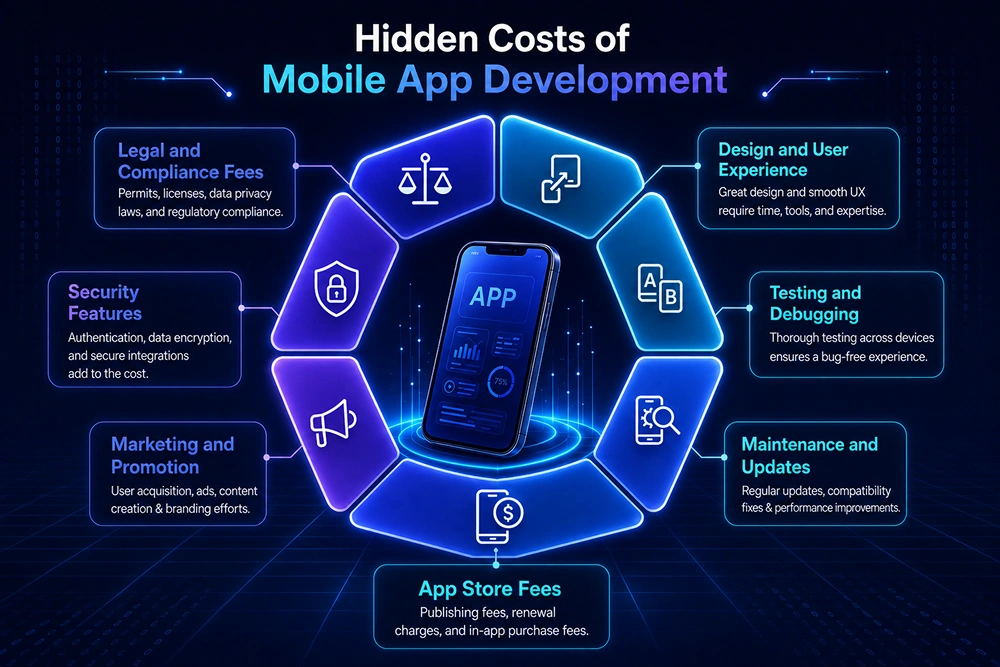
Other than the chargeable expenses, there are several “hidden” costs that can quietly increase your total budget if not planned in advance.
- Feature Creep: As the project progresses, new ideas and features often get added. While they may improve the app, they also increase development time, complexity, and cost.
- Third-Party Subscriptions: Many apps rely on external tools and services such as payment gateways, analytics platforms, APIs, or cloud services. These often come with monthly or usage-based fees that add up over time.
- Scaling Costs: As your user base grows, your app will require more server resources, storage, and performance optimization. Higher traffic will lead to higher infrastructure and maintenance costs.
- Security & Compliance: Apps handling sensitive data (like fintech or healthcare) must comply with strict regulations and security standards. Implementing encryption, compliance protocols, and regular audits can increase both development and ongoing costs.
These are some hidden factors that can increase your total mobile app development cost by 10–20%, making it crucial to account for them during initial planning to avoid budget overruns later.
Post-Launch App Maintenance Cost & Ongoing Expenses
When talking about the cost, launching your app is just the starting point, but to keep it functional, secure, and competitive requires continuous investment. Let’s check out some post-launch costs associated with mobile application development.
App Maintenance Cost Per Year
It typically comprises 15–25% of the initial development cost. For example, a $50,000 app may cost around $7,500 – $12,500 per year to maintain. This ensures your app stays updated, secure, and performs smoothly over time.
Ongoing Costs Include:
- Bug Fixes: Comprises resolving issues that arise after launch
- Updates (OS Compatibility): Adapting to new iOS and Android versions
- Server Costs: Hosting, storage, and scaling infrastructure
- Performance Optimization: Improving speed and user experience
- Security Patches: Protecting user data and preventing breaches
Post-Launch Support
- Feature enhancements and new releases
- Improvements based on user feedback
- Analytics tracking and performance optimization
Note that regular updates help retain users and stay competitive in the market. If you ignore the maintenance requirements, it can lead to performance issues, security risks, and poor user experience, ultimately causing your app to lose users and fail over time.
How CodesClue Delivers Cost-Effective Mobile App Development?
If you are looking for cost-effective mobile app development pricing, CodesClue offers a strategic advantage by combining technical expertise with flexible engagement models. From MVP development to full-scale enterprise applications, CodesClue focuses on optimizing costs without compromising on quality, performance, or scalability.
By leveraging modern tech stacks, agile methodologies, and offshore development efficiency, businesses can significantly reduce development expenses while accelerating time-to-market. The result is, high-quality apps delivered faster and at a fraction of traditional costs.
Businesses Choose CodesClue Because of:
- Experienced cross-platform & native developers
- Agile development approach
- Transparent pricing models
- Faster time-to-market
Conclusion
The cost to develop a mobile app in 2026 depends on multiple variables, but one thing is clear that there is no “one-size-fits-all” pricing. So, your smartest move should be to start with an MVP, choose the right tech stack, optimize team location, and focus on long-term scalability.
Whether you are a startup or an enterprise, understanding the full mobile app development cost breakdown helps you make informed, ROI-driven decisions.