
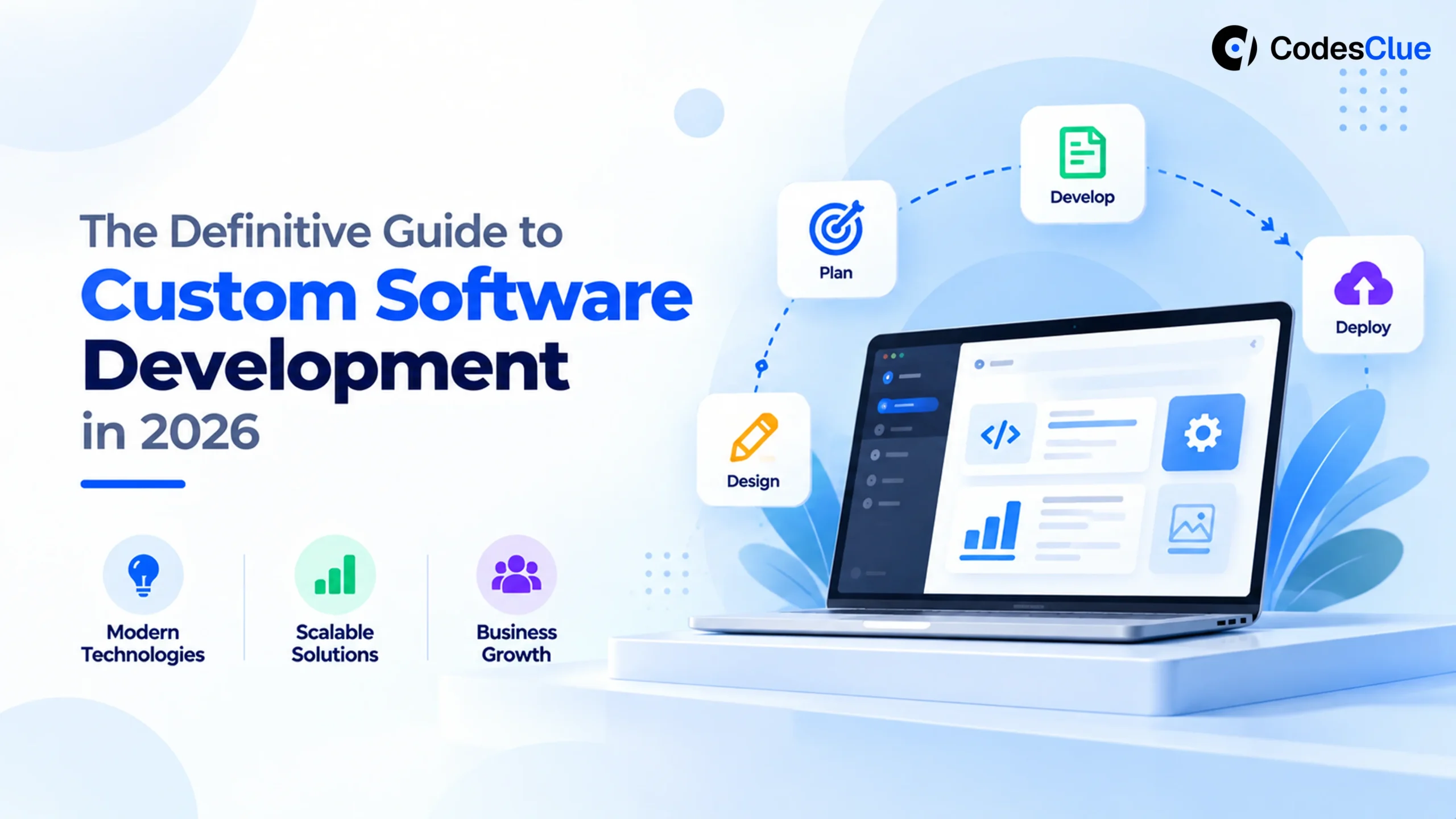
The Definitive Guide to Custom Software Development in 2026
The definitive 2026 guide to custom software development. Learn how to choose the right tech stack, manage budgets, and scale your business with custom code.
Digital transformation sounded like a buzz word earlier than 2026 with further evolving into AI-first approach that the businesses started undertaking from predictive analytics to autonomous workflows to stay competitive and future-ready.
Grand View Research reports that the global custom software market is projected to exceed $146.18 billion (opens in a new tab)by 2030. Off-the-shelf tools have become the back-benchers and the entire software development model has shifted to custom software development solutions to make your business grow. Explore with us in this blog how CodesClue has doubled its client revenue by ditching rigid SaaS for bespoke systems.
The Core Problem: “One Size Doesn’t Fits All”
Off-the-shelf SaaS tools promise convenience, but they often deliver unnecessary outcomes like:
- Too many features you don’t need
- Too few features you actually require
- Limited flexibility
- Expensive scaling
It is like you need a separate remote for your TV and cannot buy a universal remote with some unwanted features. Similarly, custom software solutions are built for you and not for everyone.
The Build vs. Buy Dilemma: A 2026 Framework
In 2026, businesses must strategically evaluate whether to build custom software or adopt off-the-shelf SaaS solutions. While SaaS offers speed and lower upfront costs, custom development ensures scalability, flexibility, and competitive differentiation, making the decision critical for long-term growth, operational efficiency, and alignment with evolving business needs.
Let’s break it down with a practical Build vs Buy software analysis:
Custom Software vs SaaS: Comparison Table
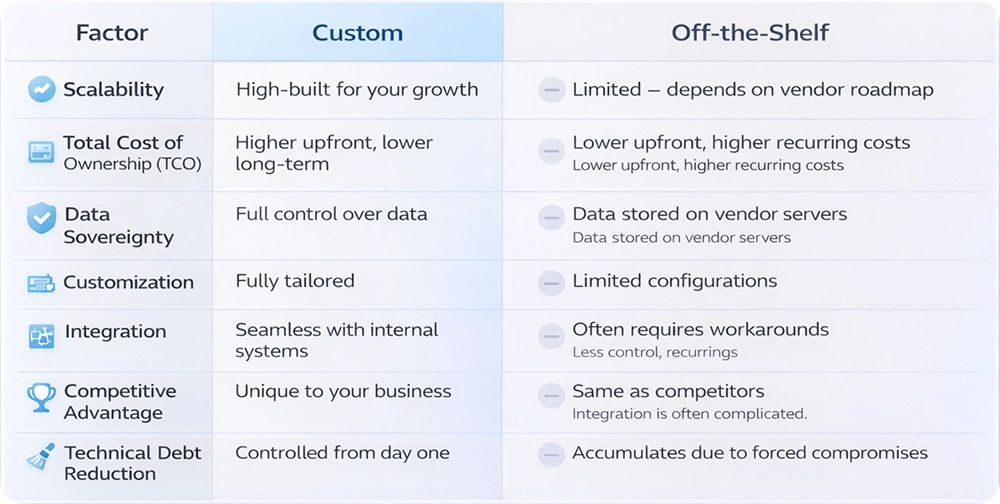
Remember if you have to use the software for a short-term or usage, then you can use the off-the-shelf or SaaS-build, but if you are looking for a long-term solution, then you should always go with the custom software development solutions.
5 Business Benefits of Custom Software in the AI Era
Custom software empowers businesses with tailored solutions, enabling seamless integration of AI, automation, and data-driven decision-making. It enhances scalability, operational efficiency, and competitive advantage by aligning technology precisely with unique business needs in the evolving AI era.
Let’s explore the benefits of custom software development and why businesses are making the switch.
1. Hyper-Personalization and UX
AI-powered custom software enables real-time personalization by adapting interfaces and recommendations based on user behavior. This results in highly engaging, dynamic customer journeys that significantly improve retention and conversion rates. With AI-driven custom software:
- Interfaces adapt to user behavior
- Recommendations improve engagement
- Customer journeys become dynamic
2. Seamless Interoperability
Custom software integrates effortlessly with legacy systems, CRMs, ERPs, and APIs, eliminating data silos and manual processes. It creates a unified ecosystem where information flows smoothly across platforms without operational friction. Most businesses today run on a mix of:
- Legacy systems
- CRMs
- ERPs
- Third-party APIs
3. Future-Proof Scalability
Built with cloud-native architecture, custom solutions are designed to scale as your business grows and evolves. They easily accommodate increasing users, data loads, and emerging technologies without requiring costly system overhauls. Custom systems are designed for enterprise application scalability.
- Built cloud-native
- Easily handle user growth
- Adapt to new technologies
4. Ownership & Intellectual Property
Custom software gives you full ownership of your codebase, roadmap, and innovation pipeline. This transforms your technology into a long-term business asset that enhances valuation and attracts investors. Here’s a powerful but overlooked truth:
Your software = your asset
With custom development:
- You own the code
- You control the roadmap
- You build long-term equity
This directly contributes to company valuation and investor appeal.
5. Enhanced Security with DevSecOps
Security is no longer a feature, it’s a necessity. With DevSecOps practices, security is embedded throughout the development lifecycle rather than added later. This ensures continuous monitoring, faster threat detection, and robust protection against evolving cybersecurity risks.
Custom software integrates DevSecOps integration, meaning:
- Security is embedded from day one
- Continuous monitoring
- Faster vulnerability patching
The Modern Custom Software Development Life Cycle (SDLC)
Today’s software development lifecycle is AI-powered and is no longer linear and slow. In fact, it is iterative, and continuously evolving. It is designed to deliver faster results with higher quality and adaptability.
Let’s check out the flowchart we follow as per our SDLC criteria.
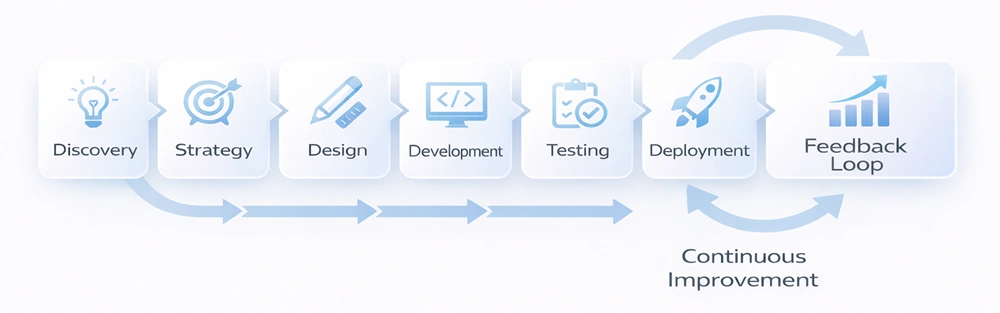
Phase 1: Product Discovery & Strategy
This phase focuses on aligning software with business objectives by identifying user pain points and defining measurable outcomes. It ensures that development is driven by value creation rather than just feature implementation. It covers:
- Defining business goals
- Identifying user pain points
- Mapping outcomes (not just features)
It’s not about building software, it’s about solving problems.
Phase 2: Agile Engineering & AI-Assisted Coding
Modern development leverages AI tools, agile sprints, and rapid prototyping to accelerate coding and decision-making. This approach enhances productivity, reduces human error, and enables faster time-to-market.
Modern development uses:
- AI coding assistants
- Rapid prototyping
- Agile sprints
Benefits:
- Faster delivery
- Reduced errors
- Improved productivity
Phase 3: Continuous QA & Automated Testing
Quality is non-negotiable. Automated testing pipelines and real-time monitoring ensure consistent quality throughout development. This minimizes bugs, improves performance, and eliminates common deployment issues early in the process.
- Automated testing pipelines
- Real-time bug detection
- Performance optimization
Phase 4: Deployment & Feedback Loop
Launch is just the beginning. Post-launch, applications are continuously monitored using analytics and user feedback to guide improvements. This creates a dynamic system that evolves over time, ensuring long-term relevance and performance.
- Monitor real-time usage
- Gather analytics
- Iterate continuously
This creates a: self-improving system.
Essential Tech Stack Trends for Businesses in 2026
Technology is evolving at breakneck speed, and modern software must be built on stacks that are intelligent, scalable, and adaptable to stay competitive.
1. AI & Machine Learning
AI and ML enable predictive analytics, recommendation engines, and multi-agent systems that can autonomously analyze data and make decisions. These systems continuously learn and collaborate, driving smarter automation and more efficient business operations.
- Predictive analytics
- Recommendation engines
- Multi-agent systems (MAS) for automation
These systems can collaborate, learn, and execute tasks autonomously.
2. Cloud-Native & Serverless
Cloud-native and serverless architectures eliminate the need for heavy infrastructure by offering on-demand resources and automatic scaling. This ensures high availability, cost efficiency, and the flexibility to handle fluctuating workloads seamlessly.
Benefits:
- Reduced infrastructure costs
- Automatic scaling
- High availability
3. Low-Code/No-Code Bridges
Low-code and no-code platforms empower non-developers to build tools and automate workflows with minimal technical expertise. When integrated with custom software, they create hybrid ecosystems that accelerate innovation while maintaining scalability and control.
Even non-developers can now:
- Build internal tools
- Automate workflows
Custom software integrates these as hybrid ecosystems.
Calculating the ROI: Is It Worth the Investment?
Understanding the ROI of custom software development goes beyond upfront costs, it’s about long-term value, efficiency, and business growth.
Reduced Manual Hours
Custom software automates repetitive tasks, significantly reducing the time spent on manual operations. This allows teams to focus on higher-value activities, improving overall productivity and cost efficiency.
Increased Customer Lifetime Value (LTV)
Personalized experiences and seamless user journeys enhance customer satisfaction and retention. Over time, this leads to higher engagement, repeat business, and increased revenue per customer.
Lower Long-Term Licensing Fees
Unlike SaaS solutions with recurring subscription costs, custom software eliminates ongoing licensing expenses. This results in substantial savings over time, especially as the business scales.
Improved Operational Efficiency
Tailored systems streamline workflows, reduce bottlenecks, and optimize resource utilization. This leads to faster processes, better decision-making, and measurable improvements in overall business performance.
Example:
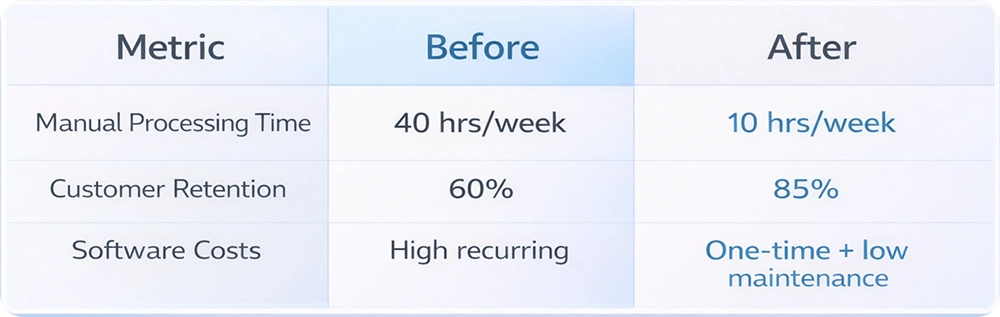
That is the real ROI.
Step-by-Step Custom Software Process for Non-Technical Founders
If you are not from a technical background, here’s the truth: you don’t need to code, you need clarity. Building great software is less about programming and more about understanding your problem, your users, and your goals. You have to convey the things to the professionals and get the software developed. But first, pay attention to:
1. Define Your Problem
Start by clearly identifying the core problem your business is trying to solve. The more specific you are, the easier it becomes to build a solution that delivers real value.
2. Identify Your Audience
Understand who will use your product and what they truly need. This helps shape features, design decisions, and overall user experience from day one.
3. Set Budget and Timeline
Establish realistic expectations around cost and delivery timelines. This ensures smoother planning, avoids scope creep, and keeps development aligned with business priorities.
4. Choose the Right Development Partner
A strong development partner doesn’t just build. Instead, they guide, challenge, and refine your idea. Choosing the right team can make the difference between a functional product and a successful one.
5. Start with an MVP (Minimum Viable Product)
Focus on building a simplified version of your product with core features. This allows you to test your idea quickly, gather feedback, and minimize risk.
6. Scale Based on Feedback
Use real user insights and data to improve and expand your product over time. This iterative approach ensures your software evolves with your users and market demands.
Think of this process like building a house: You don’t start with decorations, you start with a strong foundation, test the structure, and then expand. And the best part? You don’t need to be an engineer. You just need to know what you want to build.
The Business Case for Custom vs Off-the-Shelf Software
Let’s simplify the decision because at its core, this is not just about software, it is about how you want your business to grow.
- SaaS = Convenience
Ready-to-use solutions that get you started quickly, but often require adapting your processes to fit the tool. - Custom = Control
Built around your exact needs, giving you full flexibility over features, workflows, and future scalability. - SaaS = Recurring Cost
Subscription fees that grow as your usage, users, and requirements increase over time. - Custom = Long-Term Investment
Higher upfront cost, but significantly lower dependency and better ROI as your business scales. - SaaS = Generic
Designed for the masses, which means compromises in functionality and differentiation. - Custom = Competitive Advantage
Tailored solutions that align perfectly with your business model, helping you stand out in the market.
In 2026, the businesses that lead are not just using technology, they are owning it. Or, put simply, “SaaS helps you start. Custom software helps you win.”
Conclusion: Your Competitive Edge Starts Here
Custom software is no longer a luxury, it is a strategic necessity in a world driven by AI and automation. It empowers businesses to innovate faster, operate more efficiently, scale seamlessly, and build a foundation for long-term growth.
In today’s competitive landscape, relying on generic tools limits your potential. Because when the market is evolving at lightning speed, showing up with one-size-fits-all solutions is like bringing a knife to a laser fight. Functional, but far from competitive.
Ready to Build Your Custom Software?
If you are serious about scaling your business, it’s time to move beyond limitations.
Explore our Custom Software Development Services at CodesClue and get a free consultation or project audit today.
Frequently Asked Questions
How much does custom software development cost?
Custom software development typically ranges from $20,000 to $200,000+, depending on complexity, features, integrations, and scalability requirements.
How long does it take to build a custom software solution?
To build a custom software solution, it takes 3 to 9 months, on an average, depending on the project scope, development approach, and level of customization involved.
Custom Software vs Off-the-Shelf: Which is better for my business?
- Short-term needs: SaaS offers speed and convenience
- Long-term growth: Custom software provides scalability, control, and competitive advantage
Who owns the source code once the project is finished?
In custom software development, you own the source code and intellectual property, giving you full control over future enhancements and usage.
Can custom software be integrated with my existing legacy systems?
Yes, custom software is designed for seamless integration with legacy systems, APIs, and third-party tools making it one of its biggest advantages.
How do you ensure the security of the software?
Security is ensured through DevSecOps practices, including continuous monitoring, automated testing, and regular security audits throughout the development lifecycle.
Do I need to be “tech-savvy” to work with a development agency?
Not at all. A good development partner will guide you through every step, translating technical concepts into clear, actionable decisions.