
How Much Does Custom Software Development Cost in 2026?
Discover the key factors driving software development cost, including AI integration, team location, and security compliance. Read our expert pricing guide.
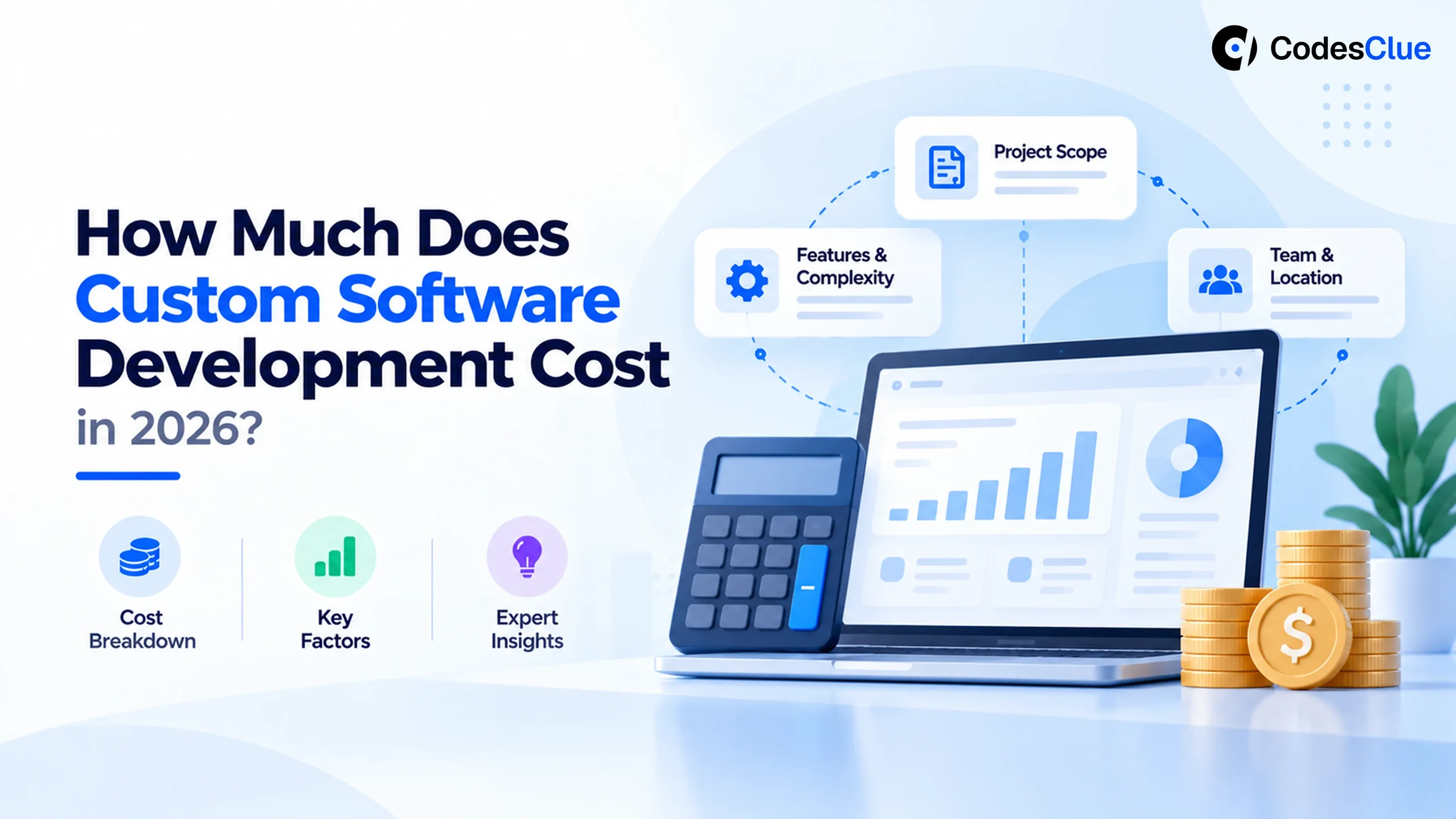
Quick answer: published 2026 agency price guides put a basic MVP at $25,000 to $80,000, a mid-size business platform at $80,000 to $250,000 and an enterprise or AI-heavy system at $300,000 or more. CodesClue projects usually come in lower: MVPs and simple products $8K to $25K (4 to 10 weeks), mid-size products $25K to $70K (3 to 5 months) and large platforms from $70K (5 to 9+ months). See our custom software development services for what each size includes.
Scope, integrations and compliance decide where your project lands, and the sections below explain each one. New to custom software? Start with our guide to custom software development.
Custom Software Development Cost – A Quick Overview
A quick reality check for custom software development depicts:
- Basic MVP: $25,000 – $80,000
- Mid-size business platform: $80,000 – $250,000
- Enterprise / AI-powered systems: $300,000 – $500,000+
These are general market estimates from published 2026 agency price guides; your project can sit outside them.
Price Benchmarks: Cost by Project Complexity
The cost of building a business application varies significantly based on its complexity, features, integrations, and scalability requirements. A simple MVP with basic functionality will cost far less than a full-scale enterprise system with AI, automation, and multi-platform integration.
It means, you are not just paying for an app. Instead, here you are investing in the level of sophistication, performance, and future readiness your business demands.
Simple Applications & MVPs ($25,000 – $80,000)
Developing simple applications and MVPs is a stage about building a lean and functional version of your idea and not a fully polished product. But it can be a working solution that proves your concept has real potential. Product at this stage is created to deliver just enough features to test assumptions, gather feedback, and validate market demand.
Typically, these projects include basic internal tools, early-stage SaaS products, or single-platform apps with minimal integrations and simple UI/UX. The emphasis is on speed and efficiency, with development timelines ranging from 6–12 weeks, allowing businesses to launch quickly and iterate based on real user insights.
In short, you are not building perfection, you are building proof that your idea deserves to scale.
Typical Examples:
- Internal tools (HR dashboards, admin panels)
- Basic SaaS MVPs
- Single-platform mobile apps
- Simple booking or management systems
Mid-Size Business Solutions ($80,000 – $250,000)
Mid-size business solutions are developed in the stage of custom software development where the software moves from experimentation to core business infrastructure. At this stage, solutions are designed to handle real-world complexities, supporting multiple users, workflows, and integrations while delivering a polished, scalable experience.
Projects under this kind of software development program typically include custom CRMs, multi-vendor platforms, and subscription-based SaaS tools, with costs driven by advanced UI/UX, API integrations, and robust backend architecture. Here, software doesn’t just support operations, it replaces multiple SaaS tools, improving efficiency and delivering stronger long-term ROI.
Typical Examples:
- Custom CRMs
- Multi-vendor e-commerce platforms
- SaaS tools with subscriptions
- Workflow automation systems
Enterprise-Grade & AI-Powered Platforms ($300,000+)
This stage leads your custom software to become a mission-critical business asset, powering complex operations at scale. These software platforms are built for delivering high-performance environments like handling large user bases, sensitive data, and advanced functionalities like AI-driven automation.
Here, the costs rise due to sophisticated architecture, strict security and compliance requirements, deep AI/ML integrations, and the need for massive scalability. At this level, you are not just building software, you are creating a long-term digital backbone for your business.
Typical Examples:
- Fintech platforms with high security
- AI-native SaaS products
- Large-scale ERP systems
- Legacy system modernization
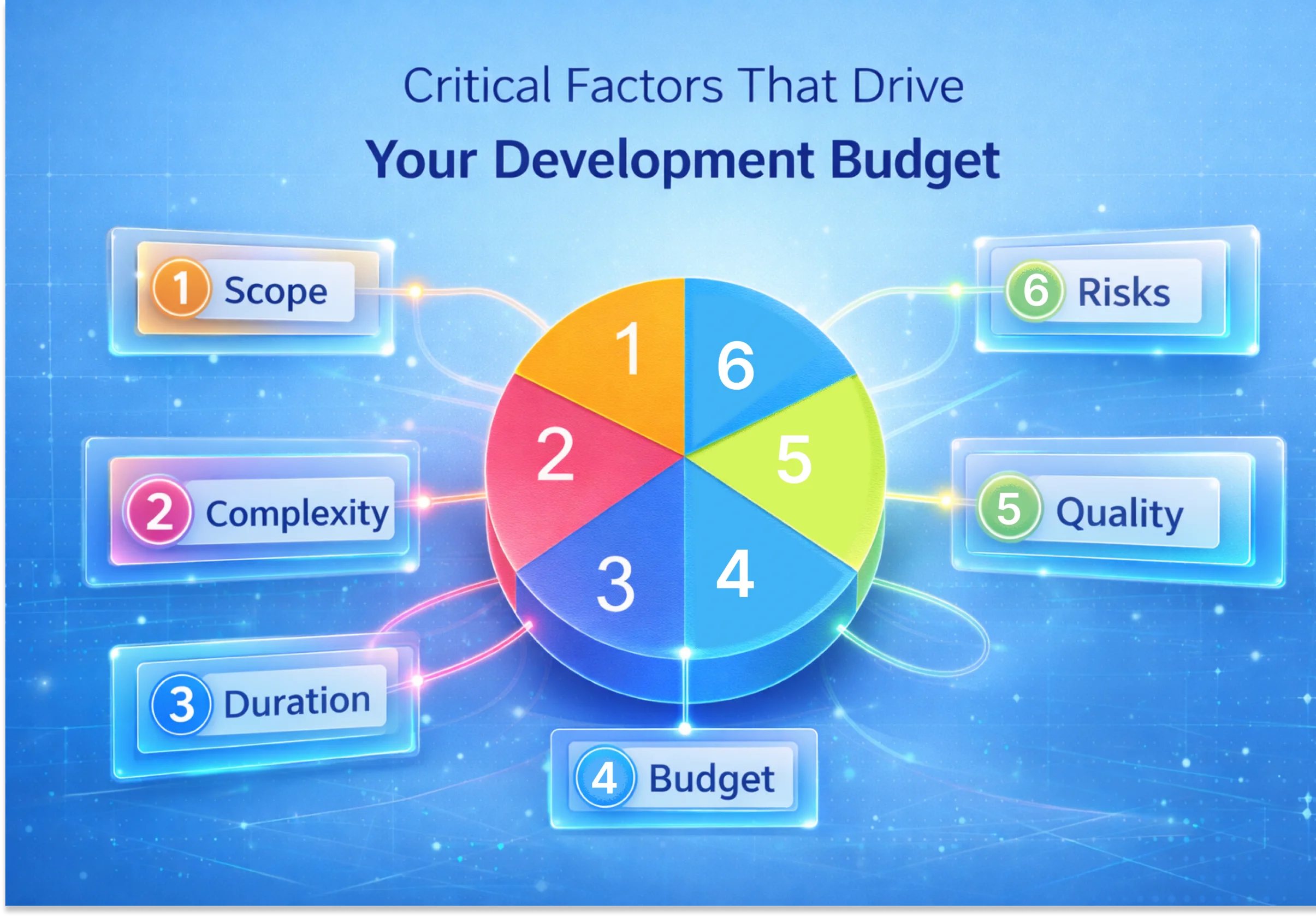
Critical Factors That Drive Your Development Budget
Your development budget depends upon many things. The reason one agency quotes $50K and another $200K for the “same” project is not inconsistency. It is about scope, quality, and long-term thinking that matters for sure success. What looks similar on the surface can differ drastically in execution, scalability, and reliability.
From feature complexity and integrations to UI/UX quality, security standards, and post-launch support, every layer adds depth and cost. In reality, you are not just paying for development hours; you are investing in how well your software performs, scales, and survives in the real world.
Let’s break down why the same project might cost $50K from one agency and $200K from another.
1. Project Scope
Project scope is one of the biggest factors influencing cost of a software project because every additional feature adds layers of design, logic, and testing. The more complex your workflows, user roles, and real-time functionalities, the more time and resources development will require.
In simple terms, a basic dashboard and a real-time logistics platform may sound similar, but under the hood, they are worlds apart in complexity and cost.
This implies to,
More features = more screens = more logic = more cost.
Key Variables:
- Number of user roles (Admin, User, Vendor, etc.)
- Workflow complexity
- Real-time features (chat, tracking, notifications)
2. The Tech Stack
Your technology choices directly impact both development effort and long-term scalability. Standard stacks like React, Node.js, and PostgreSQL are cost-effective and widely supported, while advanced technologies like AI/ML, blockchain, or real-time data pipelines require specialized expertise and higher investment.
For instance, integrating AI through platforms like OpenAI can increase costs due to usage-based pricing and the need for skilled implementation. The tech stack of a company is especially relevant when calculating the cost of integrating AI into existing software.
Standard Stack (Affordable):
- React, Node.js, PostgreSQL
Advanced Stack (Expensive):
- Blockchain
- AI/ML models
- Real-time data pipelines
3. Team Geography (The Game-Changer)
Development costs vary significantly based on where your team is located, making geography one of the most strategic cost levers. While North America commands premium rates, regions like India and Eastern Europe offer high-quality development at a fraction of the cost.
Countries like India stand out for strong engineering talent and mature outsourcing teams. The hourly rate is only part of the cost, though: how well a team plans, tests and communicates decides what you really pay.
Software Development Hourly Rates:
- North America: $100 – $250/hour
- Eastern Europe / Latin America: $40 – $90/hour
- India / South Asia: $25 – $60/hour
This is the classic offshore vs. onshore pricing debate.
India Has an Edge Because:
- High-quality engineering talent
- Cost efficiency
- Strong English communication
- Mature outsourcing ecosystem
CodesClue has teams in India, the US and Germany, so your developers overlap with your working hours.
The Hidden Costs You Must Budget For
A variety of hidden costs make most software budgets quietly fall apart, not in development, but in everything around it. Many businesses plan for the build, but they underestimate the ongoing costs that keep the software functional, secure, and competitive.
From maintenance and updates to hosting, third-party integrations, and scaling infrastructure, these “invisible” expenses can significantly impact your total investment. In reality, building the software is just the beginning, sustaining and evolving it is where the real cost (and value) lies.
1. Discovery & Planning (10–15%)
The discovery and planning phase lays the foundation by defining requirements, designing wireframes, and planning technical architecture. Skipping it may save money upfront, but often leads to costly rework, delays, and misaligned outcomes later. So, if you have spent $10K now, it will save you $50K later.
2. Infrastructure & Hosting
Cloud platforms like Amazon Web Services, Microsoft Azure, and Google Cloud power your application’s backend and scalability. Costs can start small for MVPs but grow significantly as traffic, data, and usage increase. You can develop an MVP in $100–$500/month and scaled applications in $1,000–$10,000+/month.
3. Third-Party APIs
Third-party integrations like payments via Stripe, messaging through Twilio, or AI services introduce ongoing, usage-based costs. You can name them as “silent budget killers”. As your user base grows, these expenses scale and they even scale faster than expected.
4. Maintenance & Support
Ongoing maintenance covers bug fixes, security updates, and performance optimization to keep your software reliable. It is a critical part of Total Cost of Ownership (TCO), ensuring your system remains stable, secure, and future-ready over time. The cost may incur 15-20% annually for software maintenance and support.
How AI is Changing Software Costs?
Artificial Intelligence or AI is reshaping software development economics in a fascinating and slightly paradoxical way. It is making entry-level development faster and cheaper, while simultaneously raising the bar (and cost) for advanced, intelligent systems. Let’s see how AI affects pricing of a software development project:
- Making Simple Things Cheaper: AI-powered coding tools and automation are significantly accelerating development for basic applications. Tasks that once took days like writing boilerplate code or building standard features can now be completed in hours, reducing both time and cost.
- Making Complex Things More Expensive: On the flip side, building AI-driven systems requires specialized expertise, model training, and high-performance infrastructure. From hiring skilled AI engineers to managing compute-heavy workloads, the cost of sophistication has increased substantially.
The Net Effect: Basic apps are cheaper than ever. Advanced apps are more expensive than ever. Or we can say, “AI reduces the cost of developing software, but increases the cost of building smart software.
Strategies to Reduce Your Software Development Spend
If you think about cutting software costs, it does not mean you need to compromise the quality of your software product. Instead, it means building smarter, not bigger. The key is to focus on what truly delivers value, avoid unnecessary complexity, and make strategic decisions that optimize both time and resources.
1. Start with an MVP
Step one begins with creating a lean version of your product that focuses only on solving the core problem. This allows you to validate your idea quickly, gather real user feedback, and avoid unnecessary upfront investment.
2. Prioritize “Must-Haves”
Now, in the second step, you should prioritize ‘must haves. Every additional feature you add, it will increase complexity, time, and cost, often without clear ROI. So, focus only on features that directly impact revenue or user retention, and defer everything else to future iterations.
3. Choose the Right Engagement Model
Finally, selecting the right development model can significantly impact your budget and flexibility. Fixed price works best for defined scopes, time & materials suits evolving needs, and staff augmentation gives you control while optimizing resource costs.
Remember, smart cost optimization is not about spending less, it is about spending where it actually matters.
Conclusion
Nobody would tell you that the cheap code may sometimes become expensive to fix. Hence, balancing quality and cost is important every time you are planning to develop a custom software solution.
Choosing the lowest quote often results in poor architecture, scalability limitations, and costly rewrites down the line. What looks like savings upfront can quickly turn into technical debt that slows your growth and drains your budget.
Instead, focus on what truly matters. Opting for long-term custom software development ROI, partnering with experienced teams, and building a scalable, future-ready architecture is always better. Because great software isn’t just built to launch, it is built to last.
Ready to Build Smart?
If you are planning to invest in custom software, don’t guess your budget. Instead, engineer it and customize it strategically.
Explore world-class Custom Software Development Services offered at CodesClue Technologies to get a tailored estimate and a roadmap designed specifically for your business goals.
CodesClue has delivered 50+ projects and is rated 5.0 on Clutch and 4.9 on GoodFirms. See typical project sizes on our custom software development page, or get a free written estimate within 24 hours.
FAQs on Software Development Cost
How do I estimate the right budget for custom software?
You can estimate the right budget for custom software development by defining your scope, features, and business goals. A reliable development partner can then provide a tailored estimate based on complexity, integrations, and scalability needs.
Is cheaper software development always a bad choice?
Cheaper software development is not always a bad choice, but it is thought that extremely low-cost options often compromise on quality, architecture, and scalability. This can lead to higher long-term costs due to fixes, upgrades, or complete rewrites.
How can I balance cost and quality effectively?
You can balance the cost and quality effectively by focusing on building an MVP first, prioritize essential features, and choose a development partner with proven expertise. This ensures you invest wisely without overspending
What factors impact long-term ROI in custom software?
The key factors impacting long-term ROI in custom software include scalability, performance, user experience, maintenance costs, and how well the software aligns with your business goals and growth strategy.
Can I reduce costs without affecting performance?
Yes, you can reduce costs without affecting performance by using the right tech stack, starting with an MVP, and leveraging cross-platform development where appropriate. Smart planning helps optimize costs without sacrificing quality.
How do I choose the right development partner?
You can look for a partner with relevant experience, transparent pricing, strong communication, and a focus on long-term success, and not just project delivery.