
Secure Data End-to-End: A Practical Guide to Encryption and Decryption
How to secure data end-to-end with this practical guide to encryption and decryption key concepts, methods, and best practices explained simply.
Every business now runs on data. Customer records, payment details, health files, internal chats, all of it moves across networks every second. And every second, someone is trying to intercept it. This is why data encryption best practices are no longer optional. They are the baseline for staying in business, and a core part of any serious data security strategy.
This blog breaks down encryption in plain, direct language. You will learn how encryption actually works, where it fits in your data pipeline, and how to manage it without creating chaos for your IT team.
Key Takeaways
- Encryption turns readable data into unreadable ciphertext. Decryption reverses that process using a key.
- Encryption at rest vs in transit are two different jobs. You need both, not one or the other.
- End-to-end encryption explained simply: only the sender and the receiver hold the keys. Not even the service provider can read the data.
- Symmetric vs asymmetric encryption each solve different problems. Most real systems use both together.
- A cryptographic key management lifecycle determines whether your encryption actually protects you, or just looks good on paper.
- Weak key management causes more breaches than weak algorithms do.
What Is Data Encryption, Really?
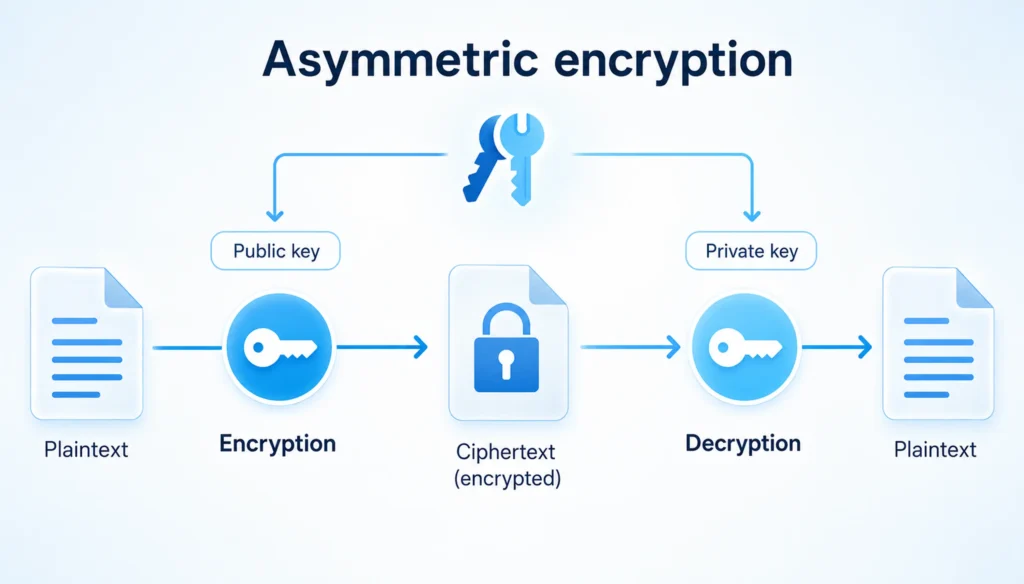
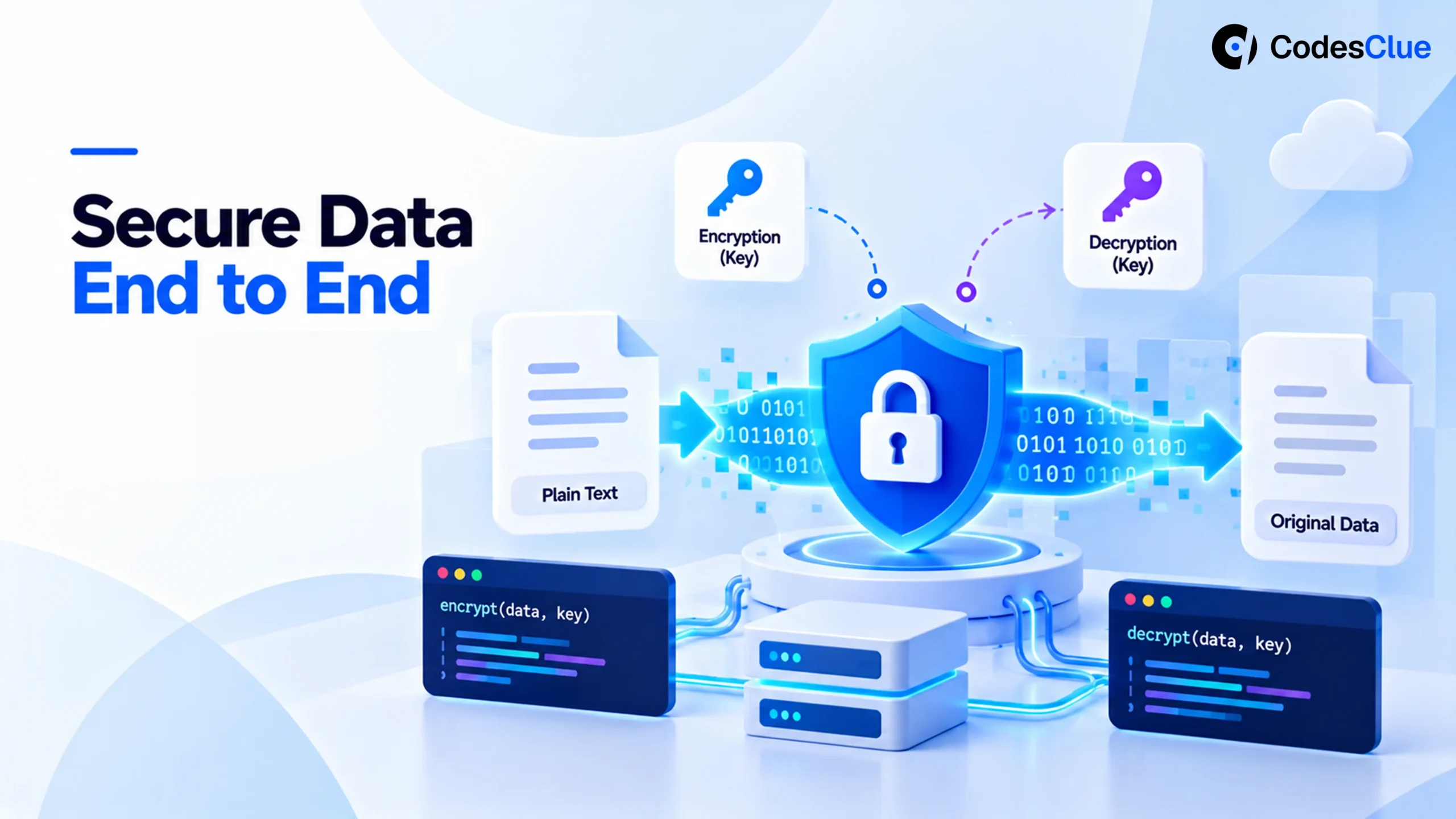
Encryption converts plain, readable data (plaintext) into scrambled, unreadable data (ciphertext). A mathematical algorithm does the scrambling. A secret value, called a key, controls exactly how the scrambling happens.
Decryption reverses this. It takes the ciphertext and the correct key, and rebuilds the original plaintext. That’s the difference between encryption and decryption in one line: encryption locks the data, decryption unlocks it. Without the right key, ciphertext looks like random noise. No shortcuts, no guessing your way in.
Modern encryption algorithms make brute-force attacks pointless. A widely used comparison: cracking a well-implemented RSA-2048 key with today’s classical computers would take longer than the age of the universe several times over, taking a classical computer over 300 trillion (opens in a new tab) years to crack a key generated by the RSA-2048 cryptographic algorithm. That’s the level of protection you’re working with when it’s implemented correctly, which is exactly what a solid software security and governance framework helps you achieve.
Encryption at Rest vs In Transit: Know the Difference
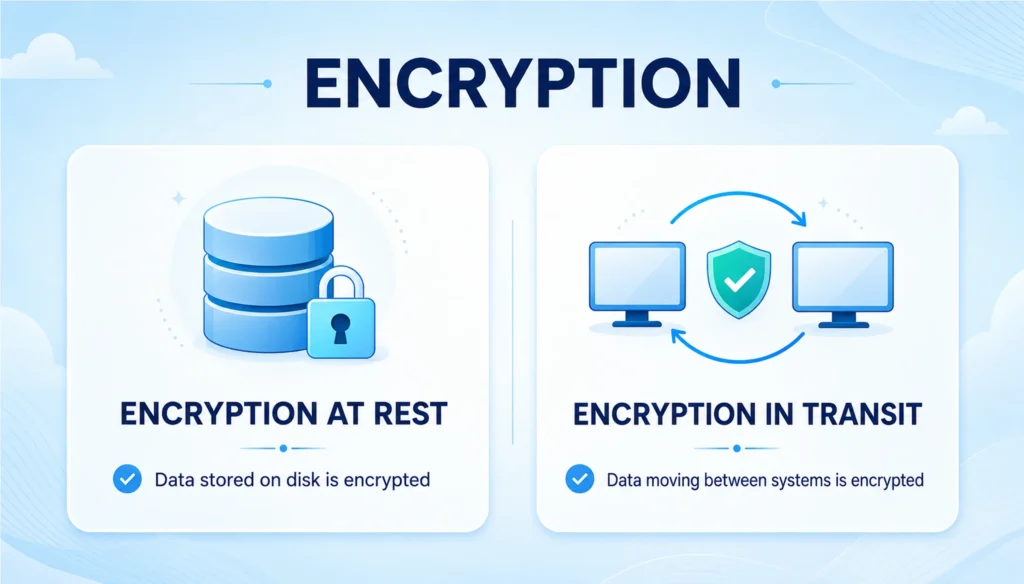
Businesses often think “we encrypted our data” means they’re covered everywhere. They’re not. Data exists in two states, and each needs its own protection.
| Type | What It Protects | Where It Applies |
|---|---|---|
| Encryption at rest | Data sitting in storage, databases, disks, backups | Servers, cloud storage, hard drives |
| Encryption in transit | Data moving between two points | Network traffic, APIs, file transfers |
| End-to-end encryption | Data from the moment it’s created to the moment it’s read | Combines both, with keys held only by sender and receiver |
Encryption in transit typically relies on protocols like TLS to protect data as it travels between a client and server, but it doesn’t provide strong protection against access by intermediaries such as application servers or network providers. That’s a critical gap. Your data might be safe on the wire but exposed the moment it lands on a server you don’t fully trust.
Secure cloud data encryption demands both layers working together: data locked down while stored, and locked down while moving. This is exactly the kind of gap a proper cloud consulting and migration engagement is built to close.
End-to-End Encryption Explained
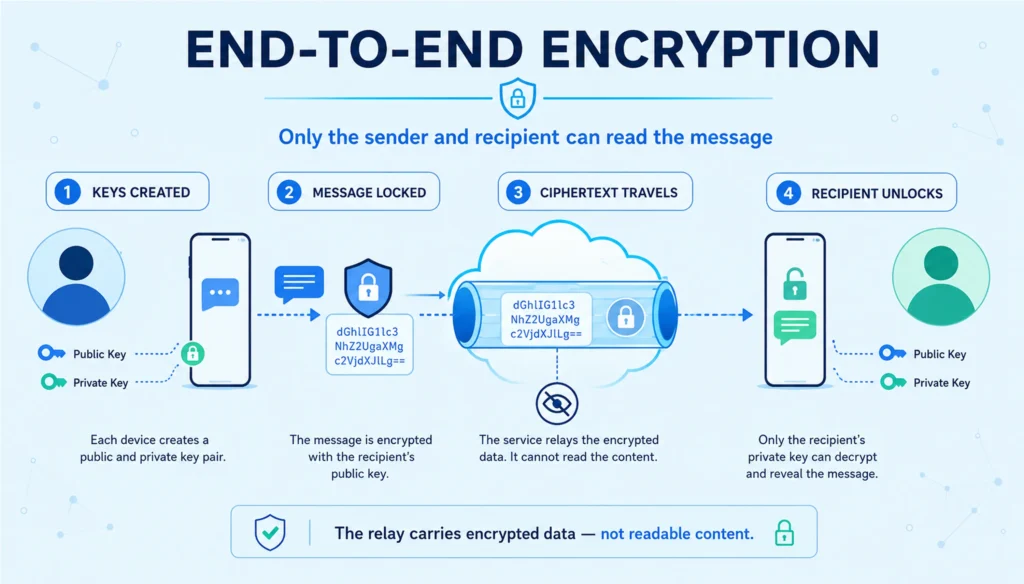
End-to-end encryption (E2EE) is the strictest standard available. Data gets encrypted on the sender’s device, stays encrypted the entire journey, and only decrypts on the recipient’s device. Service providers in the middle, cloud platforms, messaging apps, email servers, physically cannot read it because they never hold the decryption key.
The process runs in four stages: encryption, transmission, decryption, and authentication. Authentication matters more than people realize, it verifies the data wasn’t tampered with in transit, not just that it was hidden.
Products you already trust use this daily. WhatsApp and Signal apply E2EE by default to every message and call, ensuring that even the service provider cannot access the content of communications. If a messaging app worth billions of dollars runs on this model, your business data deserves the same standard.
End-to-end data protection isn’t just a technical checkbox, it’s what keeps you off the front page after a breach. IBM’s research on data breach costs puts the global average at $4.44 million (opens in a new tab) per incident, according to IBM’s Cost of a Data Breach Report. Strong E2EE directly reduces that exposure, and it’s a standard consideration in any security testing process before a product goes live.
Symmetric vs Asymmetric Encryption: Which One Do You Need?
This is where most decision-makers get confused. You don’t have to pick one. Real systems almost always combine both.
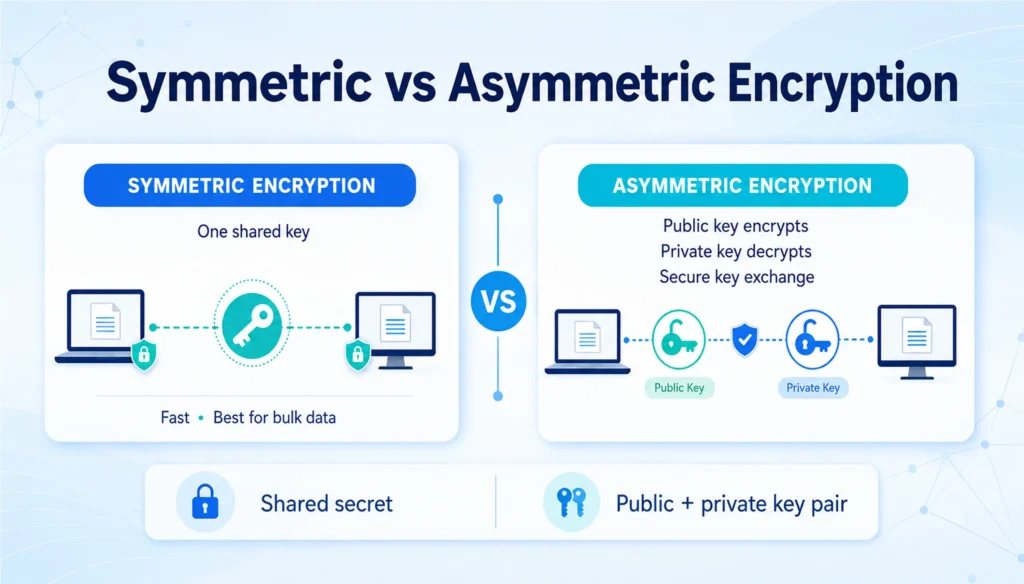
Symmetric encryption
- Uses one single key for both encryption and decryption
- Fast and efficient, ideal for large volumes of data
- Risk: if that one key leaks, everything encrypted with it is exposed
Asymmetric encryption
- Uses a key pair: a public key to encrypt, a private key to decrypt
- No need to share a secret key over an insecure channel
- Slower, so it’s typically used to protect the exchange of a symmetric key, not the full dataset
Here’s how it plays out in practice: WhatsApp generates a unique symmetric session key for a conversation, then uses asymmetric encryption to safely deliver that session key so eavesdroppers cannot steal it in transit. You get the speed of symmetric encryption and the security of asymmetric key exchange, without the trade-offs of using just one method.
Cryptographic Key Management Lifecycle: The Part Everyone Skips
Here’s an uncomfortable truth: strong encryption algorithms fail all the time, not because the math is weak, but because the keys behind them are mishandled. A cryptographic key management lifecycle governs exactly how a key is born, used, and retired.
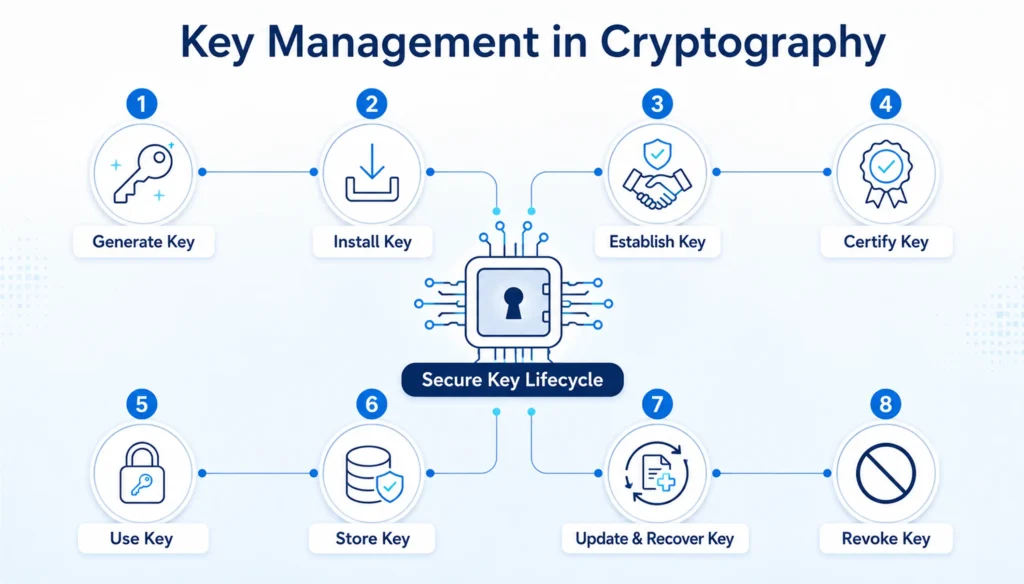
The lifecycle generally moves through these stages, based on NIST SP 800-57 guidance:
- Key generation: created using a secure, randomized process. Weak randomness means a weak key, full stop.
- Key distribution: the key reaches authorized users or systems without exposure in transit.
- Key storage: keys sit in a hardware security module (HSM) or secure vault, never in plain text on a shared drive.
- Key usage: the key operates strictly within its defined purpose (encryption, signing, or authentication).
- Key rotation: keys get refreshed on a schedule, limiting the damage window if one is ever compromised.
- Key archiving: retired keys are stored securely for cases where old data still needs decrypting.
- Key destruction: keys are permanently deleted once they’ve served their purpose, closing the loop.
Every key has an operational lifespan, known as a crypto-period. NIST research notes that a crypto-period is set based on factors including the sensitivity of the data protected and the volume of data or keys under that key’s control, which together determine both the key’s lifespan and its required strength
Skip any one of these seven stages, and your encryption strategy has a hole in it, no matter how strong the algorithm underneath. This is precisely the kind of gap our data governance practice is designed to catch before it becomes a liability.
Common Mistakes That Undermine Encryption
Even businesses that invest in encryption still get breached. Here’s why:
- Storing keys next to the data they protect. If both live on the same server, one breach exposes everything.
- Never rotating keys. A key used for years without refresh becomes a bigger target every day it stays active.
- Ignoring endpoint security. E2EE protects data in motion, but it doesn’t protect a device that’s already infected. Encrypted data becomes readable the moment it’s decrypted on a compromised endpoint, since hackers can install malware on a user’s device to access the data once it has been decrypted.
- Overlooking metadata. Message content might be locked down, but sender, receiver, and timestamp data often isn’t, and that alone can reveal sensitive patterns.
- Treating compliance as the finish line. Meeting a regulation’s minimum encryption requirement is not the same as being secure.
How This Protects Your Business, Not Just Your Data
For decision-makers, encryption isn’t an IT expense, it’s risk insurance with a direct line to your bottom line. It protects you against three things simultaneously: data breaches, regulatory penalties, and loss of customer trust. This is especially critical for regulated sectors like banking, fintech, and healthcare, where a single unencrypted record can trigger both a breach and a compliance violation.
Many privacy regulations, including GDPR, require some form of encryption as part of their data protection stipulations. Getting this wrong doesn’t just cost you data, it costs you fines, lawsuits, and customer confidence you can’t easily rebuild. Aligning your systems with these requirements is a core part of our security and compliance services.
Cryptographic key management is where the real ROI shows up. A well-run key lifecycle means that even if attackers breach your systems, the data they steal is unreadable and useless to them. That’s the entire point of encryption: making a breach a non-event instead of a headline.
Building a Foundational Data Security Layer
Forward-looking security teams are moving away from bolt-on encryption toward encryption as a foundational layer, built into the data itself, not added afterward as a patch. This approach, sometimes called a data privacy vault model, treats sensitive data as encrypted and tokenized from the moment it’s created, so it stays protected across every system it touches, not just the ones you remembered to secure.
For businesses building or scaling digital products, apps, platforms, or enterprise systems, this mindset shift matters more than picking one algorithm over another. Encryption needs to be architected in from day one, with clear ownership of the key management lifecycle, not bolted on after a security audit flags the gap. This is exactly the kind of thinking we bring into every custom software development and web development engagement, where security is designed in at the architecture stage, not patched in later.
Final Word
Data encryption best practices aren’t complicated in theory. Encrypt data at rest. Encrypt data in transit. Use end-to-end encryption wherever the data is sensitive enough to demand it. Combine symmetric and asymmetric methods where each makes sense. And above all, treat your cryptographic key management lifecycle as seriously as the encryption algorithm itself.
The businesses that get breached rarely fail because their encryption math was weak. They fail because a key sat unprotected, unrotated, or unmonitored. Get the lifecycle right, and the encryption takes care of the rest. If you’re building a product that handles sensitive data and want this baked in from the start, our software development consulting team can help you architect it correctly.