
How to Hire Dedicated Developers: A 7-Step Guide for 2026
Learn how to hire dedicated developers in 7 steps: pick the right model, test with real work, check the contract and plan the first 30 days.
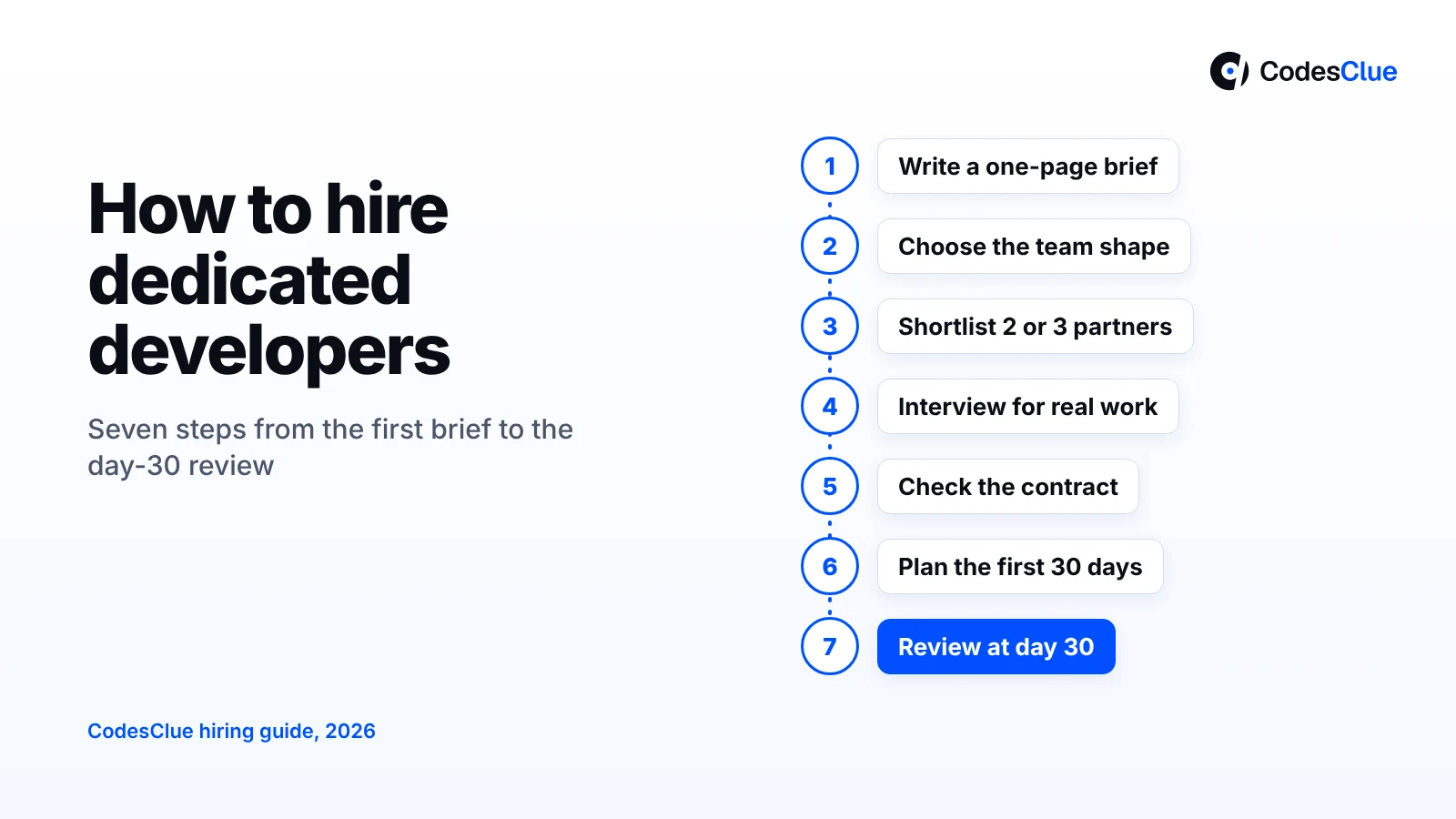
You need two more developers by next month. Your recruiter says hiring in-house takes three months, and a freelancer platform sends fifty profiles that look the same. This guide shows how to hire dedicated developers in seven steps. You will learn which model fits, what to ask, what goes in the contract and how to run the first 30 days.
Key takeaways
- Dedicated developers work only on your product, full time, inside your process. You set the priorities; the vendor handles hiring, payroll and replacement.
- Start with the work, not the job title. A one-page brief with goals, stack and the first three tasks saves weeks.
- Pick the model by situation: dedicated developers for ongoing product work, a project team for a fixed scope, a freelancer for a short, isolated task.
- Test with a real task and a paid first sprint, not with puzzles.
- Put code ownership, NDA, replacement terms and notice period in writing before day one.
What does it mean to hire dedicated developers?
To hire dedicated developers means you add engineers who work only on your product, full time, through a partner company. They join your standups, use your tools and follow your priorities. The partner handles recruiting, salaries, equipment and replacement. You pay a fixed monthly fee per person and can add or remove people as the work changes.
Think of it as renting a full-time teammate rather than buying a finished project. You keep control of what the team builds and in what order. The partner keeps the people side running.
This is different from a freelancer, who usually splits time across clients. It is also different from a project contract, where the vendor commits to a fixed scope and owns the plan. We compare all of them in the decision table below.
When should you hire dedicated developers, and when not?
Hire dedicated developers when the work is ongoing and the plan keeps changing. Common cases:
- Your product is live and the backlog grows faster than your team can ship.
- You need a skill your team lacks for six months or more, such as React Native, DevOps or AI integration.
- Your in-house hiring takes months and the roadmap cannot wait.
- A previous vendor left, and you need people who can read the code and keep going.
Now the honest part. We would not suggest this model in these cases:
- The scope is small and fixed. A three-week landing page or a single integration is simpler to run as a project.
- Nobody on your side can set priorities. This model needs a product owner. Without one, you pay for people who wait for answers.
- The idea is not tested yet. Build a small MVP with a project team first, then add dedicated developers once you know what to grow.
Pro tip: Ask yourself one question. “Will I still have work for this person in six months?” If the answer is no, look at a project contract instead.
Which hiring model fits you?
Most buyers compare four options. Find the row that sounds like your situation.
| Your situation | Best fit | Who manages the work | Watch out for |
|---|---|---|---|
| Live product, growing backlog, plan changes often | Dedicated developers | You (product owner), partner handles people | Expect to set priorities every week |
| You have a team and need one or two extra skills for a while | Staff augmentation | Your tech lead | New people must fit your existing process |
| Clear scope, fixed deadline, you want a finished result | Project contract | The vendor | Changes to scope cost time and money |
| Small, isolated task of a few weeks | Freelancer | You | No backup if the person disappears |
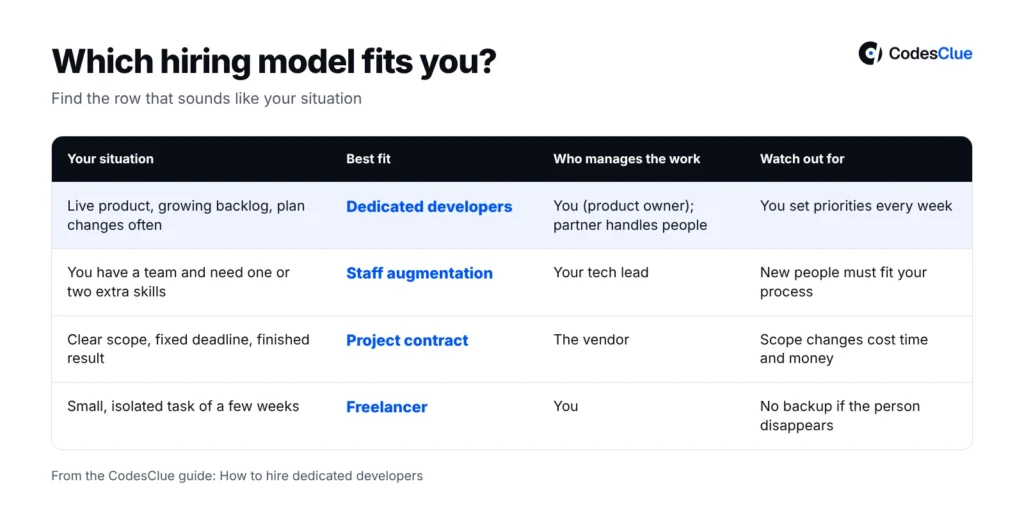
Dedicated developers and staff augmentation overlap a lot. The difference is mostly who leads: with augmentation, people join your existing team under your tech lead.
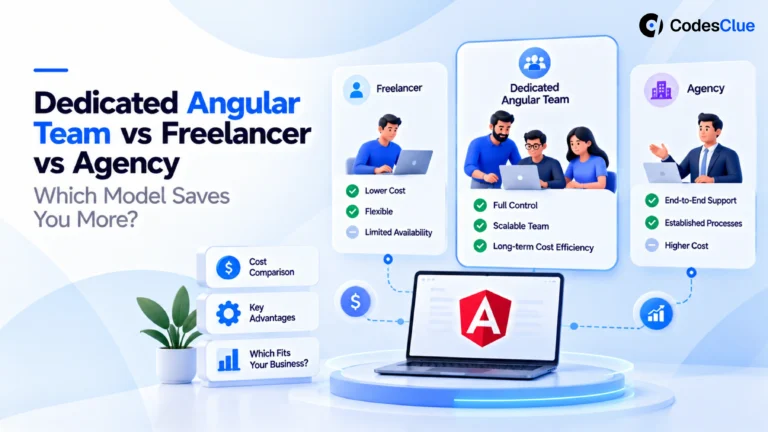
We explain that split in our guide to IT staff augmentation vs outsourcing. If you would rather hand over a whole project, read about software development outsourcing. For an Angular example with numbers, see dedicated Angular team vs freelancer vs agency.
How to hire dedicated developers in 7 steps
Here is how to hire dedicated developers in the order that saves the most time.
1. Write a one-page brief
Start with the work, not the job title. Write down the product, the stack, the goal for the next three months and the first three tasks. Add your time zone and the hours you need overlap.
A brief like this lets a partner match people in days. “Senior React developer” alone gets you fifty CVs and no answers.
2. Choose the team shape
Decide whether you need one developer or a small team. A single developer works when you already have a lead and QA. Products with web, mobile and a backend usually need more.
Take our HUSK project, a member portal for a corporate wellness company. It runs with 3 backend, 2 frontend and 2 mobile developers, plus 1 QA engineer and a project manager. Our Blueberry Pie operations dashboard needed the same shape without mobile.
Pro tip: Budget for QA from the start. Teams that skip it ship faster for a month, then lose that time fixing bugs in production.
3. Shortlist two or three partners
Look for proof you can check. Read case studies with real numbers, open their profiles on review platforms such as Clutch and GoodFirms, and ask for a reference you can call. Check where the developers sit and how many hours overlap with your day.
If you are open to a team in another country, see how we set up remote developers and offshore developers, including time zone overlap.
4. Interview for real work
Skip the puzzles. Ask each candidate to walk you through code they wrote and a decision they would change today. Then give a short, paid task from your own backlog.
Useful questions:
- “How would you start on our codebase in the first week?”
- “Tell me about a release that went wrong. What did you do?”
- “When you disagree with a product decision, what do you do?”
- “How do you show progress when a task takes longer than planned?”
5. Check the contract
Read the contract before anyone writes code. The checklist below covers what matters most.
6. Plan the first 30 days
Good onboarding decides most of the outcome. We cover a week-by-week plan in the next section.
7. Review after the first month
Book a review at day 30. Look at what shipped, how clear the updates were and how fast the team answered questions. Keep, change or replace people based on that, not on gut feeling.
Want a second opinion on your brief or team shape? Our IT staff augmentation team can review it with you.
Contract checklist before day one
Ask for each of these in writing:
- Code and IP ownership. You should own all code and intellectual property. At CodesClue, the client owns both.
- NDA. Signed before you share code, data or plans.
- Access. Who gets access to which systems, and how you remove access when someone leaves.
- Replacement. What happens if a developer leaves or does not fit, and how fast a replacement starts.
- Notice period. How many weeks you need to scale the team down.
- Working hours. The daily overlap with your time zone and holiday calendars.
- Reporting. What you get each week: demo, written update, hours, open risks.
Pro tip: Ask the partner to show you a sample weekly update from another project, with client names removed. It tells you more than any sales call.
What the first 30 days should look like
| Week | Goal | What you should see |
|---|---|---|
| Week 1 | Access and context | Accounts set up, local build running, questions about the code and the product |
| Week 2 | First small change in production | A bug fix or small feature, reviewed and released |
| Week 3 | Own a feature | A plan for one feature, estimates, first demo |
| Week 4 | Normal pace | Regular releases, a clear weekly update, a short retro |
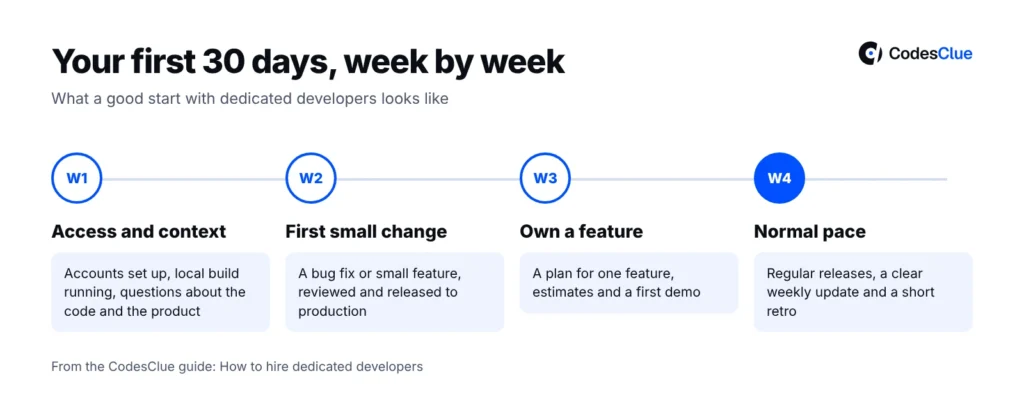
What we see in real projects: when developers join an existing product, the first week goes to reading. On HUSK, our team built on the portal code the client already had and wrote the platform documentation along the way. That reading time pays back later, because the team stops guessing.
How much does it cost to hire dedicated developers?
Cost depends on seniority, skills and where the developers work. As a market reference, Cleveroad’s 2026 guide puts a dedicated specialist at about $6,000 to $20,000 or more a month, with large gaps between regions. Treat any published range as a starting point, not a quote.
Three things move the price most:
- Seniority mix. One senior lead plus mid-level developers often ships more than a team of juniors.
- Rare skills. AI, DevOps and some mobile skills cost more because fewer people have them.
- Time zone overlap. More overlap with your working day can change who is available.
If your work is a defined build rather than an ongoing team, a fixed project can be simpler to budget. CodesClue’s project ranges are $8K to $25K for an MVP, $25K to $70K for a mid-size product, and from $70K for large platforms.
For dedicated developers, we quote after a short call about your brief, because team shape changes the number more than anything else. Development starts within 48 hours after we agree the requirements and you approve the developer.
Common mistakes to avoid
- Hiring for the CV, not the work. Test with a task from your backlog.
- No product owner. Developers without priorities build the wrong thing quickly.
- Choosing on price alone. A team that needs twice the guidance costs you more of your own time.
- No written ownership terms. Fix code and IP ownership before day one.
- Skipping the 30-day review. Problems are easiest to fix in month one.
- Going silent. A weekly demo keeps everyone honest, on both sides.
Checklist: are you ready to hire dedicated developers?
- We have a one-page brief with goals, stack and the first three tasks.
- One named person sets priorities each week.
- The model fits our situation (see the decision table).
- Two or three partners are on our shortlist, with proof we can check.
- A paid test task from our backlog is ready.
- Our contract covers IP, NDA, access, replacement and notice period.
- We booked a review for day 30.
Ready to hire dedicated developers?
You now know how to hire dedicated developers without the usual guesswork. Write the brief, pick the model, test with real work and plan the first month. If you want help with any step, send us your brief. We will suggest a team shape and tell you honestly whether dedicated developers are the right fit. Book a free consultation.
FAQs
How long does it take to hire dedicated developers?
It depends on the partner and the skill. In-house hiring often takes months. Through a partner with a ready team, you can review candidates within days. At CodesClue, development starts within 48 hours after we agree the requirements and you approve the developer. Rare skills can take longer, so share your brief early.
What is the difference between dedicated developers and staff augmentation?
They overlap. With staff augmentation, developers join your existing team and your tech lead directs them. Dedicated developers, by contrast, work only on your product, often as a small team, and you set priorities through a product owner. Both run full time on your work; the difference is mostly who leads day to day.
Who owns the code when I hire dedicated developers?
You should, and your contract should say so in plain words. Check that all code, designs and documents created for you belong to your company, and that the partner signs an NDA before you share anything. At CodesClue, the client owns the code and the intellectual property.
Can I hire just one dedicated developer?
Yes. One developer works well when you already have a tech lead, code review and QA in place. If you have none of those, a single developer has to do everything alone, and quality usually drops. In that case, a small team with a lead and QA is safer.
How do I manage dedicated developers in another time zone?
Agree on two to four hours of daily overlap and use them for standups, questions and reviews. Keep tasks written in your tracker, ask for a short written update every day and a demo every week. Most problems come from unclear tasks, not distance.
What should I ask before I hire dedicated developers?
Ask who exactly will work on your product and how senior they are. Then check how replacement works, what the weekly update contains, how many hours overlap with your day and who owns the code. Ask for a reference you can call and a case study with real numbers