

How Much Does It Cost to Build a Crypto Exchange Platform?
How much it costs to build a crypto exchange platform. Get a clear breakdown of features, security, licensing, and development expenses.

Crypto exchanges have turned into some of the largest digital-asset marketplaces in the world. In 2025, the top 10 centralized exchanges processed $18.7 trillion (opens in a new tab) in spot trading volume while thieves stole more than $3.4 billion (opens in a new tab) in crypto over the same year. That gap between opportunity and risk shows why building an exchange takes more than a trading screen and a wallet.
So what does crypto exchange development cost in 2026? The number moves with your exchange model, feature set, security depth, compliance obligations, and target scale. This guide walks through every cost driver, compares your build options, and gives you a realistic budget before you start writing a single requirement document.
Crypto Exchange Development Cost at a Glance
| Exchange Type | Estimated Cost | Development Time |
|---|---|---|
| Basic MVP | $50,000–$100,000 | 3–5 months |
| Standard CEX | $100,000–$250,000 | 5–8 months |
| Advanced Exchange | $250,000–$500,000+ | 8–12+ months |
| Enterprise Exchange | $500,000–$1M+ | 12–18+ months |
| Global Exchange Ecosystem | $1M+ | 18+ months |
These numbers cover development only. Licensing, liquidity, compliance, infrastructure, security audits, and payment integrations push the real investment higher.
What Actually Drives the Cost
No fixed price exists for crypto exchange development. Your own requirements set the budget. The factors that move the number most:
- Exchange type (CEX, DEX, hybrid, or P2P)
- Number of supported cryptocurrencies
- Trading engine complexity
- Wallet and custody model
- KYC and AML depth
- Blockchain integrations and payment gateways
- Liquidity sourcing
- Security architecture
- Mobile app requirements
- Regulatory scope
- Development team location
A platform trading five assets with basic spot trading needs a fraction of the infrastructure a global exchange needs to run hundreds of assets, multiple payment rails, and derivatives trading.
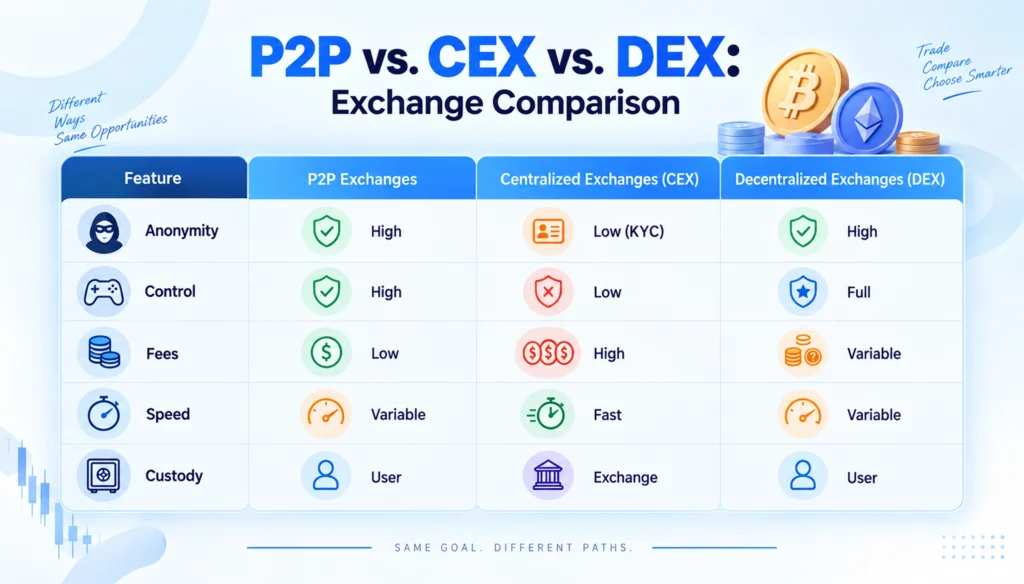
Your exchange model shapes the entire cryptocurrency exchange development services engagement. The tech stack, security layer, infrastructure, and compliance burden all shift depending on which model you pick.
Centralized Exchange (CEX).
A CEX runs trading through its own infrastructure: user accounts, KYC, wallets, deposits and withdrawals, an order book, a matching engine, and an admin dashboard. A standard CEX typically runs $100,000–$500,000+, depending on feature depth and expected traffic.
Decentralized Exchange (DEX).
A DEX shifts the weight onto blockchain networks and smart contracts, liquidity pools, automated market makers, Web3 wallet integration, blockchain indexing, and price oracles. Decentralized exchange development costs generally range from $80,000–$400,000+, and smart-contract audits add a separate, non-negotiable line item.
Hybrid Exchange.
A hybrid platform blends centralized trading infrastructure with decentralized settlement or wallet functionality. Combining two architectures raises the price to roughly $200,000–$600,000+, but it also gives you more flexibility to serve both custodial and non-custodial users.
P2P Exchange.
A peer-to-peer model connects buyers and sellers directly and settles trades through escrow rather than a central order book. P2P crypto exchange development cost tends to fall between $60,000–$300,000+, depending on escrow logic, dispute resolution tools, and payment-method coverage. Often a lighter build than a full CEX since it skips the matching engine and deep liquidity requirements.
Key Features That Move the Budget
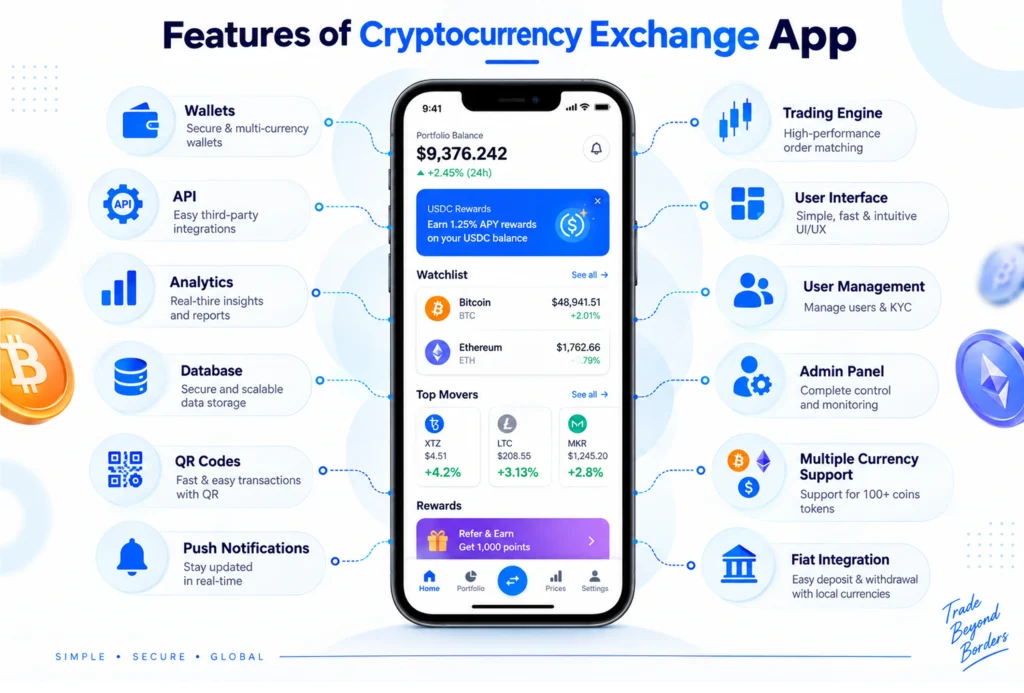
User accounts and authentication.
Beyond a basic login, expect email/phone verification, two-factor authentication, passkeys, device management, login alerts, and account recovery, all standard protection against unauthorized access.
KYC and AML.
KYC covers identity verification, document checks, facial recognition, liveness detection, and sanctions screening. AML tools monitor transactions and flag suspicious activity. Most businesses plug in specialist providers rather than build this in-house, which cuts development time but adds a recurring service cost.
Trading engine.
A basic MVP gets by with standard order matching. A high-volume exchange needs low-latency execution, high throughput, real-time order books, live market data, and fault recovery, and this is usually where cost climbs fastest as expected volume grows.
Wallet and custody.
This layer handles deposits, withdrawals, balances, and blockchain transactions, hot and cold wallets, private-key management, withdrawal controls, and transaction monitoring. Holding customer assets turns custody into a major security and compliance responsibility, not just an engineering task.
Asset support.
Supporting a handful of major cryptocurrencies is straightforward. Supporting hundreds of tokens across multiple chains multiplies the work. Each blockchain needs its own integration, monitoring, and withdrawal logic, which directly increases the cost to develop a cryptocurrency exchange.
Fiat payments.
Letting users move traditional currency in and out means integrating bank transfers, cards, local payment methods, currency conversion, and fraud/chargeback tools. A global exchange usually needs different payment providers for different regions.
Security and Legal Compliance Costs
Treat security as core infrastructure, not an add-on. A single breach costs more than the preventive engineering ever would. Budget for encryption, API protection, key management, network security, audit logging, penetration testing, and incident response.
Regulation adds a separate, often larger line item. Under the EU’s MiCA framework, covered crypto-asset service providers need formal authorization, with applications covering governance, risk controls, business continuity, ICT security, and custody policies. MiCA also sets minimum capital requirements of €50,000 to €150,000 for providers operating a crypto-asset trading platform, on top of broader prudential rules.
Crypto exchange legal compliance costs sit entirely outside your software budget, and it scales with your target jurisdictions; expect it to grow fast the moment you plan to operate across multiple regions.
Custom, White-Label, or Hybrid Build?
How you build the platform changes the total cryptocurrency exchange development cost as much as which features you pick.
Custom development gives you full control over architecture, design, and business logic the right call when you need real differentiation. A complex custom build runs $250,000–$1M+, with a longer timeline and full ownership of maintenance.
White-label exchange software gets you pre-built exchange technology that you customize and launch faster. White-label crypto exchange software cost typically starts around $50,000–$200,000+, depending on customization depth and vendor pricing, but factor in recurring licensing, infrastructure, and vendor fees before you commit.
Hybrid development builds the differentiated parts (trading interface, admin system) in-house and outsources specialized functions KYC, AML, custody, liquidity to third parties. This usually gives you the best balance of control, speed, and budget.
Crypto Exchange App Development Cost
If you want native mobile alongside web, crypto exchange app development cost adds its own budget line. A mobile app typically covers portfolio tracking, buy/sell functions, order placement, price alerts, wallet access, and push notifications.
Building separate native iOS and Android apps costs more than a cross-platform build when your requirements allow it. A simple companion app stays relatively moderate in cost; a full-featured mobile trading experience needs substantially more investment.
Development Timeline
| Stage | Approx. Duration |
|---|---|
| Planning & Architecture | 2–4 weeks |
| UI/UX Design | 3–6 weeks |
| Core Development | 8–20+ weeks |
| Blockchain & API Integrations | 4–12+ weeks |
| Testing & Security | 4–10+ weeks |
| Deployment | 2–4 weeks |
Several stages overlap. A focused MVP ships in 3–5 months; a feature-rich platform takes 8–18+ months. Regulatory approvals and third-party onboarding can extend the timeline further.
Ongoing Costs After Launch
Your budget doesn’t stop at launch. Plan for cloud hosting, blockchain nodes, KYC/AML services, security monitoring, liquidity, payment processing, technical support, bug fixes, and periodic security audits. A reasonable planning benchmark sets aside 15–30% of your initial development cost per year for maintenance; regulated or large-scale platforms should expect to run higher.
How to Cut Costs Without Cutting Quality?
You don’t need every feature on day one. A focused MVP can launch with core accounts, KYC integration, secure wallets, limited trading pairs, basic order types, essential admin controls, and strong authentication, then add advanced trading, more assets, and mobile features once demand proves out.
Lean on third-party providers for specialized functions like KYC and liquidity instead of building them in-house; building internally rarely creates a real business advantage there. Cut unnecessary scope, never essential security.
How to Start a Crypto Exchange: A Practical Roadmap
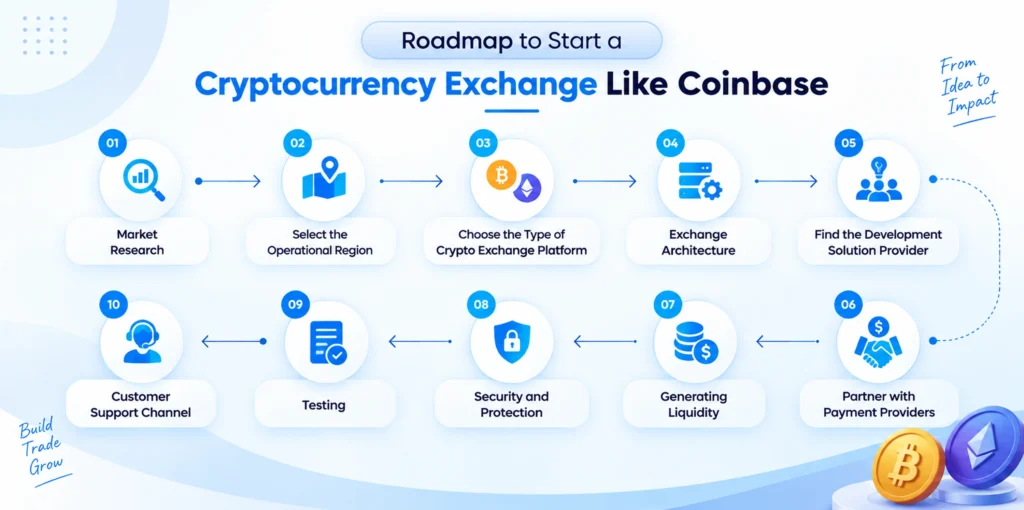
Anyone figuring out how to start a crypto exchange should nail down these decisions before hiring a development team:
- Choose the market. Decide which countries and customer segments you’re targeting.
- Pick the exchange model. CEX, DEX, hybrid, or P2P let your business goals and regulatory reality decide.
- Define the MVP. Lock in assets, trading pairs, payment methods, wallet features, and security controls for launch.
- Plan compliance early. Map out licensing, KYC, AML, reporting, and custody requirements before development starts.
- Design the product. Chart the full user journey: registration, verification, deposits, trading, withdrawals, support.
- Build and integrate. Develop the core platform and connect blockchain networks, payment providers, liquidity sources, and KYC tools.
- Test before launch. Run functional, performance, API, wallet, and penetration tests.
- Launch in phases. Start with a controlled release and monitor performance, liquidity, and security alerts before scaling.
How Crypto Exchanges Make Money
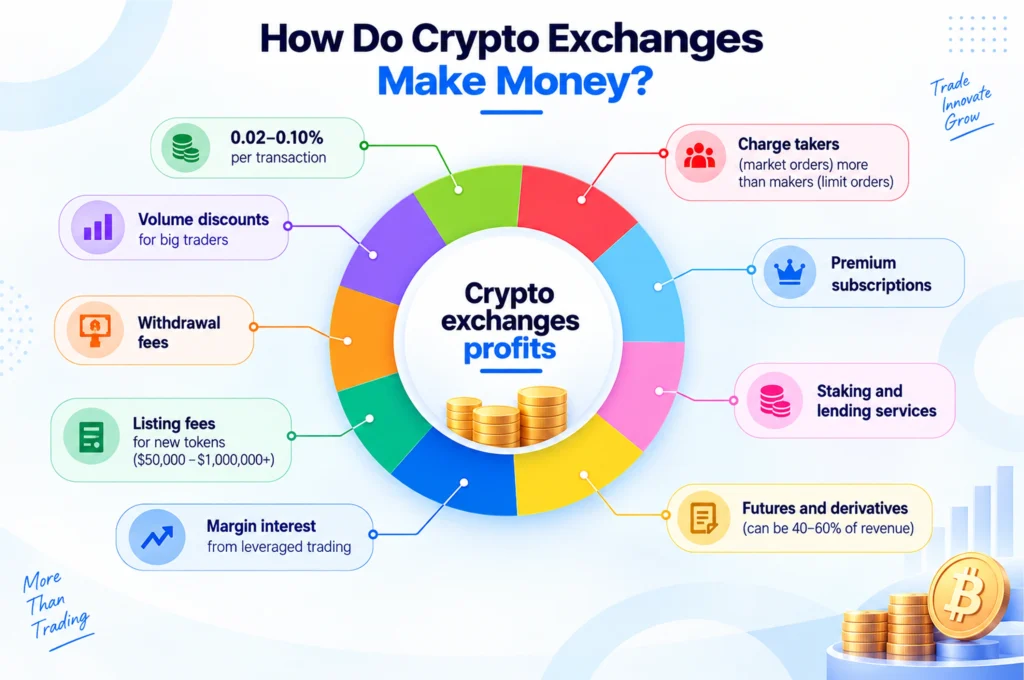
Understanding revenue matters just as much as understanding cost. Exchanges typically earn through trading fees, withdrawal fees, bid-ask spreads, institutional services, OTC trading, premium APIs, and custody services. Match your revenue model to your target market; a low-fee exchange, for instance, needs serious trading volume to cover its infrastructure and compliance costs.
Final Budget Estimate
| Platform Type | Estimated Development Cost |
|---|---|
| Basic MVP | $50K–$100K |
| Commercial Exchange | $100K–$250K |
| Advanced Platform | $250K–$500K+ |
| Enterprise Exchange | $500K–$1M+ |
| Global Ecosystem | $1M+ |
Your final number depends on product scope, technology choices, target market, security depth, and regulatory obligations. Remember that software is only one part of the investment; legal, licensing, compliance, liquidity, custody, and operations all need a place in your financial plan.
Conclusion
Building a crypto exchange in 2026 can run anywhere from $50,000 to $1M+, depending on scale and business model. Define your market, exchange type, MVP scope, and compliance needs before development starts. A focused first release keeps costs under control while leaving room to expand once the platform proves traction, and working with an experienced team for cryptocurrency exchange development services helps you avoid the expensive mistakes that come from guessing at scope instead of planning for it.