

Predictive Analytics in Manufacturing & Retail: Driving ROI with Big Data
How predictive analytics drives measurable ROI in manufacturing and retail. Learn big data strategies to reduce costs and boost efficiency
Manufacturers and retailers can no longer afford to react to equipment failures, stockouts, or supply chain disruptions after they occur. Today, competitive advantage comes from predicting these events before they impact operations.
Powered by AI, machine learning, and big data, predictive analytics helps organizations forecast demand, optimize inventory, and prevent costly downtime.
According to a study published on ResearchGate citing U.S. Department of Energy data, predictive maintenance in manufacturing can reduce maintenance costs by 25–30%, cut equipment breakdowns by 70–75%, and reduce downtime by 35–45%, delivering measurable operational and financial gains.
In this article, we will explore how predictive analytics in manufacturing and predictive analytics in retail are helping businesses improve efficiency, make smarter decisions, and drive higher ROI with big data.
Why Are Traditional Manufacturing and Retail Operations Failing to Compete?
Many organizations still operate on a reactive basis. They fix equipment after it fails, reorder inventory after shelves become empty, and respond to customer behavior only after sales decline.
While this approach worked in relatively stable markets, today’s business environment is far more dynamic. Supply chain disruptions, volatile consumer demand, rising operating costs, and global competition require organizations to anticipate change rather than simply respond to it.
Reactive operations create several costly challenges:
- Unexpected equipment downtime
- Frequent stockouts
- Production bottlenecks
- Delayed customer deliveries
- Poor forecasting accuracy
Each of these issues directly impacts profitability.
Today’s market leaders rely on big data in manufacturing and advanced analytics to predict outcomes before they become business problems.
What Is the True Cost of Reactive Supply Chain Management?
Supply chains generate continuous streams of operational data, including supplier performance, transportation status, warehouse inventory, production schedules, and customer demand.
Without predictive models, organizations often struggle to identify risks until they disrupt operations.
The consequences include:
- Production delays due to unavailable raw materials
- Emergency shipping costs
- Excess warehouse inventory
- Lost sales from stock shortages
- Increased operational expenses
ResearchGate reports that an analysis by McKinsey reveals that companies implementing AI-powered supply chain management can reduce logistics costs by up to 15%, improve inventory levels by up to 35%, and enhance service levels by up to 65%.
These improvements demonstrate why predictive analytics is no longer a competitive advantage; it is becoming a business necessity.
How Is Big Data in Manufacturing Transforming Raw Information into Profit?
Modern factories generate massive volumes of data from Industrial IoT devices, ERP, MES, SCADA systems, production equipment, and quality control processes. In the past, much of this data remained underutilized due to limited analytical capabilities.
Today, AI and machine learning transform this raw information into actionable insights by continuously analyzing machine performance, energy consumption, production output, maintenance records, supplier lead times, and product quality.
Instead of simply understanding what happened, manufacturers can now predict what will happen next, from identifying potential equipment failures and production bottlenecks to optimizing inventory and assessing supplier risks. This shift from descriptive reporting to predictive intelligence is turning big data in manufacturing into a powerful driver of efficiency, cost savings, and profitability.
How Does Predictive Analytics in Manufacturing Lower Factory Costs?
Predictive analytics improves manufacturing by optimizing maintenance, production planning, quality control, inventory management, and workforce allocation.
As a result, manufacturers experience:
- Improved production efficiency
- Better product quality
- Reduced material waste
- Faster delivery timelines
More importantly, predictive analytics helps organizations shift from reactive operations to continuous optimization, turning operational data into measurable business value.
Can You Prevent Machine Downtime Using Predictive Maintenance in Manufacturing?
One of the most valuable applications of predictive maintenance in manufacturing is reducing unexpected equipment failures.
Traditional preventive maintenance follows fixed schedules, regardless of a machine’s actual condition. This often leads to unnecessary servicing or, worse, missed warning signs that result in costly breakdowns.
Predictive maintenance takes a smarter approach.
By analyzing sensor data such as vibration, pressure, temperature, acoustics, and power consumption, AI models detect subtle changes that indicate equipment degradation long before failure occurs.
Maintenance teams can then schedule repairs during planned maintenance windows instead of responding to emergency breakdowns. These improvements directly translate into lower operational costs and higher production capacity.
How Do Real-Time Analytics Remove Production Bottlenecks?
Manufacturing bottlenecks often develop gradually.
A machine running slightly slower than expected, inconsistent material availability, or increasing quality defects can quietly reduce overall factory performance.
Real-time analytics identifies these issues as they emerge.
Instead of waiting for production reports at the end of a shift, managers receive immediate insights, enabling them to take corrective action before productivity declines.
This level of operational visibility is a major reason why predictive analytics has become a cornerstone of modern smart manufacturing.
Top Benefits of Predictive Analytics in Manufacturing
Organizations investing in predictive analytics in manufacturing are moving beyond operational monitoring to continuous optimization. By combining AI, machine learning, and IoT data, manufacturers can improve productivity, reduce costs, and make better business decisions.
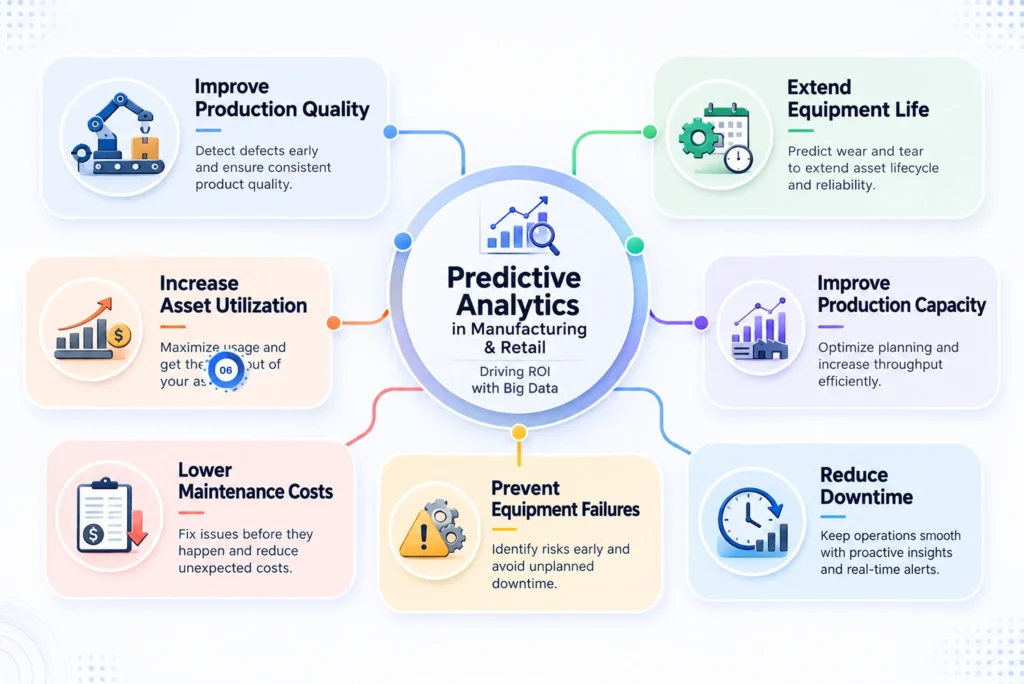
Zero Unplanned Downtime
AI-powered predictive maintenance in manufacturing detects equipment issues early, reducing downtime and improving Overall Equipment Effectiveness (OEE).
Extended Asset Lifespan
Industrial equipment is a major capital investment. Predictive analytics monitors factors like vibration, temperature, and pressure to detect wear early, enabling targeted maintenance that extends asset life and reduces replacement costs.
Minimized Material Waste
Predictive analytics identifies process deviations in real time, allowing manufacturers to correct issues before defects occur. This reduces scrap, improves first-pass yield, and lowers raw material costs.
Optimized Warehouse Space
Predictive analytics forecasts material demand more accurately, enabling Just-in-Time (JIT) inventory management. This helps manufacturers maintain optimal stock levels, reducing storage costs without risking production delays.
What Are the Real-World Benefits of Predictive Analytics in Retail?
Retail has become increasingly data-driven. Every customer interaction, whether online or in-store, creates valuable information about buying behavior, preferences, and demand patterns.
However, collecting data alone isn’t enough. Retailers need predictive models that convert customer and operational data into timely business decisions.
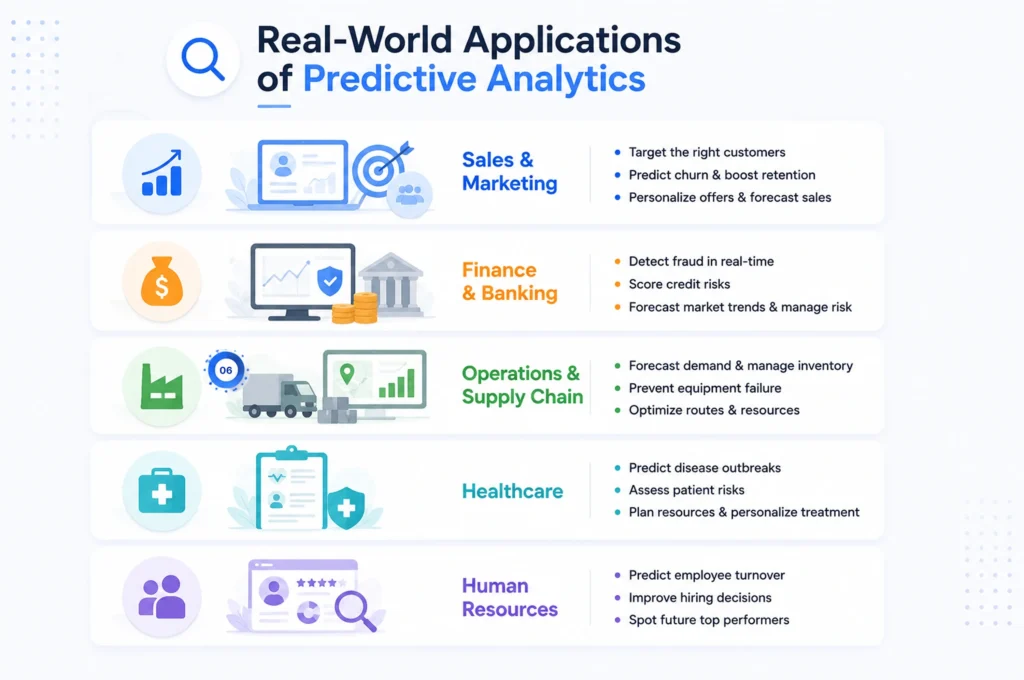
Predictive analytics in retail helps organizations answer critical questions such as:
- Which products will customers buy next?
- Which stores are likely to experience stock shortages?
- Which promotions will generate the highest conversion rates?
- Which customers are at risk of churn?
- How should prices adjust based on market conditions?
These insights enable retailers to optimize inventory, personalize customer experiences, and improve profitability.
Can Demand Forecasting in Retail Safely Eliminate Costly Stockouts?
Demand uncertainty remains one of retail’s biggest challenges. Overstocking increases storage costs and markdowns, while stockouts lead to lost sales and dissatisfied customers.
Demand forecasting in retail uses historical sales, seasonal trends, local events, weather patterns, promotional campaigns, and external market data to predict future demand more accurately.
Instead of relying solely on historical averages, AI models continuously update forecasts as new data becomes available.
Improved forecasting helps retailers:
- Maintain optimal inventory levels
- Reduce excess stock
- Lower warehousing costs
- Improve order fulfillment
- Increase customer satisfaction
How Does Retail Data Analytics Build Personalized Customer Loyalty?
Today’s consumers expect relevant, personalized shopping experiences across every touchpoint.
Retail data analytics enables businesses to understand customer preferences by analyzing:
- Purchase history
- Browsing behavior
- Loyalty program activity
- Product preferences
- Geographic location
- Seasonal buying trends
AI-powered recommendation engines then use this information to deliver personalized product suggestions, promotions, and offers.
According to McKinsey, companies that excel at personalization generate 40% higher revenue growth than organizations that do not invest in customer personalization.
Beyond increasing sales, personalization strengthens customer loyalty by making every interaction more relevant and valuable.
Top Benefits of Predictive Analytics in Retail
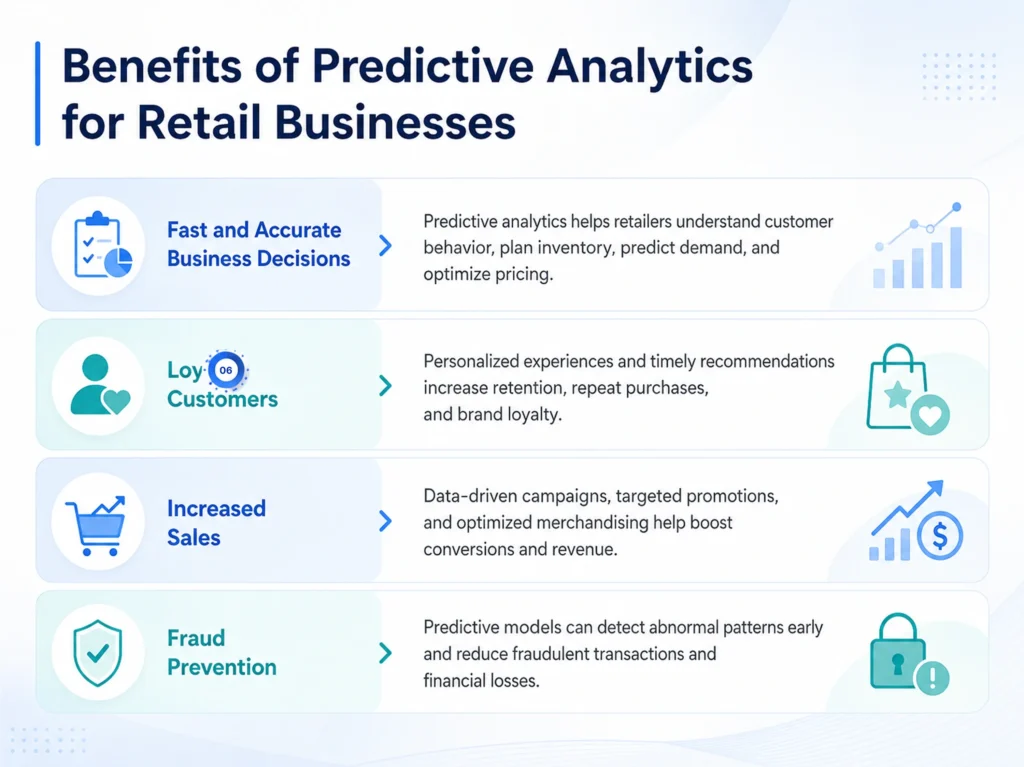
Eliminated Stockouts
Retailers use hyper-local demand forecasting to ensure products are available where and when customers need them. This improves sales while reducing emergency replenishment costs.
Protected Profit Margins
Dynamic pricing engines analyze competitor pricing, customer demand, inventory availability, and market conditions in real time. Prices automatically adjust to maximize profitability without sacrificing competitiveness.
Higher Customer Lifetime Value
Predictive customer segmentation identifies high-value customers and recommends personalized promotions that increase repeat purchases and long-term loyalty.
Reduced Store Footprint Overhead
Retailers analyze customer movement, foot traffic, and purchasing behavior to optimize store layouts, improve product placement, and increase sales per square foot.
Shared Supply Chain & Financial Benefits
Although manufacturing and retail operate differently, both industries benefit from predictive analytics across the broader supply chain.
Slashed Logistics Overhead
Transportation delays, weather disruptions, fuel costs, and supplier performance all impact delivery schedules.
Predictive analytics continuously evaluates these variables to recommend the most efficient transportation routes, optimize fleet utilization, and reduce logistics costs.
Quantifiable Capital Allocation
Executives no longer rely solely on intuition when making investment decisions.
Predictive models identify where capital will generate the highest returns, whether that involves expanding production capacity, investing in automation, increasing inventory, or opening new retail locations.
This data-driven approach improves budgeting accuracy and ensures resources are allocated where they create the greatest business value.
How Do Executives Measure True Big Data Analytics ROI?
One of the biggest advantages of predictive analytics is that its impact can be measured through clear financial and operational metrics.
Organizations should define baseline performance before implementation and continuously track improvements over time.
Key performance indicators include:
- Equipment uptime
- Maintenance costs
- Inventory turnover
- Forecast accuracy
- Order fulfillment rates
- Production efficiency
- Logistics costs
- Customer retention
- Revenue growth
- Gross profit margin
These metrics provide a comprehensive view of big data analytics ROI, helping leadership justify continued investment in AI and analytics initiatives.
What Financial Returns Can You Expect in the First Year?
The exact return depends on the organization’s size, industry, and level of digital maturity. However, many businesses begin realizing measurable improvements within the first year after deploying predictive analytics.
Common outcomes include:
- Lower maintenance expenses through predictive maintenance
- Reduced production downtime
- Better inventory utilization
- Fewer supply chain disruptions
- Improved forecast accuracy
- Increased sales from personalized customer experiences
- Higher operational efficiency
As predictive models continue learning from new data, these benefits typically grow over time, delivering sustained business value.
Which Capital Metrics Should Your Enterprise Team Track Today?
To maximize long-term returns, enterprise leaders should monitor metrics that directly connect analytics investments to business outcomes.
These include:
- Return on Assets (ROA)
- Overall Equipment Effectiveness (OEE)
- Inventory carrying costs
- Working capital utilization
- Revenue per employee
- Customer Lifetime Value (CLV)
- Forecast accuracy percentage
- On-time delivery rate
- Cost per unit produced
- Gross operating margin
Tracking these indicators helps organizations refine predictive models, improve strategic planning, and strengthen financial performance.
Ready to Build Your Data-Driven Blueprint?
Predictive analytics is helping manufacturers and retailers move from reactive operations to proactive decision-making. By combining AI, IoT, and big data, businesses can reduce downtime, optimize inventory, improve forecasting, and increase profitability.
The organizations gaining the biggest advantage are those turning operational data into measurable business outcomes. At CodesClue, we help businesses build scalable AI and analytics solutions that deliver real ROI, from predictive maintenance and demand forecasting to intelligent supply chain optimization.
Ready to future-proof your operations? Partner with us to build data-driven solutions that drive efficiency, resilience, and growth.
Frequently Asked Questions
What is predictive analytics in manufacturing?
Predictive analytics in manufacturing uses AI, machine learning, and historical operational data to anticipate equipment failures, optimize production, improve quality, and reduce maintenance costs before issues impact operations.
How does predictive maintenance reduce manufacturing downtime?
Predictive maintenance continuously monitors equipment conditions using IoT sensors and AI models. It detects early warning signs of failure, allowing maintenance teams to schedule repairs before unexpected breakdowns occur.
How is predictive analytics used in retail?
Retailers use predictive analytics to forecast customer demand, optimize inventory, personalize marketing campaigns, automate pricing strategies, and improve supply chain planning using real-time and historical data.
What is the ROI of big data analytics?
Organizations typically measure big data analytics ROI through improvements in equipment uptime, inventory turnover, forecasting accuracy, maintenance costs, logistics efficiency, customer retention, and overall profitability.
Which industries benefit the most from predictive analytics?
Manufacturing, retail, healthcare, logistics, financial services, energy, automotive, and telecommunications are among the industries realizing significant operational and financial gains from predictive analytics.
How can businesses get started with predictive analytics?
The first step is to identify high-value use cases such as predictive maintenance or demand forecasting. Organizations should then integrate data sources, implement analytics platforms, and work with experienced technology partners to develop scalable AI models.