
AI Agent Development Cost in 2026: Real Price Ranges
What does an AI agent cost in 2026? Published market ranges, 6 cost drivers, monthly running costs and how to get a quote you can trust.
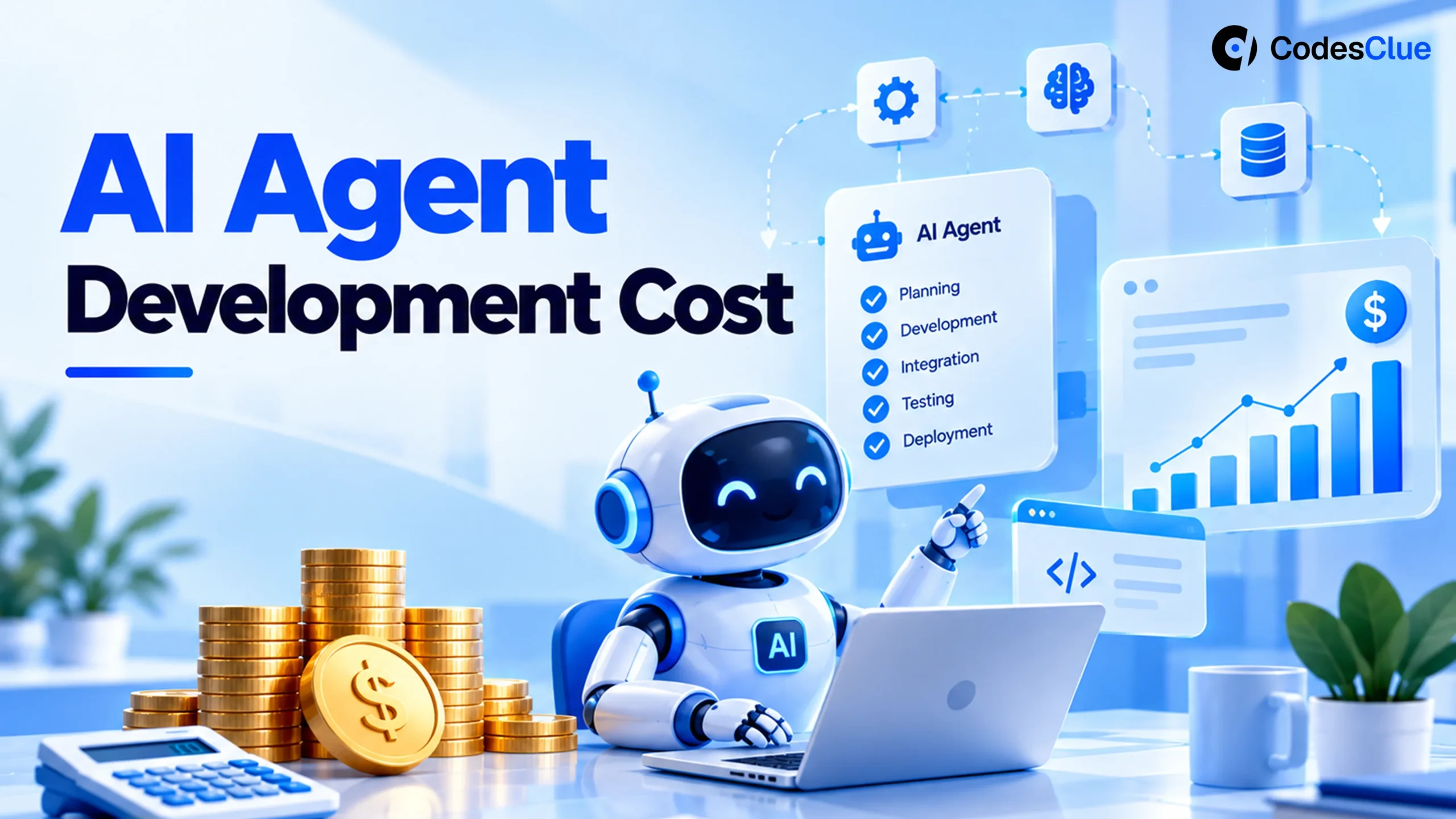
Quick answer: Based on 2026 cost guides from RaftLabs, Cleveroad, and ITRex, most custom AI agents cost between $15,000 and $200,000 to build. A simple agent that handles one task with one or two tools sits at the low end, around $15K to $40K. An agent that connects to several of your systems and remembers context costs about $40K to $150K. Multi-agent systems and agents for regulated industries start at $150K and can go beyond $500K. After launch, plan for monthly running costs for the AI model, hosting, and upkeep.
Those numbers are wide on purpose. Two “AI agents” can be as different as a bicycle and a delivery truck. This guide shows what you are really paying for, what other agencies publish, a worked example with real arithmetic, and how to get a quote you can trust. If you want a scoped number straight away, see our AI agent development services.
What counts as an AI agent (and why it costs more than a chatbot)
A chatbot answers questions. An AI agent does work. It reads a request, decides which steps to take, calls your tools (your CRM, database, email, billing system), checks the result, and moves to the next step. If you only need a conversational interface on top of a model, that is closer to generative AI and LLM product work. If you need something that acts inside your systems, that is an agent.
That “does work” part is where the cost lives. Every tool the agent can use needs a safe connection, clear rules, and tests. Every decision it makes needs a way to check it was right. The AI model itself is usually the cheapest piece.
AI agent development cost: what agencies publish in 2026
We read the cost guides that rank for this question. Here is what three development companies publish. These are their numbers, not ours, and each company groups agents a little differently.
| Type of agent | Published range | Source |
|---|---|---|
|
Single-workflow agent (one task, one or two tools) |
$15K to $40K |
RaftLabs |
|
Reactive agent (FAQ or rule-based) |
$20K to $35K+ |
Cleveroad |
|
Contextual agent (memory, multi-step flows) |
$40K to $70K+ |
Cleveroad |
|
Customer support agent |
$40K to $85K |
RaftLabs |
|
Production agent (3 to 5 integrations, memory, monitoring) |
$80K to $200K (depending on how many systems it touches) |
RaftLabs |
|
Autonomous agent (planning, many tools) |
$80K to $120K+ |
Cleveroad |
|
Multi-agent system |
$150K to $400K |
RaftLabs |
|
Enterprise generative AI agent |
$100K to $500K+ |
ITRex |
Source: Published by RaftLabs, Cleveroad and ITRex, read on 13 October 2026. SoftTeco gives a wider overall band of about $20K to $500K+.
Which row is yours?
- “I want to automate one repetitive task.” Look at the single-workflow or reactive rows. Our workflow automation services cover this kind of work.
- “I want an agent that remembers customers and handles multi-step requests.” Look at the contextual or customer support rows.
- “I want it connected to 3 or more of our systems and running 24/7.” Look at the production agent row.
- “I need several agents working together, or I handle regulated data.” Look at the multi-agent and enterprise rows.
Notice the overlap. A “customer support agent” can cost $40K or $85K depending on how many systems it touches and how much it is allowed to do on its own. That is why a price list alone will not tell you your number.
The 6 things that decide your price
Here is where the money actually goes, in order of how much it usually moves the quote.
1. How many systems it connects to.
This is the biggest driver. Each connection to your CRM, ERP, helpdesk, or payment system needs secure access, error handling, and tests. RaftLabs puts integration work at $8K to $30K per integration and notes that five integrations cost far more than five times one, because they also have to work together. This is the core of our AI integration services.
2. How much it is allowed to do on its own.
An agent that drafts a reply for a person to approve is cheaper than one that sends refunds by itself. More freedom means more guardrails, more test cases, and more approval steps.
3. What it needs to know.
If the agent must answer from your own documents, contracts, or product data, that content has to be cleaned, split, and indexed so the agent can find the right piece. This is often called retrieval (RAG). Messy data is one of the most common reasons these projects run over budget. Good data engineering up front prevents this, and LLM integration connects the model to that data.
4. Rules your industry must follow.
Healthcare, finance, and legal work add audit logs, access control, data residency, and extra review. RaftLabs lists compliance such as HIPAA, PCI, or SOC 2 as adding $20K to $60K to the build. We build for these sectors regularly: see our work in healthcare and fintech.
5. Text, voice, or both.
Voice agents need fast replies, speech-to-text, and text-to-speech. RaftLabs puts voice AI agents at $50K to $150K, higher than most text agents of similar scope.
6. Testing and monitoring.
An agent can confidently give the wrong answer. Good teams build a set of test cases before launch and keep watching real conversations after it. Skip this, and you pay later, usually in customer trust. Our software testing services and LLMOps work cover this.
What it costs to run an AI agent every month
The build is only part of the bill. Once the agent is live, you pay for:
- The AI model. You pay per use. RaftLabs estimates $50 to $300 a month at 1,000 to 5,000 requests, rising to $1,000 to $8,000 at 100,000 to 500,000 requests.
- Hosting and storage. Servers, the database, and the search index that holds your documents. See our cloud consulting and migration services.
- Monitoring tools. Logs and dashboards so you can see what the agent did and why.
- Upkeep. Prompts, tools, and models change. ITRex suggests budgeting 15% to 20% of the build cost each year for maintenance and improvements. Our product maintenance and support runs at a fixed cost with defined response times.
Watch out: A quote that shows only the build price and says nothing about running costs is incomplete. Ask for a monthly estimate at your expected volume.
Worked example: a customer support agent
Here is an illustrative example built from the published ranges above. Your figures will differ.
Scenario: A support agent connected to a helpdesk, a CRM, and a billing system, answering from your help documents, handling about 10,000 requests a month, with a person approving refunds.
| Cost item | Estimate | Basis |
|---|---|---|
|
Build (3 integrations, memory, knowledge base, monitoring) |
about $60,000 |
Within the $40K to $85K support-agent range |
|
AI model usage |
$100 to $600 / month |
Interpolated from RaftLabs’ usage estimates |
|
Hosting, storage, monitoring |
$200 to $500 / month |
Typical cloud setup. Varies with data volume and provider |
|
Upkeep |
$9,000 to $12,000 / year |
15% to 20% of build (ITRex) |
|
First-year total |
about $73,000 to $85,000 |
Build + 12 months of running costs |
What does it earn back? Suppose the agent resolves 3,000 tickets a month that a person would otherwise handle, at about $4 each. That is roughly $12,000 saved. After about $1,500 a month in running costs, the net is around $10,500 a month, so the build pays back in about 6 months. Replace these inputs with your own ticket volume and cost per ticket to get your own payback period.
How does CodesClue price AI agent projects?
We price by scope after a short discovery call, and every engagement starts with a written estimate: scope, timeline, and a fixed price. Our bands are lower than some published ranges.
| Project size | What it usually covers | CodesClue band |
|---|---|---|
|
MVP |
One workflow, one or two tools, human approval on key steps |
$8K to $25K |
|
Mid-size |
Several integrations, memory, your own knowledge base, monitoring |
$25K to $70K |
|
Large |
Multi-agent systems, regulated data, high volume |
From $70K |
Why our MVP band looks lower than the $15K to $40K above: an MVP is deliberately narrow. It covers one workflow, keeps a person approving key steps, and skips extras like voice, advanced memory, or multi-system sync. The agencies’ ranges for a “single-workflow agent” often include more polish and wider integration scope. If you need that, you will land in our mid-size band.
Your exact number depends on the six drivers above. Ask us for the build estimate and the expected monthly running cost together.
Not sure where to start? Book a free 30-minute call (opens in a new tab) or get a scoped estimate.
Real project example: AI documentation for clinicians
For Therapix.AI, we built a healthcare platform that turns therapy session input into structured clinical notes and SOAP reports. Clinicians review and approve what the AI writes before it is saved, and patient data is handled with strict access control. It runs on the web, iOS, and Android on AWS.
The results reported in the case study: 62% less documentation time and a 70% lower administrative workload. You can browse more results in our portfolio.
The lesson for budgeting: the human review step and the security work are not extras. In healthcare, they are what make an AI tool safe to use, so plan for them from day one.
Build vs buy: which is cheaper?
|
Off-the-shelf tool |
Custom agent |
|
|
Upfront cost |
Low (subscription) |
$15K+ build |
|
Time to start |
Days |
Weeks to months |
|
Fits your systems |
Common tools only |
Built around your systems |
|
Data control |
Data usually sits with the vendor |
You decide where data lives |
|
Cost over time |
Per-seat fees keep growing |
Mostly running and upkeep costs |
|
Best for |
Common tasks, small teams |
Custom workflows, sensitive data |
If a custom agent needs a platform to run on, that falls under custom software development or enterprise software development. For a deeper look at this choice, read our guide to custom AI agents for enterprise workflows.
Common mistakes that push the budget up
- Scope creep. “While we’re at it, add voice and three more integrations” can double the cost mid-project.
- Messy data. Unclean documents and inconsistent records add weeks of fixing wrong answers.
- No test set. Without test cases written before launch, you find errors through unhappy customers.
- Full autonomy on day one. Letting the agent act alone before you trust it creates expensive mistakes.
- Ignoring running costs. A cheap build with high model usage and no monitoring gets expensive fast.
5 ways to keep the cost down without cutting corners
Start with one workflow. Pick the task that eats the most hours each week. Prove it there first, then expand. This is the same logic behind our proof-of-concept and MVP approach, described in how we work.
- Keep a person in the loop at first. Let the agent draft and a person approve. You learn where it goes wrong before it costs you.
- Use a hosted model for the first version. Move high-volume tasks to a smaller or open-source model once you know your real usage. Our LLM development team can help with that move, and you can read our guide on building an AI agent with open-source LLMs.
- Clean the data before you build. A tidy knowledge base saves weeks. Our AI consulting helps you check data readiness first.
- Ask for the running cost up front. Model, hosting, monitoring, and upkeep, at your expected volume.
Related Blogs: How Much Does Vibe Coding Cost? Prototype, MVP, and Cleanup and From AI Prototype to Production: A Checklist.
How to get a quote you can trust?
Before you ask any agency for a price, write down three things:
- The one job the agent should do, and how it is done today.
- Every system it must read from or write to.
- What the agent may do alone, and what needs a person’s OK.
Then be careful with quotes that skip discovery, say nothing about testing, or leave out monthly running costs. Those gaps tend to come back as change requests.
Want a number for your own agent? Our AI agent development team will scope it with you and send a written estimate. If you already have a plan and need people, you can hire AI agent developers or look at our staff augmentation model. Development can start within 48 hours of requirements being agreed and the developer being confirmed.
FAQs
How much does a simple AI agent cost?
Agencies usually price a simple agent (one task, one or two tools) at $15K to $40K. At CodesClue, an MVP agent of this kind sits in our $8K to $25K band because we keep the scope narrow, with human approval on key steps.
How long does it take to build an AI agent?
Published estimates are about 4 to 8 weeks for a single-workflow agent and 12 to 20 weeks for a production agent with several integrations. Data cleaning and the number of systems involved move this the most. Our own AI agents and automation projects typically run 3 to 8 weeks.
Is an AI agent more expensive than a chatbot?
Yes, usually. A chatbot answers questions. An agent takes actions in your systems, so it needs secure integrations, guardrails, and more testing.
What are the hidden costs of an AI agent?
Model usage fees, hosting, document storage, monitoring tools, and ongoing upkeep. Ask for these as a monthly figure before you sign.
Should I build a custom agent or use an off-the-shelf tool?
Off-the-shelf tools are cheaper to start and fine for common tasks. Build custom when the agent must work inside your own systems, or when your data cannot leave your control. See the comparison table above.
How do I calculate ROI on an AI agent?
Estimate the hours or tickets the agent will take over, multiply by their current cost, subtract monthly running costs, then divide the build cost by that net monthly saving. The worked example above shows the steps.