
How to Hire an Azure Developer in 2026: Skills, Certifications and Interview Questions
How to hire an Azure developer in 2026: the skills that matter, the AZ-204 retirement, interview questions, a paid trial task and the red flags to avoid.
Your product runs on Microsoft Azure, the backlog keeps growing and the cloud bill keeps rising. You need someone who can ship features and keep the platform healthy at the same time. This guide shows how to hire an Azure developer who fits that brief. It covers the skills that matter and what changed in Microsoft’s certifications this year. You also get interview questions that separate real experience from buzzwords, plus a paid trial task you can copy.
Key Takeaways
- Hire for the Azure services your product already uses, not for a long list of every service Microsoft sells.
- Microsoft retired the AZ-204 developer exam on 31 July 2026. Older badges still show real study, but ask what the person has built since.
- Good candidates raise identity, cost and monitoring on their own. Weak ones only talk about deployment.
- A short paid trial task on a copy of your setup tells you more than three interview rounds.
- Decide between in-house, freelance and a dedicated team before you write the job post, because each one changes the brief.
How to hire an Azure developer: the short answer
To hire an Azure developer who works out, start with a one-page brief. List the services you run and the outcome you need in 90 days. Screen for hands-on work with those services, identity and cost control. Then run a two to four hour paid task on a sandbox copy of your setup. Make the final call on how they reason about trade-offs, not on how many services they can name.
What an Azure developer actually does
The title covers very different jobs. Before you post a role, decide which of these you need most:
| Focus | Typical work | Core services |
|---|---|---|
| Application developer | APIs, portals and background jobs that run on Azure | App Service, Functions, Azure SQL, Cosmos DB |
| Integration developer | Connecting ERP, CRM and partner systems with queues and events | Service Bus, Event Grid, Logic Apps, API Management |
| Platform or DevOps developer | Pipelines, environments and infrastructure as code | Azure DevOps or GitHub Actions, Bicep or Terraform, Key Vault |
| Container developer | Packaging services and running them at scale | Container Apps, AKS, Container Registry |
| AI application developer | Adding search, chat or document features to an existing product | Azure OpenAI, AI Search, Blob Storage |
Most small and midsize teams need an application developer who is comfortable with pipelines. Large estates often need two people with different focuses rather than one person who claims all five.
Azure developer skills to look for
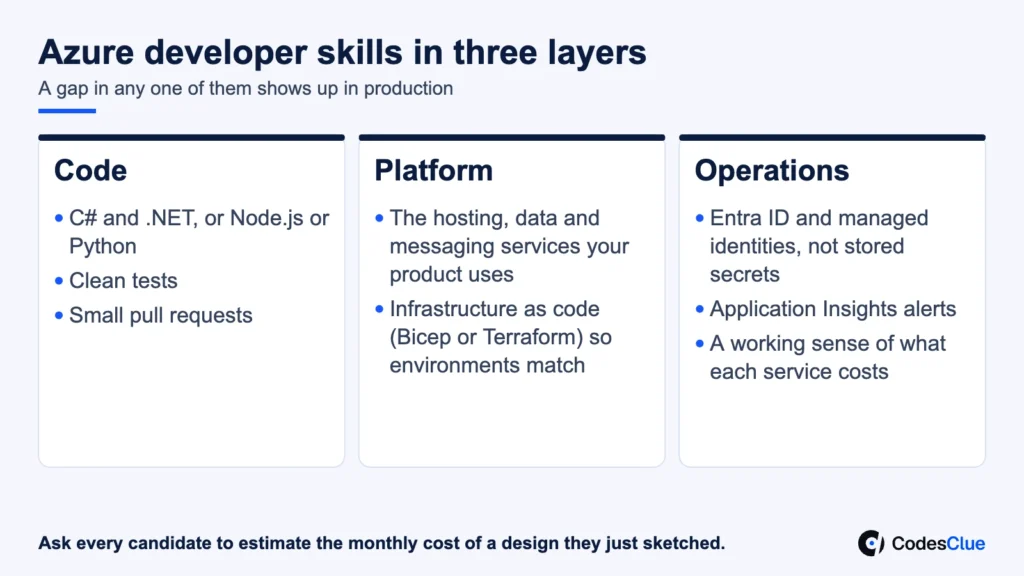
Strong Azure developer skills come in three layers. Check all three, because a gap in any one of them shows up in production.
- Code: C# and .NET, or Node.js or Python, with clean tests and a habit of small pull requests.
- Platform: the hosting, data and messaging services your product uses, plus infrastructure as code so environments match.
- Operations: Entra ID and managed identities instead of stored secrets, Application Insights alerts, and a working sense of what each service costs.
Pro tip: Ask every candidate to estimate the monthly cost of a small design they just sketched. You do not need an exact number. You want to see whether cost is part of how they think.
What changed in Azure developer certifications in 2026
For years, the Azure Developer Associate badge (exam AZ-204) was the standard filter in job posts. Microsoft’s retired exams list (opens in a new tab) shows it retired on 31 July 2026.
Microsoft now offers the Azure AI Cloud Developer Associate (opens in a new tab) certification, exam AI-200. Its skills list covers containerized solutions, AI features built on Azure data services, connecting to Azure services, and securing and monitoring solutions.
What this means for your hiring:
- Do not reject a strong candidate because they hold AZ-204 rather than AI-200. The study behind it is still valid.
- Do not require AI-200 yet. It is new, and many skilled developers have not sat it.
- Treat any badge as a sign of study, never as proof of delivery. The trial task does that job.
Where to find Azure developers: in-house, freelance or a dedicated team
| Model | Best for | Watch out for |
|---|---|---|
| In-house hire | Long-term ownership of a core platform | Months to recruit, plus salary, benefits and training |
| Freelancer | A short, well-defined task such as one migration step | One person, no cover for leave and little shared knowledge |
| Dedicated developer from a partner | Ongoing feature work with fast start and backup | Clear access rules and code ownership in the contract |
| Project team | A fixed scope such as a new portal or a full migration | Needs a clear scope and acceptance criteria up front |
Maybe you need a full project rather than one person. Typical ranges are $8K to $25K for an MVP, $25K to $70K for a growth product and from $70K for a complex platform. A short discovery call turns your scope into a written estimate.
What to put in the job post
A clear post attracts the right people and filters out the rest before you spend time on calls. Keep it to one page and include:
- The product and its users, in two sentences, so candidates know what their work will change
- The Azure services you run today, named exactly, plus the language and framework of the codebase
- The first 90 days, written as two or three outcomes, such as “move the nightly jobs to Functions”
- How the team works, including time zone overlap, review process and who they report to
- How you hire, with the number of steps and the paid trial task, so candidates know what to expect
Leave out long wish lists. A post that asks for every service, five languages and ten years of experience backfires. It scares off focused, capable people and attracts those who say yes to everything.
Interview questions that reveal real Azure experience
Skip trivia such as “list the storage tiers.” Ask about decisions instead. These questions work for most Azure developer roles, with signs of a strong answer for each.
- “An API on App Service slows down every afternoon. Walk me through how you would find the cause.” Strong answers start with Application Insights. They check dependencies such as the database, and only then talk about scaling.
- “How do you let a Function read from a database without storing a password?” Listen for managed identity and role assignments in Entra ID. Key Vault should hold only the few secrets nobody can avoid.
- “When would you choose Service Bus over Event Grid?” Good candidates contrast commands that one worker must handle exactly once with events that many listeners react to.
- “Your monthly bill doubled. What do you check first?” Look for Cost Management by resource and idle or oversized services. Logs that keep too much data and missing autoscale rules come next.
- “How do you make sure staging matches production?” Expect Bicep or Terraform, one pipeline for every environment and settings kept out of the code.
- “Tell me about a deployment that went wrong.” You want a specific story, what they changed afterwards and no blame on teammates.
Pro tip: Ask follow-up questions on the candidate’s own examples. Someone who did the work can go three levels deep. Someone who read about it runs out after one.
A paid trial task you can copy
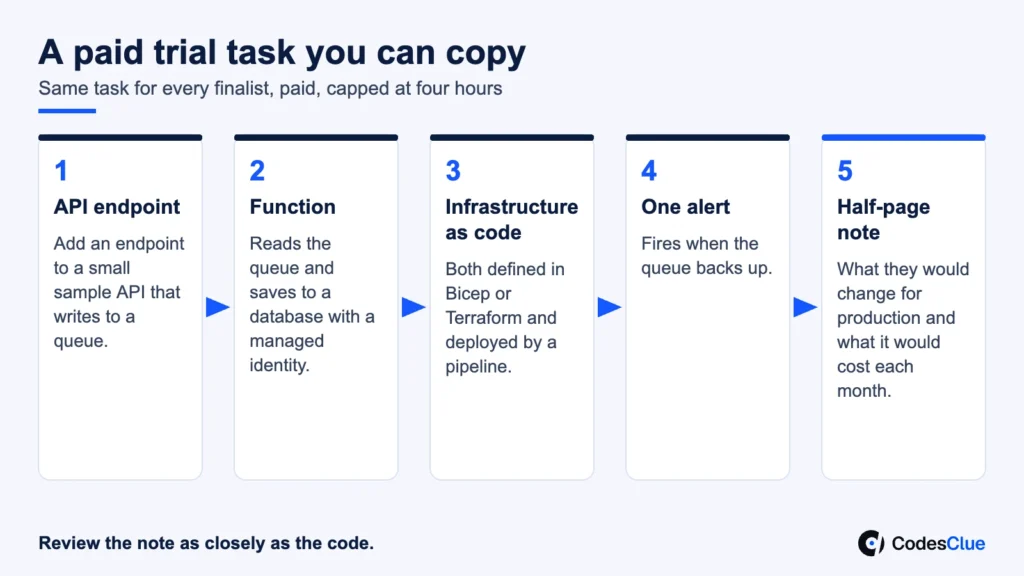
Give finalists the same small task, pay them for it and cap it at four hours. Here is one that fits most application roles:
- Add an endpoint to a small sample API that writes to a queue.
- Add a Function that reads the queue and saves the result to a database using a managed identity.
- Define both in Bicep or Terraform and deploy them through a pipeline.
- Add one alert that fires when the queue backs up.
- Write a half-page note on what they would change for production and what it would cost each month.
Review the note as closely as the code. It shows judgment, honesty about limits and how they communicate with a team that is not in the room.
Red flags when you hire Azure talent
- Connection strings and keys pasted into code or pipeline files
- Every answer ends with “add more instances” or “move it to Kubernetes”
- No opinion on cost, monitoring or how to roll back a release
- Can only describe work through the Azure portal, with no scripts or templates
- Claims deep experience with every Azure service on the résumé
Onboarding: the first two weeks
A good hire still fails without a clear start. Give least-privilege access in Entra ID on day one, scoped to a development subscription. Share an architecture sketch, the pipeline and the current cost report. Set one small production change for the first week and one meaningful feature for the second. Review both together, then widen access step by step.
When hiring an Azure developer is the wrong call
Your product may be small, run on one or two services and change rarely. Then a managed hosting plan and a few hours of support each month may be enough. The same applies if the real problem is an unclear product plan. A developer cannot fix a roadmap, so settle that first and then decide who you need.
Hire Azure developers with CodesClue
If you would rather skip months of recruiting, you can hire Azure developers from CodesClue. They work in your subscription, repositories and boards. We set up access through Entra ID and sign an NDA before you share any code. You choose the hours, from a full-time developer to a few hours a week, and development starts within 48 hours.
Ready to hire an Azure developer without the recruiting delay? Send us three things: the Azure services you run, the outcome you need in the next 90 days and your preferred engagement model. We reply within one business day with a shortlist plan. You can also explore our cloud computing services or contact us to start.
FAQs
How long does it take to hire an Azure developer?
An in-house hire often takes one to three months once you count sourcing, interviews, notice periods and onboarding. A freelancer can start within days but brings less cover. With a dedicated developer from CodesClue, development starts within 48 hours once you approve the developer, because screening is already done and only your access and onboarding remain.
Should an Azure developer also handle DevOps?
For a small team, yes: one developer who writes code and maintains the pipeline and infrastructure templates keeps things simple. As the platform grows, split the roles. A separate platform engineer can own networking, policies and shared environments, while application developers focus on features and stay fast.
Is .NET experience required for Azure work?
No. Azure runs Node.js, Python, Java and containers well, and many teams never touch C#. Hire for the language your codebase already uses. .NET experience helps most when you are moving older Windows applications or SQL Server databases to Azure, because those projects often involve legacy .NET code.
Can an Azure developer help us reduce our cloud bill?
Yes, and it is a good first task for a new hire. They can review Cost Management by resource, resize or switch off idle services, set autoscale rules, shorten log retention and buy reserved capacity for steady workloads. Ask them to report expected monthly savings before they make each change.
How do we protect our code and data when working with an outside developer?
Sign an NDA and a contract that states you own the code. Give access through Entra ID with the lowest role that does the job, start in a development subscription and keep production secrets in Key Vault. Remove access the same day the engagement ends, and review sign-in logs regularly.