
How to Hire C# Developers in 2026: Skills, Tests, Red Flags
How to hire C# developers in 2026: match the .NET version, ask decision-based questions, run a paid task and plan for the .NET 8 support end date.
You have a C# product that works, a backlog that keeps growing and a team that cannot keep up. Every recruiter sends the same résumés listing ASP.NET, Azure and SQL Server. The hard part is telling which of those people can ship a safe change to your code in their first week. This guide shows how to hire C# developers for the work you actually have, with interview questions that expose real experience and a short paid task that settles the rest.
Key Takeaways
- Start with your runtime: modern .NET (8, 9 or 10) and the older .NET Framework 4.x need different people.
- Microsoft set 10 November 2026 as the last day of support for .NET 8 and .NET 9, so upgrade experience to .NET 10 is now a hiring skill, not a bonus.
- Ask about decisions they made on real systems, not syntax trivia. A strong C# developer explains trade-offs and what went wrong.
- Close every shortlist with a capped, paid task in a copy of your stack.
- Plan the first two weeks before day one: access, a small production fix, then a feature.
How to hire C# developers: the short answer
To hire C# developers well, write a one-page brief naming your .NET version, hosting and the first three tasks. Screen for that stack, then run a decision-based interview and a paid task of three to four hours. Pick the hiring model last, once you know if you need one person, cover for leave or a full team.
The order matters. Most failed hires happen because the role was vague, not because the candidate was weak. A team running a 2014 WebForms portal and a team building a .NET 10 API on Azure are hiring for two different jobs, even though both job posts say “C#”.
Step 1: Name the runtime and the kind of C# work
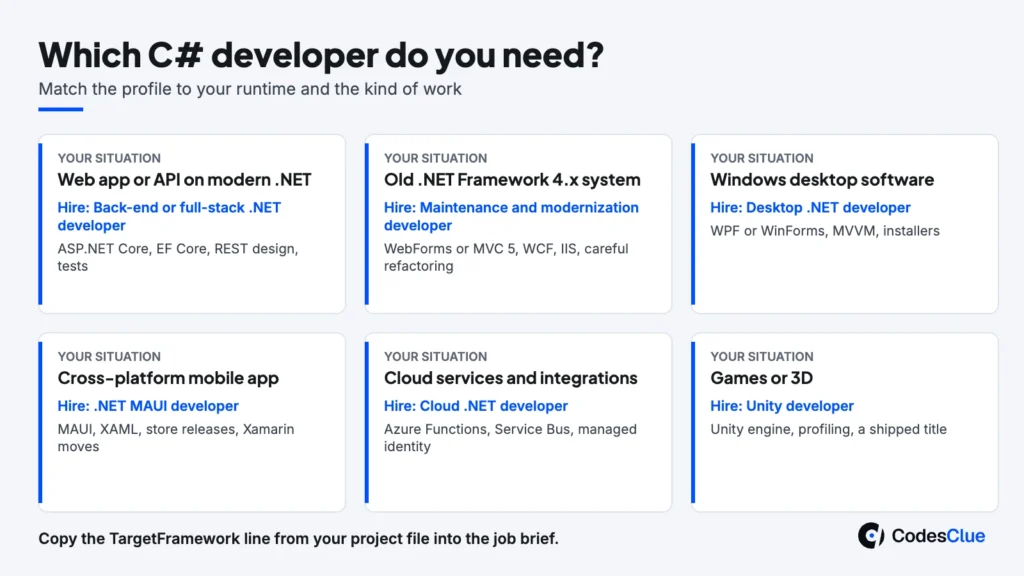
C# is one language, but the work behind it splits into clear types. Decide which one you have before you write the job post.
| Your situation | Profile to look for | Skills that matter most |
|---|---|---|
| Web app or API on modern .NET | Back-end or full-stack .NET developer | ASP.NET Core, Entity Framework Core, REST design, automated tests |
| Old .NET Framework 4.x system that must keep running | Maintenance and modernization developer | WebForms or MVC 5, WCF, IIS, careful refactoring, upgrade tooling |
| Windows desktop software | Desktop .NET developer | WPF or WinForms, MVVM, installers, device drivers if needed |
| Cross-platform mobile app on .NET | .NET MAUI developer | MAUI, XAML, store releases, migration from Xamarin |
| Cloud services and integrations | Cloud .NET developer | Azure Functions, Service Bus, managed identity, pipelines |
| Games or 3D | Unity developer | Unity engine, performance profiling, a shipped title |
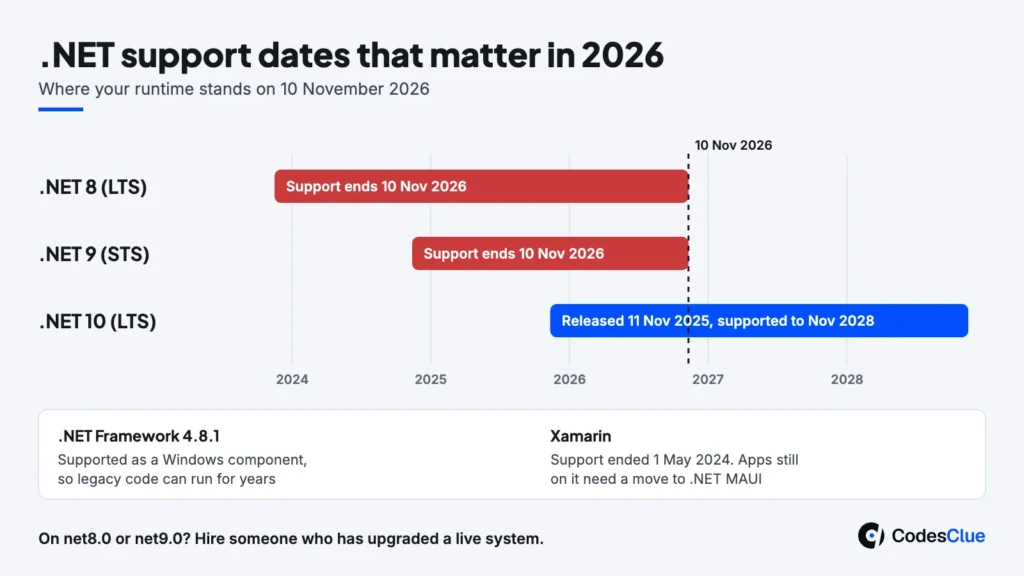
The legacy row deserves extra care. Microsoft treats .NET Framework 4.8.1 as a Windows component (opens in a new tab), so it stays supported on a supported Windows version. That means many companies will run Framework code for years. A developer who only knows modern .NET may struggle with it, and one who only knows Framework may not be the right person to move you off it.
Mobile teams have a similar trap. Microsoft ended Xamarin support on 1 May 2024 (opens in a new tab). If your app still runs on Xamarin, you need someone who has already completed a move to .NET MAUI on a live app.
Pro tip: Open your main project file and copy the TargetFramework line into the brief, for example net8.0 or v4.7.2. That one line tells a good candidate more about the job than a paragraph of buzzwords.
Step 2: Check where your .NET version stands in November 2026
This step is new for 2026, and none of the usual hiring guides cover it. Microsoft named 10 November 2026 as the day support ends for .NET 8 and for .NET 9 (opens in a new tab). .NET 10 shipped on 11 November 2025, and Microsoft supports it through November 2028 (opens in a new tab).
After the cutoff, apps on .NET 8 or 9 stop getting security patches. For a product that handles customer data or payments, that becomes an audit and insurance question quickly. So if your code targets net8.0 or net9.0, your next .NET developer should have done at least one version upgrade on a live system.
Ask for specifics. Which breaking changes did they hit? How did they test before release? Did they upgrade NuGet packages first or the runtime first? Someone who has done it will answer in detail without notes.
Step 3: Write a one-page brief
A short brief saves weeks of screening. Keep it to one page and send it to every candidate or partner before the first call.
- Product in two lines: what it does and who uses it.
- Stack: .NET version, database, hosting (Azure, AWS, on-premises), front end.
- First three tasks: real items from your backlog, in plain words.
- Working hours: how many hours of overlap with your team you need each day.
- Who reviews their code: a lead, a CTO or nobody yet.
- Length of the need: three months, a year or open-ended.
Point 5 is the one most teams skip. If nobody on your side can review C# code, you need a senior person or a partner who brings their own review, not a junior developer working alone.
Step 4: Choose the hiring model that fits the need
| Model | Works best when | Watch out for |
|---|---|---|
| In-house employee | The product is your core business and the need is permanent | Long hiring cycles, benefits and payroll costs, no cover during leave |
| Freelancer | A short, well-defined task with a clear end | Split attention across clients, gaps when they leave, weak handover notes |
| Dedicated developer from a partner | You need steady capacity fast and want screening, replacement and review handled | You still own product decisions and priorities |
| Project team | You want a fixed scope delivered with design, testing and release included | Scope changes need a clear change process |
Many teams mix these. A common pattern is one in-house lead who owns the architecture, plus dedicated developers who add capacity around them. At CodesClue, development starts within 48 hours once we have discussed your requirements and you approve the developer. The engineers on our team sit in Ahmedabad, and our US and German offices take planning calls in your time zone. You can see how this works on our page to hire C# developers.
Pro tip: Whatever model you pick, put intellectual property assignment, source code ownership and access removal at exit in the contract before any code is written. Ask your own lawyer to review the terms.
Step 5: Screen with decision-based interview questions
Syntax questions such as “What is a delegate?” show who studied, not who shipped. Strong C# developer interview questions ask about choices on real systems. Use these six and listen for the signs in the right column.
| Question | A strong answer includes |
|---|---|
| An API endpoint got slow after a release. Walk me through how you found the cause. | Measuring first (logs, Application Insights or a profiler), checking database queries, a specific fix and how they proved it worked |
| When would you use async and await, and when would it make things worse? | I/O-bound work vs CPU-bound work, the risk of blocking with .Result, and a real bug they met |
| How do you keep Entity Framework Core from hurting performance? | N+1 queries, AsNoTracking for reads, projections, reading the generated SQL |
| Tell me about an upgrade between .NET versions that you led or joined. | The versions, breaking changes they hit, package order, how they tested and rolled out |
| How do you store secrets and connection strings? | Never in source control, a secret store or managed identity, rotation, separate values per environment |
| Describe a release that went wrong. What did you change afterwards? | Ownership of the mistake, a concrete fix to the process, no blame on others |
Score each answer from 1 to 3 on the same sheet for every candidate. Three interviewers using one score sheet compare people far more fairly than three people forming impressions.
Step 6: Run a short paid task
A paid task is the closest thing to watching someone work. Keep it to three or four hours, pay for it and use a small copy of your real stack, not a puzzle.
A good C# task looks like this:
- Add one endpoint to a small ASP.NET Core API you provide.
- Read and write through Entity Framework Core with one migration.
- Write unit tests for the main rule and one failure case.
- Fix one planted bug, such as a missing null check or a blocking async call.
- Add a short note on what they would change with more time.
Then review the pull request together for 30 minutes. How they explain their choices, and how they take feedback, often tells you more than the code itself.
Pro tip: Put the planted bug in code they did not write. Developers who read existing code carefully are the ones who will not break your production system in week two.
Checklist before you make an offer
- The candidate has worked on your runtime type (modern .NET or .NET Framework).
- They have shipped at least one version upgrade if you are on .NET 8 or 9.
- Their interview scores and paid task results are written down.
- You have spoken to one past manager or client about delivery, not only skills.
- Working hours overlap with your team as the brief requires.
- The contract covers code ownership, confidentiality and access removal.
- Day-one access is ready: repository, a non-production environment and the ticket board.
Common mistakes to avoid
- Hiring for every Microsoft keyword. A job post listing 25 technologies attracts people who list 25 technologies. Name the five that matter.
- Treating .NET Framework and modern .NET as the same skill. They share a language, but hosting, tooling and libraries differ a lot.
- Skipping the paid task to save time. Three hours of a paid trial costs far less than three months with the wrong person.
- Ignoring the support deadline. Hiring a maintenance developer for a .NET 8 app without a plan to reach .NET 10 just delays the same problem.
- Giving production access on day one. Start with the lowest access that lets them work, and widen it as trust grows.
The first two weeks after you hire
A clear start keeps a good hire from feeling lost. Use a simple plan.
- Day 1: repository access, local build running, a walk through the architecture.
- Days 2 to 5: one small production fix that goes through your full review and release path.
- Week 2: one real feature from the backlog, with tests, demoed at the end of the week.
By the end of week two you will know whether the hire works. If they cannot ship a small, reviewed change in that time, the problem is either the person or your onboarding, and both are worth fixing early.
When hiring is not the answer
Sometimes a new developer will not fix the real problem. If your roadmap changes every week, a developer will only move faster in random directions. If the product is small and stable, a maintenance plan with a fixed number of hours may serve you better than a full-time hire. And if the core issue is an old system nobody understands, start with a short code review and a modernization plan before you add people. Our legacy software modernization guide explains how to scope that first step.
Next step
If you are ready to hire C# developers and know the work but not the person yet, send us your one-page brief: your .NET version, hosting, and the first three tasks. Within one business day you get a developer profile matched to your stack, and development starts within 48 hours once you approve. You can also read how we work across the Microsoft stack on our .NET development services page, or see our guide on how to hire Azure developers if your product runs in Azure.
FAQs
Should I hire a C# developer or a .NET developer?
In practice they are the same hire. C# is the language and .NET is the platform it runs on, so almost every C# job is a .NET job. What matters more is which .NET you run. Modern .NET 8, 9 or 10 and the older .NET Framework 4.x use different hosting, tools and libraries, so name the version in your job post.
What does the .NET 8 end of support mean for my hiring plan?
Microsoft set 10 November 2026 as the date security patches end for .NET 8 and .NET 9. If your product targets either version, plan an upgrade to .NET 10, which Microsoft supports through November 2028. Hire or contract someone who has already upgraded a live system, and ask them to describe the breaking changes they handled.
How long does it take to hire a C# developer?
An in-house hire usually takes several weeks once you count sourcing, interviews, the paid task, notice periods and onboarding. A dedicated developer from a partner is faster because screening is already done. With CodesClue, development starts within 48 hours after we discuss your requirements and you approve the developer.
Can one C# developer maintain an old .NET Framework app and build new features?
Yes, if they have hands-on experience with both, but check it directly. Ask about WebForms, WCF or IIS work as well as ASP.NET Core. Many teams split the work instead: one person keeps the legacy system stable while another builds new parts on modern .NET, so the migration can happen step by step.