
Native Android vs Cross-Platform Development Cost: Cost Comparison
Native Android vs cross-platform development cost: compare budgets, timelines, and long-term maintenance to choose the right approach for your app.
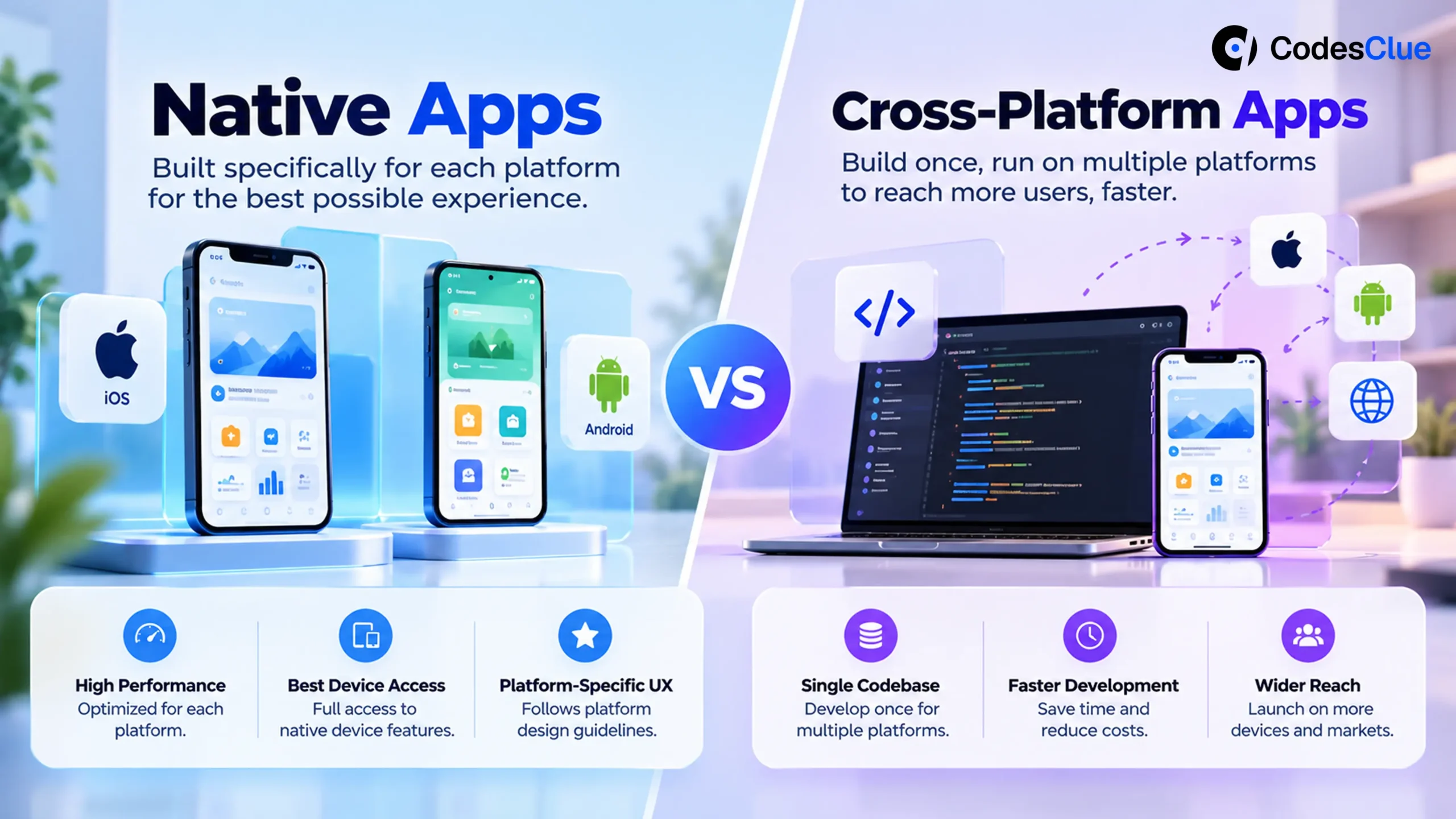
Choosing between native and cross-platform development is one of the biggest financial decisions a founder or IT decision-maker makes before writing a single line of code. Native vs. cross-platform app development costs vary so widely that choosing the wrong approach can quietly drain your budget by 30-40% before you even launch.
This blog breaks down real cost numbers, performance trade-offs, and a framework to help you decide what fits your business in 2026.
Key Takeaways
- Native Android development cost typically runs $25,000 to $150,000+ for a mid-complexity app, since you’re building a single platform with full access to hardware capabilities.
- Cross-platform app development costs in 2026 for an equivalent app (covering both iOS and Android) usually fall between $18,000 and $90,000 because of shared codebases.
- Cross-platform frameworks like Flutter and React Native cut development timelines by 30-40%, directly lowering labor costs.
- In the native vs. hybrid app development debate, native still wins on performance-heavy use cases: gaming, AR/VR, and apps leaning on device-specific APIs.
- Security and compliance work (GDPR, data storage rules, API key protection) adds 8-15% to project cost regardless of the framework you pick, so budget for it upfront.
- For most startups building an MVP, cross-platform is the financially smarter best app development approach for startups, unless the product genuinely needs native-only capabilities.
Why This Cost Comparison Matters in 2026
The mobile app economy has matured. Users expect fast, polished experiences, and investors expect capital-efficient builds. That combination puts the cost to build a mobile app in 2026 at the center of nearly every product conversation. A wrong framework choice doesn’t just cost money once, it compounds through every future update, bug fix, and feature release.
Before you approve a budget, you need clarity on three things: what native actually costs, what cross-platform actually saves, and where those savings quietly disappear (hint: security, maintenance, and platform-specific tweaks).
Native Android Development Cost:
Native Android apps are built using Kotlin or Java, directly on Android’s SDK. You get full access to the operating system, camera, sensors, and background processes, with zero performance compromise.
| App Complexity | Features | Typical Cost (USD) | Timeline |
|---|---|---|---|
| Simple | Login, basic UI, 1-2 core screens | $10,000 – $25,000 | 6-10 weeks |
| Medium | API integration, payments, push notifications | $25,000 – $80,000 | 3-6 months |
| Complex | Real-time sync, AI features, custom animations | $80,000 – $150,000+ | 6-12 months |
The Native Android development cost climbs fast once you add custom UI components, offline-first architecture, or heavy backend integration. And remember, this table only covers Android. If you also need an iOS version, you’re essentially paying for a second build from scratch using Swift, which roughly doubles your total spend.
Cross-Platform Development Cost: Where the Savings Come From
Cross-platform frameworks let you write one codebase that deploys to both Android and iOS. The two dominant players in 2026 are Flutter (Google’s UI toolkit using Dart) and React Native (Meta’s framework using JavaScript/TypeScript).
| App Complexity | Typical Cost (USD, both platforms) | Timeline |
|---|---|---|
| Simple | $8,000 – $18,000 | 5-8 weeks |
| Medium | $18,000 – $50,000 | 2-4 months |
| Complex | $50,000 – $90,000+ | 5-9 months |
The core reason cross-platform app development cost in 2026 stays lower is simple math: one team, one codebase, two platforms. You’re not paying two separate developer teams to build, test, and maintain parallel apps. When founders compare cross-platform app development cost in 2026 against a full two-platform native build, the gap widens even further once ongoing maintenance is factored in.
Flutter vs Native Android Cost Comparison
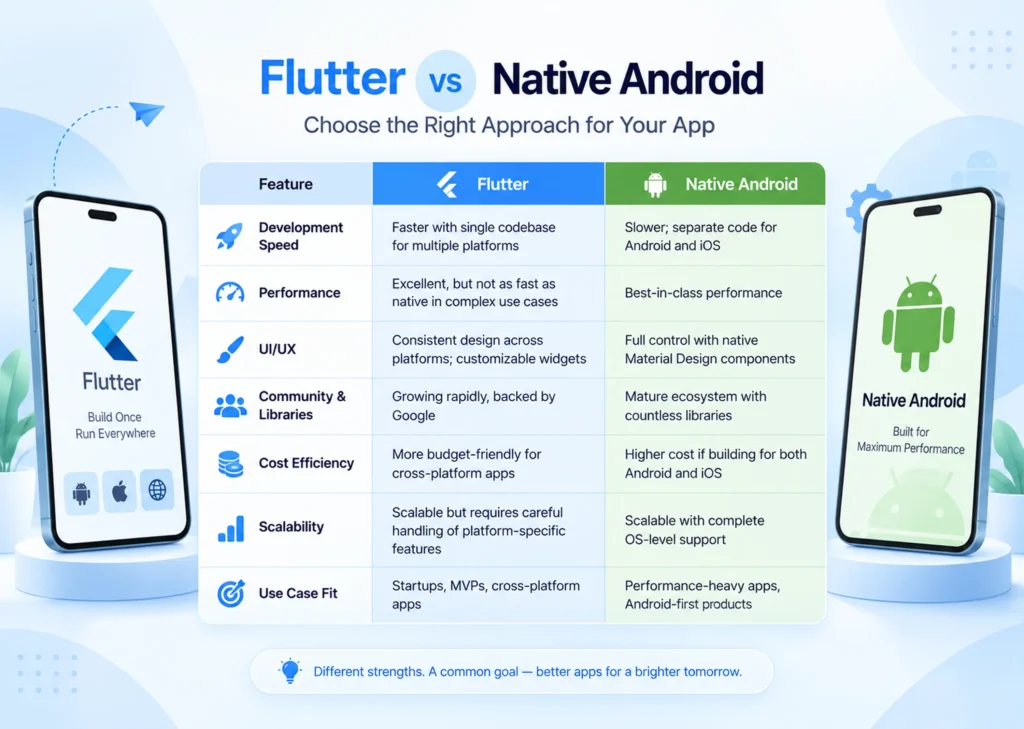
Flutter compiles down to native ARM code, which means it gets surprisingly close to native performance while still sharing 90%+ of the codebase across platforms.
- Development speed: Flutter’s hot-reload feature lets developers see changes instantly, cutting iteration time significantly compared to native builds.
- Cost efficiency: A Flutter vs Native Android cost comparison for a medium-complexity app usually shows Flutter costing 35-45% less overall, once you account for iOS being included.
- Where native still wins: Apps needing deep integration with Android-specific hardware (like custom Bluetooth protocols or specialized camera controls) may need native modules bridged into Flutter, adding cost back in.
React Native vs Native App Development Cost
React Native remains popular because of its massive JavaScript developer pool, which makes hiring easier and often cheaper in markets like India.
- Talent availability: JavaScript developers are more widely available than native Kotlin/Swift specialists, which directly lowers hourly rates in a React Native vs Native app development cost comparison.
- Bridge overhead: React Native uses a “bridge” to communicate between JavaScript and native modules, which can introduce minor performance lag in animation-heavy or data-intensive apps.
- Best fit: Content-driven apps, e-commerce, social platforms, and booking systems, where UI responsiveness matters more than raw processing power.
Native vs Hybrid App Development: Performance and Cost
It’s worth separating native vs. hybrid app development into two distinct conversations, because businesses often conflate performance and cost as if they move together.
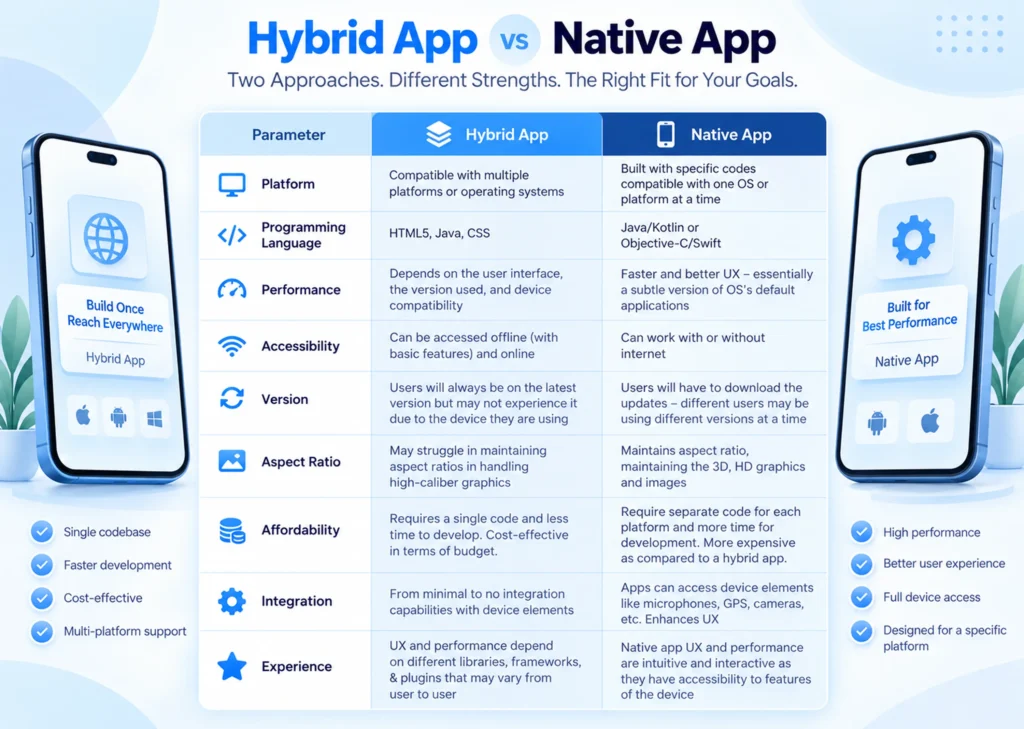
Performance factors:
- Native apps have direct access to platform APIs, resulting in faster load times and smoother animations for complex, resource-heavy apps.
- Cross-platform apps have narrowed this gap significantly by 2026, especially with Flutter’s native compilation, but gaming and AR/VR apps still see measurable lag on hybrid frameworks.
Cost factors:
- Native development requires two separate codebases for full platform coverage, meaning double the QA cycles, double the bug fixes, and double the release management overhead.
- Cross-platform development consolidates this into a single pipeline, which is where the long-term maintenance savings really show up, not just in the initial build.
So when the native vs hybrid app development question comes up in planning meetings, the honest answer is: it depends on whether your product’s edge is raw performance or speed to market.
The Hidden Cost Most Comparisons Skip: Security and Compliance
Every cost estimate you’ll find online focuses on development hours. Almost none of them mention that security and compliance work adds real, unavoidable cost, regardless of whether you go native or cross-platform.
Here’s what actually needs budgeting for:
- Secure data storage: Following platform guidelines for internal vs external storage, and avoiding deprecated world-readable modes, requires deliberate architecture decisions early in the build, not patches later.
- API key protection: Storing and rotating API keys securely, using tools like Android Keystore and environment-specific credentials, is a recurring engineering task, not a one-time setup.
- GDPR and data privacy compliance: If your app touches EU users even indirectly, consent management, SDK governance, and data subject access request handling all become mandatory engineering work in 2026, and regulators now verify this technically, not just cosmetically.
- Third-party SDK audits: A typical app integrates 10-30 third-party SDKs, and each one needs a data-processing review before it ships, since your business remains liable for what those SDKs collect.
- Penetration testing and security audits: A structured pre-launch security testing checklist, covering authentication, encryption, and network transactions, typically adds a dedicated testing phase before release.
Budget an additional 8-15% of your total development cost specifically for security and compliance work. Skipping this isn’t cheaper, it just moves the cost to after launch, usually in the form of a costly retrofit or a regulatory fine.
Best App Development Approach for Startups
If you’re building an MVP with limited runway, here’s the practical framework:
Choose cross-platform if:
- You need to launch on both Android and iOS with one budget.
- Your app is content, transaction, or workflow-driven (not graphics-intensive).
- Speed to market matters more than squeezing out the last 10% of performance.
Choose native if:
- Your app is gaming, AR/VR, or hardware-dependent (fitness wearables, IoT control).
- You’re building for a single platform market first, and performance is a core differentiator.
- You have the budget to
- maintain two separate codebases long-term.
For most early-stage founders, cross-platform remains the best app development approach for startups, because it lets you validate the product with real users on both platforms without doubling your burn rate.
Total Cost of Ownership: Don’t Just Look at Build Cost
A cheaper build cost today can turn into a more expensive maintenance bill later. Native apps require two separate teams to stay updated with OS changes, new device form factors, and platform-specific security patches. Cross-platform apps consolidate this, but framework updates (like major Flutter or React Native version bumps) can occasionally require refactoring work across the shared codebase.
When you calculate your real budget, factor in:
- Initial development cost
- Annual maintenance (typically 15-20% of build cost per year)
- Security and compliance updates
- Feature additions post-launch
This is where cross-platform development consistently proves its value, not just at launch, but across the full lifecycle of the product.
Final Thoughts
There’s no universal winner between native and cross-platform, only a right answer for your specific product, timeline, and budget. If your app leans on performance-critical, hardware-specific features, native Android development earns its higher price tag. If you’re validating a business idea across both platforms without a massive engineering budget, cross-platform frameworks like Flutter and React Native give you the fastest, most cost-efficient path to market in 2026.
Whichever route you choose, don’t treat security and compliance as an afterthought. Build it into your cost estimate from day one, and you’ll avoid the expensive surprises that hit teams who only budgeted for development hours.