
LLM Integration Cost in 2026: Build Price, Token Bills and Which Option Fits
LLM integration cost in 2026: build ranges for API, RAG and self-hosted options, plus a worked token bill using today's OpenAI, Claude and Gemini prices.
Your customers keep asking questions your help pages already answer. Your team spends hours summarising calls and copying data out of PDFs. You know GPT, Claude or Gemini could do this inside your product, but nobody gives you a straight number.
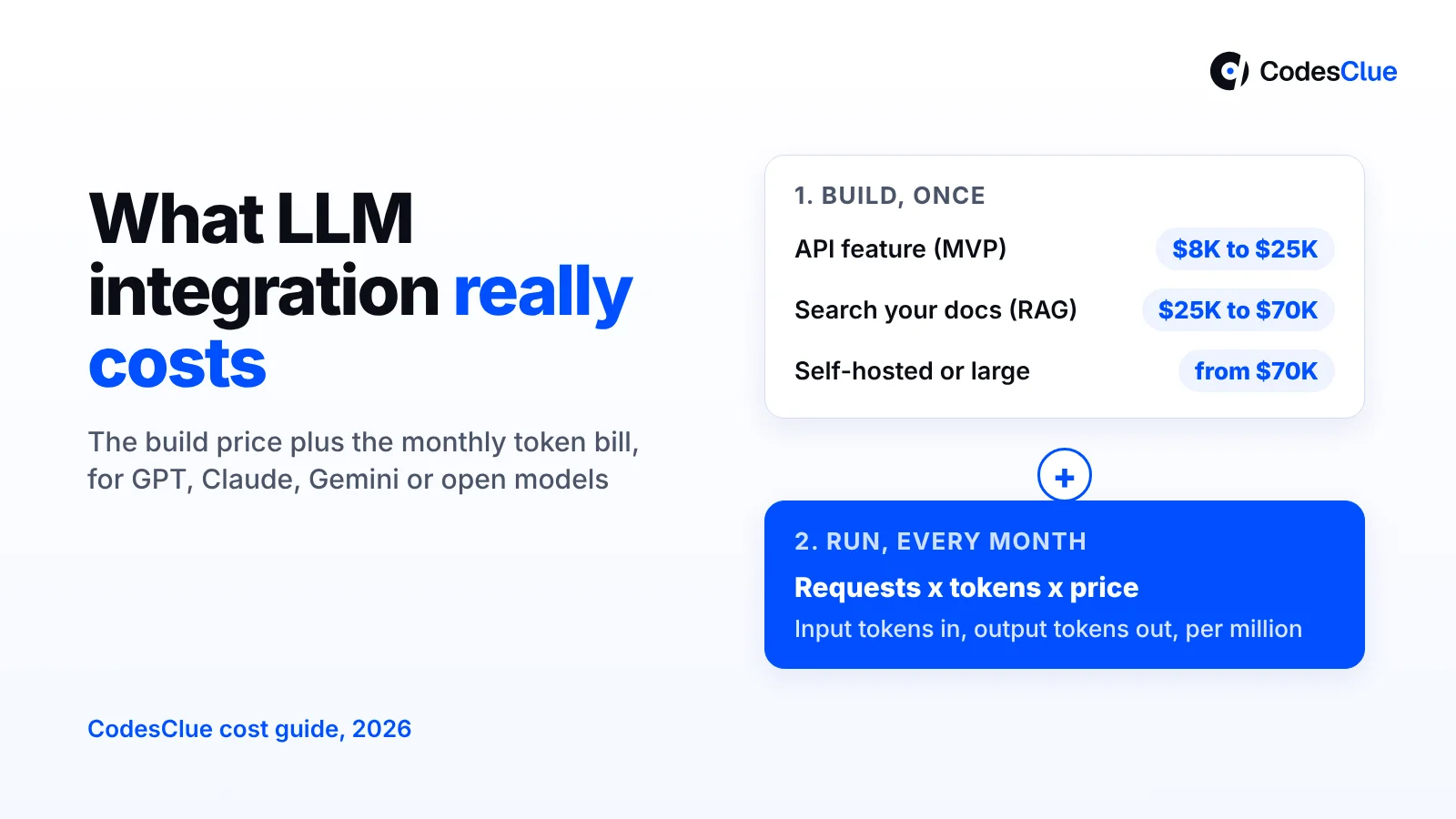
This guide splits the LLM integration cost into the two bills you will pay: the build and the monthly token bill. You get today’s official prices and a worked example.
Key takeaways
- You pay twice: once to build the feature, then every month for tokens, the small pieces of text the model reads and writes.
- A simple feature such as summaries or data extraction often fits about $8K to $25K. Search over your own documents (RAG) usually lands at $25K to $70K.
- Fine-tuning and self-hosted open models make sense in fewer cases than most teams think. Start with an API call or RAG.
- Output tokens cost five to six times more than input tokens on the models we checked. Short answers keep the bill down.
- Test on your own examples before you choose a model. The price gap between model tiers is up to 100 times.
What does LLM integration cost in 2026?
LLM integration cost has two parts. The build runs from about $8K for one simple feature, such as summaries. A self-hosted model or a large, multi-system setup starts at about $70K. The running cost is the token bill. In our worked example below, 20,000 questions a month cost between $14 and $1,400, depending on the model.
Most buyers only ask about the first bill. The second decides whether the feature still pays off a year later.
| Bill | What you pay for | When you pay | What moves it most |
|---|---|---|---|
| Build | Design, prompts, data work, backend, testing, guardrails, launch | Once, plus small changes later | Which option you choose and how messy your data is |
| Running | Tokens, plus hosting for search indexes or your own servers | Every month | Number of requests, prompt length, answer length, model tier |
How does LLM integration work inside an existing app?
Your app sends the model a request and shows the reply. The request holds standing instructions (the system prompt), the user’s input and often some of your data. Your code checks the answer before anyone sees it.
Providers charge per million tokens, small pieces of words. Tokens you send in cost less than tokens the model writes back.
Most product teams start with one of four features:
- Chat: an assistant inside your app that answers questions.
- Search over your documents (RAG): the app finds the right passages in your files first, then asks the model to answer from them. RAG stands for retrieval-augmented generation.
- Summaries: calls, long tickets or contracts turned into a short brief.
- Extraction: names, dates and amounts pulled from emails and PDFs into clean fields.
If the feature must act on its own, such as issuing refunds, you are building an agent. We cover that in our guide to AI agent development cost.
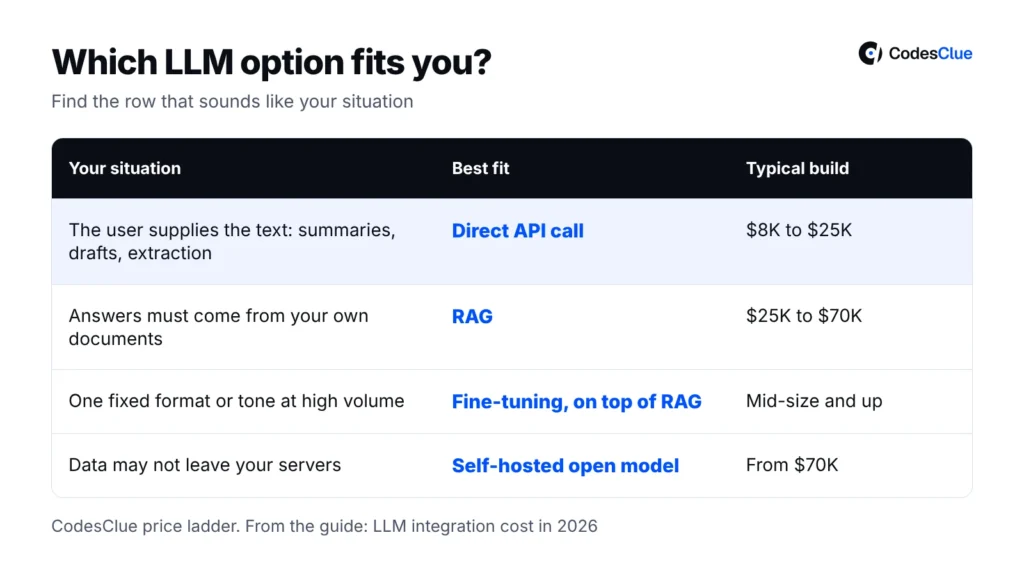
Which option fits you: API call, RAG, fine-tuning or a self-hosted model?
Pick the option by your situation, not by what sounds advanced. This choice moves the LLM integration cost more than any other decision.
- The user gives the model everything it needs (a call transcript, a PDF, a draft): a direct API call.
- Answers must come from your own documents (help centre, policies, product data): RAG.
- You need one fixed format or tone at high volume, and prompts alone keep missing it: fine-tuning, usually on top of RAG.
- Data may not leave your servers, or your volume is huge and steady: a self-hosted open model such as Llama or Mistral.
| Option | Best when | Typical build (CodesClue ladder) | Main running cost | Watch out for |
|---|---|---|---|---|
| Direct API call | Summaries, drafts, extraction from text the user supplies | MVP: about $8K to $25K | Tokens per request | Wrong or made-up details; add checks |
| RAG | Answers from your own files, with sources | Mid-size: about $25K to $70K | Tokens (search results make prompts longer), search index hosting | Messy documents and user permissions |
| Fine-tuning | A narrow task at volume where prompts fall short | Mid-size and up, often added to RAG | Training runs plus tokens | Needs hundreds of good examples; does not add fresh facts |
| Self-hosted open model | Strict data rules or very high, steady volume | Large: from about $70K | GPU servers that run all month, plus upkeep | You own uptime, updates and security |
Other firms publish similar ranges. RaftLabs lists $10K to $25K for a basic API feature and $20K to $80K for RAG. Teamvoy puts a single-system AI integration at $40K to $80K.
Pro tip: Before you pay for fine-tuning, try a better prompt with five good examples inside it. That often closes the gap, and you can change a prompt in minutes.
What drives the LLM API cost every month?
Four numbers decide your token bill: requests per month, input tokens, output tokens and the model’s price. Prompt length surprises people most, because RAG adds a few pages of your documents to every question. This is the part of LLM integration cost that grows as your users grow.
We opened the official pricing pages of OpenAI (opens in a new tab), Anthropic (opens in a new tab) and Google (opens in a new tab) on 21 October 2026. Standard prices per million tokens, input and then output:
| Tier | OpenAI | Anthropic | |
|---|---|---|---|
| Small, fast | gpt-6-luna: $0.10 / $0.50 | Claude Haiku 5.5: $0.10 / $0.50 (prompts up to 100,000 tokens) | gemini-3.1-flash-lite: $0.25 / $1.50 |
| Mid | gpt-6.1-sol: $2 / $10 | Claude Sonnet 5.5: $2 / $10 | gemini-4-argon: $2 / $10 until 30 Nov 2026, then $4 / $20 |
| Top | gpt-6-astra: $10 / $50 | Claude Fable 5.1: $10 / $50 | No model at this price on the page |
Two discounts matter. Anthropic and Google state 50% off for batch jobs, and OpenAI lists batch prices at half of standard. All three also offer caching, where repeated prompt text costs a fraction of the input price.
We could not verify embedding prices today. Embeddings turn your documents into numbers so RAG can search them. You pay to index files when they change, plus hosting for the index.
Worked example: a monthly token bill (estimate)
Picture a SaaS help assistant that answers 20,000 questions a month using RAG. This is a labelled estimate, not a quote.
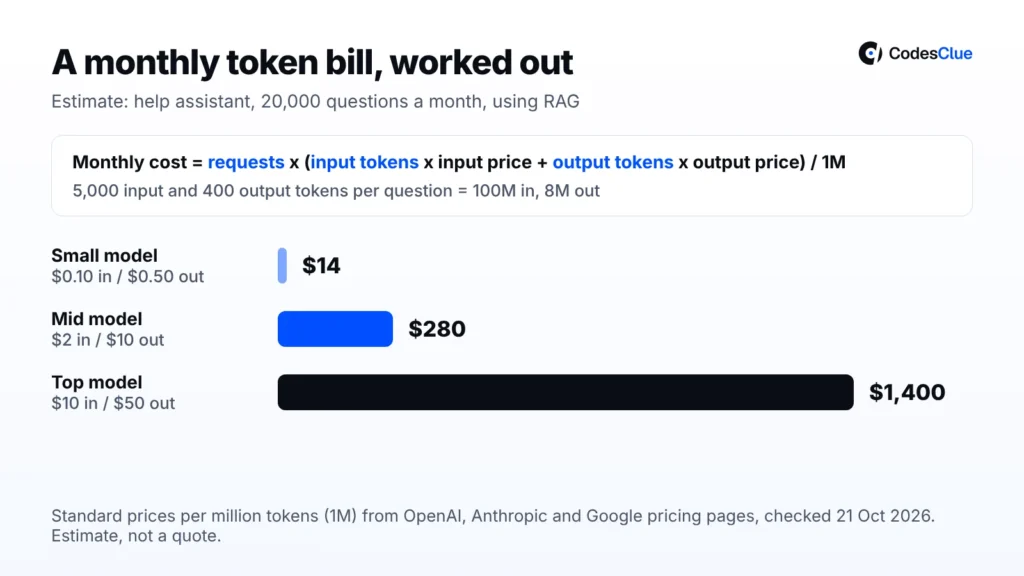
- Input per question: 1,500 tokens of instructions, 3,000 tokens of retrieved documents and 500 tokens of question and history. That makes 5,000 tokens.
- Output per question: 400 tokens, about a short paragraph or two.
- Formula: monthly cost = requests x (input tokens x input price + output tokens x output price) / 1,000,000.
That gives 100 million input tokens and 8 million output tokens a month. At the mid tier, $2 and $10: 100 x $2 + 8 x $10 = $280 a month. On a small model at $0.10 and $0.50 the bill drops to $14. A top model at $10 and $50 costs $1,400.
Prices also move. On Gemini 4 Argon the same month costs $280 now and $560 from 1 December 2026, according to Google’s page. Caching the 1,500-token instructions at the mid tier saves roughly $57 a month, before small cache-write fees.
Pro tip: Set a hard spending cap with your provider and a per-user request limit in your app before launch. One looping script can burn a month’s budget in a night.
Want this worked out for your own feature? Send us your use case and a rough request volume. We will reply with a build estimate and a token estimate side by side.
How to cost and ship an LLM feature in 6 steps
This is the order we follow to integrate an LLM into an app without surprises.
- Pick one job and one measure. “Draft replies to billing tickets, accepted without edits 70% of the time” beats “add AI to support”.
- Collect 50 to 100 real examples. Real tickets, PDFs and questions, each with a good answer, become your test set.
- Prototype on two or three models. Run the test set on a small and a mid model from different providers. Compare quality, speed and cost per answer.
- Estimate the token bill with your numbers. Use the formula above with your real prompt length and expected volume, then add 30% headroom.
- Build the guardrails. Output checks, a human review step where mistakes are costly, logging, rate limits and a spending cap.
- Launch to a small group first. Watch cost per request and answer quality for two weeks, then open it up.
On our LLM integration work, a proof of concept takes 1 to 3 weeks and an MVP 4 to 10 weeks. Teams building on Flutter can also read our guide to integrating Gemini into a Flutter app.
Real example: AI clinical notes for Therapix.AI
Therapix.AI is a clinical documentation platform we designed and built for therapists and clinicians. Clinicians enter session details as text or through guided inputs. AI workflows turn those inputs into structured SOAP notes, reports and summaries.
The key design choice was the review step. Nothing goes into the record until a clinician reviews, edits and approves it. The platform runs on React.js, Node.js, PostgreSQL and AWS, with iOS and Android apps.
The case study reports a 62% reduction in documentation time and a 70% decrease in administrative workload. The lesson: put AI where people lose time, and keep a human in the loop where errors matter.
What we see in real projects, and when not to use an LLM
Data work usually takes longer than model work. Old help articles contradict each other, and PDFs arrive as scans. Clean the sources before you judge the model.
Providers also retire models, so plan a short test run against your example set every few months.
Now the honest part. We would not add an LLM in these cases:
- The answer must be exact every time, such as tax, pricing or dosage. Use rules and code, and let the model only explain the result.
- Your data is already structured. A filter or a database query answers “orders over $500 last week” faster and for free.
- The task happens twice a week. A person with a good template is quicker to set up and easier to trust.
- A tool you already pay for does it. Many help desks and CRMs now ship AI features. Try them first.
Pro tip: Ask “what happens when the model is wrong?” for every feature. If the answer is “a customer loses money”, design the review step before you design the prompt.
Checklist before you ask for a quote
- The one job the feature does, and how you will measure success
- Expected requests per month at launch and in a year
- Where the data lives (help centre, Drive, database, CRM) and how much there is
- Who may see what: user roles and document permissions
- Data rules: personal data, health data, EU or US data location
- Preferred provider, if any, and any provider you cannot use
- Your app stack and who maintains the feature after launch
Common mistakes to avoid
- Choosing the model before the test set. You end up paying top-tier prices for a small-model job.
- Ignoring output length. Output costs five to six times as much as input on the models we checked. In our worked example, doubling answer length adds $80 a month at the mid tier.
- Stuffing whole documents into prompts. Good retrieval sends three right passages, not thirty pages.
- Skipping permissions in RAG. If the search index ignores user roles, a junior user can read the board pack.
- Jumping to fine-tuning or self-hosting. Both add cost and upkeep. Prove the feature on an API first.
- No spending cap or logging. You cannot fix a cost or quality problem you cannot see.
FAQs
How much does it cost to integrate an LLM into an existing app?
For one simple feature, such as summaries or data extraction, expect about $8K to $25K. Search over your own documents with permissions usually lands at $25K to $70K. Self-hosted models and multi-system setups start at about $70K. Clean data, fewer systems and light review keep you at the lower end.
What is the monthly LLM API cost for a typical feature?
It depends on volume, prompt length and model tier. Take a help assistant answering 20,000 questions a month, with 5,000 input and 400 output tokens each. Our estimate is about $280 on a mid-tier model, $14 on a small one and $1,400 on a top one. We used official prices checked on 21 October 2026.
Should I choose RAG or fine-tuning?
Choose RAG when answers must come from your own documents and those documents change. You can update a search index in minutes, and answers can show their sources. Pick fine-tuning when you need one fixed format or tone at high volume and good prompts still miss it. Many teams never need it at all.
How long does LLM integration take?
A proof of concept on your real examples usually takes 1 to 3 weeks. A production MVP with guardrails, logging and a review step takes about 4 to 10 weeks. Data clean-up and older systems add time. If you need extra hands, you can hire an LLM engineer, and development starts within 48 hours.
Is a self-hosted open model worth it to avoid token fees?
Only in a few cases. Self-hosting removes per-token fees, but you pay for GPU servers all month, busy or quiet. You also own updates, scaling and security. It makes sense when data may not leave your servers, or volume is very high and steady. For most products, an API model costs less in year one.
Is my data safe when I send it to GPT, Claude or Gemini?
Read each provider’s data terms for the plan you use, not the consumer app. Google’s pricing page says free-tier content helps improve Google’s products, so keep customer data on the paid tier. OpenAI offers regional data residency endpoints at a 10% uplift on newer models. Health or financial data also needs access control and logging.
Get a clear LLM integration cost for your product
Tell us the one job you want an LLM to do in your product. We will send back an LLM integration cost estimate, a model shortlist and a monthly token forecast. Book a free consultation, or see our AI integration services and LLM development work first.