
Why Your Supply Chain Needs a Dedicated Vendor & Partner Portal
How a vendor & partner portal improves supply chain visibility, supplier collaboration, and procurement efficiency.
Modern supply chains demand more than moving products from point A to point B. They run on constant communication between procurement teams, suppliers, logistics providers, manufacturers, distributors, and business partners. Yet most organizations still manage these relationships through emails, spreadsheets, and disconnected systems.
As supplier networks grow, these outdated processes choke supply chain visibility, slow down decision-making, and raise operational risk. A dedicated Vendor Portal for Supply Chain operations solves this by bringing every stakeholder onto one digital platform, simplifying collaboration, automating workflows, and delivering real-time insights that help businesses decide faster and smarter.
Deloitte’s 2025 Global Chief Procurement Officer Survey (opens in a new tab) found that 64% of procurement leaders prioritize greater supply chain visibility, while 61% focus on improving supplier information sharing and collaboration to strengthen resilience. Digital supplier collaboration has moved from operational convenience to strategic priority.
Why Traditional Vendor Management No Longer Works
Most organizations already invest heavily in ERP systems, CRM platforms, and procurement software, yet supplier communication stays fragmented. A purchase order originates in the ERP, invoices arrive by email, compliance certificates sit in shared folders, and shipment updates come through phone calls. Teams burn hours hunting for information instead of making decisions.
These gaps directly hurt supply chain management by cutting visibility, delaying supplier decisions, and slowing the business’s ability to respond to change.
| Traditional Challenge | Business Impact |
|---|---|
| Manual supplier onboarding | Delayed procurement cycles |
| Email-based communication | Slow response times |
| Multiple document repositories | Missing or outdated records |
| Manual approvals | Longer purchasing cycles |
| Limited supplier visibility | Higher operational risks |
| No centralized reporting | Poor decision-making |
These inefficiencies compound as supplier networks scale. McKinsey’s Global Supply Chain Survey found that 45% of organizations have little or no visibility beyond their first-tier suppliers, which makes it difficult to anticipate disruptions before they hit operations.
What Is a Vendor Portal for Supply Chain?
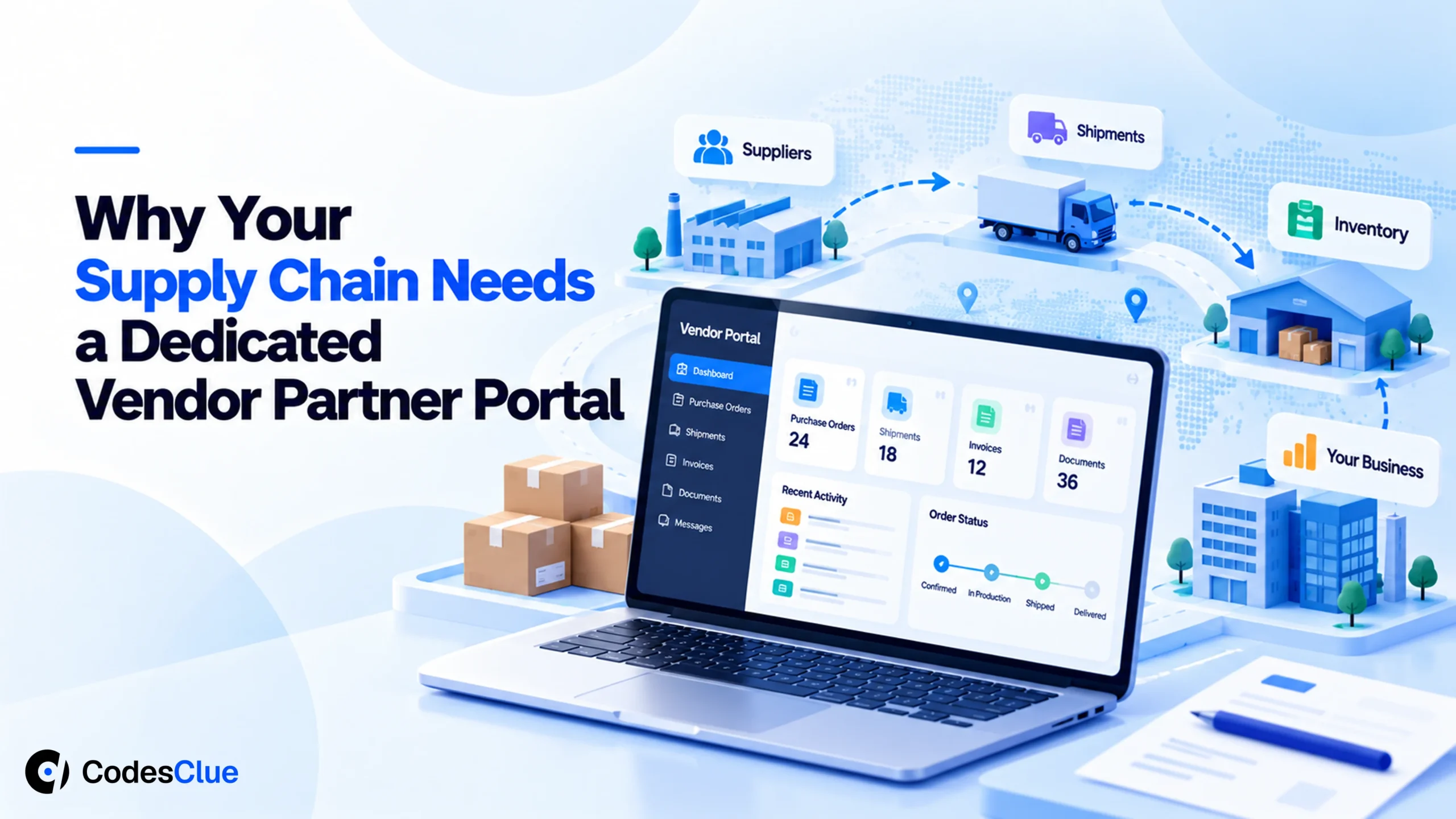
A Vendor Portal for Supply Chain is a secure digital platform that connects businesses with suppliers, vendors, distributors, logistics providers, and strategic partners in one centralized workspace, replacing scattered emails, calls, and spreadsheets.
Through the portal, vendors can:
- Receive purchase orders
- Submit invoices
- Upload compliance documents
- Track payment status
- Update company information
- Complete onboarding activities
- Respond to RFQs
- Communicate directly with procurement teams
The portal becomes the single source of truth for every supplier interaction.
How a Vendor Portal Improves Visibility and Collaboration
In a traditional process, a supplier’s request travels through email and phone calls, passing sequentially through procurement, finance, operations, and inventory, creating delays, duplicate work, and manual approvals at every handoff.
A Vendor Portal for Supply Chain replaces that chain with a hub: suppliers, procurement, finance, logistics, and partners all connect into one platform that integrates directly with ERP, CRM, and inventory systems. Because everyone works from the same real-time data, businesses can monitor supplier performance, track progress, and make faster decisions instead of reconstructing status updates from scattered sources.
Why Businesses Need a Dedicated Vendor & Partner Portal
1. Faster Supplier Onboarding
Supplier onboarding is often the first bottleneck in procurement. Teams exchange dozens of emails to request tax certificates, insurance documents, banking details, and compliance records, and missing paperwork can stall purchasing for weeks.
A supplier onboarding portal digitizes the entire process. Suppliers register online, upload documents, sign contracts electronically, and track approval status in real time, while procurement teams get automated notifications whenever action is needed. This cuts administrative effort and ensures vendors meet compliance requirements before they go active.
2. Stronger Supplier Collaboration and Relationships
Resilient supply chains run on strong relationships, and effective supplier relationship management helps businesses resolve issues faster and build long-term partnerships. A vendor collaboration portal gives procurement teams and suppliers one secure environment to exchange information. Instead of digging through old email threads, vendors get immediate access to purchase orders, invoices, delivery schedules, product specifications, and compliance requirements.
That transparency cuts misunderstandings, speeds up response times, and builds the kind of trust that keeps suppliers engaged over the long term. Deloitte names enhanced supplier information sharing and collaboration as one of the most effective strategies for strengthening supply chain resilience, a view 61% of procurement leaders share.
3. Greater Supply Chain Visibility
Supply chain leaders need real-time answers: Which suppliers have delayed shipments? Which invoices are awaiting approval? Which compliance certificates expire next month? Which purchase orders remain outstanding?
Without centralized visibility, answering these questions takes manual investigation. Supply chain visibility software solves this with dashboards that consolidate procurement workflows, shipment updates, approvals, and performance metrics into one interface. McKinsey reports that organizations with end-to-end visibility dashboards are far better positioned to anticipate and avoid supply chain disruptions.
4. Less Administrative Work, More Strategic Focus
Procurement professionals often lose too much time to repetitive administrative tasks. A digital procurement portal automates purchase order distribution, document verification, approval workflows, reminders, and invoice processing, improving consistency and reducing manual errors. That frees procurement teams to focus on supplier negotiations, cost optimization, and long-term planning instead of paperwork.
Essential Vendor Portal Features
Not every portal delivers the same value. The strongest solutions combine automation, security, collaboration, and analytics.
| Vendor Portal Features | Business Benefit |
|---|---|
| Supplier onboarding portal | Faster registration and compliance |
| Vendor self-service portal | Fewer support requests |
| Purchase order management | Faster procurement |
| Invoice submission | Improved payment processing |
| Document management | Better compliance |
| Workflow automation | Faster approvals |
| ERP integration | Centralized operations |
| Performance dashboards | Better supplier evaluation |
| Role-based access | Improved security |
| Real-time messaging | Faster collaboration |
A vendor self-service portal deserves particular attention: it lets suppliers answer their own routine questions about invoice status, payment timelines, banking updates, and outstanding compliance documents without emailing procurement. That single capability eliminates a large share of the repetitive back-and-forth that slows procurement teams down.
Why Partner Portal Software Is Becoming Essential
Today’s supply chains extend well beyond suppliers to distributors, logistics providers, contract manufacturers, dealers, franchise partners, consultants, and service providers. Each one contributes to product and service delivery, yet many still work through disconnected channels.
Partner portal software solves this by giving every authorized partner a unified digital environment tailored to their role. A dedicated partner portal can support:
- Contract management
- Product documentation
- Marketing resources
- Purchase order tracking
- Shipment updates
- Training materials
- Support requests
- Performance dashboards
Centralizing these interactions improves collaboration while keeping security and access controls tight.
Off-the-Shelf vs. Custom Vendor Portal
Many companies start with off-the-shelf supplier management software because it deploys faster. These platforms handle basic procurement well, but they often can’t adapt to unique business requirements, such as a manufacturer that needs quality inspections before approving purchase orders, a healthcare organization that must meet strict regulatory compliance, or a retailer that needs to integrate multiple warehouse systems.
A custom vendor portal lets organizations design workflows around their operations instead of reshaping operations to fit the software. Common customization options include industry-specific approval workflows, custom dashboards, multi-company support, vendor scorecards, multi-language interfaces, custom reporting, ERP and CRM integrations, automated compliance workflows, and role-specific permissions.
| Feature | Off-the-Shelf Solution | Custom Vendor Portal |
|---|---|---|
| Deployment time | Faster | Moderate |
| Business process alignment | Limited | Fully customized |
| ERP integration | Standard connectors | Tailored integration |
| Scalability | Moderate | High |
| User experience | Generic | Business-specific |
| Industry workflows | Limited | Fully configurable |
| Long-term flexibility | Medium | Excellent |
Organizations with complex supplier ecosystems typically get more value from a custom build, since it aligns with existing operations and scales with future growth.
Why B2B Vendor Portal Development Is Gaining Momentum
Digital transformation has turned procurement from a transactional function into a strategic capability. Businesses now expect supplier platforms to automate processes, improve visibility, and surface actionable insights, which is why investment in B2B vendor portal development continues to grow across manufacturing, healthcare, logistics, construction, retail, energy, and enterprise technology.
Modern vendor portals have moved past simple document repositories. They integrate with ERP systems, automate workflows, run analytics, and support collaboration across the entire supply chain. Many now fold in artificial intelligence, machine learning, and predictive analytics to help procurement teams flag risks, forecast demand, evaluate supplier performance, and automate routine decisions.
Measuring the Return on Investment
A vendor portal’s value goes well beyond cutting paperwork. Organizations typically track success through these metrics:
| KPI | Expected Business Impact |
|---|---|
| Supplier onboarding time | Reduced significantly |
| Procurement cycle time | Faster approvals |
| Administrative effort | Lower operating costs |
| Invoice processing | Improved accuracy |
| Supplier compliance | Higher compliance rates |
| Vendor response time | Faster communication |
| Procurement visibility | Better decision-making |
| Supplier satisfaction | Stronger relationships |
Choosing the Right Supplier Portal Software
Selecting supplier portal software takes more than comparing feature lists. Business leaders should weigh whether a platform supports long-term growth, integrates with existing systems, and adapts as procurement processes evolve.
| Evaluation Area | Why It Matters |
|---|---|
| Ease of supplier onboarding | Accelerates vendor activation |
| Workflow automation | Reduces manual effort |
| ERP integration | Eliminates duplicate data |
| Cloud scalability | Supports business growth |
| Security controls | Protects sensitive information |
| Analytics and reporting | Enables data-driven decisions |
| Mobile accessibility | Improves user adoption |
| Customization | Supports unique workflows |
| Self-service capabilities | Reduces support requests |
Choosing a scalable platform ensures the portal keeps delivering value as the supplier network expands.
The Future of Vendor and Partner Portals
Supply chain management is shifting fast, moving away from isolated procurement systems toward connected digital ecosystems built for collaboration, automation, and real-time decision-making. Future-ready vendor portals will increasingly bring in AI-powered supplier risk analysis, predictive procurement analytics, intelligent document processing, automated compliance monitoring, digital contract management, real-time supply chain dashboards, and API-first integrations with enterprise applications, helping organizations respond faster to disruption and strengthen resilience.
Conclusion
A dedicated Vendor Portal for Supply Chain strengthens supply chain management, improves supplier collaboration, increases supply chain visibility, and automates routine processes. As supply chains grow more complex, investing in the right digital platform pays off in efficiency and long-term growth.
At CodesClue, we build secure, scalable custom vendor portal solutions tailored to your business. Whether you need a vendor management portal, a supplier onboarding portal, or a full enterprise supply chain collaboration platform, our team can help you build a solution that keeps your supply chain connected and future-ready.