
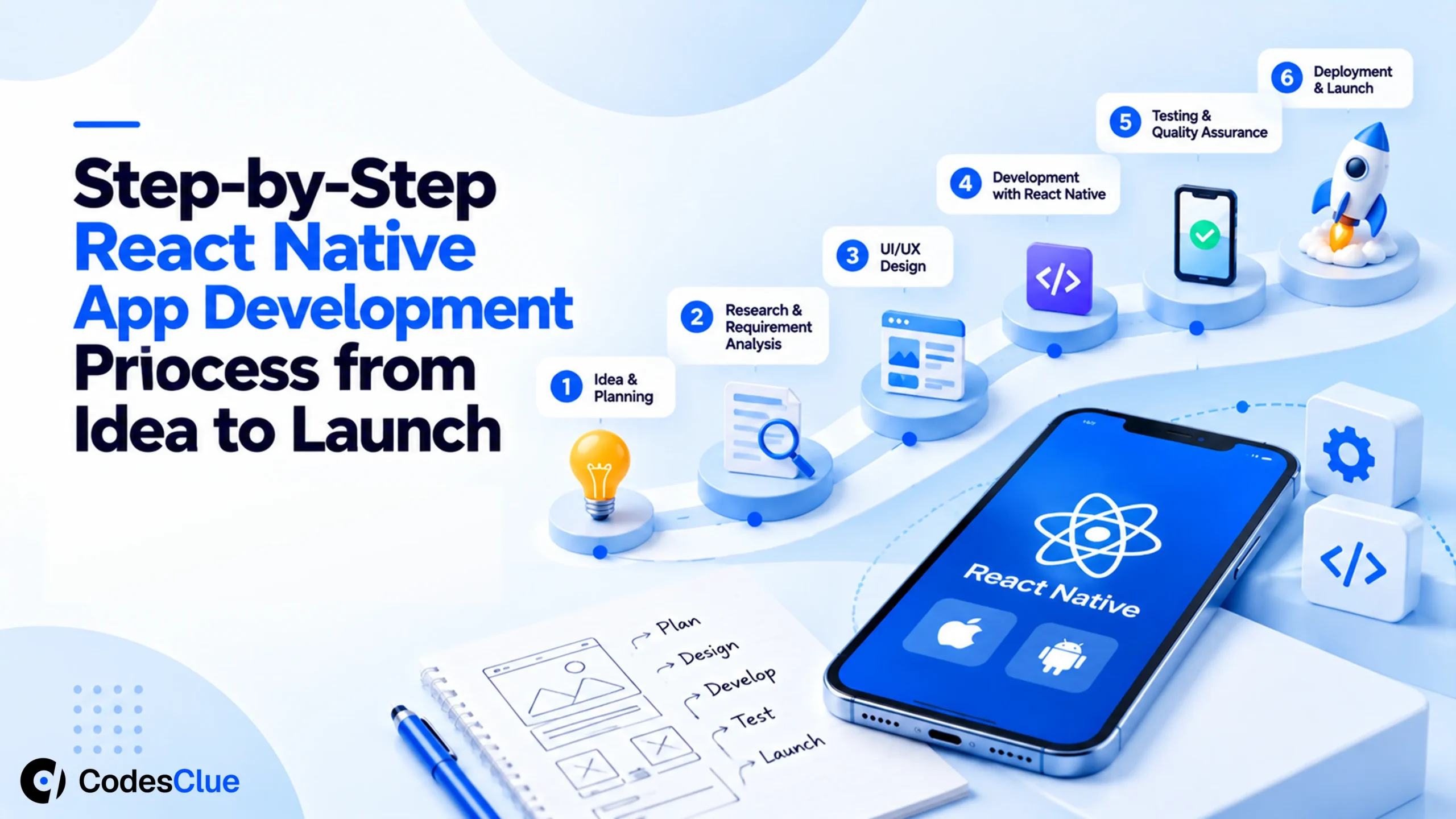
Step-by-Step React Native App Development Process: From Idea to Launch
Complete React Native app development process step by step: from planning and UI design to coding, testing, and deployment.
The global mobile app market (opens in a new tab) continues to expand rapidly, driven by increasing smartphone adoption, mobile-first customer experiences, and enterprise digital transformation initiatives. As businesses compete to launch applications faster while controlling development costs, cross-platform frameworks have become the preferred choice for startups and enterprises alike. Among them, React Native remains one of the most widely adopted frameworks, enabling companies such as Shopify, Meta, Bloomberg, Discord, and Walmart to build high-performance mobile apps with a native-like user experience while accelerating time-to-market.
However, building a successful React Native application involves much more than choosing the right framework. Many projects struggle due to inadequate planning, poor architecture decisions, limited testing, or a lack of post-launch strategy. Understanding the complete React Native app development process is essential for reducing risks, controlling costs, and ensuring long-term scalability. This guide walks through every stage of React Native app development, from idea validation and architecture planning to development, testing, deployment, and ongoing maintenance, helping businesses build successful mobile applications with confidence.
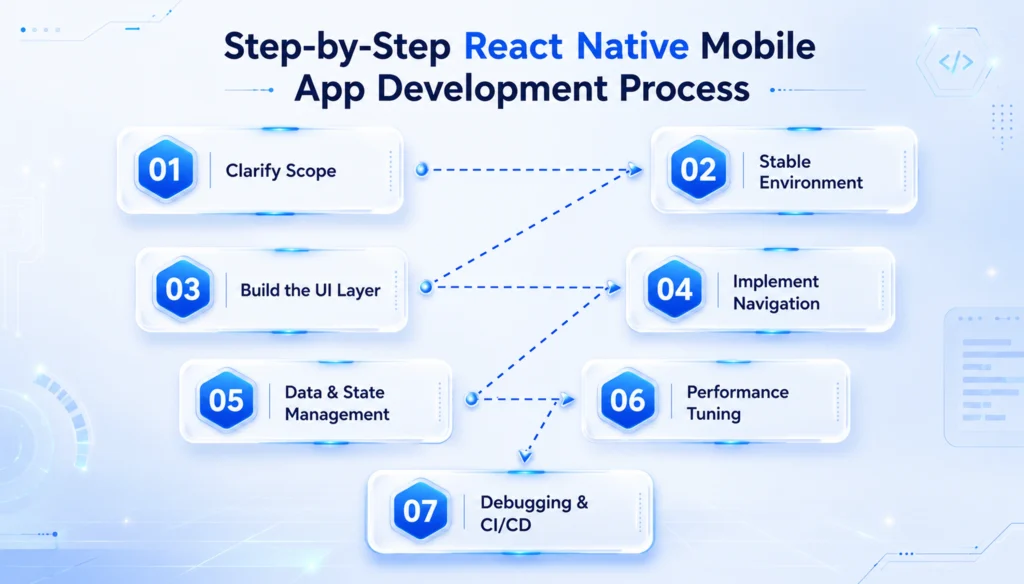
React Native Development Process at a Glance
Remember, the typical development time taken by most startup MVPs is 3–5 Months. Similarly, the typical development time taken by enterprise-grade platforms is 6-12 Months.
Why Discovery Determines 80% of Project Success?
Project Management Institute’s research consistently shows that poor requirements gathering is among the leading causes of project failure. The discovery phase in the React Native development typically consumes only 5–10% of the total project effort, but can prevent significant rework later.
During the mobile app discovery phase, the teams need to answer the following questions:
- What problem are we solving?
- Who are the users?
- Which features belong in the MVP?
- What integrations are required?
- What is the launch timeline?
The output is termed a Product Requirements Document (PRD), which becomes the blueprint for further development.
Experts suggest that the startups frequently overbuild MVPs. Successful MVPs focus on solving one core problem exceptionally well before expanding functionality.
UI/UX Design: The Most Underrated Revenue Driver
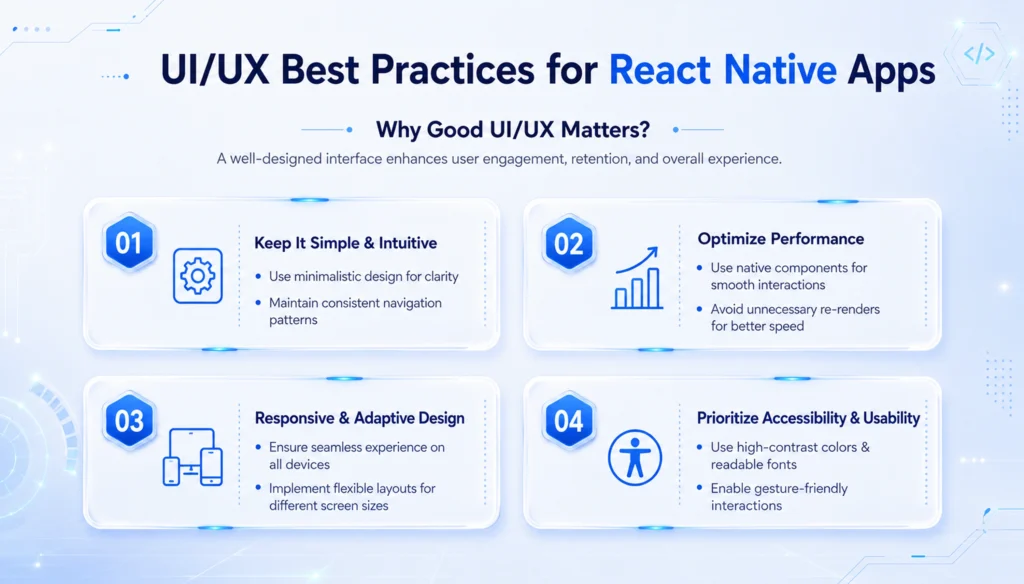
According to Forrester Research, every $1 invested in UX can generate up to $100 in return through improved conversion and customer satisfaction, which represents a potential ROI of 9,900%. This is why leading product companies spend significant time validating designs before development begins.
In fact, Forbes states that staying in the game requires an efficient UX strategy without giving an afterthought.
What Happens During This Design Stage?
- Mobile app wireframing steps
- User journey mapping
- Interactive prototypes
- Design system creation
- Accessibility reviews
React Native Architecture Setup: The Foundation That Determines Scalability
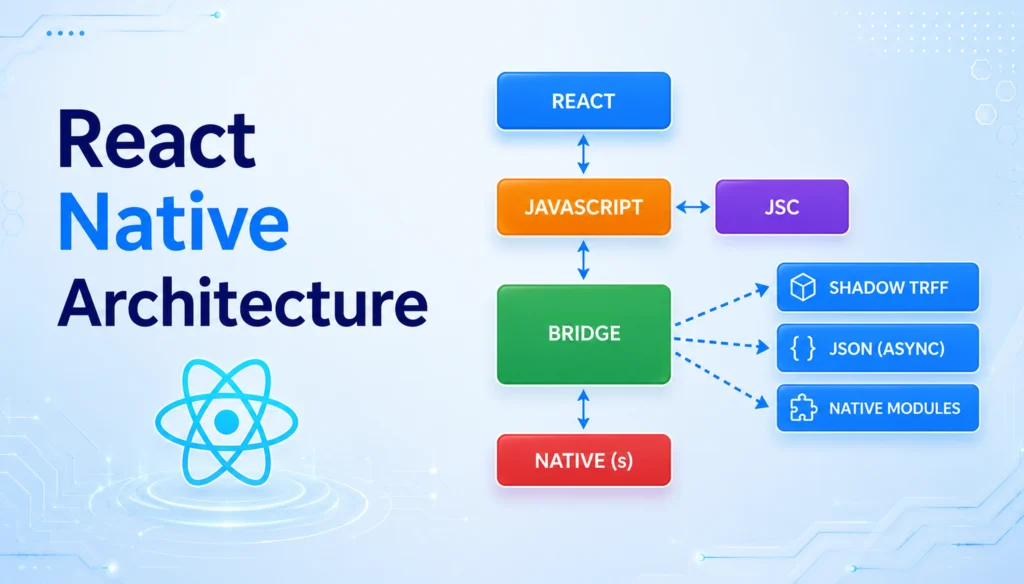
Generally, the biggest mistakes teams make are jumping directly into coding without defining a clear architecture. A scalable React Native architecture serves as the foundation for long-term success and significantly impacts the development speed, bug frequency, future feature expansion, and maintenance costs.
Expo vs Bare React Native Mobile App Workflow
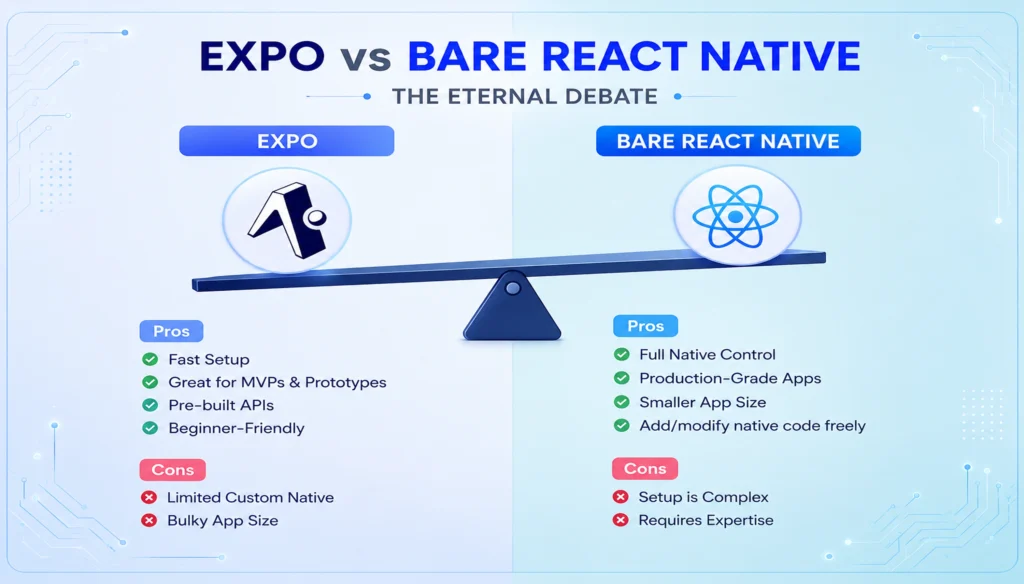
Agile Development Sprints: Where Most Budget Is Spent
At CodesClue, the development phase typically consumes 50–70% of a React Native project’s total budget, making it the most resource-intensive stage of the app development lifecycle. All React Native development steps include building features, integrating APIs, developing UI components, and implementing core business logic.
A typical React Native sprint lasts:
1 Week Sprint: Best for rapid iterations, bug fixes, feature enhancements, and fast-moving startup environments requiring frequent releases.
2 Week Sprint: The most common agile cycle, providing sufficient time for React Native project planning, development, testing, reviews, and stakeholder feedback.
During each sprint, development teams focus on delivering incremental features, validating functionality, resolving technical challenges, and maintaining code quality. A well-managed sprint structure improves project visibility, accelerates delivery timelines, and helps control overall development costs.
Most applications require:
Backend Selection: What Should You Use?
One of the most common questions businesses ask during the React Native app development process is:
“What backend should I use with React Native?”
The answer for React Native app requirements gathering depends upon your application’s complexity, scalability goals, development timeline, and long-term business needs. Choosing the right backend architecture early can significantly impact performance, maintenance costs, and future growth.
Choosing the Right Backend
- Firebase offers managed infrastructure, authentication, databases, and push notifications, making it ideal for startups looking to launch quickly.
- Supabase provides an open-source alternative with PostgreSQL support, real-time capabilities, and rapid development workflows.
- Node.js is highly scalable and commonly used for applications expecting significant user growth or complex integrations.
- NestJS extends Node.js with enterprise architecture patterns, making large-scale applications easier to maintain.
- Django excels when applications require complex business logic, analytics, machine learning, or extensive data processing.
- Laravel remains a popular choice for business applications requiring rapid backend development and robust administrative functionality.
AI-Era Recommendation
For many startups in 2026, one of the most effective technology stacks is:
React Native + Supabase + AI APIs
This combination enables rapid MVP development, lower infrastructure complexity, built-in database capabilities, authentication services, and seamless integration with modern AI platforms. It provides a fast, cost-effective path to product validation while maintaining flexibility for future scaling and feature expansion.
By selecting the right backend architecture from the start, businesses can accelerate development, reduce technical debt, and create a stronger foundation for long-term growth.
Quality Assurance: The Hidden Cost Saver
Many businesses underestimate the impact of quality assurance on overall development costs. Research from IBM has consistently shown that the cost of fixing defects increases significantly when issues are discovered after deployment rather than during development.
As a result, mature React Native development teams invest heavily in automated testing, continuous integration, and proactive quality assurance processes. Identifying issues early helps reduce rework, improve application stability, and accelerate long-term product growth.
Why QA Pays for Itself?
A comprehensive strategy for undertaking the React Native app testing process helps teams detect issues before users encounter them, reducing maintenance costs, preventing negative app store reviews, and improving user retention.
For most projects, investing in React Native QA automation early is significantly less expensive than addressing performance optimization issues, crash monitoring, and critical bugs after launch.
Deployment & App Store Launch
Many first-time founders assume that the React Native app development process ends once coding is complete. In reality, deployment, app store approvals, compliance checks, and release management introduce another critical phase that can impact launch timelines.
Successfully publishing a React Native application requires careful preparation, testing, documentation, and adherence to platform-specific guidelines. From React Native project setup to launch, teams plan for deployment early, often to avoid costly delays during release. Thus, the iOS App Store checklist and Google Play Store checklist should be followed correctly.
Why Does Deployment Planning Matter?
A well-structured deployment strategy helps teams release updates faster, reduce human errors, improve software quality, and maintain a consistent delivery cycle. By combining automated testing, CI/CD pipelines, and app store compliance best practices, businesses can accelerate time-to-market while minimizing launch-related risks.
React Native Post-Launch Support Phase for Long-Term Success
Many businesses focus heavily on launch day. However, the most successful mobile applications are built through continuous improvement during the months that follow release.
Post-launch maintenance, monitoring, and optimization play a critical role in user retention, application performance, and long-term ROI. The first 12 months often determine whether an app scales successfully or struggles to maintain user engagement.
React Native Upgrade Cycles
React Native continues to evolve with regular releases that introduce new features, performance improvements, bug fixes, and security enhancements. Keeping applications updated helps maintain a healthy and future-proof codebase.
Benefits of Staying Current:
- Improved security and stability
- Reduced technical debt
- Better performance and developer experience
- Continued compatibility with iOS and Android updates
- Access to new React Native capabilities
Why Post-Launch Investment Matters?
The launch of a React Native application is not the finish line; it’s the beginning of the product growth cycle. Companies that continuously monitor performance, analyze user behavior, gather feedback, and maintain their technology stack are better positioned to improve user retention, increase revenue, and achieve sustainable long-term success.
Frequently Asked Questions
What does a React Native development roadmap look like for an enterprise app?
Enterprise projects typically follow discovery, architecture planning, security reviews, multiple Agile sprints, extensive QA, and ongoing optimization. The roadmap focuses on scalability, compliance, and long-term maintainability.
What are common mistakes in React Native app development?
Common mistakes include poor planning, skipping testing, overloading the MVP, and using unsupported libraries. These issues can increase development costs and delay launches.
Is the React Native app development process faster than Flutter?
Both frameworks support rapid cross-platform development, but React Native benefits from a mature ecosystem and extensive JavaScript community support. Development speed largely depends on project requirements and team expertise
What are the phases in React Native mobile app development?
React Native development typically includes discovery, architecture setup, development sprints, testing, deployment, and post-launch maintenance as the React Native UI/UX design process. Each phase helps ensure scalability, performance, and faster time-to-market.
How to build a React Native app for a startup?
As per the React Native app development guide, start by validating your idea, defining an MVP, and creating a clear product requirements document (PRD). Focus on core features first to reduce the typical cost range per phase and accelerate launch.
How long does it take to build a React Native app step by step?
Step-by-step React Native development comprises a basic MVP development that usually takes 3–5 months, while feature-rich or enterprise applications may require 6–12 months. Timelines depend on complexity, integrations, and team size.
What is the typical cost of each phase in React Native development?
Costs vary by project scope, but discovery, design, development, testing, and deployment each contribute differently to the overall budget. Development sprints generally account for the largest share of costs.
How many sprints does a typical React Native app need?
Most MVPs require 4 to 6 sprints, while medium-complexity apps often need 8–12 sprints. Enterprise applications may involve 15 or more development cycles.
What backend should I use with React Native?
Popular choices include Firebase, Supabase, Node.js, NestJS, Django, and Laravel. The right backend depends on scalability needs, budget, and application complexity.
How does testing work in a React Native development workflow?
Testing includes unit testing, integration testing, UI testing, and performance validation across devices. Automated testing helps identify issues early and improves release quality.
What happens after launching a React Native app?
Post-launch activities include monitoring crashes, collecting user feedback, optimizing performance, and releasing updates. Continuous improvements help maintain user engagement and app stability.