
MVP App Development: Steps, Cost and a Real Example
MVP app development made simple: what to build first, app store rules, real costs ($8K to $25K at CodesClue) and a 3-month build example.
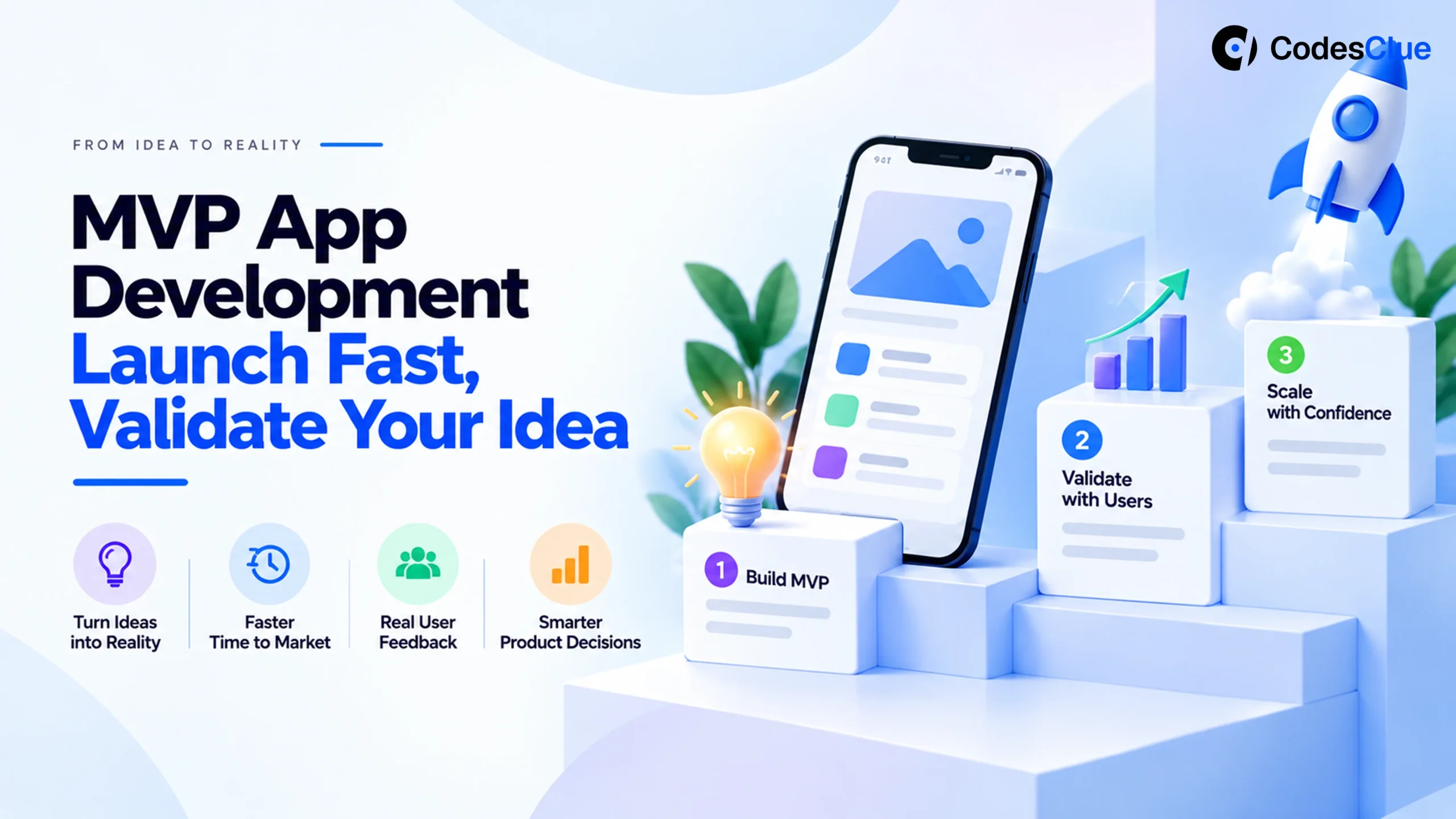
You have an app idea, a fixed budget and strong opinions about features. The real danger is six months spent on screens nobody opens. MVP app development cuts that risk by putting a small, working app in front of real users first. This guide covers what to build, what to leave out, what it costs and how to read the results.
Key Takeaways
- An MVP is the smallest working app that tests one core idea with real users. It is a real product, not a demo.
- In a 2026 CB Insights study of failed VC-backed startups, 43% cited poor product-market fit. An MVP tests that fit before you scale.
- Plan the app store steps early. New personal Google Play accounts need a closed test with at least 12 testers for 14 days.
- At CodesClue, an MVP usually costs $8K to $25K and takes about 4 to 10 weeks.
- Pick one success metric before launch, then let real usage choose the next feature.
What is MVP app development?
MVP app development means building the smallest version of your app that real people can install and use to solve one problem. It holds only the features you need to test your main idea. You launch it, watch what users do, and plan the next release from that evidence.
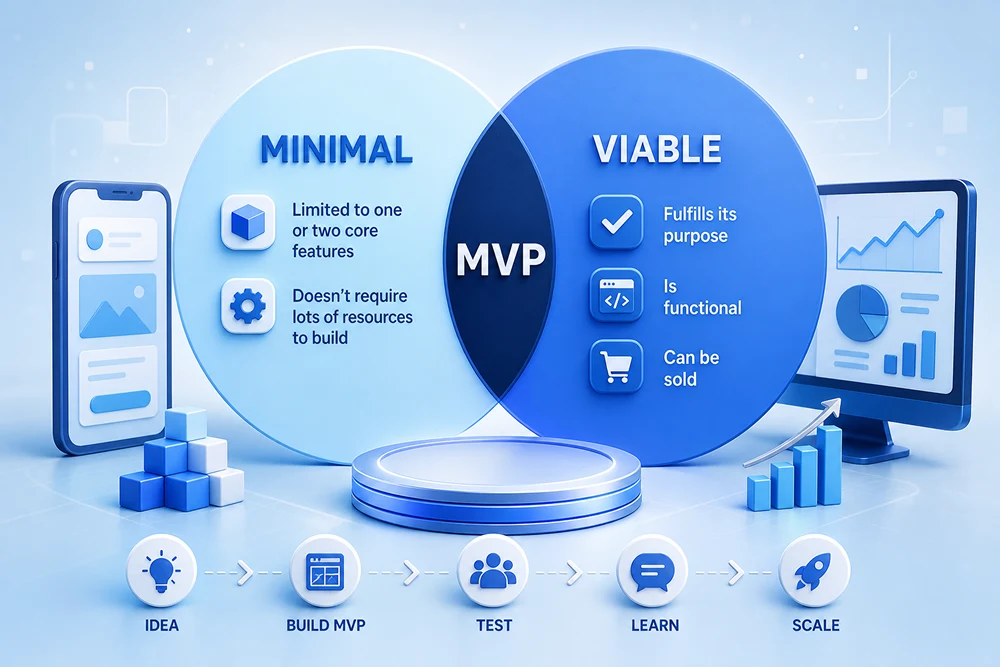
MVP stands for minimum viable product. “Minimum” means you drop every feature that does not test the core idea. “Viable” means the app still works well enough that people come back to it.
The approach comes from the Lean Startup method that Eric Ries made popular. You build, you measure, you learn, and you repeat. Each loop should answer one question about your users.
MVP vs proof of concept, prototype and full product
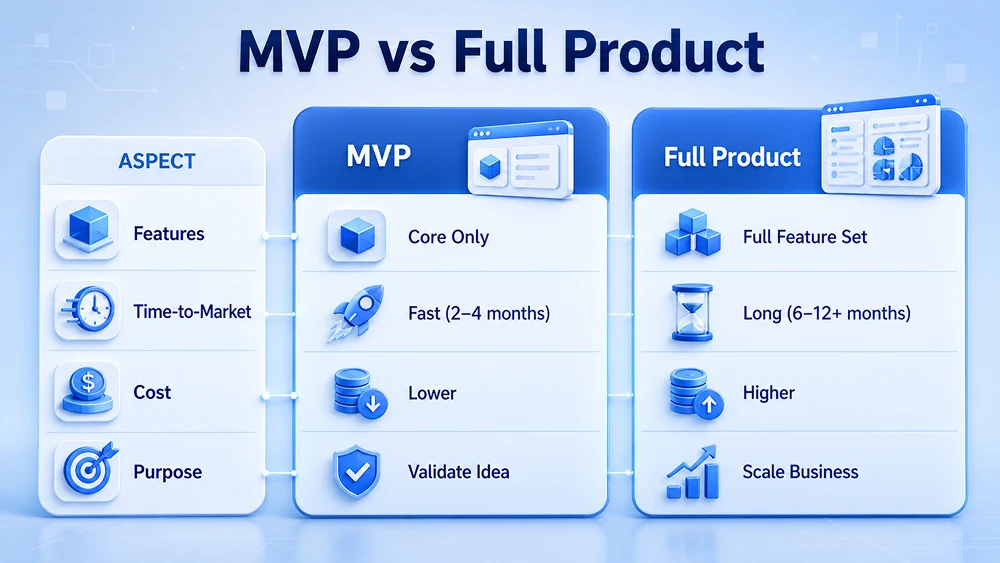
These four terms get mixed up all the time. Each one answers a different question, so pick the one that matches what you need to learn right now.
| Stage | Question it answers | Who uses it | Real code and data? | Typical time at CodesClue |
|---|---|---|---|---|
| Proof of concept | Can we build this at all? | Your team | Real code, test data | 1 to 3 weeks |
| Prototype | Do people understand the flow? | A few target users | Clickable screens only | Part of design work |
| MVP | Will people use it, and pay for it? | Early adopters | Yes, live product | 4 to 10 weeks |
| Full product | How do we grow it? | Your whole market | Yes, at scale | From 12 weeks |
Pro tip: If a landing page and a waitlist can test demand, run that test before you write any code. It takes days, and it tells you whether the MVP deserves a budget.
Why build an MVP before the full app?
Many products fail because the market does not want them. In a CB Insights analysis of 431 VC-backed companies (opens in a new tab) that shut down since 2023, 43% cited poor product-market fit. In the same group, 70% ran out of capital.
An MVP attacks both problems. You spend a small part of your budget to learn if the idea works. If it does not, you still have money left to change course.
It also gives you a better story for investors. A live app with real usage data answers questions that a pitch deck can only guess at.
When an MVP is the wrong choice
We would not push a classic MVP in every case. Here are the honest exceptions:
- Regulated data from day one. A health or payments app needs its privacy and security controls in version one. You can cut features, but you cannot cut compliance.
- Value that only appears at scale. Some network products feel empty with 50 users. Test the idea with a smaller, focused group or a manual service first.
- Replacing a tool people already depend on. Existing users compare your app with the old one on day one. A thin version can lose their trust.
- Safety-critical software. Anything that controls devices, medicine or money movement needs full testing before release.
How to build an MVP app in 7 steps
The order matters more than the tools. Each step narrows the scope before the next one starts.
- Write the problem in one sentence. Name the user, the pain and the moment it happens.
- List your riskiest assumption. For example: “Clinic managers will pay to stop booking patients by phone.”
- Sort features with MoSCoW. Label each one must, should, could or won’t. Version one gets the musts only.
- Map one user journey. Draw the path from sign-up to the first useful result. Design those screens in Figma and test them with a few target users.
- Build in short sprints. Ask for working software every one or two weeks, not slide updates.
- Release to testers first. Use TestFlight on iOS and a closed testing track on Google Play before the public launch.
- Launch and decide. Track one success metric for a fixed period. Then keep going, change direction or stop.
Pro tip: Write the success metric and the target number before the first sprint. Set it after launch and you will be tempted to move it until the result looks good.
What belongs in version one
Scope is where most budgets go wrong. Use this checklist to test each feature on your list.
MVP scope checklist
- The one core action that solves the user’s problem.
- Sign-up or login, but only if users need to return to their own data.
- A simple way for users to send feedback from inside the app.
- Analytics events on the core action, with a tool such as Firebase Analytics, Mixpanel or PostHog.
- Crash reporting, for example with Crashlytics or Sentry.
- A privacy policy and a way to delete an account. Both app stores ask for these when users can sign up.
- Payments, but only if willingness to pay is the thing you are testing.
Leave out the rest for now. Multi-language support, dark mode, social sharing, complex user roles and polished admin reports can wait for version two.
Cross-platform or native for your first release?
For most MVPs, one cross-platform codebase is the practical choice. It covers iOS and Android with a single team. Native apps make sense when the core idea depends on deep device features.
| Option | Best when | Trade-off |
|---|---|---|
| Flutter | You want one codebase and a custom look on both stores | Fewer developers know Dart than JavaScript |
| React Native | Your team already writes JavaScript or TypeScript | Some device features need native modules |
| Native (Swift and Kotlin) | The idea relies on camera, Bluetooth or heavy graphics | Two separate apps, so more time and cost |
| Web app first | Users mainly work at a desk, or you need to test fast | No app store presence and fewer device features |
App stores add their own timeline. Apple says its App Review team (opens in a new tab) typically checks at least 50% of submissions in under 24 hours and 90% in under 48 hours.
Google Play is stricter for newcomers. Personal accounts created after 13 November 2023 need a closed test with at least 12 testers (opens in a new tab). Those testers must stay opted in for 14 days in a row before production.
Pro tip: Open the Google Play closed test in your first build sprint, not your last. The 14-day clock then runs while your team finishes the app.
How much does MVP app development cost?
At CodesClue, MVP app development usually falls between $8K and $25K. Mid-size products run from $25K to $70K, and large platforms start from $70K. The final number depends on scope, so we price after a scoping call.
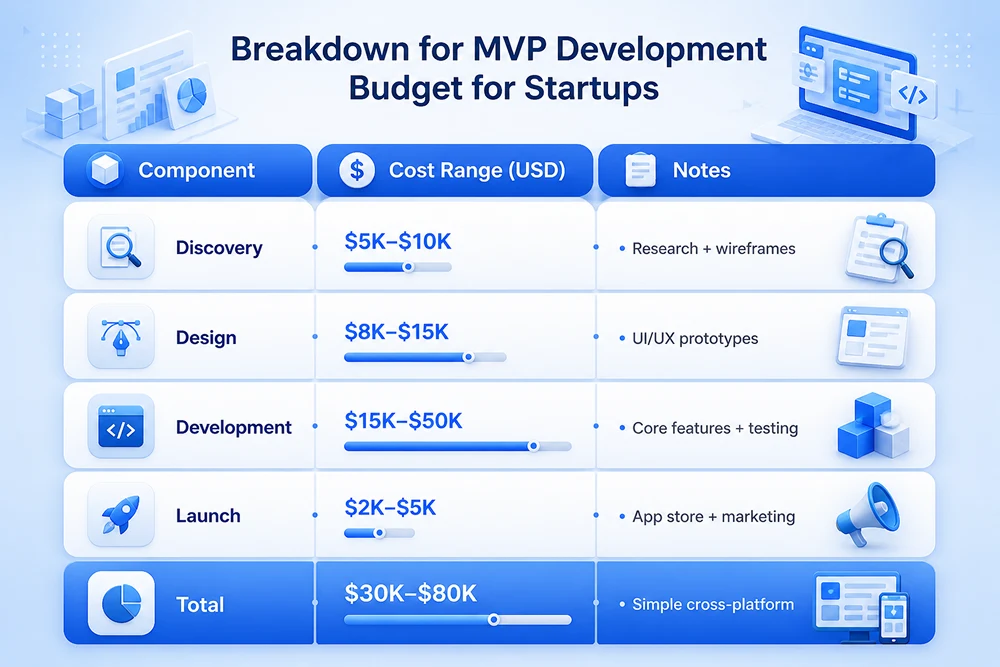
For a market view, Clutch publishes a pricing guide from client reviews (opens in a new tab). It says most app projects reviewed there range from $10,000 to $49,999. The average across all projects is $90,780, but that covers full apps, not only first versions.
| Cost driver | Keeps cost lower | Pushes cost higher |
|---|---|---|
| Platforms | One cross-platform codebase | Separate iOS and Android apps |
| Users and roles | One user type | Several roles with different access |
| Integrations | One payment or login provider | Many third-party systems |
| Data rules | No sensitive personal data | Health or payment data with audits |
| AI features | One model call behind a simple screen | Agents, custom training or human review steps |
Keep part of the budget for the changes users will ask for after launch. For a full breakdown by app type, read our guide on mobile app development cost.
Already have a feature list? Send it over and we will mark which items belong in version one. Ask for a scoped estimate.
A real example: HEOS, built from scratch in 3 months
HEOS is a strategic intelligence platform for healthcare organizations. An advisory firm in the USA asked us to build it from nothing. A team of five delivered it in three months: three developers, one QA engineer and one project manager.
Executives complete AI-guided discovery sessions across eight areas of their organization. A scoring engine turns their answers and documents into maturity scores. A consultant then checks every AI finding before the client sees it.
HEOS is a React and Node.js web platform, not a phone app. Its lessons still apply to any first release:
- Settle the fixed rules early. Each client’s data stayed separate from day one, and every AI finding gets a human review.
- Put changing rules in settings. The scoring domains and bands live in configuration, so the method can change without a rebuild.
- Give every role an owner. Three developers built, one QA engineer tested and one project manager ran the plan.
Planning a multi-client product like this? Our SaaS development services cover that kind of build from the first sprint.
What to measure after launch
Measure behavior, not compliments. Friends will praise your app, but their usage tells the truth.
- Activation: the share of new sign-ups who complete the core action.
- Retention: how many users come back in week two, week four and week eight.
- Time to value: how long a new user takes to get the first useful result.
- Stability: crash-free sessions, so bugs do not hide a good idea.
- Reasons: five short user calls each month to explain the numbers.
When the numbers hold, plan the move to production. If AI tools wrote part of your first version, run through our AI prototype to production checklist before you invite a larger audience.
Pro tip: Look at retention by sign-up week, not as one total. A rising curve for newer groups shows your changes are working.
Common mistakes to avoid
- Building for everyone. A narrow first user group gives you clear signals. A broad one gives you noise.
- Adding “just one more” feature. Every extra feature delays launch and blurs what the test proves.
- Skipping analytics. Without events on the core action, you finish the MVP with opinions instead of data.
- Treating MVP as low quality. Users forgive missing features. They rarely forgive crashes or lost data.
- Ignoring store rules. A late privacy policy or a missed tester window can push launch back by weeks.
- Never deciding. Set a date to choose between growing, changing or stopping, and keep it.
How CodesClue runs an MVP project
Our MVP projects follow one path: proof of concept, then MVP, then production. The AI-first engineers who write your code work from Ahmedabad, with further CodesClue offices in Germany, India and the USA. Work moves in short Agile sprints, and each sprint ends with a build you can tap through yourself.
Across more than 50 shipped projects, clients have scored us 5.0 on Clutch, with 4.9 on GoodFirms. For product work beyond mobile, see our custom software development services. For iOS and Android builds, visit our mobile app development services page.
Prefer to grow your own team instead? You can hire software developers from us. Once you approve the developer and we sign off the requirements together, development starts within 48 hours.
Start small, learn fast
Good MVP app development buys you evidence before you spend the big budget. Build the one core action, measure it honestly, and let your users decide what comes next.
Ready to scope yours? Use our contact form to send three things: the one action a user must complete, who your first users are, and your feature list as it stands today. Within one business day, a product engineer writes back with what belongs in version one, what can wait, and whether cross-platform or native suits your launch.
Want to see the method on a real build first? Read how a team of five delivered HEOS in three months, from a blank page to a working platform.
FAQs on MVP App Development
What are the top MVP development trends in 2026
AI-native MVPs with personalization and modular APIs dominate, alongside no-code tools cutting timelines by 50%. Startups prioritize ethical AI and synthetic data for faster, privacy-compliant validation.
How much does an AI-powered MVP app cost in 2026?
Most agency-built AI-powered MVPs cost $25K to $50K in 2026, depending on the AI features, the data they need and the integrations. These are general market estimates, not a quote; CodesClue sends a free written estimate for your project within 24 hours of a scoping call.
Should you include AI features in your MVP?
Yes, for competitive edge, basic LLMs for summaries or recommendations test real user value early. Skip if it bloats scope; focus on solving one problem 10x better.
What's the fastest way to validate an app idea pre-MVP?
Use landing pages, surveys, or no-code prototypes to test hypotheses with 100 targets. Track sign-ups and willingness-to-pay before coding, aim for 5-10% conversion as green lights.
How do you measure MVP success before scaling?
Key metrics: 40% Day 1 retention, 5%+ conversion, NPS >7, and usage frequency. Tools like Mixpanel reveal product-market fit fast; pivot if metrics lag.
No-code vs. custom code for MVP: Which wins in 2026?
No-code (e.g., Bubble, Adalo) launches in weeks for $500-$5K, ideal for solo founders. Custom code (Flutter/React Native) scales better for startups eyeing VC, choose based on your runway.