

Cost to Hire a React Developer in 2026: What You Really Pay
Cost to hire a React developer in 2026: US salary plus benefits, why hourly rates differ 2x, 4 hiring routes, hidden costs and real budget examples.

You have a React app to build or fix, and three quotes on your desk. One says $45 an hour, one says $150, and a recruiter says a full-time hire needs a $140K salary. They cannot all be right, so which number do you plan around?
This guide breaks down the real cost to hire a React developer in 2026. You will see what a US salary turns into once you add benefits, and why published hourly rates disagree by two times or more. It also covers the hidden costs most budgets miss and three budget scenarios, including two from our own React projects.
Key takeaways
- A US software developer earns a median of $135,980 a year (BLS, May 2025). Benefits push the employer’s real cost to roughly $199,000.
- Published hourly rates for the same seniority vary from about $45 to over $250. Always ask what the rate includes before you compare.
- The hiring route changes the bill more than the rate does. Match it to how long the work lasts.
- Budget for ramp-up, code review, testing and React security updates. These rarely show up in a quote.
- A one-page brief and a short paid task cut the risk of paying for the wrong person.
Cost to hire a React developer: the short answer
The cost to hire a React developer in the US runs from about $93,000 to $136,000 a year in median salary, depending on the role. With benefits, a full-time hire costs the employer about 46% more than the salary. Contract and agency rates range from roughly $45 to $250 an hour, set by seniority, region and what the price covers.
That range is wide on purpose. The rest of this guide shows how to narrow it to a number you can defend in a budget meeting.
What does a full-time React developer cost in the US?
Start with salary, then add everything an employer pays on top. The US Bureau of Labor Statistics gives the cleanest public numbers.
- Software developers: $135,980 median a year (May 2025), from the BLS Occupational Outlook Handbook (opens in a new tab). Senior React engineers who own architecture usually sit in this group.
- Web developers: $92,650 median a year (May 2025), from the BLS web developer page (opens in a new tab). Many front-end React roles fall here.
Salary is only part of the bill. In June 2026, wages made up 68.5% of the cost of a full-time private sector worker, and benefits made up the other 31.5%. That comes from the BLS employer compensation data (opens in a new tab).
| Role (BLS group) | Median salary | Rough total employer cost per year | Rough cost per month |
|---|---|---|---|
| Web developer | $92,650 | About $135,000 | About $11,300 |
| Software developer | $135,980 | About $199,000 | About $16,500 |

We worked out the last two columns by dividing salary by 0.685. Treat them as estimates. The 68.5% share is an average for all full-time workers, not for developers alone, and it leaves out recruiting fees, laptops and software licenses.
Pro tip: Ask finance for your own benefits load. Health plans and payroll taxes vary by state and company size, so your real figure may sit above or below the national average.
Why do published React developer rates disagree so much?
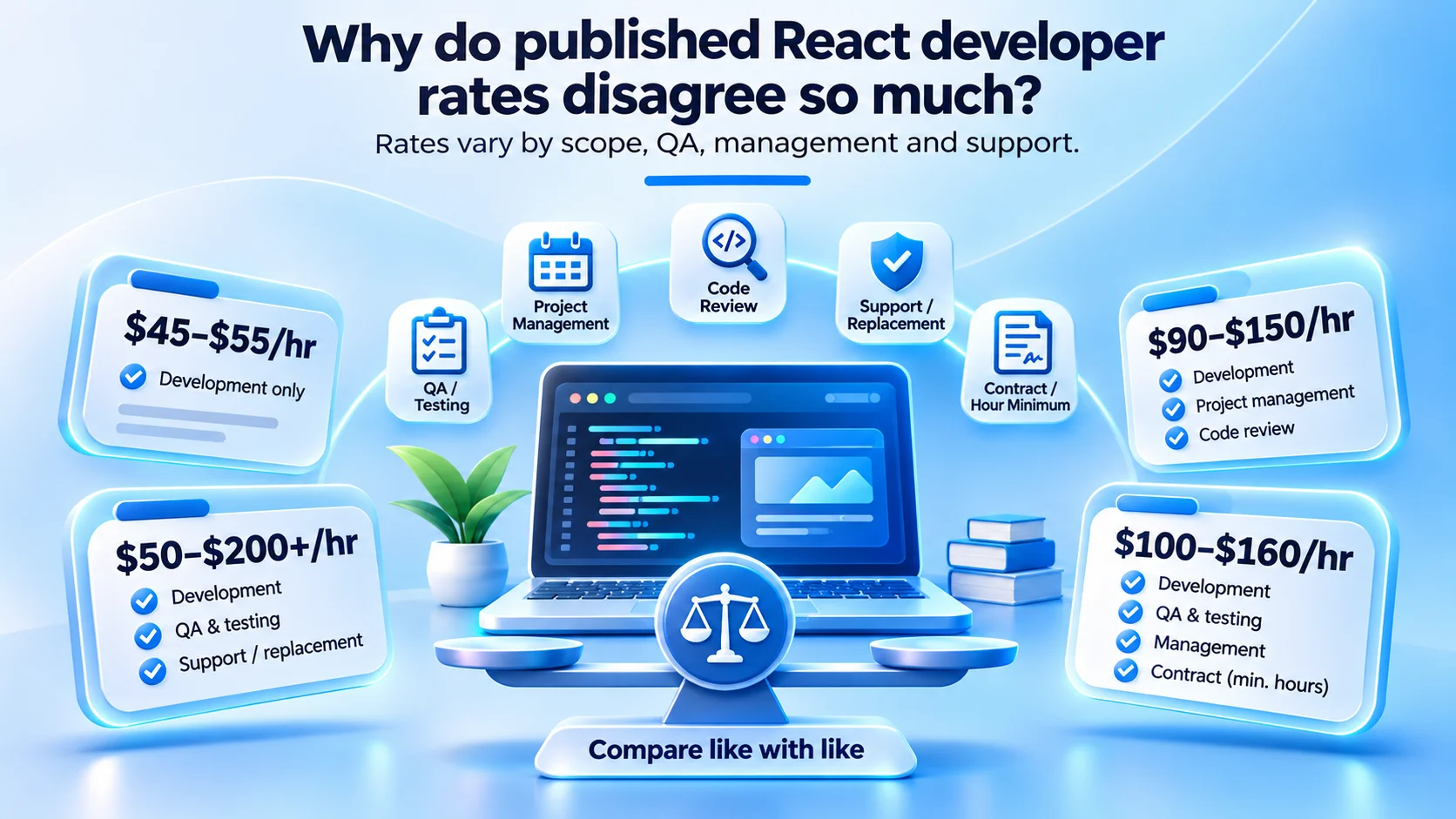
Search for React developer rates and you will find four price lists that disagree. Here is what a few agencies publish on their own blogs today.
| Published by | Junior | Mid-level | Senior |
|---|---|---|---|
| Cleveroad (by experience) | $45 to $55 an hour | $55 to $80 an hour | $80 to $100 an hour |
| Relia Software (North America) | $60 to $100 an hour | $100 to $160 an hour | $160 to $250+ an hour |
| Aimprosoft (North America, all levels) | $90 to $150 an hour | ||
| Proxify (all levels) | $50 to $200+ an hour | ||
None of these lists names its data source, and none says what the rate covers. That is the real reason they differ. A freelancer’s rate pays one person. An agency rate often also pays for a project manager, QA time, a replacement if someone leaves, and the company’s margin.
So compare like with like. Before you line up two quotes, ask each vendor four things:
- Is QA or code review included, or billed on top?
- Who manages the work day to day?
- What happens if the developer leaves or falls ill?
- Are there minimum hours or a minimum contract length?
Five things that raise or lower the price
Seniority and location set the base price. These five factors decide where in the range you land.
1. Your React version and build setup
The current release is React 19.3, shipped on 9 September 2026, per the official React versions page (opens in a new tab). An app still on React 17 or 18 needs upgrade work before new features.
The React team also deprecated Create React App in February 2025 (opens in a new tab) and points teams to a framework or a build tool such as Vite. If your app still runs on Create React App, budget for that move too.
2. Server-side React
Next.js, Server Components and server-side rendering need skills a pure front-end developer may lack. These roles cost more, and they carry more security weight (see the hidden costs section).
3. TypeScript and testing habits
A developer who writes typed code and tests costs more per hour. They also cost less per feature, because fewer bugs reach your users.
4. Scope and integrations
Payments, maps, real-time chat and role-based access each add days. A clear list of screens and integrations is the best way to get comparable quotes.
5. Deadline pressure
A fixed launch date with a large backlog means more people at once. Two developers for three months rarely cost the same as one developer for six, because coordination adds work.
Pro tip: Put your React version, framework and test coverage in the first paragraph of your brief. Vendors price risk, and an unknown codebase looks risky.

Four ways to hire React developers, compared by cost
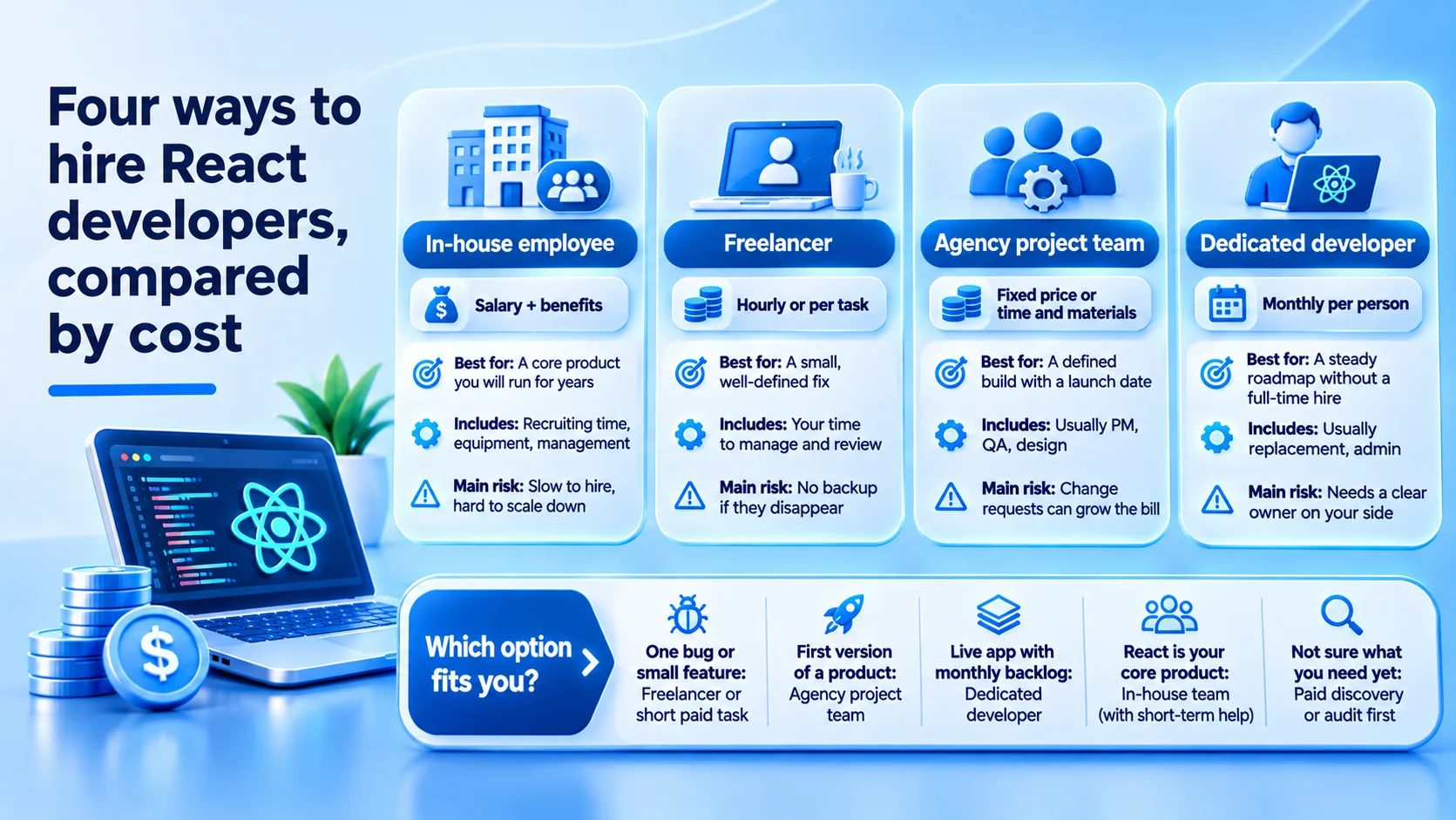
The route you choose changes the total more than any hourly rate. This table compares the four common options.
| Route | How you pay | What sits on top of the price | Best for | Main risk |
|---|---|---|---|---|
| In-house employee | Salary plus benefits | Recruiting time, equipment, management | A core product you will run for years | Slow to hire, hard to scale down |
| Freelancer | Hourly or per task | Your time to manage and review | A small, well-defined fix | No backup if they disappear |
| Agency project team | Fixed price or time and materials | Usually included: PM, QA, design | A defined build with a launch date | Change requests can grow the bill |
| Dedicated developer | Monthly per person | Usually included: replacement, admin | A steady roadmap without a full-time hire | Needs a clear owner on your side |
Which option fits you?
- You have one bug or one small feature: a freelancer or a short paid task with an agency.
- You need a first version of a product: an agency project team with a fixed scope.
- You have a live React app and a monthly backlog: a dedicated developer.
- React is your core product and you will hire a team: in-house, with outside help while you recruit.
- You are not sure what the app needs yet: a paid discovery or audit first, then pick a route.
Weighing a dedicated developer? You can meet vetted React developers at CodesClue and approve the person before any work starts.
The hidden costs most React budgets miss
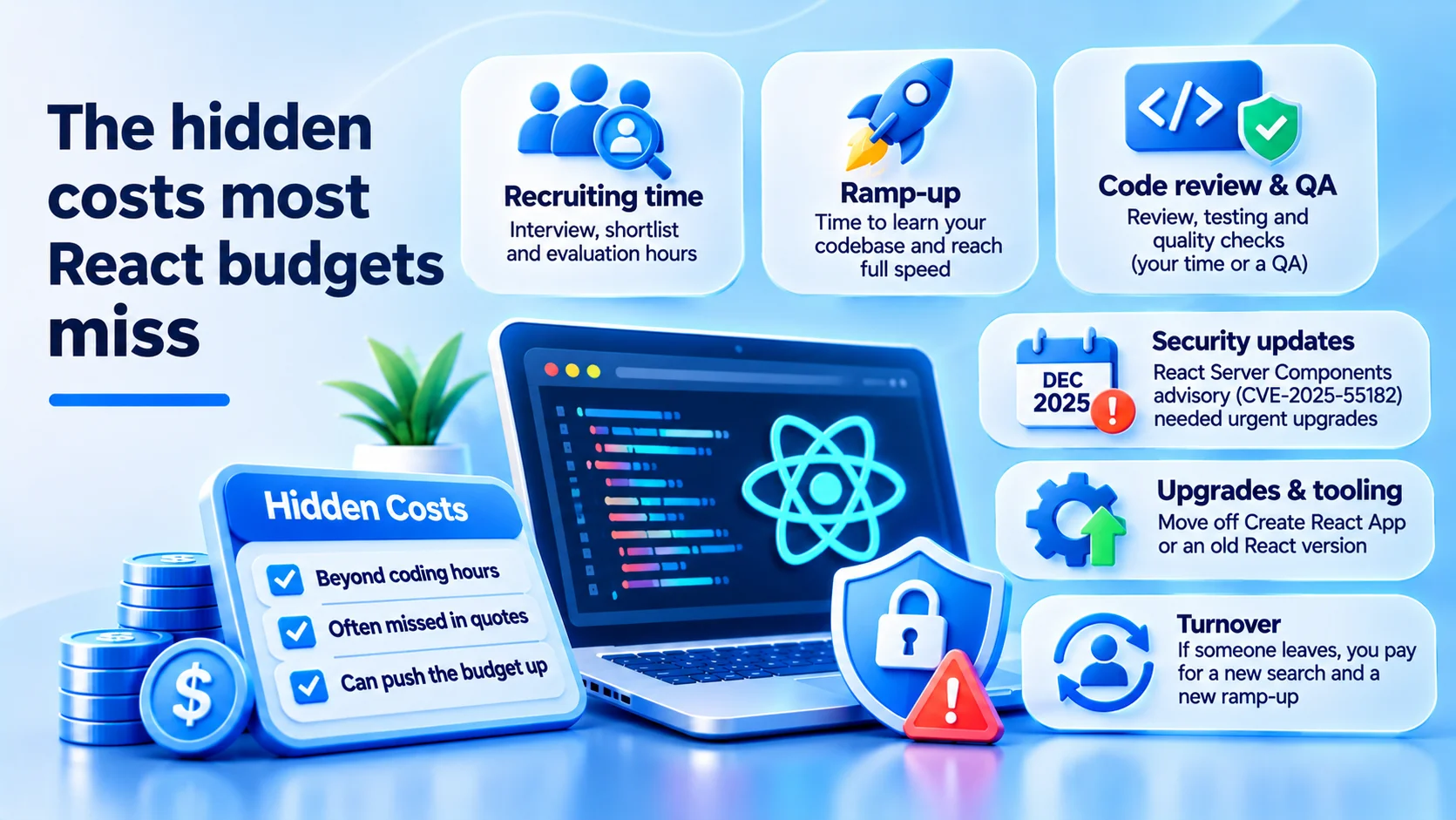
Most quotes price the coding hours. They often skip the work around the code, which is where budgets slip.
- Recruiting time: every interview takes hours from your lead engineer or founder.
- Ramp-up: a new developer needs time to learn your codebase before full speed.
- Code review and QA: someone has to check the work. If that is you, count your hours.
- Security updates: in December 2025 the React team disclosed a critical flaw in React Server Components (opens in a new tab) (CVE-2025-55182). Fixes shipped in React 19.0.1, 19.1.2 and 19.2.1, and later advisories followed. Apps using Server Components needed urgent upgrades.
- Upgrades and tooling: moving off Create React App or an old React version is real work.
- Turnover: if someone leaves mid-project, you pay for a new search and a new ramp-up.
What we see in real projects: patching is quick. The slow part is finding out which apps use Server Components and whether anyone owns them. Keep a short list of every React app you run, with its version.
Pro tip: Ask candidates how they handled the December 2025 Server Components advisories. A clear answer shows they follow React releases, not just React tutorials.
Three budget scenarios from real React work
Numbers make more sense with a situation attached. The first scenario is a typical example. The other two come from CodesClue case studies.
Scenario 1: a founder’s first web app (typical example)
A founder needs a React web app with sign-up, a dashboard, payments and an admin panel. A fixed-scope build through our React.js development services fits best here.
When we quote work like this at CodesClue, a first version tends to fall in the $8K to $25K band. Apps with more user roles and integrations move into $25K to $70K, and large platforms begin at $70K.
Scenario 2: a live React app that feels slow
Subjects Master is a game-based study platform built on React and MongoDB. Its founder came to us with a live product and a single founder’s budget.
Nobody rebuilt anything at the start. Our first step was a map of where the teacher portal and admin CMS lost time. Each problem then got a severity rating and a separate estimate. The founder could then pay for the fixes that hurt most first.
Scenario 3: a new platform from scratch
For HEOS, a US healthcare advisory firm needed a multi-tenant platform. We built it from scratch in React and Node.js in three months. Five people did the work: a project manager, a QA engineer and three developers. A team shape like this costs more per month than one developer. It also reaches a working product far sooner.
Building a mobile app instead? Mobile budgets follow other rules, covered in our React Native app development cost breakdown.
How to keep your React hiring budget under control
A lower rate is not the same as a lower bill. These steps cut waste on any route.
- Write a one-page brief. List the React version, framework, main screens, integrations and deadline.
- Pick the route before you collect quotes. Use the fit guide above, so every quote prices the same thing.
- Ask what each rate includes. Use the four questions from the rates section.
- Run a short paid task. Three or four hours on a copy of your codebase shows more than any interview.
- Start with a milestone, not a year. Agree the first deliverable and review it before you commit further.
- Keep review in the plan. Book code review and testing time from day one.
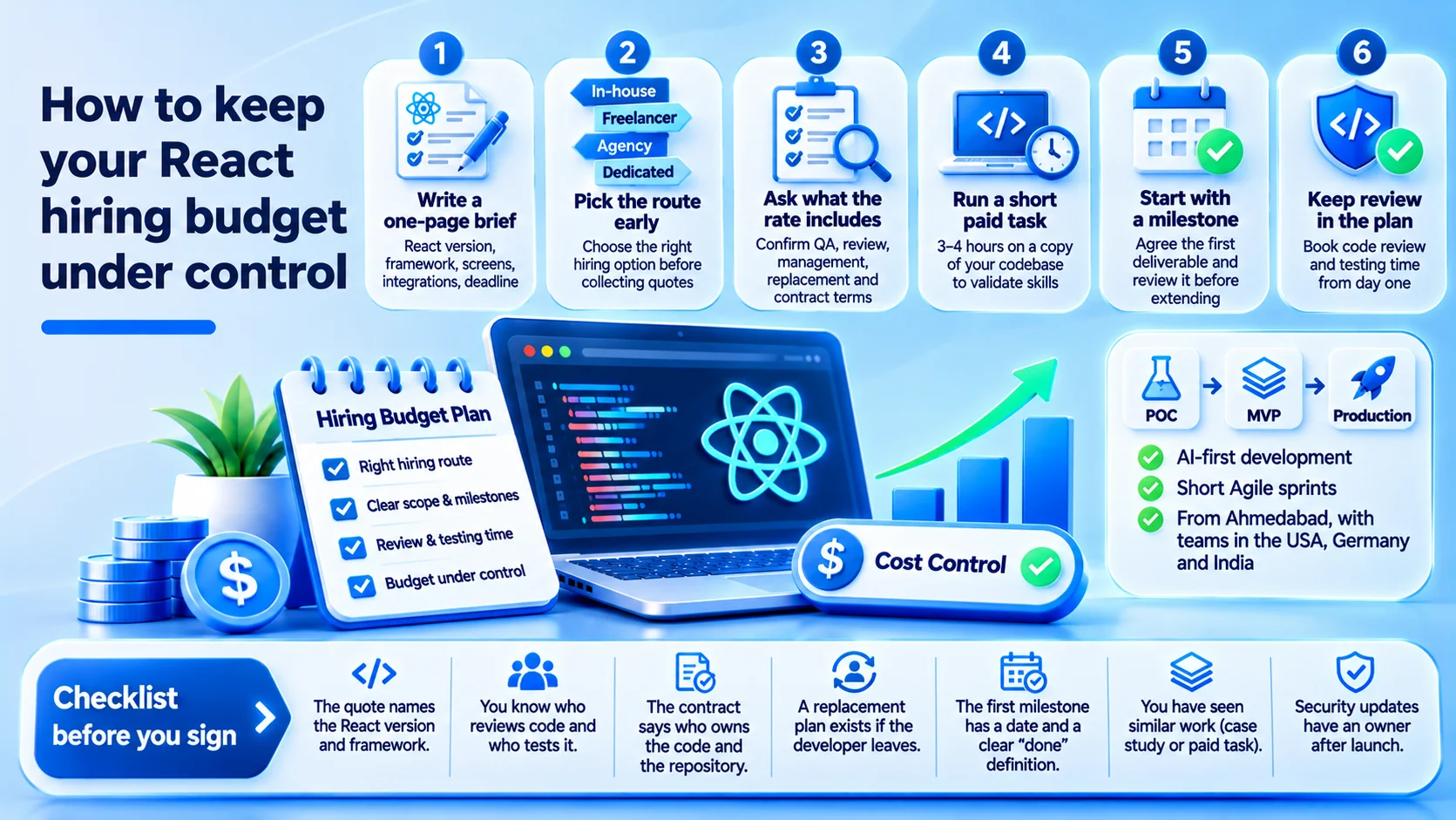
Most of our engineering happens in Ahmedabad, with staff in Germany, the USA and India close to clients. We build AI-first and ship in short Agile sprints. Each product moves one stage at a time: a proof of concept, then an MVP, then the production release. Approve the developer you want, then development starts within 48 hours.
Checklist before you sign
- The quote names the React version and framework it assumes.
- You know who reviews code and who tests it.
- The contract says who owns the code and the repository.
- A replacement plan exists if the developer leaves.
- The first milestone has a date and a clear “done” definition.
- You have seen work similar to yours, such as a case study or a paid task.
- Security updates have an owner after launch.
Common mistakes to avoid
- Comparing hourly rates alone. A $50 rate that needs heavy review can cost more than an $80 rate that does not.
- Using salary as the full cost. Benefits add about 46% on top for a typical full-time worker.
- Hiring a junior for architecture. Early structure decisions are expensive to undo later.
- Skipping the upgrade question. An old React version or Create React App setup hides weeks of work.
- Signing a long contract first. Start with one milestone and earn trust both ways.
- Forgetting maintenance. React apps need updates after launch, as the December 2025 advisories showed.
Final thoughts: plan the whole cost, not the rate
The cost to hire a React developer depends less on the hourly rate and more on fit. Pick the route that matches how long the work lasts, and ask what every price includes. Plan for the work around the code as well as the code itself.
Want a number for your own app? Send us your brief. We will come back with a price range, the team we would put on it and a first milestone you can review. You can also set up a free call with us to talk it through first.
FAQs
Does hiring a React developer offshore cost less?
The hourly rate is usually lower offshore, but the full cost depends on more than the rate. Count the time zone overlap you need, how much review the work will need and who manages the developer each day. A lower rate with weak communication can cost more per feature. Ask for a short paid task first, then compare the results, not only the price.
How much does a senior React developer cost compared with a junior?
Agency price lists show senior rates at roughly two to three times junior rates for the same region. A senior developer also makes the early structure decisions that are expensive to change later, such as state management, routing and the server setup. For a new product, one senior plus one mid-level developer is often a better buy than three juniors.
Does a Next.js developer cost more than a React developer?
Often yes. Next.js work adds server-side rendering, Server Components, caching and deployment, which sit closer to back-end work. Those skills are less common and carry more security weight, as the December 2025 React Server Components advisories showed. If your app is a plain single-page app, you may not need to pay for that skill set.
Can I hire a React developer for a fixed price?
Yes, for work with a clear scope, such as a first product version or a defined set of screens. A fixed price needs a written list of features, integrations and a done definition for each milestone. For an open backlog that changes every month, a dedicated developer paid monthly usually fits better, because a fixed price would need constant change requests.
How fast can a hired React developer start?
It depends on the route. An in-house hire can take weeks or months once you add sourcing, interviews and notice periods. A freelancer may start within days for a small task. With a dedicated developer from CodesClue, you interview and approve the person first. From that sign-off, development starts within 48 hours.