

AI in Banking: Use Cases, US Rules and How Banks Start
AI in banking for US banks and credit unions: 9 use cases with the rule each one triggers, SR 26-2, build vs buy, budgets and a 90-day pilot plan.
Your board wants an AI plan for next year. A vendor has pitched a chatbot and the fraud team wants better alerts. Compliance wants to know who signs off on a model nobody can explain. Where should a bank actually start?
This guide covers AI in banking the way a US bank or credit union team has to deal with it. You will see the use cases that pay back first and the federal rules your examiners will ask about. You also get a build, buy or partner table, realistic budgets and a 90-day plan for your next steering meeting.
Key takeaways
- Start with one workflow where people already work from data: fraud alert triage, document intake or service questions.
- In April 2026 the Federal Reserve, OCC and FDIC replaced SR 11-7 with new model risk guidance (SR 26-2). Generative and agentic AI sit outside its scope, so your own governance has to cover them.
- The CFPB withdrew its AI adverse action circulars in May 2025, yet Regulation B still requires specific reasons when a lender denies credit.
- Buy for common problems, build where your data or process is the edge, and partner when you lack the engineers.
- Measure one number before go-live, such as false positives per 1,000 alerts, and judge the pilot against it.
What is AI in banking?
AI in banking means software that learns from a bank’s data to flag, sort, predict or draft work that staff used to do by hand. Typical jobs include scoring fraud risk on a payment or reading a loan document. Others answer a balance question or rank which alert a BSA analyst opens next. People still own the decision.
Two families matter here. Predictive models score or classify things, such as a transaction or an applicant. Generative AI writes and summarizes text, such as a call note or a policy answer. US supervisors treat them differently, as the rules section below explains.
9 AI in banking use cases that pay back first
The use cases below come up most often with banks and credit unions. The table shows the data each one needs, the rule your compliance team will raise and the first metric to track.
| Use case | Data it needs | Rule that usually applies | First metric to track |
|---|---|---|---|
| Card and payment fraud scoring | Transaction history, device and location signals | Model risk guidance, Regulation E for disputes | False positives per 1,000 alerts |
| AML alert triage | Alerts, case notes, customer risk ratings | BSA/AML program rules, model risk guidance | Analyst minutes per alert |
| Credit underwriting support | Application data, bureau files, cash flow | ECOA and Regulation B, fair lending | Approval rate by segment, reason code quality |
| Loan document intake | Pay stubs, tax forms, bank statements | Data security guidelines (GLBA) | Files processed per day without rework |
| Customer service assistant | FAQs, product terms, account events | UDAAP, complaint handling | Share of chats solved without a hand-off |
| Staff knowledge assistant | Policies, procedures, product manuals | Internal AI governance, data access rules | Time to answer an internal question |
| Collections prioritization | Payment history, contact outcomes | UDAAP, plus FDCPA when an outside agency collects | Promise-to-pay rate per call hour |
| Cash flow and liquidity forecasting | Deposit flows, rate data, seasonality | Model risk guidance | Forecast error against actual results |
| Payment reconciliation | Ledger entries, processor files, bank statements | Audit trail and record keeping | Breaks cleared automatically each day |
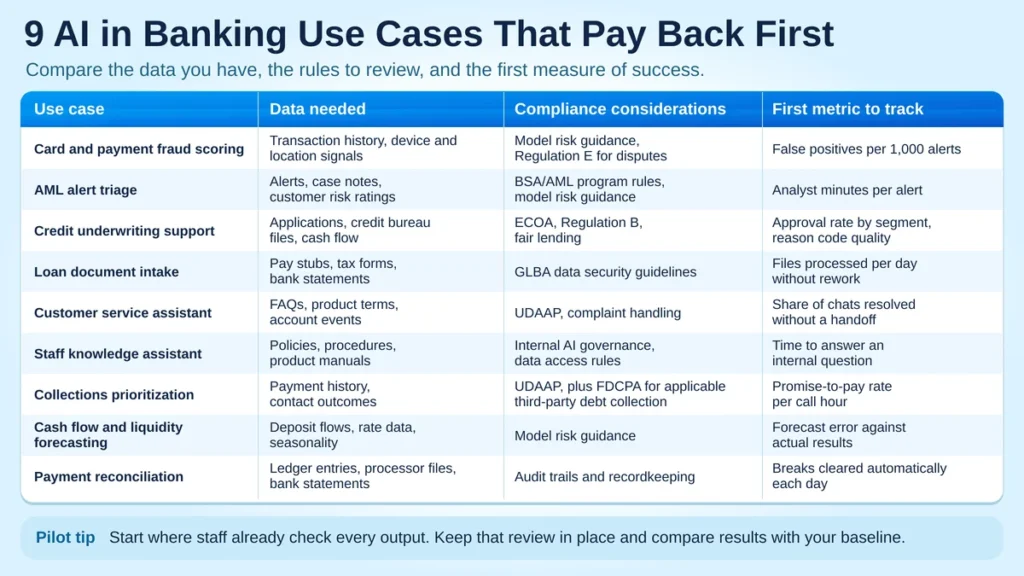
Fraud, AML triage and document intake tend to move first. Their data already sits in one place, staff already review every case, and the before and after numbers are easy to count.
Pro tip: Pick the use case where a human already checks every output today. You keep that review step during the pilot, so the model can be wrong without hurting a customer.
Fraud detection and AML
Rule-based fraud systems fire on fixed thresholds, so they flag many honest customers. A model that weighs dozens of signals at once can rank alerts by real risk. Your analysts then open the riskiest cases first instead of working the queue in order.
The same idea helps AML teams. A triage model does not file a suspicious activity report for you. It sorts alerts, drafts a case summary and shows the analyst why it scored each one high.
Lending and underwriting
Models can read cash flow data from bank statements and help thin-file applicants get a fair look. Here the stakes are highest, because every denial needs reasons a consumer can understand. Choose models that can produce clear reason codes, and test outcomes by segment before launch.
Service and operations
Bank of America’s Erica showed years ago that customers will ask a bank assistant about balances, bills and card locks. Most community banks do not need to build their own Erica. A narrower assistant that answers product questions and hands off to a person often covers the bulk of chat volume.
Back-office work offers quieter wins. Reading documents, matching payments and drafting call notes save hours every week and carry less customer risk.
AI in investment banking
Investment banks use AI mostly for research and document work: summarizing filings, drafting pitch book sections, screening deal targets and checking trade data. The rules differ from retail lending, since SEC and FINRA expectations on records and supervision apply. The pattern holds, though. Keep a person on every client-facing output and log what the tool produced.
Want a second opinion on which of these fits your data? Our banking software team can review one workflow with you and tell you plainly if AI is worth it there.
The US rules that shape artificial intelligence in banking
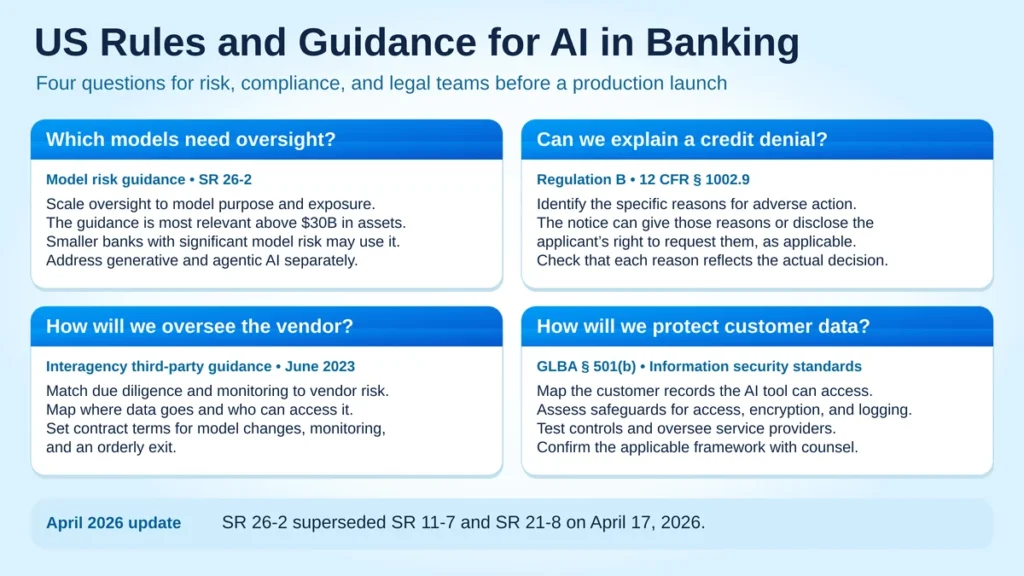
Your compliance and risk teams will ask four questions before any model touches production. Knowing them early saves weeks of rework. This section is a map, not legal advice, and your bank’s counsel makes the final call.
Model risk management: SR 26-2 replaced SR 11-7
On 17 April 2026 the Federal Reserve, OCC and FDIC issued revised guidance on model risk management (opens in a new tab) (SR 26-2). It supersedes SR 11-7 from 2011 and SR 21-8, the 2021 statement on BSA/AML models. Many articles still quote SR 11-7 as current, so check any vendor deck that does.
- Risk-based: the effort a model gets depends on its materiality, which the guidance ties to the model’s purpose and exposure.
- Size: the agencies expect it to matter most to banks with over $30 billion in assets. Smaller banks with heavy model use may still find it relevant.
- AI scope: traditional models and non-generative, non-agentic AI fall inside it. Generative and agentic AI models sit outside it, so your general risk and governance practices must cover them.
Pro tip: Out of scope does not mean unregulated. Write a short internal standard for generative AI now: approved uses, data it may see, human review and logging. Examiners will ask what you do in place of SR 26-2.
Credit decisions: Regulation B still asks for specific reasons
In May 2025 the CFPB withdrew 67 guidance documents (opens in a new tab). The list included its 2022 and 2023 circulars on adverse action notices for complex algorithms. The regulation underneath did not change. 12 CFR 1002.9 (opens in a new tab) still requires a statement of specific reasons when a lender takes adverse action. A note that the applicant missed an internal standard does not meet it.
In practice, any model that touches a credit decision must explain each result in plain reasons. A black box score with no reason codes will not pass review.
Vendors: the 2023 third-party guidance
Most banks will buy at least part of their AI stack. The interagency guidance on third-party relationships (opens in a new tab), final in June 2023, expects you to vet, contract and monitor each vendor in line with its risk. Ask any AI vendor where your data goes, who can see it, how they update the model and how you exit.
Customer data: GLBA security guidelines
Banks protect customer data under the Interagency Guidelines Establishing Information Security Standards (opens in a new tab), which put section 501(b) of the Gramm-Leach-Bliley Act into effect. Non-bank lenders and many fintechs fall under the FTC Safeguards Rule instead. Either way, an AI tool that reads account data needs access controls, encryption and an audit trail from day one.
Generative AI in banking: where it fits today
Inside the bank is the best first home for generative AI, because staff check every answer. JPMorgan, for example, says its in-house LLM Suite sits on the desktops of more than 200,000 employees (opens in a new tab). Most of that use is drafting, summarizing and finding answers in long documents.
Good first uses include:
- Drafting call and meeting notes for review
- Answering staff questions from your own policy library
- Summarizing loan files or complaint threads
- Producing first drafts of routine customer letters
Keep customer-facing generative answers narrow until you have months of logs. A wrong answer about a fee or a rate becomes a complaint, and possibly a UDAAP issue. Our AI agent developers usually start agents with read-only access and a person approving each action.
Pro tip: Tie every generative answer to a page from your policy library and display that citation beside it. Staff trust an answer they can check in one click, and auditors can trace it later.
Build, buy or partner: which fits your bank?
Most banks end up with a mix. The table helps you decide each use case on its own.
| Option | Best when | Watch out for | Typical example |
|---|---|---|---|
| Buy a product | The problem is common across banks and a mature product exists | Data sharing terms, model updates you cannot see, exit costs | Card fraud scoring from your processor |
| Build in-house | Your data or process gives you an edge and you have engineers to run it | Hiring, model upkeep, validation workload | A cash flow model for your loan book |
| Partner on a custom build | You need a fit to your core and workflows but lack the team | Knowledge transfer, who owns the code and the model | Document intake wired into your loan system |
Our honest view: a community bank or credit union should rarely build fraud scoring from scratch. Your processor sees far more transactions than you do. Custom work pays off around the edges, in the workflows and integrations no product covers.
What AI in banking costs and how long it takes
Cost follows scope, data readiness and how many systems the tool has to touch. Custom AI work from our team usually lands in one of three price ranges:
- A focused pilot, such as a staff knowledge assistant over one policy library: $8K to $25K.
- A production workflow with core or loan system integration, role-based access and audit logs: $25K to $70K.
- Multi-workflow platforms with several models, monitoring and validation support: from $70K.
On timing, most first pilots fit inside the 90-day plan below. Two costs surprise teams most often. Data cleanup can take as long as the model work. Validation and documentation also take real time, since your model risk team must review the model before it goes live. For a wider look at banking project budgets, see our banking software cost guide.
How to start: a 90-day AI plan for a bank
- Weeks 1 to 2: pick one workflow. Choose a high-volume task with a human check already in place. Write down today’s numbers, such as alerts per analyst per day.
- Weeks 2 to 4: check the data. Confirm where the data lives, who owns it and whether it may leave your network. Fix the gaps before any model work.
- Weeks 3 to 4: bring risk and compliance in. Agree the materiality rating, review steps and what documents they need. Do this before you write code, not after.
- Weeks 5 to 10: build the pilot. Run it beside the current process, with people checking every output. Log every result and every override.
- Weeks 10 to 12: measure and decide. Compare against the baseline. Scale, change or stop, and write down why.
This mirrors how we deliver AI work in general. A small proof of concept comes first, then an MVP that real staff use, then production once the numbers hold. Short on hands for the pilot? You can bring in our AI developers. After you sign off on the engineer, development starts within 48 hours.
Common mistakes to avoid
- Starting with the chatbot. It is the most visible project and often the riskiest. Back-office wins build trust faster.
- Skipping the baseline. Without today’s numbers, nobody can prove the pilot worked.
- Bringing compliance in at the end. A late “no” costs more than an early “yes, if”.
- Quoting old guidance. SR 11-7 and the withdrawn CFPB circulars still show up in vendor decks. Check the date on every source.
- Ignoring vendor exit terms. Ask how you get your data and model outputs back before you sign.
- Testing on clean demo data. Run the pilot on real, messy records from your own systems.
What we have learned from fintech builds
We have not built a model for a US bank, and we will not pretend otherwise. Our fintech projects still taught us what AI in financial software depends on. The hard parts sit in the data and the audit trail.
On EmberPay, a digital payments platform, we built real-time transaction status updates, automated reconciliation and audit-ready transaction records. Clean, timestamped records like these are exactly what a fraud or reconciliation model needs to learn from. On InvoiceMinds, we automated invoice generation and payment status tracking, to reduce manual calculation errors, with no AI involved.
The lesson from both: get the data flow and the audit trail right first. A model on top of messy records only automates the mess.
Pro tip: We would not add AI where a clear rule does the job. If a threshold or a simple reference table solves the problem, use it. It costs less to run and is easier to explain to an examiner.
Checklist: is your bank ready for AI?
- One named workflow with a business owner
- Today’s baseline numbers written down
- Data sources mapped, with owners and access rules
- Risk and compliance agreed on the review path
- A written standard for generative AI use
- Vendor questions on data use, updates and exit
- A human review step for every customer-facing output
- A date to decide: scale, change or stop
Getting started with AI in banking
AI in banking works best as a series of small, measured steps. Pick one workflow, set a baseline, involve risk early and let the numbers decide what comes next. The 2026 rules reward that approach, because a well-documented pilot is easy to defend.
Our AI-first engineers work from Ahmedabad, with team members on the ground in the USA and Germany too. Send us three things: the workflow you want to improve, where its data lives and the compliance rules your team has flagged. A senior engineer will reply within one working day with a first view of scope and risk. Share your workflow with our team, or look through our fintech software services first.
FAQs
Does SR 26-2 apply to a community bank or credit union?
SR 26-2 comes from the Federal Reserve, OCC and FDIC, and the agencies point to banks above $30 billion in assets as its main audience. Banks with a lot of model use below that size may still want to follow it. Credit unions answer to the NCUA, not these agencies, so check NCUA expectations with your examiner. Either way, a short written process for each model is a sensible baseline.
Can a bank use a generative AI model to help decide on a loan?
It can assist, but it should not make the call alone. Regulation B requires specific reasons for any adverse action, and a large language model rarely gives stable, explainable reasons. Use generative AI to summarize the file or flag missing documents, and keep the decision with an underwriter or an explainable scoring model your risk team has reviewed.
How do we keep customer data safe when we test an AI vendor?
Start with masked or synthetic data for the first demo, then move to real data only under a signed contract. Ask the vendor where data is stored, whether it trains their models, who can access it and how they delete it at exit. Your security team should review access controls and logging before any production account data reaches the tool.
What should we measure in the first AI pilot?
Pick one business number and one risk number. For fraud triage, that might be analyst minutes per alert and missed fraud cases. For document intake, files processed per day and rework rate. Record both before the pilot starts, track them weekly and agree in advance what result means scale, change or stop.