
AI in Food Supply Chains: Solving the 2026 Logistics Crisis
AI in food supply chains, explained: fresh demand forecasts, cold chain alerts, FSMA 204 traceability, agent tasks, a 6-step pilot and real cost ranges.
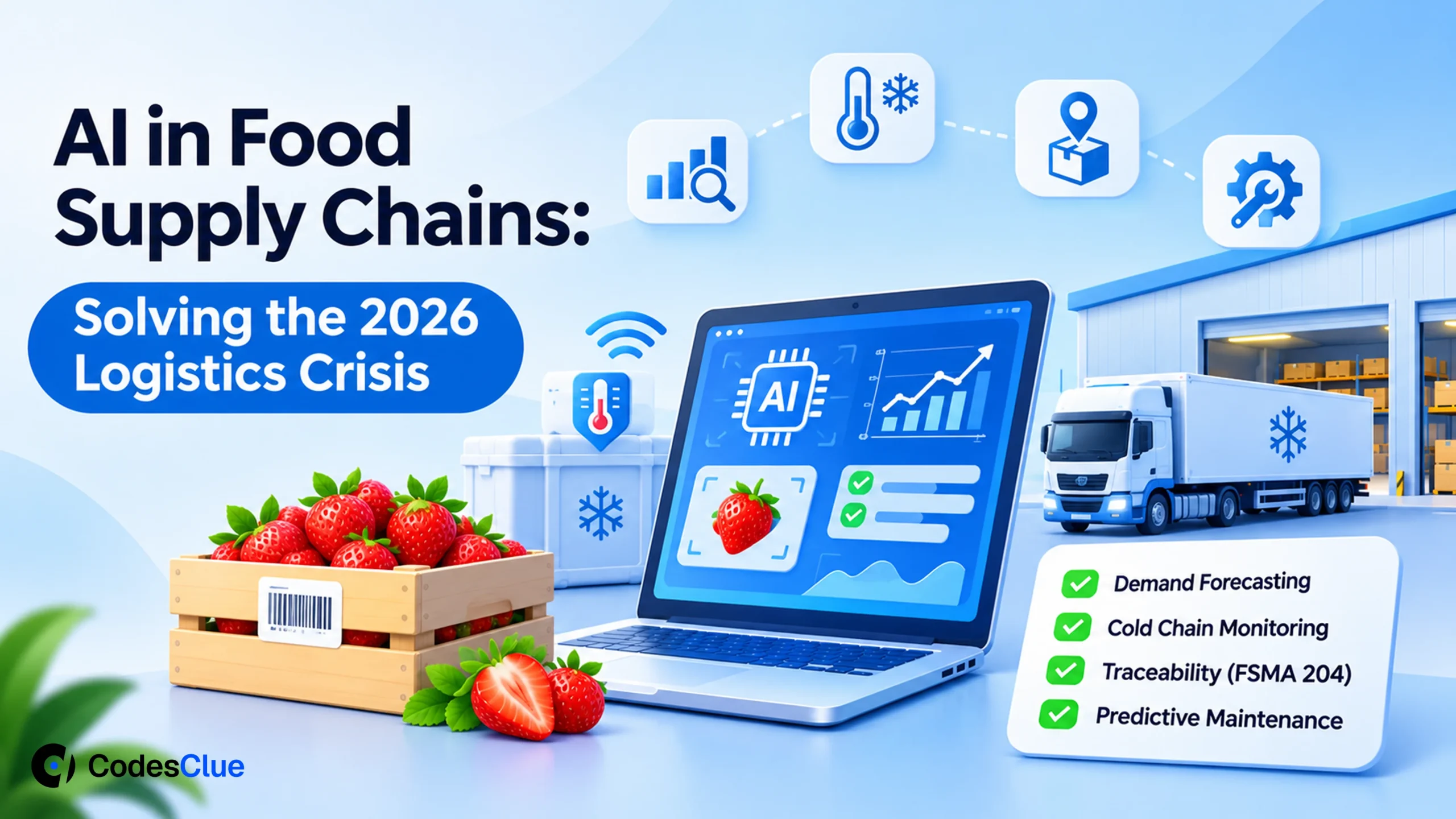
A pallet of strawberries has about a week to go from field to shelf. Miss one cold truck, guess the order wrong or wait on a supplier email, and it ends up in a dumpster. That is why AI in food supply chains is moving from slide decks into daily planning. This guide shows where it pays off, what the new FDA traceability rule asks of you, and how to start without a giant platform bill.
Key Takeaways
- Food is different from other freight: it spoils, it faces recalls and it changes with the weather. AI earns its keep on exactly those three problems.
- The best first projects are demand forecasting for fresh items, cold chain alerts and traceability records.
- The FDA food traceability rule (FSMA 204) now takes effect on July 20, 2028. Clean lot-level data helps both compliance and AI.
- Agentic systems work best when they draft orders and chase suppliers, while a planner approves anything that costs money.
- Start with one product family and one number to move, then grow from proof.
How AI and Agentic Systems Are Fixing Food and Beverage Supply Chains
AI in food supply chains means software that learns from sales, sensor, supplier and weather data to predict what will happen next. It then acts on that guess or hands a clear choice to a planner. In practice, that means fewer spoiled cases, fewer empty shelves and faster answers when a recall hits. The math is old. What changed is that the data now arrives fast enough to use.
The pressure is real. A UN Environment Programme report from March 2024 (opens in a new tab) found that 1.05 billion tonnes of food went to waste in 2022. Retail, food service and homes threw out 19% of the food available to consumers. The supply chain lost about 13% more before food reached a store.
So the case for AI in the food and beverage industry is simple. Every case you do not throw away is margin you keep.
Why food supply chains break more often than other supply chains
Most supply chain software grew up planning bolts and boxes. Food adds three problems that a standard planning tool handles badly.
| Problem | What goes wrong | What AI adds |
|---|---|---|
| Shelf life | Stock that sells next week is worthless next month | Forecasts by day and by store, with expiry dates in the math |
| Temperature | One warm hour on a dock can spoil a full load | Sensor alerts that predict a failure before the product warms up |
| Recalls | Teams pull whole product lines because they cannot find the exact lot | Lot-level records you can search in minutes |
| Weather and seasons | Crop yields, holiday peaks and heat waves move demand fast | Outside signals blended with your own sales history |
| Thin margins | A small error in ordering wipes out the profit on a product | Order suggestions tuned to waste cost, not only to stockouts |
Pro tip: Rank your products by waste cost before you pick a use case. The top ten items often carry most of the loss, and they make the best pilot.
Where AI in the food industry pays off first
Good first projects share four traits. They repeat daily, they use data you already collect, they have a clear right answer and a planner can check the result. Here are the areas where we see AI in the food industry deliver soonest.
1. Demand forecasting for fresh products
A forecasting model reads store sales, promotions, holidays and local weather, then predicts demand per item, per store, per day. For a dairy or bakery line, that turns a gut-feel order into a number with a range. Planners still make the call, only now with better odds.
2. Cold chain monitoring
Among the advantages of AI in cold chain logistics, early warning ranks first. Temperature and door sensors already sit in most reefer trucks and walk-in coolers. A model studies the normal pattern of each unit and flags drift hours before a compressor fails. It can also rank loads by remaining shelf life, so the oldest safe stock ships first.
3. Quality checks on the line
Cameras with computer vision spot bruised fruit, wrong labels, broken seals and foreign objects at line speed. AI sensors for food and beverage manufacturing add weight, color and moisture readings to the same check. The system pulls a bad unit and logs a photo, which gives your quality team evidence instead of a hunch.
4. Plant maintenance
AI-driven maintenance analytics for F&B plants read vibration, power draw and temperature on mixers, fillers and freezers. The model warns you when a part starts to behave like the last one that failed. You swap it on a planned shift instead of losing a full production run.
5. Restaurant and food service ordering
AI in food service industry kitchens works on a smaller scale. It predicts covers per day part, suggests prep quantities and drafts the next supplier order. In the AI in fast food industry, chains use the same idea across hundreds of stores. Our guide to AI in restaurants covers the menu side of this in detail.
Food traceability: what FSMA 204 asks of you
The FDA’s Food Traceability Rule (FSMA 204) (opens in a new tab) covers foods on its Food Traceability List, such as many fresh fruits, vegetables, seafood, eggs and soft cheeses. The compliance date moved from January 2026 to July 20, 2028. That extra time helps, but it does not shrink the work.
The rule asks every covered business to keep Key Data Elements for each Critical Tracking Event: harvesting, cooling, initial packing, shipping, receiving and transformation. Each record links to a traceability lot code. During an outbreak, the FDA can ask for an electronic sortable spreadsheet within 24 hours.
AI does not replace those records. It makes them usable:
- Reading messy paperwork. Models pull lot codes and dates from supplier invoices, bills of lading and PDFs.
- Finding gaps early. A check flags any shipment that arrived with a missing lot code, long before an auditor does.
- Answering the 24-hour request. One search builds the spreadsheet from every linked event, instead of a weekend of email.
- Narrowing a recall. Lot-level links show which stores got the affected batch, so you pull one lot and not the whole line.
Pro tip: Start traceability work now and treat it as your AI data project. The same clean lot records power better forecasts and faster recalls.
Planning one of these projects? Send us the product family and the system you track lots in today, and we will tell you which record gaps to close first.
Agentic AI in food logistics: software that acts on the warning
A forecast only warns you. An agent acts on that warning, inside limits your planners set. Agentic AI in supply chain work reads a goal, checks the data, calls tools such as your ERP or email, and drafts the next step. We cover the general pattern in our guide to predictive analytics and AI in logistics. In food, three agent jobs stand out.
| Agent job | What it does | Who approves |
|---|---|---|
| Supplier follow-up | Spots late purchase orders, emails the supplier and reads the reply | A buyer approves any new delivery date |
| Short-dated stock | Finds stock near its sell-by date and proposes a markdown, a transfer or a food bank donation | A store or category manager |
| Reroute on a cold chain alert | Proposes the closest site that can receive a load before it warms up | A dispatcher clicks accept |
Agentic AI in logistics should never cancel orders or change prices on its own in a first release. Give it narrow tools and keep a person on every step that moves money. Promote a task to more freedom only after a month of clean results.
Pro tip: Log every agent step with the data it read. When a buyer asks why the agent chose a supplier, you want the answer in one click.
Build or buy food and beverage manufacturing AI solutions?
Many planning and warehouse suites now ship with AI features. They suit standard processes. A custom build suits you when your edge sits in how you plan, source or trace. Use this table to decide.
| Your situation | Buy a platform feature | Build a custom layer |
|---|---|---|
| Data lives in one system | Yes | Rarely needed |
| Data spans ERP, WMS, sensors and supplier email | Hard to connect | Yes |
| Process matches most firms in your sector | Yes | Only for a small add-on |
| You need your own traceability rules or reports | Check the vendor roadmap | Yes |
| You want to own the model and its logs | Usually not possible | Yes |
Many teams do both. They switch on the vendor feature for the basics. Then they build a thin custom layer that joins their own data. That mix is how most food and beverage manufacturing AI solutions end up in practice.
How to start AI in food supply chains in 6 steps
- Pick one problem and one number. For example, waste on chilled ready meals, measured as cases thrown away per week.
- Measure the baseline for four weeks. Without it, nobody can prove the model helped.
- Audit the data. Check sales history by store and day, lot codes, sensor feeds and supplier lead times. Fix the fields the task depends on.
- Build a pilot for one product family. Run it beside your planners and compare every suggestion with what they ordered.
- Go live in one region. Planners accept or reject each suggestion, and each rejection teaches the model.
- Decide at 90 days. Scale to more lines, fix what failed, or stop. Stopping a weak pilot early saves money.
How to stay competitive in the food industry with AI
You do not need the biggest model. You need the cleanest data and the shortest loop between a prediction and a decision. Mid-size producers and regional distributors often move faster than giants here. One planner can test a new forecast on Monday and see the result by Friday.
Three habits separate the teams that win. They track waste and stockouts as one balance, not two separate goals. They share forecasts with key suppliers, so everyone plans from the same number. And they keep humans in charge of the calls that carry food safety or brand risk.
What we see in real projects
Food software lives or dies on clean product data. When we built Free Food Labels, a web tool that turns recipes into FDA-style Nutrition Facts labels, the hard part was data. Most of the work went into the ingredient database and serving size math. A label is only as accurate as the data behind each ingredient. Forecasts and traceability records work the same way.
On SmartPantryPal, a Flutter pantry app for households, the key lesson was about expiry alerts. They have to arrive early enough to act on, and rarely enough that people do not mute them. Short-dated stock alerts for a store manager face the same test.
Common mistakes to avoid
- Starting with a company-wide platform before one product line proves the value
- Forecasting total demand while ignoring shelf life and waste cost
- Feeding the model sales history that hides stockouts, which makes lost sales look like low demand
- Treating FSMA 204 as a paperwork task instead of a data project
- Letting an agent email suppliers before buyers trust its drafts
- Skipping the baseline, so no one can tell whether the pilot worked
When AI is the wrong call
Skip AI for a product that sells the same amount every week. A simple reorder rule will do. Skip it when your lot codes live on paper and nobody enters them. Fix the records first. And skip it for any choice that affects food safety where no person can check the result in time.
What an AI project for a food business costs
Price follows two things: the number of systems the work touches and how much the tool decides alone. Here are the bands we use for food supply chain projects:
| Scope | Typical work | Range |
|---|---|---|
| Pilot | One product family, one forecast or alert, two or three data sources | $8,000 to $25,000 |
| Production system | Several sites, planner approvals, traceability reports, monitoring | $25,000 to $70,000 |
| Supply chain platform | Forecasting, cold chain, traceability and agents across the business | From $70,000 |
Your cloud and model providers bill usage on top. New sensors or cameras, if you need them, sit in a separate hardware budget.
Plan your first food supply chain AI project
AI in food supply chains works when it starts narrow: one product family, one clean data set and one number that matters to your margin. Our AI-first engineers sit in Ahmedabad, and we also keep people in the USA and in Germany. In short Agile cycles, they carry this kind of work from a first proof to a working MVP and on into production.
Use the contact form to send three things. Tell us the products that waste the most and the systems that hold your sales and lot data. Then add when you want to see results. Expect an engineer’s reply inside one business day. You get a suggested first use case, the data gaps to close and a cost band from the table above.
You can also see our food service software development work, our logistics software development services and our machine learning development services. Need extra hands on your own team? You can hire AI developers too. Once an engineer passes your interview, development starts within 48 hours.
FAQs
How does AI reduce food waste in a supply chain?
It cuts waste at three points. Better daily forecasts mean stores order closer to what they sell. Cold chain alerts catch failing coolers before products warm up. Short-dated stock alerts give managers time to mark down, transfer or donate food. Most savings come from fresh items with short shelf life, so start there.
Do we need FSMA 204 compliance if we only sell in one state?
Very likely, if you handle foods on the FDA Food Traceability List. The rule covers businesses that manufacture, process, pack or hold those foods, with some exemptions for small farms and certain retailers. Check the FDA exemption list against your own operations, or ask a food safety advisor, before you plan your records.
What data do we need before starting an AI forecasting pilot?
At least one year of sales by item, store and day, so the model sees seasons and holidays. Add promotion dates, stockout records and supplier lead times if you have them. Weather data is easy to buy. The most common gap is stockouts: without them, the model reads lost sales as low demand.
Can AI work with older ERP and warehouse systems?
Yes, in most cases. Where your system exposes an API, or a database we are allowed to read without risk, we connect to it directly. If not, scheduled exports work for forecasting, because most food planning runs daily. Real-time jobs such as cold chain alerts usually read sensor platforms directly instead of the ERP.