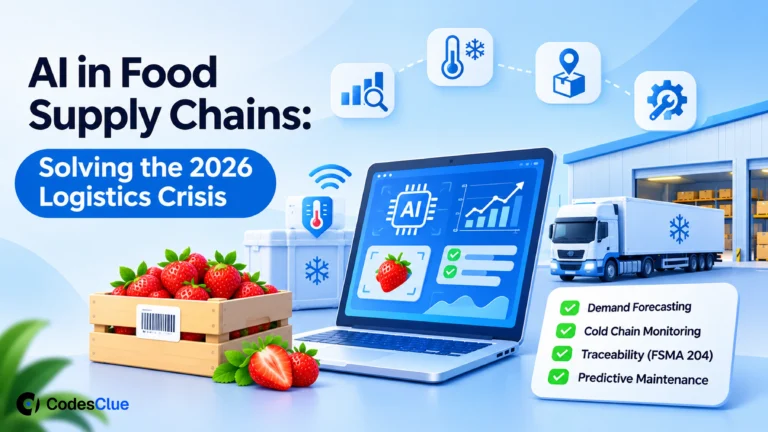

AI in Restaurants: A Practical Guide to Generative AI Menu Personalization
How AI in restaurants builds a personal menu for each guest: how it works, add-on vs custom, guardrails for prices and allergens, and a 5-step launch.
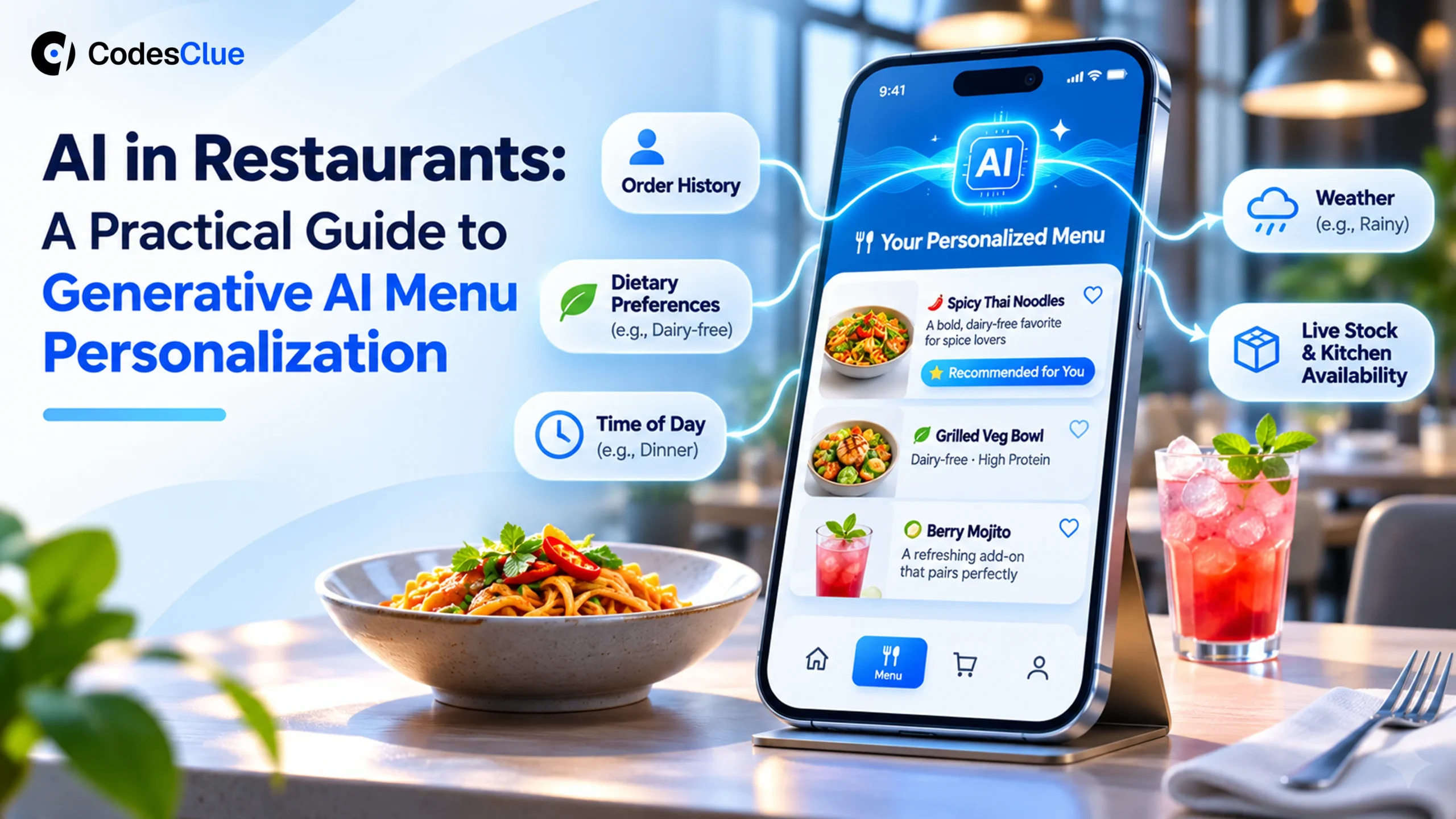
A regular opens your app on a rainy Tuesday night. She skips dairy, loves spicy food and always adds a drink. Your menu still shows her the same cheesy bestseller it shows everyone else.
That gap is where AI in restaurants now earns its keep. This guide explains how generative AI builds a menu for each guest and where it pays off beyond the menu. You will also see how to launch it without risking prices, allergens or trust.
Key Takeaways
- Generative AI can show each guest a personal menu built from their order history, the time of day and what your kitchen has in stock.
- Prices, allergens and stock levels must come from your own systems. The model reorders and rewrites, it never invents facts.
- The biggest wins come when menu personalization connects to demand forecasting and inventory.
- Most stalled pilots fail on data and accuracy, not on the model. Clean item data comes first.
- Start with one digital channel, test against your current menu for four to six weeks, then expand.
What does AI in restaurants mean for your menu?
For your menu, AI in restaurants means a model that builds a personal view of the menu for each guest. It reads past orders, the time and weather, and live stock. Then it reorders dishes, rewrites short descriptions and suggests pairings. Prices and allergen labels still come straight from your POS and recipe system.
Older recommendation tools follow fixed rules, such as showing fries to everyone who orders a burger. Generative AI menu personalization understands context and explains its picks in plain words. That turns AI for personalized customer experiences from a widget into something closer to a good server.
On the guest’s screen, the model can:
- Move likely favorites to the top of each category
- Rewrite a dish description to match what the guest cares about, such as spice or portion size
- Suggest a side or drink that fits the dish and your margin goals
- Filter for vegan, gluten-free or nut-free choices the guest saved
- Answer questions like “What’s light and under $15?”
How a personalized menu works, step by step
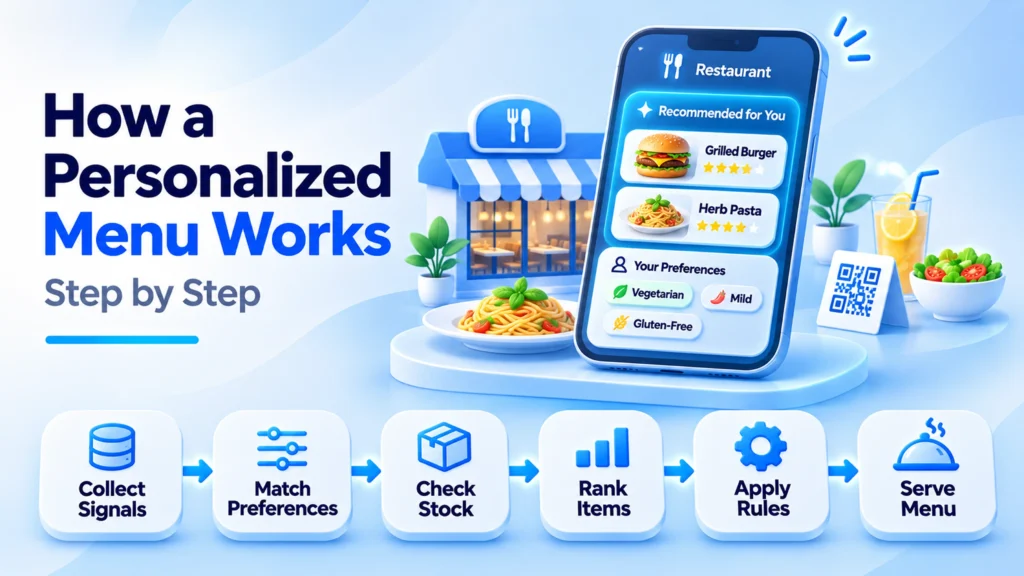
- Collect signals. The app reads the guest’s past orders, saved dietary needs, channel and time of day.
- Match a persona. The system places the guest in a group such as “weekday lunch regular” and then adjusts for the individual.
- Check the kitchen. It pulls live stock and prep levels so it never pushes a dish you cannot make.
- Rank and write. The model orders the items and drafts short, personal descriptions.
- Apply guardrails. Rules lock prices, allergens and legal claims to your source systems.
- Learn. Each order and each ignored suggestion feeds the next menu.
Pro tip: Treat step five as the one you can never skip. If a rule cannot verify a price or an allergen, the suggestion should not appear at all.
Why AI in restaurants matters in 2026
Guests expect personal treatment, and the tools are finally ready for mid-size brands. Here is what recent research shows.
| What the data shows | Figure | Source |
|---|---|---|
| Consumers who expect personalized interactions | 71% (76% get frustrated without them) | McKinsey, 2021 (opens in a new tab) |
| Typical revenue lift from personalization | 10 to 15% | McKinsey, same study |
| Operators using or piloting AI for reporting and analytics | 69% by mid-2026, up from just over 25% at the start of the year | Restaurant365 mid-year report, 2026 (opens in a new tab) |
| Active AI users reporting lower food and labor costs | 61% and 62% | Restaurant365, July 2026 (opens in a new tab) |
Adoption is rising fast, yet guest-facing use still lags. In Deloitte’s late-2024 survey of 375 restaurant leaders, only 9% used generative AI daily. So brands that personalize well still stand out.
The news points the same way. In September 2026, McDonald’s announced ArchIQ, an AI operating system for drive-thru ordering, inventory tracking and order accuracy, as Restaurant Dive reported (opens in a new tab). You do not need a chain-sized budget to follow. You need clean data, one clear use case and a team that can connect the pieces.
Static, rules-based or generative AI menu: how they compare
| Factor | Static menu | Rules-based menu | Generative AI menu |
|---|---|---|---|
| Personal to each guest | No | By segment | Yes, one to one |
| Uses live context | No | Limited | Yes, in real time |
| Answers guest questions | No | Basic filters | Natural conversation |
| Upsell style | Fixed combos | “Often bought together” | Pairings that fit the moment |
| Best for | Small, stable menus | Simple loyalty offers | Brands with app, web and kiosk orders |
Customer persona AI: the starting point
Think of customer persona AI as the engine under the menu. It groups guests by behavior, such as a price-aware weekday lunch crowd or weekend families who order dessert. The generative model starts from that persona and then adapts to each person as their order history grows.
Personas also solve the new-guest problem. A first-time visitor gets a sensible menu for their persona, and it sharpens with every order.
Pro tip: Begin with five to eight personas built from POS and loyalty data. Name each one in plain words so managers can sanity-check what the model does.
Where AI in the restaurant industry pays off beyond the menu
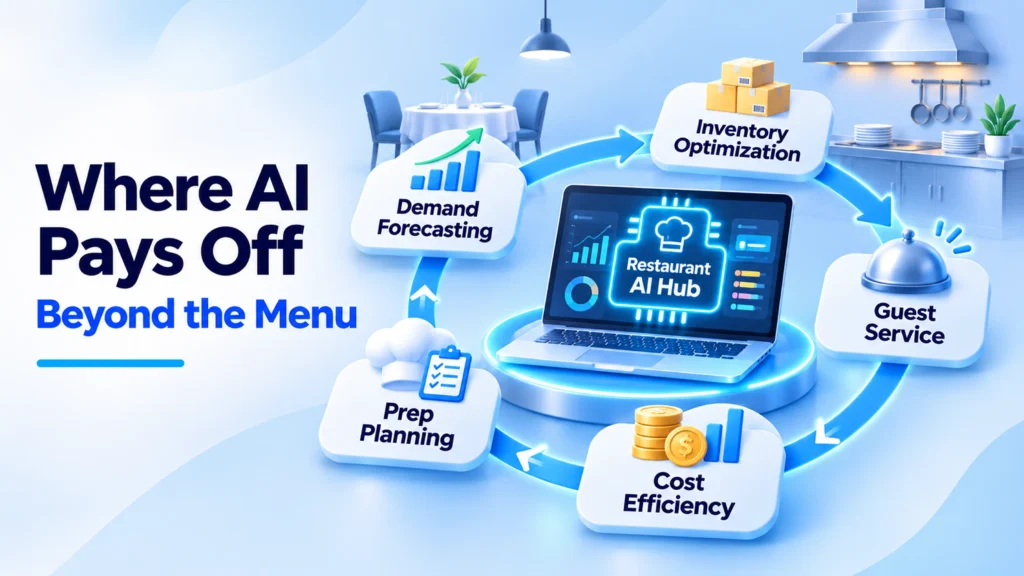
A personal menu fails if it promises dishes the kitchen cannot make. Connect it to forecasting and stock, and AI in the restaurant industry pays off twice: more revenue per order and less waste.
AI demand forecasting in restaurants
With AI demand forecasting in restaurants, the system predicts covers and item sales by the hour from sales history, weather and local events. Your menu engine can then promote dishes you over-prepped and quietly hide items that are running low. Our guide to AI predictive analytics shows how these forecasts work.
Agentic AI in restaurants
Generative AI suggests. Agentic AI in restaurants acts, inside limits you set. One agent can spot a slow Tuesday and send an offer to lapsed regulars. Another can feature surplus salmon to guests who order seafood. Keep a person approving anything that touches price or allergens. Hotel teams apply the same idea to bookings and guest requests, covered in AI in travel and hospitality.
AI tools for reducing operational costs in restaurants
The data that lifts revenue also cuts cost. These are the main AI tools for reducing operational costs in restaurants and where the savings show up.
| Tool type | Where the savings show up |
|---|---|
| Demand forecasting | Less waste, tighter prep lists |
| Labor scheduling | Fewer overstaffed hours |
| Inventory intelligence | Lower food cost, fewer stockouts |
| Menu engineering | Better menu mix, higher average check |
Example scenario (typical pattern, not a client result): A 12-location fast casual brand sees the forecast call for a quiet, rainy evening. The kitchen preps fewer salads.
The app moves soups and hot bowls to the top for regulars who order warm dishes on cold days. It pairs each bowl with a drink that has a healthy margin. Nobody changes a price.
Planning a personal menu for your app or kiosk? Tell us what you want to build and an engineer will reply within one business day with honest next steps.
Add-on or custom build: which option fits you?
When you compare AI tools for restaurant customer personalization, you are trading speed against control. A POS add-on goes live quickly but stays generic. A custom layer fits your brand, menu logic and data, and it takes longer.
| Question | POS or ordering add-on | Custom personalization layer |
|---|---|---|
| Time to first test | Weeks | A few months for one channel |
| Fits your menu rules | Partly | Fully |
| Uses data from several systems | Usually only its own | POS, loyalty, recipes and inventory together |
| Who owns the data and logic | The vendor | You |
| Cost pattern | Monthly subscription | Build cost, then hosting and support |
Which one fits you:
- One or two locations, one ordering app: start with the add-on your POS already offers.
- Several brands or channels on different systems: a custom layer pays off because it joins the data.
- A loyalty program is your main asset: build custom, so the guest data and the logic stay yours.
- Unsure: pilot with an add-on, measure, then build custom only where the add-on falls short.
For a custom build, CodesClue’s ranges are $8K to $25K for an MVP and $25K to $70K for a mid-size product. Large platforms start from $70K. A short discovery phase turns that range into a firm, written estimate.
Pro tip: Ask any vendor how they keep prices and allergens out of generated text. A vague answer tells you all you need to know.
Why restaurant AI pilots stall, and how to avoid it
Most guides list what AI can do. Few explain why projects fail. Restaurant365’s 2026 mid-year survey of more than 420 US operators names the main barriers.
| Barrier | Operators citing it | The fix |
|---|---|---|
| Data privacy and security | 37% | Clear consent, easy opt-out and a written data-retention policy |
| Output accuracy | 34% | Ground the model in your real menu, prices and recipes |
| Cost | 29% | Pilot one channel before a full rollout |
| Not knowing where to start | 18% | One use case, one KPI, one channel |
Big brands show the same lessons in public:
- Data comes before models. McDonald’s bought a personalization start-up in 2019 and sold it to Mastercard in 2022 (opens in a new tab). Its 2026 plan rests on a unified POS and one shared pool of restaurant data.
- Accuracy decides adoption. McDonald’s ended its drive-thru voice test with IBM in 2024 after accuracy problems. In 2025, Taco Bell said busy stores may do better with a person taking orders, as Nation’s Restaurant News reported (opens in a new tab).
- Readiness gates scale. McDonald’s says each restaurant must meet technology prerequisites before ArchIQ goes live there.
The personalization “creepy line”
Personalization builds loyalty until it feels like surveillance. Use this guide to decide which guest signals your menu may use.
| Signal | Rule | Why |
|---|---|---|
| Past orders, saved favorites | Use freely | Guests expect you to remember them |
| Time of day, weather, channel | Use freely | Context, not personal data |
| Dietary needs and allergies | Ask first | Sensitive, so guests should opt in |
| Location history, birthdays | Ask first | Useful, but personal |
| Guessed health, income or life events | Avoid | Feels intrusive and adds legal risk |
Pro tip: Add a short “Because you ordered the spicy bowl” note under each suggestion. That one line makes personalization feel helpful instead of strange.
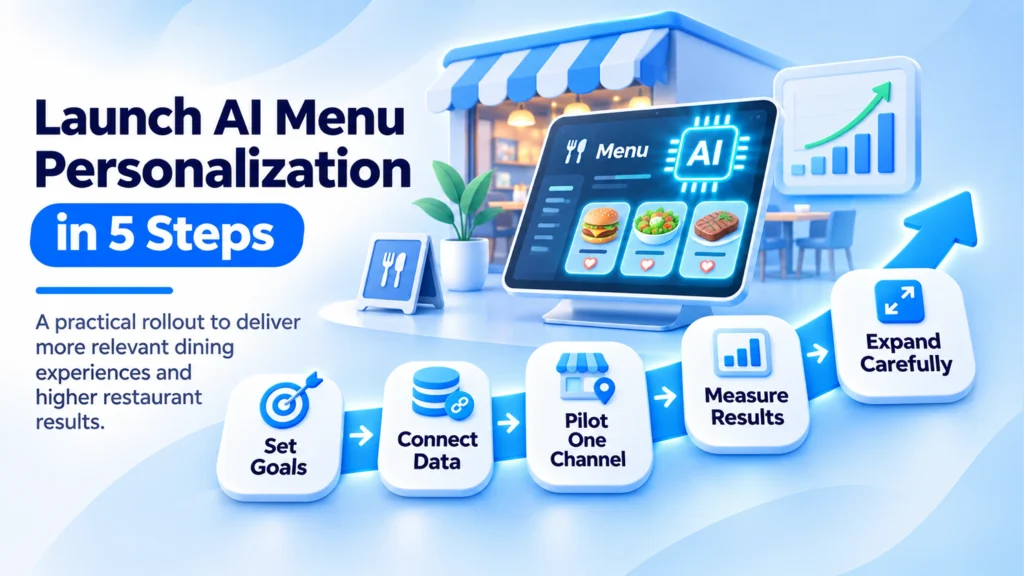
How to launch AI menu personalization in 5 steps
- Pick one channel. Start with your app, online ordering or kiosk, where each guest has their own screen.
- Clean your data. Match item IDs across POS, loyalty, recipes and inventory.
- Set guardrails. Lock prices, allergens and claims. The model rewrites copy, never facts.
- Run an A/B test. Compare the personal menu with your current menu for four to six weeks.
- Measure, then expand. Track average check, add-on rate, repeat visits and complaints before you add channels.
Before you switch on any AI tool for guests, confirm this checklist:
- One verified source feeds allergen and nutrition data
- Prices and promotions come from your systems, never from the model
- Guests can see and change how you use their data
- Managers can pause recommendations in one click
- Logs show why each guest saw each suggestion
Common mistakes to avoid
- Letting the model write prices or allergen text. One wrong allergen line costs more trust than a year of good suggestions earns.
- Starting with voice. Drive-thru voice is the hardest channel. Screens forgive errors, while a misheard order reaches the window.
- Skipping the control group. Without an A/B test you cannot tell a seasonal bump from a real lift.
- Personalizing a menu the kitchen cannot deliver. Tie suggestions to live stock from day one.
- Measuring only clicks. Average check, repeat visits and complaints tell you far more.
What we see in real projects
Our food work keeps teaching the same lesson: the data source matters more than the model. On Free Food Labels, nutrition values come from the USDA food database, never from free text. A personal menu needs that same single source for allergens and nutrition.
SmartPantryPal suggests recipes from what a household already has in the cupboard. Restaurants can apply the same idea to the walk-in fridge: recommend what you have, not only what sells.
Our engineers work AI-first, in short agile sprints, from Ahmedabad and with offices in India, the USA and Germany. For a restaurant brand that usually means a small proof of concept on one channel, then an MVP, then production once the numbers hold.
When personalization is the wrong call
We would not build a custom layer for a single location with a short, stable menu. A good static menu and a simple loyalty offer will do more for less. Fix the basics first if your item data lives in three systems that disagree.
The bottom line on AI in restaurants
AI in restaurants has moved past drive-thru experiments. Generative AI can now give every guest a menu shaped around their taste and the moment, while your kitchen sells what it actually has. The brands that win pair it with forecasting, firm guardrails and honest use of guest data.
Want a menu that feels made for each guest? Share your POS, loyalty and ordering setup, and we will map the shortest safe path to a pilot.
See our food service software development, generative AI and AI agent development services, or start the conversation here. Need extra hands instead? Hire AI developers for your own team, and development starts within 48 hours.
FAQs
How does AI menu personalization handle a guest who has never ordered before?
A new guest gets a menu built for a persona, using signals that need no history: time of day, channel, weather and what is popular at that location right now. If the guest saves dietary needs at sign-up, those filters apply from the first visit. Personal ranking starts after a few orders and gets sharper with each one.
Should generative AI change menu prices for each guest?
We advise against it. Personal pricing can feel unfair, can clash with local consumer rules, and it breaks trust fast once guests compare screens. Most brands personalize the order of items, the descriptions and the pairings while every guest sees the same price. Time-based offers, such as a quiet-hour discount open to everyone, carry far less risk.
Does AI menu personalization work for dine-in guests?
Yes, through QR code menus, table tablets and server handhelds that suggest pairings for the table. Dine-in is harder than an app because several people share one screen and many guests are anonymous. Most brands start with digital ordering, prove the lift there, and then bring the same engine to QR menus and staff devices.
Can a small independent restaurant use AI for personalization?
Yes, but start small. Many POS and online ordering systems already include basic recommendations, so switch those on and watch the add-on rate for a month. A custom build makes sense once you run several locations or channels, or when your loyalty data is strong enough that you want to own the logic yourself.
What data does a personalized restaurant menu need from our systems?
At minimum it needs clean item IDs, prices and modifiers from your POS, order history from your app or loyalty program, and allergen data from one recipe source. Live stock or prep levels help a lot but can come later. The hardest part is usually matching the same dish across systems that each use a different name or code.