

Flutter vs React Native in 2026: Which Framework Is Better for Startups?
Choosing between Flutter and React Native for your startup? See how they stack up in 2026 on speed, talent pool, and long-term costs
Market Research Future (opens in a new tab) reveals that the cross-platform mobile application market is expected to grow from 15.67 USD Billion in 2025 to 47.61 USD Billion by 2035, driven by businesses seeking faster development cycles and broader platform reach. As startups and newly established businesses are racing to launch products quickly while controlling costs, cross-platform frameworks have become the preferred choice over separate native development teams.
Both Flutter and React Native are mature, production-ready technologies. They are backed by industry giants – Google and Meta, respectively. Each framework powers applications used by millions of users worldwide.
This guide is much more than another developer-focused tutorial. It helps you navigate the decision-making framework designed specifically for startup founders, CTOs, and product leaders evaluating the best mobile framework for startups. Let’s break down every factor that actually matters for startups.
Flutter & React Native: A Quick Overview
As they are used in cross-platform solutions, Flutter and React Native solve the same problem – building applications for multiple platforms from a single codebase. However, they take fundamentally different approaches.
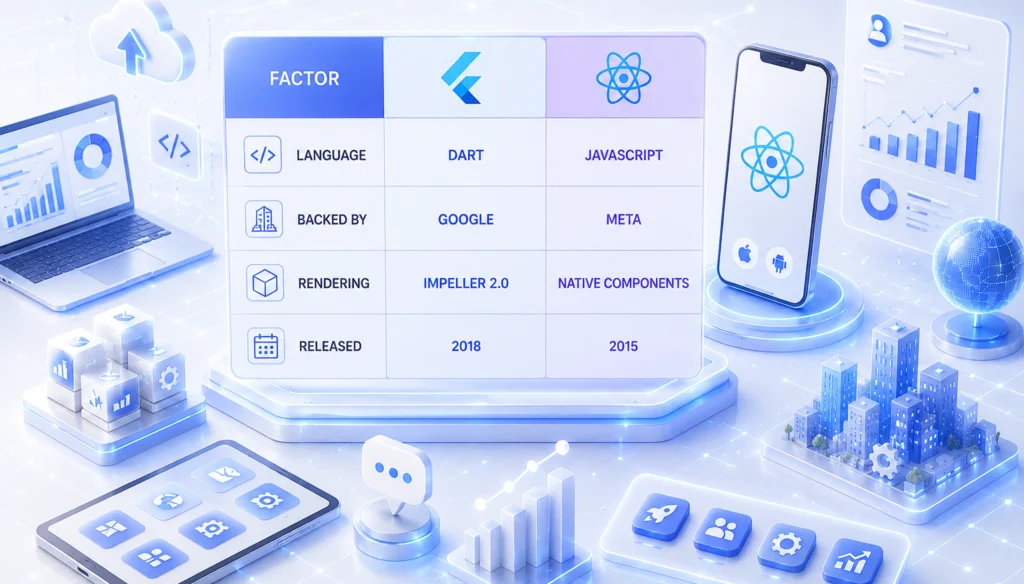
Flutter is Google’s UI toolkit that uses Dart and its own rendering engine, Impeller 2.0, to draw every interface element directly on the screen. This gives developers complete design control and highly consistent experiences across platforms.
On the other hand, React Native is developed by Meta and uses JavaScript and React. Instead of drawing its own UI, it connects to native platform components, helping apps feel naturally integrated with iOS and Android.
Quick Comparison
Performance: Which Framework Works Faster in 2026?
One of the most discussed aspects of the React Native vs Flutter performance debate is to find which framework works faster.
Flutter still maintains an edge in raw benchmark performance. Thanks to its Ahead-of-Time (AOT) compiled Dart architecture and Impeller 2.0 rendering engine, Flutter consistently delivers smooth animations and can maintain up to 120fps on supported devices. Average cold startup times hover around 250ms in optimized applications.
React Native has also made tremendous progress in recent years. The introduction and stabilization of the React Native New Architecture, including Fabric, TurboModules, and JavaScript Interface (JSI), has removed many of the performance bottlenecks associated with the old bridge architecture. Modern React Native applications often achieve cold start times around 350ms.
Memory consumption also favors Flutter:
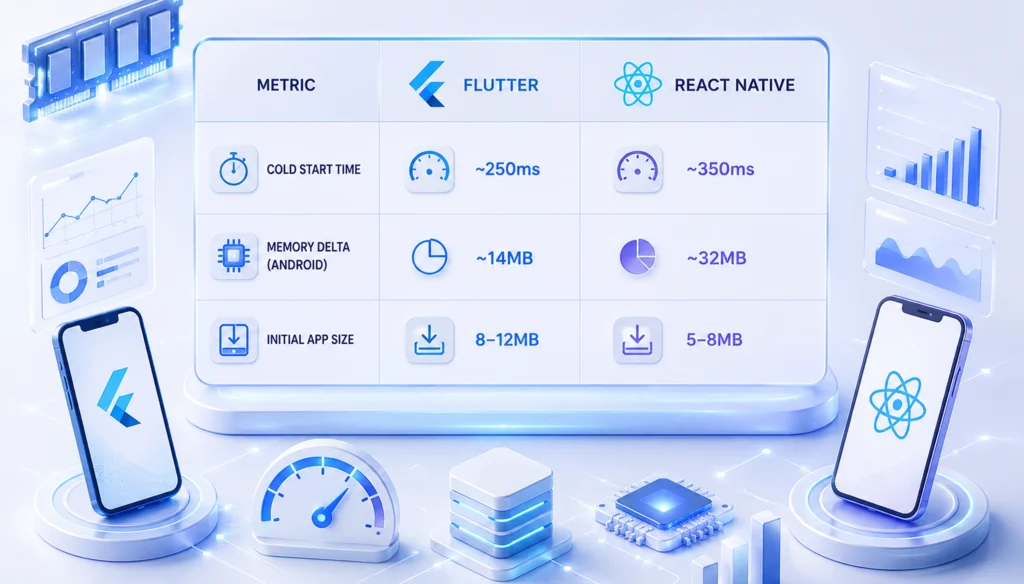
While React Native often produces slightly smaller initial application packages, the difference becomes less significant as projects grow.
Performance Verdict
Flutter wins on pure performance benchmarks. However, for typical business applications, SaaS products, marketplaces, and content-driven apps, end users rarely notice the difference. Performance should only become a deciding factor if your product relies heavily on animations, real-time visualizations, or highly customized interfaces.
Developer Experience & Hiring Reality
Technology choices often fail not because of code quality but because startups struggle to hire developers. This is where React Native holds a major advantage.
Because React Native uses JavaScript, startups gain access to one of the world’s largest developer ecosystems. Current hiring trends show significantly more React Native job openings and a JavaScript talent pool that is several times larger than Dart’s.
So, while comparing Dart vs JavaScript mobile development, JavaScript offers a lower barrier to entry because many web developers can transition into React Native with minimal retraining.
Flutter, meanwhile, requires developers to learn Dart. While Dart is considered easy to learn, it still creates an onboarding step for many engineering teams.
Both frameworks support hot reload, but Flutter’s implementation remains slightly faster and more reliable for preserving application state during development.
Startup Hiring Verdict
If your startup has a small team, limited hiring budget, or aggressive timelines, React Native often delivers faster onboarding and lower recruitment costs.
UI Flexibility & Design Control
One of the biggest differentiators in the Flutter vs React Native for startups discussion is design flexibility.
Flutter renders every visual component itself. As a result, developers can achieve nearly identical interfaces across Android and iOS while maintaining pixel-perfect consistency.
React Native takes the opposite approach by leveraging actual native components. This means applications automatically inherit platform-specific behaviors and conventions.
React Native works particularly well for:
- Business applications
- Productivity tools
- Enterprise software
- Accessibility-focused products
- Apps requiring platform-native experiences
Key Insight
If your design is a major competitive advantage, Flutter offers unmatched flexibility. If platform familiarity and native behavior matter more, React Native is often the stronger choice.
Development Cost & Time-to-Market
Startups care about one thing above almost everything else – speed.
Both frameworks significantly reduce development costs compared to maintaining separate native iOS and Android teams. However, their economic advantages differ.
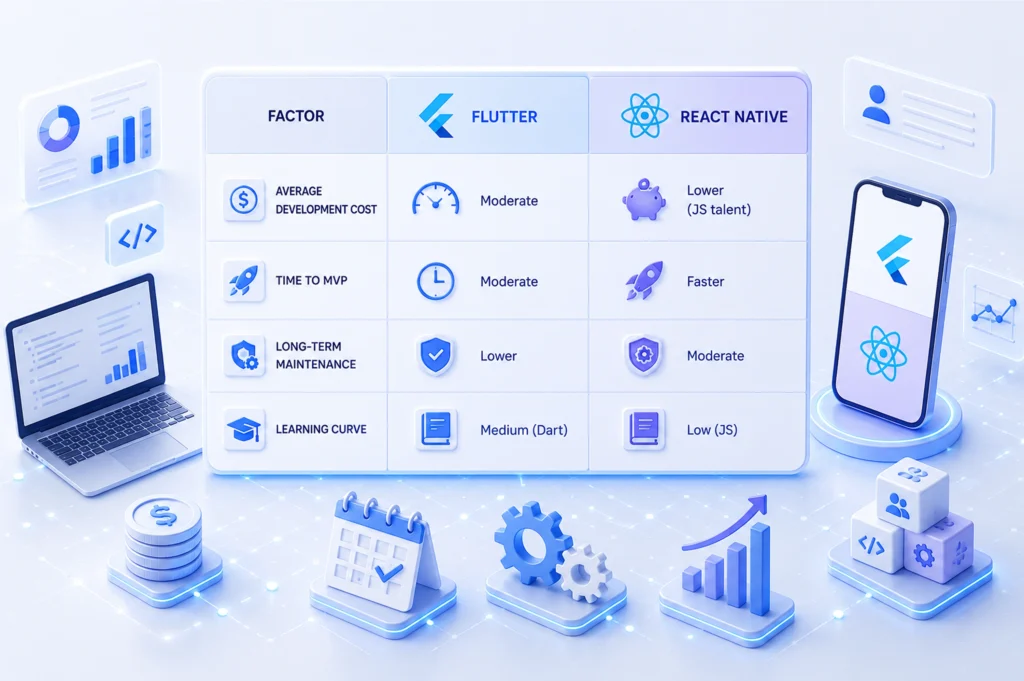
React Native often wins during the MVP phase because JavaScript developers are easier to hire, and many organizations already possess React expertise.
Flutter, on the other hand, tends to reduce UI inconsistencies and platform-specific bugs over time, lowering maintenance costs as products mature.
Cost Comparison
Startup Verdict
Need an investor-ready MVP within eight weeks? React Native is often the safer choice.
OR
Building a product expected to evolve over the next five years? Flutter may deliver stronger long-term value.
Scalability & Long-Term Growth
Scalability is where framework decisions begin impacting business outcomes.
Flutter’s architecture gives it advantages for performance-intensive applications and enterprise-grade mobile products. Because Flutter controls rendering directly, teams can maintain consistent experiences as applications grow more complex.
React Native also scales effectively, especially for SaaS platforms, AI-powered products, marketplaces, and content-heavy applications.
Importantly, neither framework faces abandonment risks. Google and Meta continue investing heavily in both ecosystems.
Flutter or React Native: Which One Should You Pick?
There is no universal answer to whether Flutter or React Native is better.
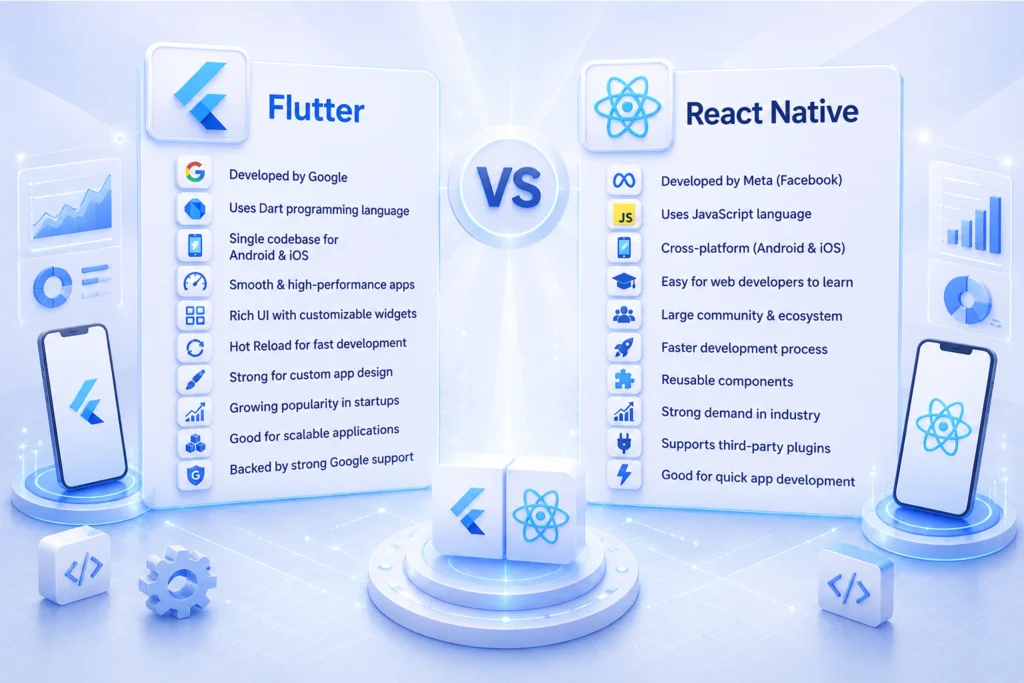
The right choice depends on your business priorities.
Go For Flutter Development Service If:
- Your application is heavily UI-driven.
- Design consistency is essential.
- You’re building a long-term mobile-first product.
- Performance at scale matters.
- Desktop support is part of your roadmap.
Go For React Native Development Service If:
- You need a fast MVP.
- Your team already knows JavaScript.
- Hiring speed is important.
- You’re building SaaS platforms.
- AI integrations are a significant part of your roadmap.
Master Comparison Table
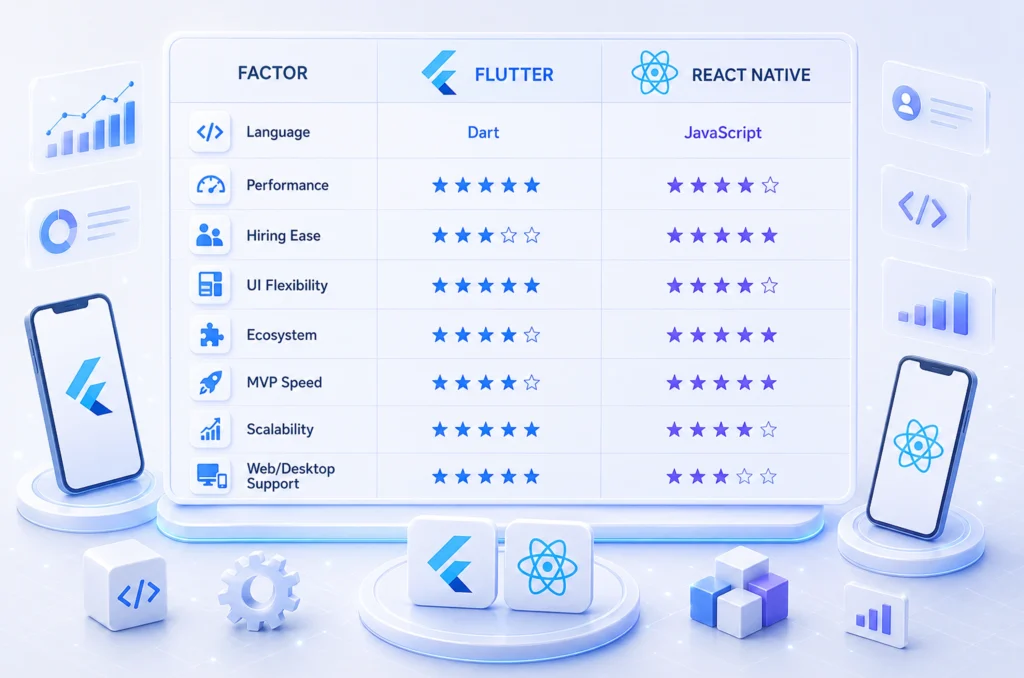
What’s New in 2026: Key Updates You Should Know
The gap between Flutter and React Native continues to shrink.
Flutter’s Impeller 2.0 renderer is now the default rendering engine across both iOS and Android, delivering smoother animations and improved graphics consistency. Flutter Web has also seen substantial rendering improvements.
On the React Native side, the New Architecture is now fully stable. When combined with the Hermes engine, startup times have improved significantly, with many teams reporting 40–50% faster launches than with older React Native implementations.
Both frameworks now deliver experiences remarkably close to native performance. However, React Native maintains a slight advantage for AI integrations due to its JavaScript ecosystem and faster access to emerging AI libraries.
Community growth, enterprise adoption, and GitHub activity remain strong across both platforms.
Conclusion
The Flutter vs React Native debate doesn’t have a universal winner because startup requirements differ. Flutter excels in performance, design control, and long-term scalability, making it ideal for mobile-first products where user experience is a competitive differentiator. React Native shines in hiring ease, rapid MVP delivery, and JavaScript-first development environments, making it a strong choice for startups focused on speed and validation.
Before choosing your MVP app development framework, ask yourself three questions:
- Does my team already know JavaScript?
- Do I need an MVP in under three months?
- Is UI customization a core part of my product?
Your answers will often reveal whether Flutter or React Native is the better fit for your startup’s growth journey.
Frequently Asked Questions
Which is better for startups: Flutter or React Native?
It depends on your priorities. Flutter is ideal for performance and custom UI, while React Native is often better for rapid MVP development and easier hiring.
Is React Native still relevant in 2026?
Yes. With the stable React Native New Architecture, improved performance, and strong Meta support, React Native remains one of the leading cross-platform frameworks.
Does Flutter perform better than React Native?
In benchmark tests, Flutter generally delivers better rendering performance and smoother animations. However, for most business applications, users rarely notice a significant difference.
Which framework is cheaper to develop with?
React Native often has lower initial development costs because JavaScript developers are more widely available. Flutter may reduce maintenance costs over the long term.
Can Flutter and React Native support AI-powered applications?
Yes. Both frameworks can integrate AI services and APIs. React Native has a slight advantage due to the larger JavaScript ecosystem and faster access to AI libraries.
Which framework is better for long-term scalability?
Flutter is often preferred for highly customized, performance-intensive applications, while React Native scales effectively for SaaS, marketplace, and content-driven products.
How do I choose the right framework for my business?
Consider your team’s expertise, launch timeline, hiring plans, UI requirements, and long-term product roadmap. A technology consultation can help identify the best option