
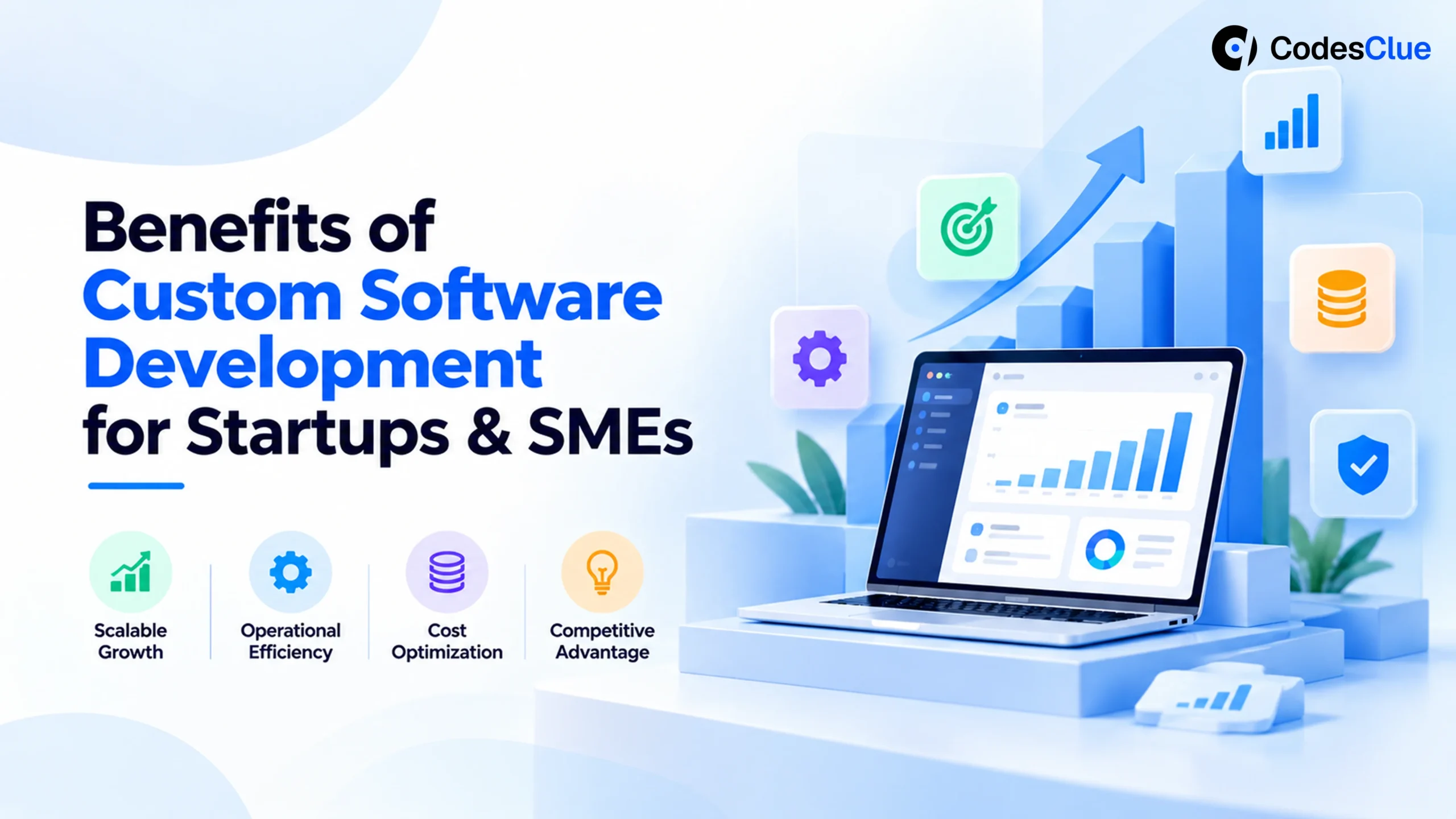
Benefits of Custom Software Development for Startups & SMEs
Learn how custom software development gives startups & SMEs a competitive edge with scalable, secure, and cost-efficient digital solutions.
The concept of custom software development wasn’t that popular years back, the SMEs and startups were heavily leaned on the off-the-shelf tools for quick deployment, easy to use and cost-effective nature.
But this narrative became outdated with the introduction of modular architectures, AI-assisted development, and cloud-native scalability features in custom software development. Thus, custom development has become more accessible, faster to build, and significantly more cost-efficient than ever.
This blog covers how beneficial custom software development has become for startups, especially for companies looking to scale, differentiate, and achieve long-term ROI.
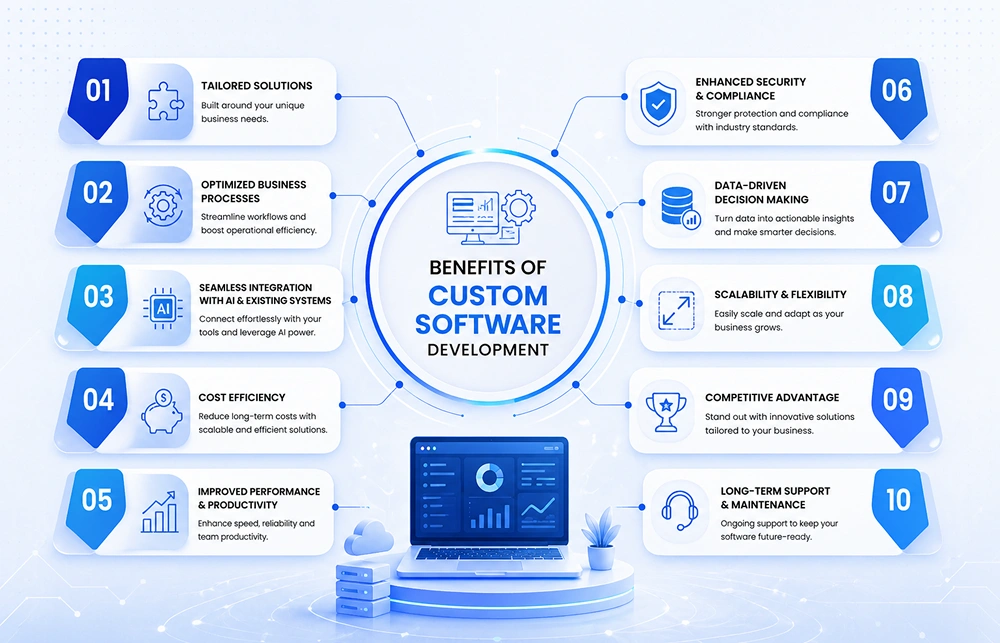
1. Perfect Alignment with Unique Business Workflows
Most startups and SMEs use SaaS tools to perform their generic workflows. These tools work well and often force teams to adapt their processes to the software. Studies and industry observations suggest SMEs waste up to 20% of operational time working around tool limitations.
However, custom software flips this dynamic. Instead of adapting your business to rigid systems, you build software that mirrors your exact workflows, leading to improved operational efficiency, reduced manual workarounds, faster execution cycles, and lower training overhead.
It matters because when your software aligns perfectly with your operations, your team spends less time managing tools and more time delivering value. This is especially critical for startups where every hour and resource counts.
2. Predictable Scalability for Rapid Growth
Most startups begin with basic SaaS plans. The ready-made software lets you hit its limitations within 6–12 months only due to user caps, feature restrictions, performance bottlenecks, and expensive upgrades.
Custom-built systems are designed with scalable software solutions for startups in mind from day one by leveraging cloud-native scalability, microservices architecture, and elastic infrastructure. You ensure your system grows seamlessly with your business.
The key benefits of using custom software programs include no forced migrations, no sudden pricing shocks, and no need to rebuild your system mid-growth. Instead, you scale predictably and sustainably.
3. Ownership of Intellectual Property (IP)
When you use SaaS tools, you are essentially renting software and not buying. You pay monthly or annually for the usage, but you don’t own the code, you have limited control, and you depend on vendor decisions.
On the other hand, with custom software, you gain full Intellectual Property (IP) ownership that you miss in case of using the SaaS software.
For startups, IP ownership is not just technical, it’s financial. It becomes a balance sheet asset, increases company valuation, and strengthens your position during funding rounds or acquisitions.
Investors don’t just evaluate your idea, they evaluate your technology moat. Owning your software gives you a defensible competitive advantage.
4. Seamless Integration of Your Tech Stack
Tech stack matters a lot in any development case scenario. Most small businesses operate using a fragmented stack comprising spreadsheets for data, communication tools for teams, CRM tools for sales, and separate platforms for marketing and operations.
This leads to data silos, duplicate work, and inconsistent reporting. But custom solutions act as the central nervous system of your business. They integrate all tools into a unified platform, real-time data synchronization, and automated workflows. Thus, the outcome covers a single source of truth, better decision-making, and reduced operational friction. This is a crucial step toward improving digital maturity.
5. Enhanced Security & Compliance on a Budget
Many SMEs believe SaaS tools are inherently more secure. Of course, both technologies have equal importance. In reality, popular SaaS platforms are prime targets for cyberattacks due to their large user base.
Custom applications can be developed using DevSecOps practices (security integrated from day one) role-based access control, end-to-end encryption, and compliance-ready architectures. Custom solutions let you control where your data is stored, how it is processed, and who can access it. This ensures data sovereignty, which is increasingly important in global compliance scenarios.
Custom software allows SMEs to achieve enterprise-grade security without enterprise-level costs.
6. Long-term Cost Efficiency (Total Cost of Ownership)
At first glance, custom software seems expensive. But when you evaluate the cost-benefit analysis of custom software for SMEs, the story changes dramatically.
Build vs Buy Comparison
| Features: | Custom Software Development | Off-the-Shelf (SaaS) |
| Upfront Cost: | High (Initial investment in design & build) | Low (Subscription-based) |
| Licensing Fees: | $0 (You own it) | High (Per-user pricing grows with team) |
| Scalability: | Unlimited | Restricted by vendor tiers |
| Competitive Edge: | High (Unique capabilities) | Low (Same tools as competitors) |
| Maintenance: | Controlled by you | Vendor-controlled updates |
| Data Ownership: | 100% Ownership | Vendor-controlled hosting |
| Long-Term ROI: | High (Breakeven in 18–24 months) | Low (Costs increase indefinitely) |
The ROI of custom software becomes evident within 18–24 months, especially when your teams grow, SaaS licensing costs multiply, and integration costs increase.
Custom software also minimizes your technical debt, as it’s built with your future roadmap in mind and not retrofitted later.
7. Leveraging AI for a Competitive Edge
Startups today are not just digital, they are AI-enabled by default. Custom software enables you to embed AI-driven analytics, predictive insights, and iIntelligent automation.
With the right custom system, small teams can automate repetitive tasks, reduce manual errors, and scale output without increasing headcount. This is known as hyper-automation for small teams.
The real impact shows that a 5-person team can perform like a 15-person team, faster decision-making with real-time insights, and stronger competitive differentiation.
Conclusion: Digital Maturity Starts with the Right Foundation
The shift toward custom software is not just a technical decision, you have to strategically decide upon it.
From improving operational efficiency to enabling scalable growth, from owning your intellectual property to reducing long-term costs, the benefits are clear.
Startups and SMEs that invest early in the right foundation, avoid SaaS limitations, reduce technical debt, achieve faster growth, and build stronger valuation.
In 2026 and beyond, digital maturity is defined by how well your technology adapts to your business and not the other way around.
Ready to Build Your Competitive Edge?
If you are exploring custom vs off-the-shelf for small business, it’s time to evaluate what truly delivers long-term value.
Connect with CodesClue’s Custom Software Development experts to get a tailored ROI consultation and discover how to scale smarter.
Frequently Asked Questions
Isn't custom software too expensive for a bootstrap startup?
No. With modular development and AI-assisted coding, startups can adopt low-cost custom software strategies by building MVPs first and scaling gradually.
How does custom software help with "SaaS fatigue"?
Custom software eliminates the need for juggling multiple tools by creating a unified system, reducing subscription overload and improving workflow efficiency.
Can custom software help me get funding?
Yes. Investors value IP ownership and scalable tech. A custom-built platform increases credibility and strengthens your valuation during funding rounds.
What is the ROI timeline for a typical SME project?
Most SMEs achieve breakeven within 18–24 months, especially as SaaS subscription and licensing costs scale with team growth.
Is it hard to maintain custom software once it's built?
Not if built correctly. With modern architectures and proper documentation, maintenance becomes predictable, and you retain full control over updates and improvements.