
How to Choose a Custom Software Development Company: Scorecard, Questions and Red Flags
How to choose a custom software development company: a vendor scorecard, 8 questions to ask, red flags and the contract points to check before you sign.
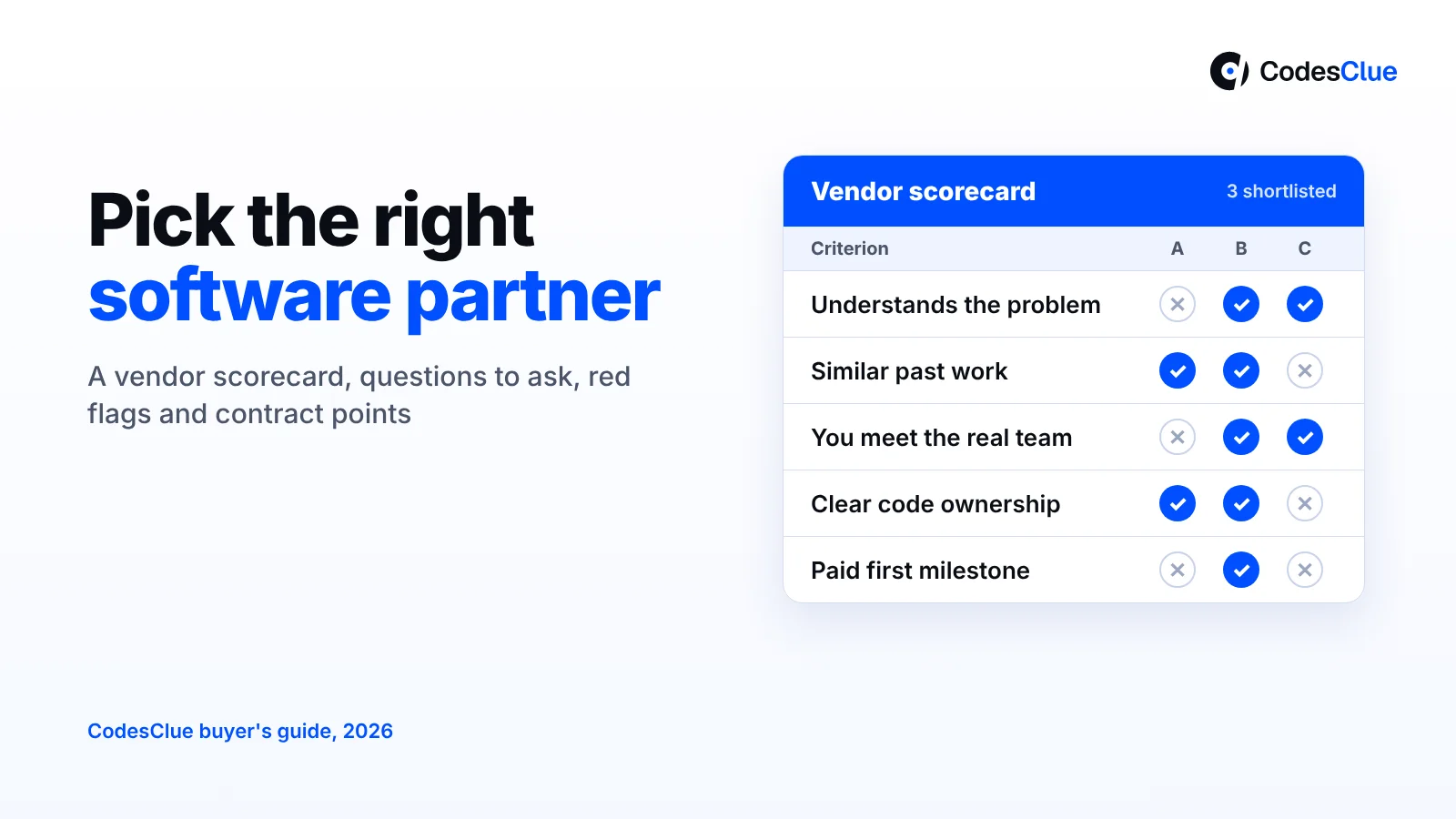
You have three proposals on your desk for the same software. One says eight weeks, one says six months, and the prices are miles apart. Every website shows five stars. Here is how to choose a custom software development company with one scorecard, sharp questions and a contract checklist.
Key takeaways
- Judge vendors on how they think about your problem, not on how polished the pitch looks.
- Match the size of the partner to your project: a freelancer, a small studio, a mid-size firm and a large firm each fit different situations.
- Score every shortlisted company on the same eight criteria, and meet the people who will actually build.
- Start with a paid discovery phase or a small first milestone before you commit to the whole build.
- Get code ownership, milestones, change requests, warranty and handover in writing before any code exists.
How to choose a custom software development company: the short answer
To choose a custom software development company, write a one-page brief, shortlist three firms with work like yours, and score them on the same criteria. Meet the actual team, call a past client and start with a paid discovery phase. Sign only when ownership, milestones and support terms are clear in writing.
The hard part is telling a good answer from a smooth one. The rest of this guide helps with that.
If you have not yet decided whether to build at all, read custom software vs off-the-shelf first. A ready-made tool is sometimes the better call.
When you should not hire a company yet
Honest advice first. A development company is the wrong next step in a few common cases:
- You cannot describe the problem in two sentences. Spend a week with your users first.
- Nobody on your side can make decisions. A build needs one person who answers questions within a day. Without that person, any vendor stalls.
- A spreadsheet or an off-the-shelf tool already solves 80% of it. Use that for six months and learn what you really need.
- Your budget only covers the first version. Software needs fixes and updates after launch.
Pro tip: Ask yourself what you would do if the software never shipped. If the honest answer is “carry on as today”, test the idea with a smaller step first.
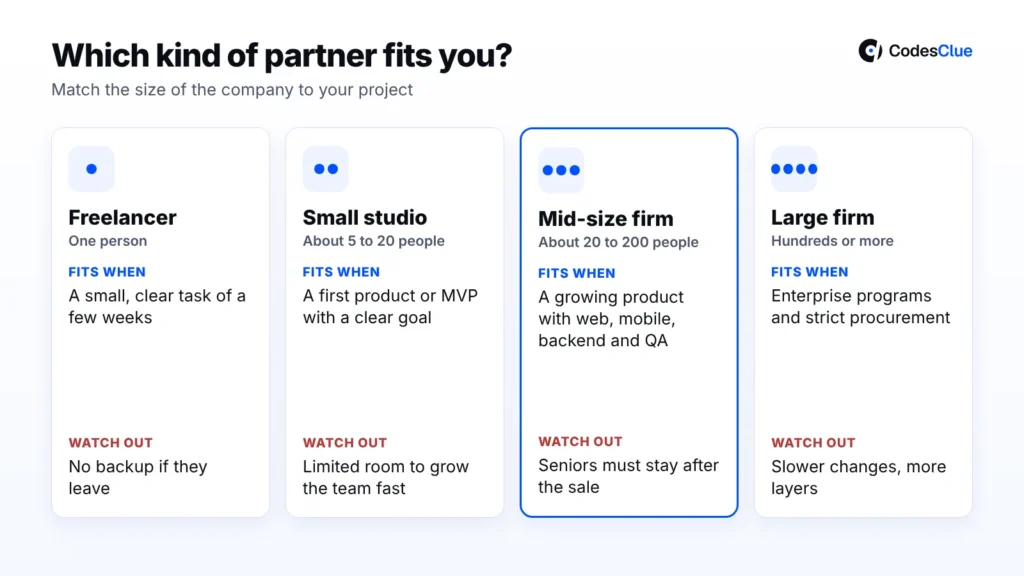
Which kind of software development partner fits you?
Size matters more than most buyers expect. A large firm can feel slow on a small product, and a freelancer can struggle with a platform.
| Partner type | Fits you when | What you get | Watch out for |
|---|---|---|---|
| Freelancer | A small, clear task of a few weeks, and you can manage the work yourself | Direct contact and quick starts | No backup if the person gets sick or leaves |
| Small studio (about 5 to 20 people) | A first product or MVP with a clear goal and a modest budget | Senior people close to your project and fast decisions | Limited capacity if you need to grow the team quickly |
| Mid-size firm (about 20 to 200 people) | A product that will grow, with web, mobile, backend and QA needs | A full team, a defined process and room to scale | Make sure senior people stay on your project after the sale |
| Large firm (hundreds or thousands) | Enterprise programs, strict procurement, many teams and long contracts | Scale, formal compliance and many specialists | Slower changes, more layers and your project may be a small account |
The team sizes are rough bands. What matters is whether your project would be important to that company.
The vendor scorecard: what good looks like
Use one scorecard for every company you speak to. Score each criterion from 1 to 5 during the call, not later from memory. A red flag means you stop scoring and walk away.
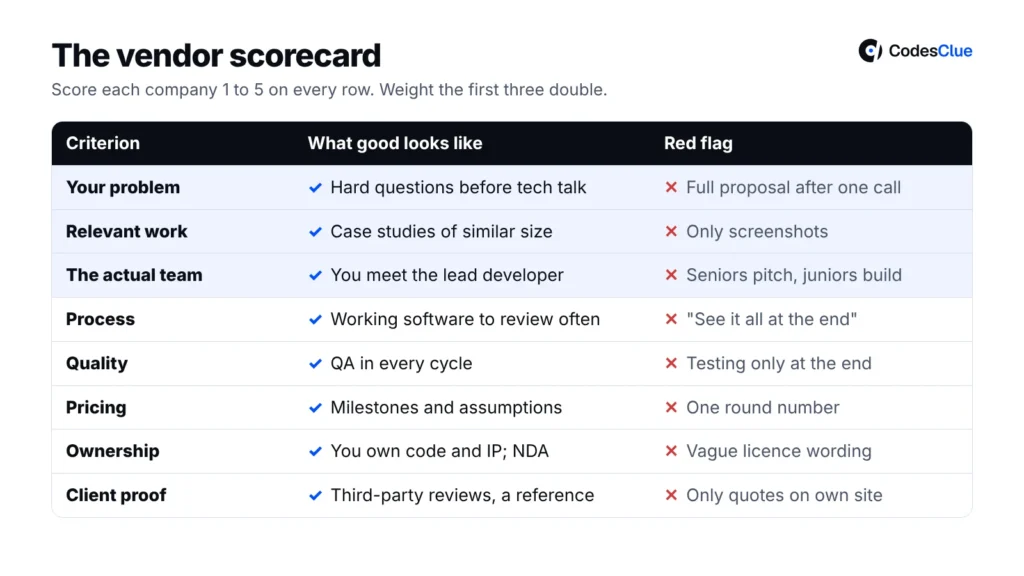
| Criterion | What good looks like | Red flag |
|---|---|---|
| Understanding of your problem | They ask hard questions about users, data and goals before they talk about tech | A full proposal a day after a 20-minute call |
| Relevant work | Case studies with similar complexity, named platforms and real results | Only screenshots, or projects far simpler than yours |
| The actual team | You meet the lead developer and project manager before signing | Seniors in the pitch, unnamed juniors in delivery |
| Process and visibility | Short cycles, working software to review and a clear weekly update | “We will show you everything at the end” |
| Quality and testing | QA in every cycle, code reviews and automated tests where they pay off | Testing appears only as a final phase, or not at all |
| Pricing and estimates | A written estimate with milestones and stated assumptions | One round number with no breakdown |
| Ownership and security | You own all code and IP; NDA signed before you share details | Vague licence wording or reused code they keep rights to |
| Proof from clients | Reviews on third-party sites plus a reference you can call | Only anonymous quotes on their own website |
Weight the first three criteria double. A vendor who understands the problem and puts strong people on it fixes most other gaps.
Pro tip: Score each vendor straight after the call, and ask a colleague to score the same call on their own. If your scores differ by two points or more, you need another conversation.
6 steps to choose a software development company
Each step removes weak options before you spend more time.
- Write a one-page brief. Cover the problem, users, must-have features, systems to connect, budget range and deadline.
- Pick the partner type. Use the fit table above, then look only at companies of that kind.
- Shortlist three companies. Look for case studies close to your project and read their reviews on Clutch or GoodFirms.
- Run the same call with each. Share the same brief, ask the same questions and fill in the scorecard as you go.
- Call one past client per finalist. Ask what went wrong and how the vendor handled it.
- Start small and paid. Begin with a discovery phase or a first milestone. You learn how they work before the big commitment.
Buyers skip step six most, yet it protects you most. A short paid start shows you real updates, real code and real communication. Our software development consulting page shows how we agree each stage before the next one starts.
Want a second opinion on your brief or on proposals you already have? Send them to us and an engineer will tell you what looks solid and what to question.
Questions to ask a software development company
Good questions make vendors show their thinking. Each one below comes with what a strong answer sounds like.
- “What would you need to know before you give us a firm estimate?” A good partner lists open questions about users, data and integrations. A weak one gives a number straight away.
- “Who exactly will work on our project, and can we meet them?” Look for names, roles and time on your project. Be wary if the answer is “our team”.
- “Tell us about a project that went wrong.” Strong vendors give a specific story and what they changed after it.
- “How will we see progress each week?” Expect working software to review, a written update and a shared task board.
- “What happens when we change our minds?” They should explain a simple change request process with cost and time shown before work starts.
- “Which parts would you not build from scratch?” A good answer names proven services for payments, sign-in or email.
- “What does support look like after launch?” Listen for a warranty period, response times and who fixes what.
- “What would make you turn this project down?” Honest vendors have limits and can name them.
Pro tip: Ask for a sample weekly update from another project, with client names removed. It tells you more about daily life with that vendor than any sales deck.
Contract points to check before you sign
Read the contract before anyone writes code:
- Code and IP ownership. All code, designs and documents made for you belong to you once paid. Ask them to list any code they reuse from earlier work.
- NDA. Signed before you share data, plans or code.
- Milestones and payments. Tie payments to working results you can review, not to time passing.
- Acceptance. Agree how you sign off a milestone and how long you have to test it.
- Change requests. A written process, with the cost and time impact shown before you approve.
- Warranty. A period after launch where the vendor fixes its own bugs at no extra charge.
- Exit and handover. Your notice period, plus full access to code, servers, accounts and documents if you part ways.
- Data and compliance. Where your data lives, who can access it, and rules such as GDPR or HIPAA where they apply.
Have a lawyer read the final version. At CodesClue, the client owns the source code after development, and we sign an NDA before every engagement.
What we see in real projects
The team you meet before signing shapes the whole project. On TracknTake, a delivery tracking platform for web, iOS and Android, the CEO’s review names our project manager. Clients remember people, not process documents.
Architecture questions also tell you a lot early. Akcru runs on iOS, Android, Android TV and the web, with one API and sign-in service behind every app. Ask each vendor how they would share one backend across your platforms. The answer shows whether they plan for growth or build each app on its own.
A hypothetical example: a logistics firm compares three vendors for a dispatch tool. Vendor A quotes the least but cannot name the team. Vendor B asks twenty questions and proposes a paid two-week discovery. Vendor C sends a strong deck with no similar work. B wins on the double-weighted criteria, with a mid-range price.
One honest limit: no scorecard removes all risk. The paid first milestone does the rest. You can see how we run that work, sprint by sprint, on our agile development process page.
Common mistakes to avoid
- Choosing on price alone. The smallest quote often leaves out testing, support or whole features.
- Comparing proposals built on different briefs. Give every vendor the same one-page brief, or the numbers mean nothing.
- Trusting ratings without reading reviews. Read what clients say about communication and problems, not only the star count.
- Never meeting the builders. Insist on a call with the lead developer before you sign.
- Signing a fixed price for an unclear scope. Unclear work at a fixed price leads to arguments. Run discovery first.
- Forgetting life after launch. Agree support, hosting and updates before the build starts.
Checklist: are you ready to choose?
- We have a one-page brief with the problem, users, must-haves and a budget range.
- One named person on our side makes decisions within a day.
- We know which partner type fits us.
- Three companies are on the shortlist, each with similar work we can check.
- Every call used the same scorecard.
- We spoke to a past client of each finalist.
- Our contract covers IP, NDA, milestones, acceptance, change requests, warranty and handover.
- The first commitment is a paid discovery phase or a first milestone.
For what the build itself looks like after you sign, see the custom software development process. For budgets, read how much custom software development costs. Our own projects run about $8K to $25K for an MVP and $25K to $70K for a mid-size product. Large platforms start from $70K.
FAQs
How many software development companies should I compare?
Three is usually right. Fewer gives you no real comparison, and more turns the search into a second job. Start with a long list of eight to ten from case studies and review sites. Cut it to three after a short first call, and give all three the same brief.
Should I choose a local or an offshore development company?
Choose on skill, fit and working-hour overlap, not on the map alone. A local team makes in-person workshops easier. An offshore or mixed team can give you more senior people for the same budget. What matters most is two to four hours of daily overlap and clear written updates. CodesClue, for example, has teams in India, the US and Germany.
Should I pick fixed price or time and materials?
Fixed price works when the scope is clear and unlikely to change, such as a well-defined MVP. Time and materials suits products where you will learn and adjust as you go. Many buyers mix them: a fixed-price discovery phase first, then milestones once the scope is clear. Whichever you pick, tie payments to working results you can review.
What are the biggest red flags when you vet a vendor?
Watch for a detailed proposal after one short call, a team you never meet and vague code ownership terms. Other warning signs are a single price with no breakdown, no testing in the plan and reviews you cannot check elsewhere. One of these deserves a direct question. Two or more usually mean walk away.
How do I check a development company’s reviews and references?
Read their profiles on third-party sites such as Clutch and GoodFirms, and focus on comments about communication and problems. Then ask for one client reference you can call. Ask that client what went wrong and whether they would hire the company again. For example, CodesClue holds 5.0 on Clutch from 6 reviews and 4.9 on GoodFirms.
How long should choosing a vendor take?
Plan on two to four weeks for a careful choice. Writing the brief takes a few days, and calls with three companies take about a week. Reference calls and contract review take another week or two. Rushing to save a fortnight often costs months later, so protect this time in your plan.
Ready to build your shortlist?
You now know how to choose a custom software development company: a clear brief, one scorecard and a contract that protects you. To test a vendor against it, put our custom software development services on your shortlist and read our client reviews. Then book a free consultation and get a written estimate within 24 hours of the scoping call.