
MVP App Development: Launch Fast & Validate Your Idea
Expert MVP app development for startups and founders. Ship a fully functional prototype in weeks, validate demand, and raise with confidence.

MVP app development is the smartest way for the businesses, especially the startups to test ideas quickly without burning huge cash. It aids them to build, launch, and learn before pushing everything to their aspiring project. The reason is, minimum viable product app development launches product faster, validates ideas, and iterates based on real user feedback to validate startup ideas with MVP .
How? Let’s go through this blog to understand how a focused, lean version of a product is designed to test an idea. Let’s break down how to build an MVP app, validate your idea, and scale confidently.
What is MVP?
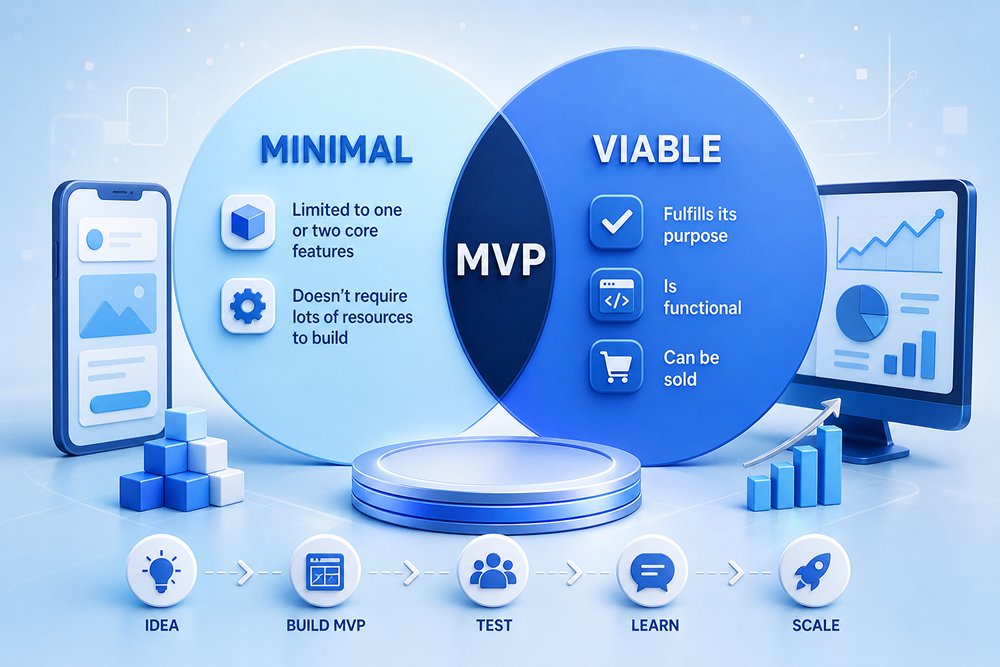
MVP makes the simplest version of your app and it delivers core value to early users. It ultimately minimizes the development efforts and serves the users like a “happy meal” of the features.
An MVP or a Minimum Viable Product (MVP) is far different from Proof of Concept (PoC) that offers technical feasibility in a lab-like demo. On the other hand, MVP development covers presenting a live and user-facing product for real world validation without burning huge cash, making it ideal for MVP development for startups and MVP mobile app development strategies.
For example, when Dropbox started with a simple video MVP showing file sync, it gathered 75,000 sign-ups overnight without coding the full app. This is the approach of this minimum viable product app development, which is basically rooted in the ‘Lean Startup Methodology’ proposed by Eric Ries that turns assumptions into data fast.
Why MVP for Startups?
90% startups often fail due to building products that nobody wants. The concept of MVP enables app idea validation early, confirming product-market fit before scaling. Imagine, you are pitching investors for a validated app with 1,000 active users versus a shiny demo nobody tested – guess who wins the funding?
The MVP would definitely be the winner with facilitating faster time-to-market (often 2-4 months), reduced risk, and real user insights. You can validate your app idea introducing an MVP in the market targeting early adopters who provide feedback loops. This helps achieve product market fit for mobile apps.
Many companies like Airbnb have used MVPs for testing demand, pivoting from air mattresses to global bookings based on early adopter feedback app.
MVP Development Process
Discover, design, build, launch, iterate – the MVP development process goes through a clear roadmap. Start with product discovery for mobile apps through interviews, surveys, and competitor analysis to define your MVP development roadmap. Agile methodology shines here, breaking work into 2-week sprints for rapid app prototyping.
Here’s the process you can build an MVP step by step:
- Idea Validation: Run landing pages or surveys to bring visitor’s interest (tools like Card or Typeform).
- Feature Prioritization: Use MoSCoW method for feature prioritization (Must-have, Should-have, Could-have, Won’t-have).
- Design & Prototype: Wireframes in Figma, then clickable prototypes.
- Development: Code core features (more on tech below).
- Testing & Launch: Beta test with 50-100 users, launch on app stores.
- Measure & Iterate: Track metrics via build-measure-learn loop.
You should expect an MVP development timeline of 8-16 weeks for completing the entire process from idea to launch MVP. This lean startup methodology for mobile apps keeps things nimble, adjustments are conducted based on data, not guesses.
MVP vs Full Product
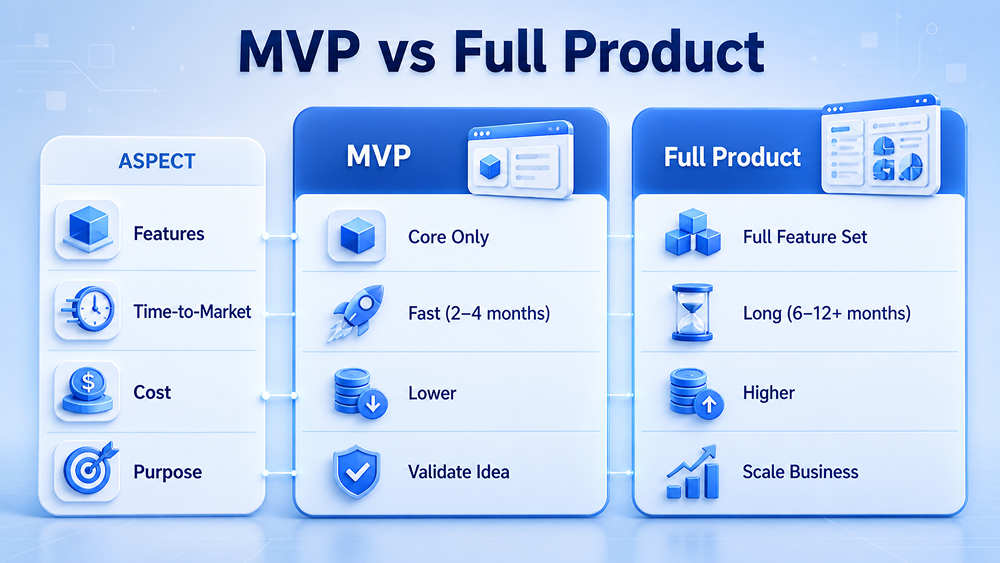
| Aspect | MVP | Full Product |
|---|---|---|
| Features | Core Only | Full Feature Set |
| Time-to-Market | Fast (2-4 months) | Long (6-12+ months) |
| Cost | Lower | Higher |
| Purpose | Validate Idea | Scale Business |
Cost to Build a Minimum Viable Product
MVP app development costs differ in terms of complexity, location, and team. For example, in 2026, a basic mobile MVP model costs between $30,000-$100,000, which is cheaper than full apps ($150K+). Startups love fixed price MVP development for predictability. Thus, they outsource MVP development to agencies for $40-$60/hour rates.
Breakdown for MVP development budget for startups:
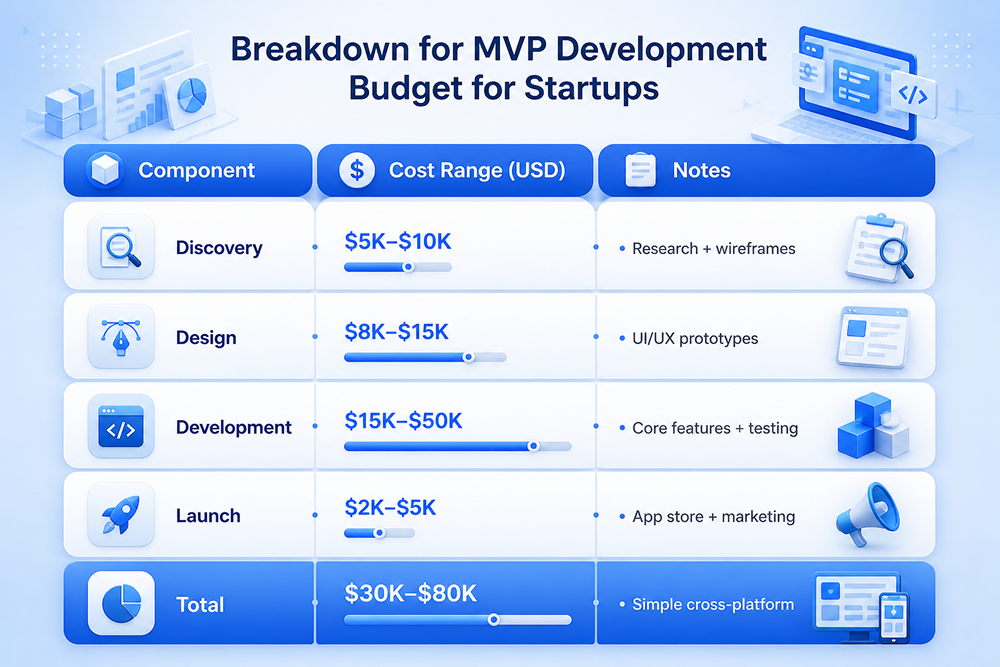
| Component | Cost Range (USD) | Notes |
|---|---|---|
| Discovery | $5K-$10K | Research + wireframes |
| Design | $8K-$15K | UI/UX prototypes |
| Development | $15K-$50K | Core features + testing |
| Launch | $2K-$5K | App store + marketing |
| Total | $30K-$80K | Simple cross-platform |
Using cross-platform tools results in reducing costs up to 40% to 60% while building minimum viable products. US teams cost 2-3x more than Eastern Europe/India ($25-$50K total).
Track ROI: A validated MVP can attract $500K+ seed funding.
Tech Stack Choices
Cross-platform app development tools comprising a combination of Flutter React Native is best for MVP development. Flutter (Google) offers pixel-perfect UIs and hot reload for speed; React Native (Facebook) leverages JS devs and native performance. For cloud-native MVP, use Firebase/AWS Amplify for backend-as-a-service (auth, database, hosting), launch in weeks.
API-first architecture brings scalability. Always go with modular endpoints for future features. Use Adalo or Bubble suit as non-code tools or non-tech founders for rapid app prototyping, but custom mobile app development services via professional app development companies beats them for control.
Is it cheaper to build an MVP with Flutter or React Native? Flutter MVPs can be slightly faster to build. The cost difference is usually only ~5–15% at most. In many cases, both frameworks cost almost the same ($20K–$40K MVP range)
Post-Launch Strategy
Post-launch mobile app support indicates you to follow the build-measure-learn cycle. Monitor metrics like DAU/MAU, retention (aim 40% Day 1), and churn via Amplitude or Mixpanel. MVP iteration uses user feedback loop mobile app data to prioritize v2 features.
Scaling after MVP: Once the product survives in the market or it fits in the market (e.g., 30% retention), always go with expansion. What metrics define a successful MVP launch? Net Promoter Score >7, conversion >5%, positive early adopter feedback app reviews. Pivot if needed – Instagram started as Burbn, killing extras post-MVP.
Hire for post-launch mobile app support: Bug fixes, analytics, A/B tests. Transition to full product when revenue validates growth.
Why Choose CodesClue MVP development services?
We, at CodesClue, are your coding partner. We are the best MVP development company for startups. Our specialized MVP development services for startups cover custom mobile app development with fixed-price MVP development and no budget overruns. We are a professional app development company and MVP development agency and assist our clients from idea to launch MVP as a responsible partner.
Outsource MVP development to our development experts for cross-platform app development using Flutter/React Native, plus post-launch mobile app support. Our company has helped 50+ startups validate ideas, with 80% achieving product market fit in 3 months.
Now if you ask why CodesClue? Then it is always for taking assistance from the agile teams, transparent roadmaps, and startup-friendly pricing and no corporate bloat.
Ready to turn your idea into reality? : Get a free MVP consultation today.
FAQs on MVP App Development
What are the top MVP development trends in 2026
AI-native MVPs with personalization and modular APIs dominate, alongside no-code tools cutting timelines by 50%. Startups prioritize ethical AI and synthetic data for faster, privacy-compliant validation.
How much does an AI-powered MVP app cost in 2026?
Basic AI-first MVPs start at $1,000-$5,000 via specialized studios, while traditional agency builds range $25K-$50K. No-code options hit $500, slashing costs 40-60% from prior years.
Should you include AI features in your MVP?
Yes, for competitive edge, basic LLMs for summaries or recommendations test real user value early. Skip if it bloats scope; focus on solving one problem 10x better.
What's the fastest way to validate an app idea pre-MVP?
Use landing pages, surveys, or no-code prototypes to test hypotheses with 100 targets. Track sign-ups and willingness-to-pay before coding, aim for 5-10% conversion as green lights.
How do you measure MVP success before scaling?
Key metrics: 40% Day 1 retention, 5%+ conversion, NPS >7, and usage frequency. Tools like Mixpanel reveal product-market fit fast; pivot if metrics lag.
No-code vs. custom code for MVP: Which wins in 2026?
No-code (e.g., Bubble, Adalo) launches in weeks for $500-$5K, ideal for solo founders. Custom code (Flutter/React Native) scales better for startups eyeing VC, choose based on your runway.