
Flutter App Development Cost in 2026: A Practical Budget Guide
Flutter app development cost in 2026: MVPs from $8K to $25K, business apps $25K to $70K. See Flutter-only costs, Flutter vs native and running costs.
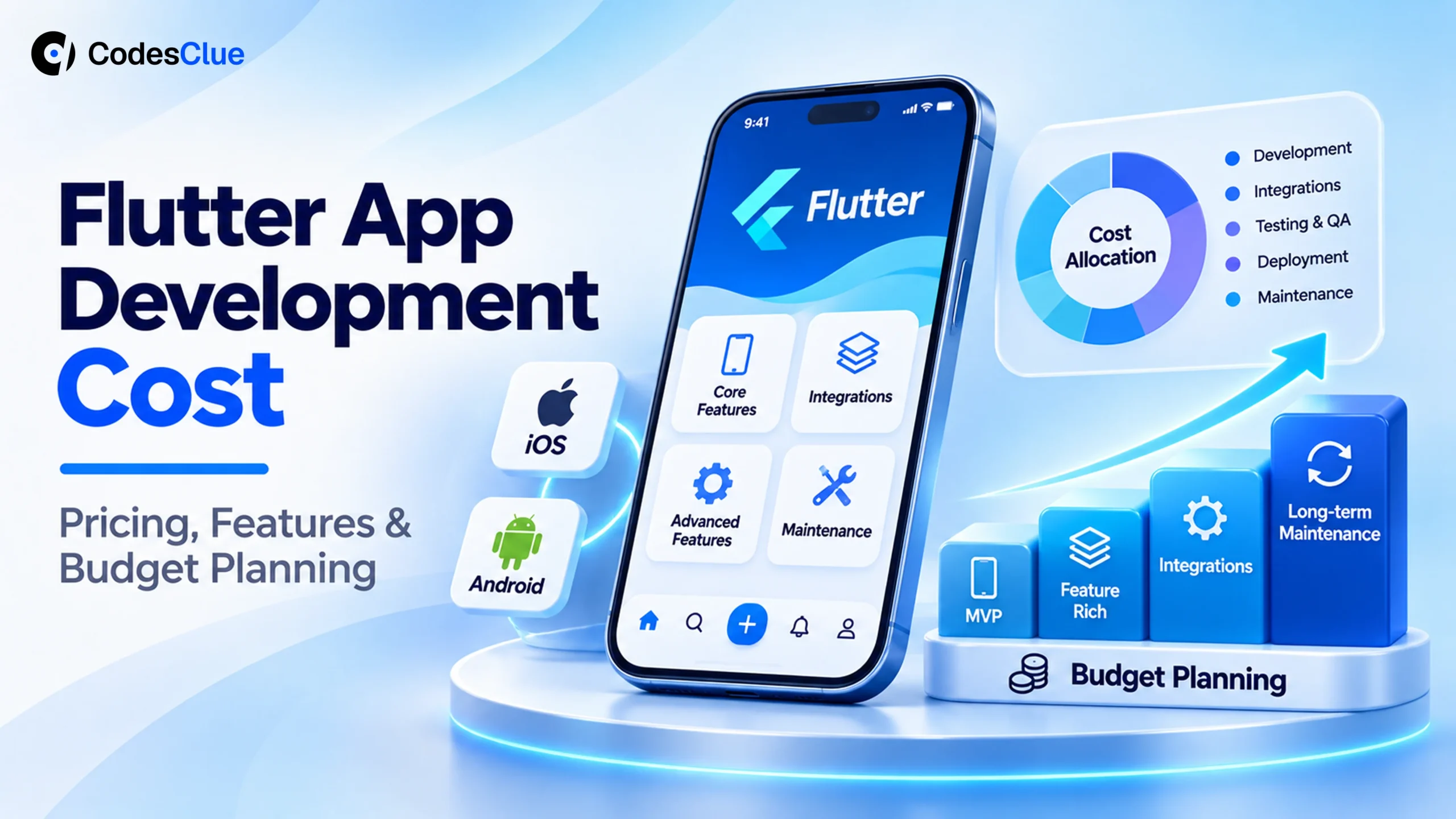
You want one app on both iPhone and Android, and Flutter keeps coming up as the way to do it with a single team. Then the quotes arrive, and one agency says $15,000 while another says $150,000 for what sounds like the same app. This guide breaks down the real Flutter app development cost in 2026. You will see what each budget band buys, which Flutter-specific items move the price and which costs show up only after launch.
Key Takeaways
- Most Flutter business apps fall into three bands: $8K to $25K (MVP), $25K to $70K (mid-size) and from $70K (larger platforms).
- Features, the backend and integrations drive the price far more than the framework does.
- Flutter gives you a single codebase for iPhone and Android, yet native device features, store reviews and testing on both platforms still take real work.
- Plan for running costs: store accounts, hosting, third-party services and regular framework updates.
- Give every vendor the same written scope so you can compare like with like.
How much does Flutter app development cost in 2026?
Expect $8K to $25K and 4 to 10 weeks for a focused Flutter MVP. A mid-size business app with a custom backend, payments or integrations usually costs $25K to $70K over 3 to 5 months. Larger platforms with several user roles, admin panels and compliance needs start from $70K and take 5 to 9 months or more.
Published guides from US and Canadian agencies quote anything from about $5,000 to $500,000 for a Flutter app, and their own tiers often overlap. A range that wide does not help you budget. It is more useful to match your app to the kind of product it is.
| App type | What it usually includes | Timeline | Our usual range |
|---|---|---|---|
| MVP or simple app | Sign-in, 5 to 10 core screens, a managed backend such as Firebase, basic analytics | 4 to 10 weeks | $8K to $25K |
| Mid-size business app | Custom API, payments or bookings, push notifications, an admin panel, one or two integrations | 3 to 5 months | $25K to $70K |
| Larger platform | Several user roles, real-time features, ERP or CRM links, offline mode, security reviews | 5 to 9 months or more | From $70K |
Pro tip: Name the single task your first release has to get right. Every screen that does not serve that task can wait for version two. That one decision often moves a project down a whole band.
What drives Flutter app development cost
Two apps with the same number of screens can differ in price by several times. These factors move the number most.
1. Features and business rules
A product list is quick to build. One that changes by user role, region, stock level and price rules is not. The logic behind each screen costs more than the screen itself, so describe the rules, not only the screens.
2. The backend
Flutter builds the app people hold in their hands. The data, accounts and business logic live on a server. A managed backend like Firebase suits many MVPs. A custom API in Node.js or another stack takes longer but gives you full control over data, reporting and future integrations. On many projects the backend takes as much effort as the app.
3. Design
Flutter draws its own interface, so a custom design looks the same on both platforms. That is a strength, but it also means someone has to design every state: loading, empty, error and offline. A design system with reusable components costs more at the start and saves time on every later screen.
4. Integrations
Payments, maps, calendars, CRMs and ERPs each need mapping, error handling and testing. A modern API with clear documentation takes days. An older system with no clean API can take weeks.
5. Security and compliance
Health, finance and enterprise apps need encrypted storage, audit logs, role-based access and sometimes outside penetration tests. Budget for this from the first estimate, since adding it late means rework.
Flutter-specific costs most estimates skip
Many guides treat Flutter as “one codebase, half the work”. The single codebase is real, but a few items are specific to Flutter and belong in every honest estimate.
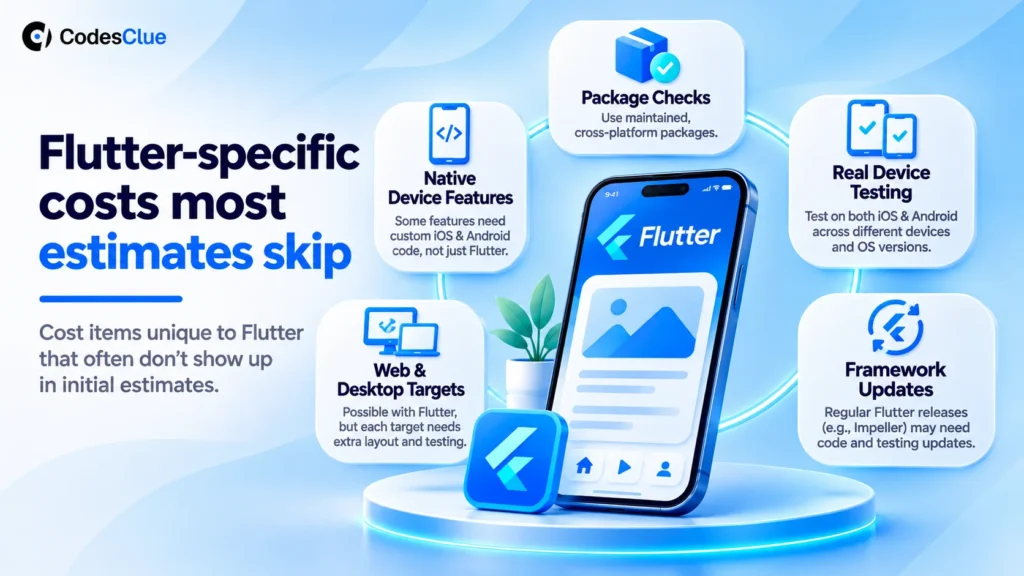
- Native device features: some SDKs, such as a hardware scanner or a payment terminal, have no maintained Flutter package. A developer then writes platform code for iOS and Android and connects it to Flutter. That part is not shared.
- Package checks: Flutter apps lean on open source packages. Check that each one has an active maintainer and supports both platforms before you depend on it.
- Testing on real devices: one codebase still runs on two operating systems and many screen sizes. Store reviews, permissions and notifications behave differently on each.
- Web and desktop targets: Flutter can also build for the web and desktop, but each extra target needs its own layout work and testing. Read our business case for Flutter on web and desktop before adding them to scope.
- Framework updates: Flutter ships regular releases. For example, its newer rendering engine, Impeller, became the default on iOS and on Android API 29 and above as of Flutter 3.27 (opens in a new tab). Changes like this need a test pass on your app, so plan time for upgrades.
Pro tip: Before you sign, ask the vendor to list every device feature your app needs and which ones have a maintained Flutter package. Any feature without one is where a fixed quote most often grows.
Flutter vs native vs React Native: cost compared
The framework choice changes the shape of the team more than the size of the bill. Here is how the options compare for a typical business app.
| Factor | Flutter | Two native apps | React Native |
|---|---|---|---|
| Codebases to build and maintain | One, plus small platform parts | Two (Swift and Kotlin) | One, plus small platform parts |
| Team | Flutter developers, backend, QA | iOS and Android developers, backend, QA | React Native developers, backend, QA |
| Interface | Same custom look on both platforms | Fully platform native | Uses native components |
| Best fit | Custom design, fast MVPs, apps that may add web later | Heavy device use, AR, advanced camera or audio work | Teams that already work in JavaScript or React |
| Main cost risk | Native SDKs without a package | Paying for every feature twice | Dependency upgrades |
For a deeper look at the two cross-platform options, see React Native vs Flutter, or read what React Native apps cost to build. If you already have a native app, Flutter’s add-to-app (opens in a new tab) option lets you build new screens in Flutter inside it. That can spread the cost of a move over several releases.
Running costs after launch
Launch day is not the last invoice. Budget for these from day one:
- Store accounts: Apple’s developer program costs $99 a year (opens in a new tab), and a Google Play developer account has a one-time $25 fee (opens in a new tab).
- Hosting and backend services: servers or Firebase usage grow with your users, so ask for an estimate at your expected user numbers, not today’s.
- Third-party services: maps, SMS, email, crash reporting and analytics often charge by volume.
- Maintenance: operating system releases, Flutter upgrades, package updates and security fixes. Many teams plan a fixed yearly budget for this rather than paying as problems appear.
- Improvements: the first real users always ask for changes. Keep budget for at least one round after launch.
Pro tip: Ask every vendor how they handle a Flutter version upgrade and how long the last one took them. A clear answer tells you more about future costs than any day rate.
Real Flutter projects we have shipped
Two projects from our portfolio show how scope shapes cost.
SmartPantryPal is a household pantry app. Our team shaped the product, then shipped the iOS and Android apps from a single Flutter codebase. We also built its Node.js and Firebase backend and a Next.js website. It has nine features, from barcode scanning and expiry warnings to shared pantries and online reordering. Most of the effort went into the data rules behind those features, not the screens.
For ArcelorMittal’s UAE site, we built a Flutter gate app with a Node.js backend. At the gate, staff scan each visitor’s Emirates ID and log the arrival against the right employee and vendor. They close the visit when the person leaves. The app has few screens, but the ID scan, company sign-in and reliable visit records needed careful work and testing. Small apps with strict rules still need a proper budget.
How to estimate your Flutter app cost in 5 steps
- Define the first release. List the users, the main task the app performs and the screens that task needs.
- List every system it touches. Payments, login providers, CRMs, ERPs and any hardware.
- Choose the backend. A managed service for speed, or a custom API for control.
- Note the rules. Security, privacy, accessibility and any industry rules such as HIPAA or PCI DSS.
- Ask for a written estimate by phase. Discovery, design, build, testing and launch, each with its own deliverables.
With those five items written down, vendors price the same scope and you can compare their answers line by line.
Common Flutter budget mistakes to avoid
- Building every idea into version one instead of testing the core job first
- Choosing packages without checking who maintains them
- Leaving the backend and admin panel out of the first estimate
- Testing on one platform and finding store or permission issues on the other at launch
- Skipping framework upgrades for a year, then paying for a large catch-up
- Comparing quotes that cover different scopes
An MVP often helps here. Our guide to MVP app development explains how to pick the smallest release that still answers your main business question.
Plan your Flutter app development cost with CodesClue
A reliable Flutter app development cost estimate starts with your users, your first release and the systems the app must work with. The engineers who build our Flutter apps sit in Ahmedabad. Offices in the USA and Germany put us near clients across North America, the UK and Europe. When a risk needs testing, we run a short proof of concept first, then take the app to an MVP and on to production.
Send us a few lines on your app, who will use it and the integrations it cannot launch without. A Flutter engineer answers inside one business day with the questions that matter for your scope and the price band it fits. See our Flutter app development services or contact us to start. Already have a product team? You can hire Flutter developers to join it, and development starts within 48 hours.
FAQs
Does Flutter cost less than building two native apps?
For most business apps, yes, because one team writes the shared code once instead of twice. The saving is smaller when the app relies on device features that need platform code, such as a hardware scanner or advanced camera work. Ask your vendor which parts of your app will need native code.
How long does it take to build a Flutter app?
A focused MVP usually takes 4 to 10 weeks. A mid-size business app with a custom backend and integrations takes 3 to 5 months. Larger platforms with several user roles and compliance needs take 5 to 9 months or more. Late scope changes and slow feedback are the most common causes of delay.
What does it cost to maintain a Flutter app after launch?
Plan for store accounts, hosting, paid third-party services and regular updates for new iOS, Android and Flutter releases. The amount depends on your users and features, so ask for a yearly maintenance estimate with the build quote. Skipping updates for a long time usually makes the next upgrade cost more.
Can I move an existing native app to Flutter step by step?
Yes. Flutter’s add-to-app feature lets you build new screens in Flutter inside an existing iOS or Android app. Many teams move one feature at a time, which spreads the cost over several releases and keeps the app in the stores while the work happens. A short audit first shows which screens to move first.