

React Native vs Flutter: Best Framework for Your App
Stuck choosing between React Native and Flutter? We break down the key differences in speed, development cost, and platform support.
Today’s cross-platform development in 2026 has become more mature, competitive, and performance-driven. Instead of asking ‘which type of app’, businesses ask ‘which framework provides the best ROI near-native performances, and faster launches’.
React Native vs Flutter: debate continues. Both are dominant frameworks in the modern mobile ecosystem. Both support faster releases and reduced development costs using a single codebase for mobile app development. However, with the evolution of React Native New Architecture (Fabric), Flutter Impeller rendering engine 2026, AI-assisted development workflows, and growing enterprise adoption, selecting the right framework has become tougher than ever.
So, what do you think, which is better in 2026: React Native or Flutter? Let’s discuss in this blog to help you make the right decision.
What Is React Native?
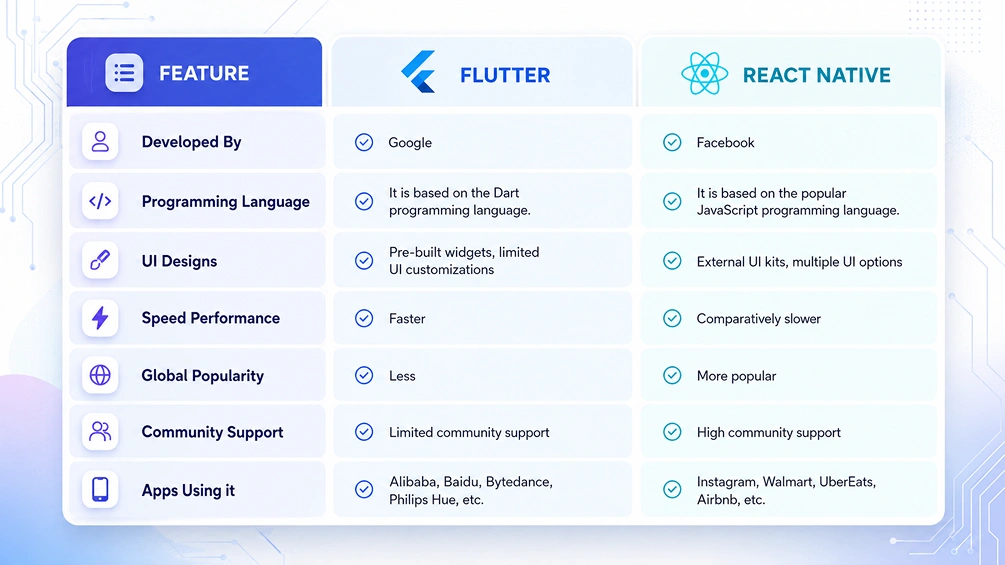
Developed by Meta, React Native lets you create fully native apps without compromising your users’ experiences. It is an open-source cross-platform framework that is used by the developers to create iOS and Android apps using JavaScript and React.
React Native has significantly evolved in 2026 through the React Native New Architecture (Fabric) that contributes towards enhancing speed, startup performance, native communication, and UI responsiveness.
Core Strengths of React Native in 2026
-
- Large JavaScript ecosystem
- Faster onboarding for web developers
- Strong community support
- Easier native module integration
- Mature Over The Air (OTA) updates ecosystem
- Ideal for content-heavy and business-focused apps
- Component-based architecture for scalable UI systems
There are numerous reasons for which React Native proved highly relevant in 2026 to serve companies with:
- Faster product delivery
- Shared web + mobile engineering talent
- Lower maintenance costs
- High code reusability across platforms
What Is Flutter?
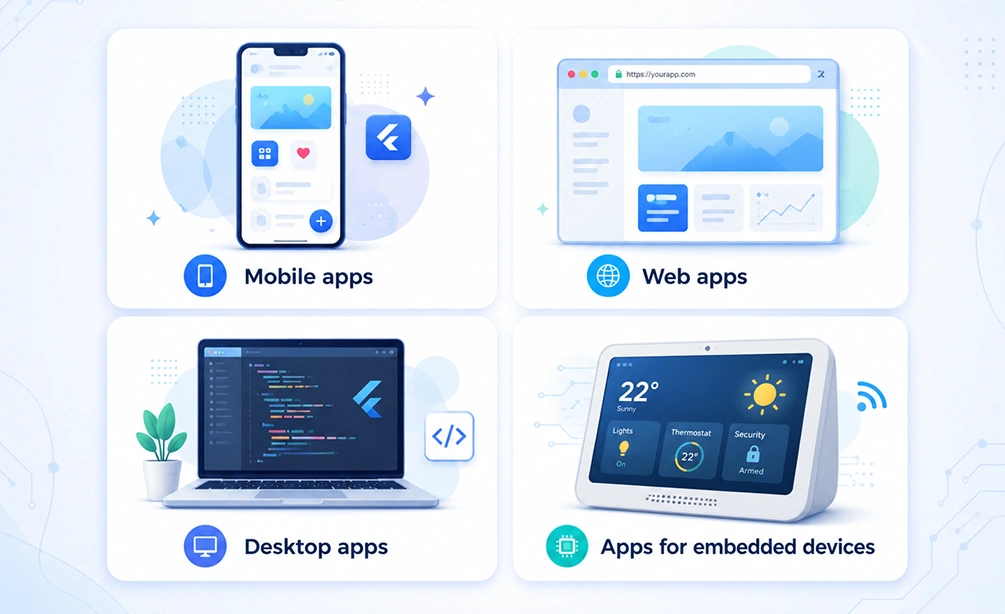
Google’s mobile SDK and another open-source development framework, Flutter, is used to build the natively compiled applications using Dart programming language.
Flutter doesn’t rely on native UI components that React Native does. Instead, it uses its own rendering engine, i.e. Flutter Impeller rendering Engine that provides lower shader compilation lag, smoother graphics rendering, and highly consistent animations.
Core Strengths of Flutter in 2026
- Exceptional UI consistency across platforms
- Superior animation handling
- Strong rendering performance
- AOT compilation (Flutter) for optimized production builds
- Powerful widget tree architecture
- Excellent hot reload / hot restart experience
- Near-native visual fidelity
Flutter is especially popular for:
- Highly animated apps
- Design-first products
- eCommerce applications
- Fintech dashboards
- Custom UI-heavy applications
Flutter vs React Native: Performance Comparison (Fabric vs Impeller)

Performance remains one of the biggest deciding factors in the React Native vs Flutter for app development debate, especially as businesses demand faster, smoother, and more scalable mobile experiences in 2026.
While both frameworks support high-quality cross-platform app development, their architectures handle rendering, animations, and native interactions differently, directly impacting app speed and responsiveness.
React Native Fabric Renderer vs Flutter Impeller
React Native Fabric Renderer
React Native’s Fabric Renderer improves Native UI synchronization, concurrent rendering, faster bridge communication, better memory management, and reduced UI thread bottlenecks. This made React Native dramatically perform better than its other previous versions, especially that were catered to medium-to-large business applications.
Flutter Impeller Rendering Engine 2026
Flutter’s Impeller engine focuses heavily on graphics consistency and animation smoothness. Its benefits include stable 120fps rendering, reduced frame drops, faster shader preparation, better GPU optimization, and consistent rendering across Android and iOS. Flutter still performs outstanding for graphics-intensive applications.
Cross-Platform App Performance: Which Is Faster?
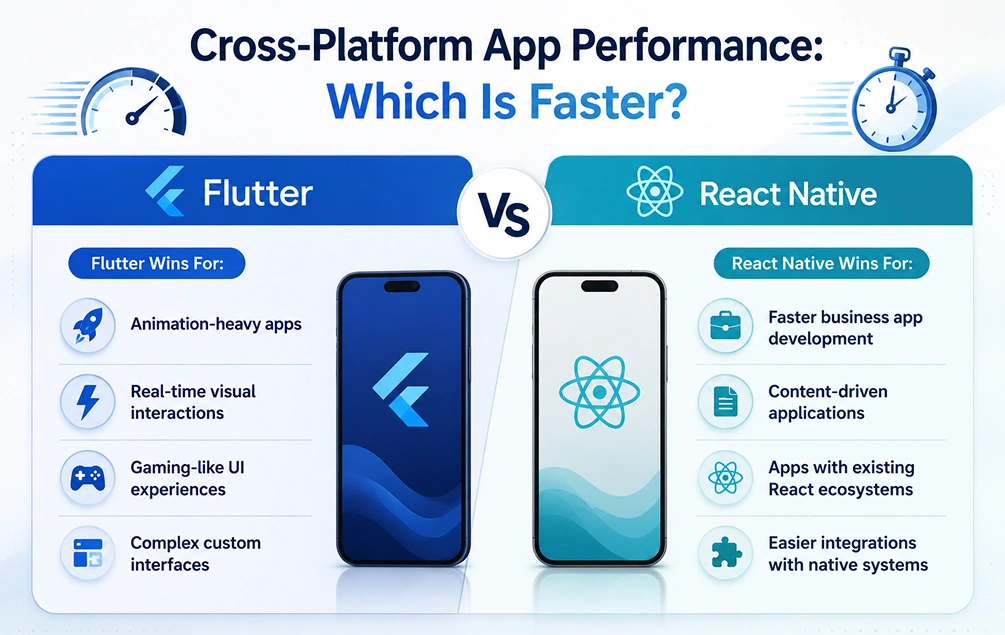
Flutter Wins For:
- Animation-heavy apps
- Real-time visual interactions
- Gaming-like UI experiences
- Complex custom interfaces
React Native Wins For:
- Faster business app development
- Content-driven applications
- Apps with existing React ecosystems
- Easier integrations with native systems
Practically, now both the frameworks offer excellent native app performance cross-platform experiences when they are correctly built. The performance gap that existed in earlier years has narrowed significantly in 2026.
Development Cost: Flutter vs React Native
When you are choosing the right cross-platform platform framework for mobile app development, the cost factor remains a major consideration for startups and enterprises.
Flutter vs React Native Development Cost
Utilizing both the frameworks is a smart move. They reduce development expenses compared to native app development. But the total cost of your mobile app development project depends upon your team’s expertise, your project’s requirements, UI, complexity, and long-term maintenance goals.
React Native Typically Costs Less When:
- You already have React or web developers on your team
- Your app focuses more on business logic than complex UI
- You need faster MVP development and rapid market validation
- Your project relies heavily on third-party integrations and plugins
- You want quicker hiring due to React Native’s larger developer ecosystem
Flutter Typically Costs Less When:
- Your app requires highly customized and animation-rich UI
- You need consistent design and behavior across Android and iOS devices
- You want fewer platform-specific UI adjustments and fixes
- Long-term visual scalability and design control are priorities
- You prefer a unified rendering engine that minimizes UI inconsistencies
In 2026, the overall app development cost difference between Flutter and React Native is often influenced more by project complexity, developer availability, and maintenance strategy than by the framework itself.
React Native vs Flutter: Time to Market
After development, businesses and startups aim to launch their products quickly to validate their ideas faster and strive to stay ahead in the competition. Thus, time to market products becomes critical.
React Native and Flutter, both accelerate the development of cross-platform mobile apps. But the advantages they offer are different and depend upon the scope of the project.
React Native Advantages
- Larger global developer pool for faster hiring
- Easier onboarding for teams with JavaScript or React experience
- Extensive JavaScript libraries and community support
- Mature plugin ecosystem for rapid feature integration
- Faster MVP development for business-centric applications
Flutter Advantages
- Faster UI implementation with customizable widgets
- Strong built-in components reduce dependency on external libraries
- Less platform-specific code for consistent development workflows
- Better design consistency across Android and iOS
- Smooth rendering performance for visually rich applications
React Native facilitates the quickest launching of MVPs for most startups due to their developers widespread availability and mature ecosystem. On the other han, Flutter can reduce long-term UI maintenance efforts by providing a unified rendering approach and greater visual consistency across platforms.
Which Framework Is Best for Startups? (MVP Perspective)
Startups should always consider the cost, speed, scalability, and product validation goals as deciding factors to choose between React NAtive vs Flutter. Since startups typically look for rapid iteration and fast launch of their apps, comparing both the frameworks is important before making a selection.
Startups usually focus on:
- Fast product validation
- Lower initial development costs
- Scalable architecture
- Faster iteration cycles
React Native for MVP Development
For MVP app development, React Native is a highly preferred component as it supports faster execution and efficient cross-platform app development.
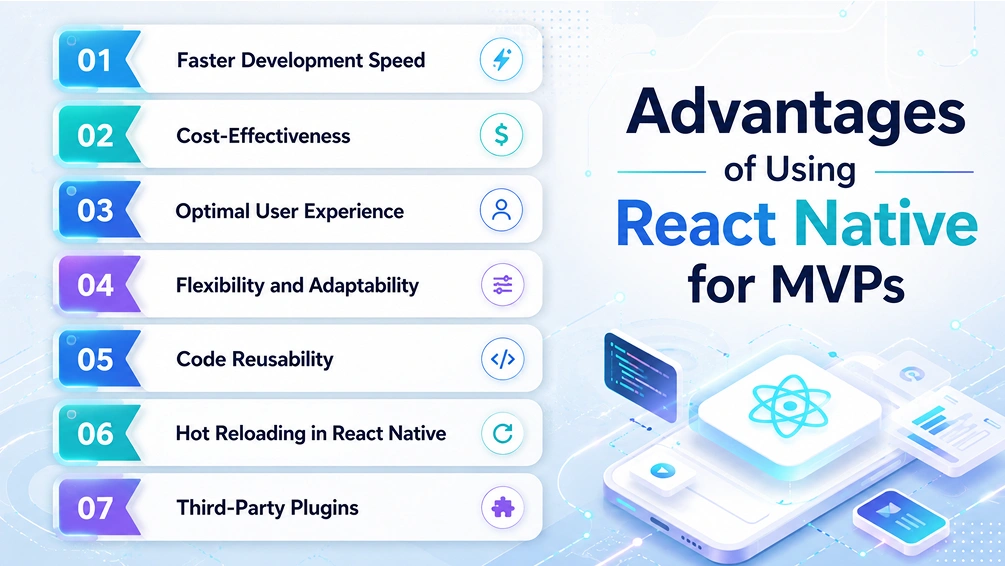
The framework benefits the startups because:
- JavaScript talent is widely available
- Existing React or frontend teams can adapt quickly
- Faster third-party integrations reduce development delays
- OTA updates simplify app releases and testing
React Native works especially well for:
- SaaS products
- Marketplaces
- Social networking apps
- Service platforms
For startups aiming to validate ideas quickly and launch faster, React Native often provides the shortest route to market.
Flutter for Startup Products
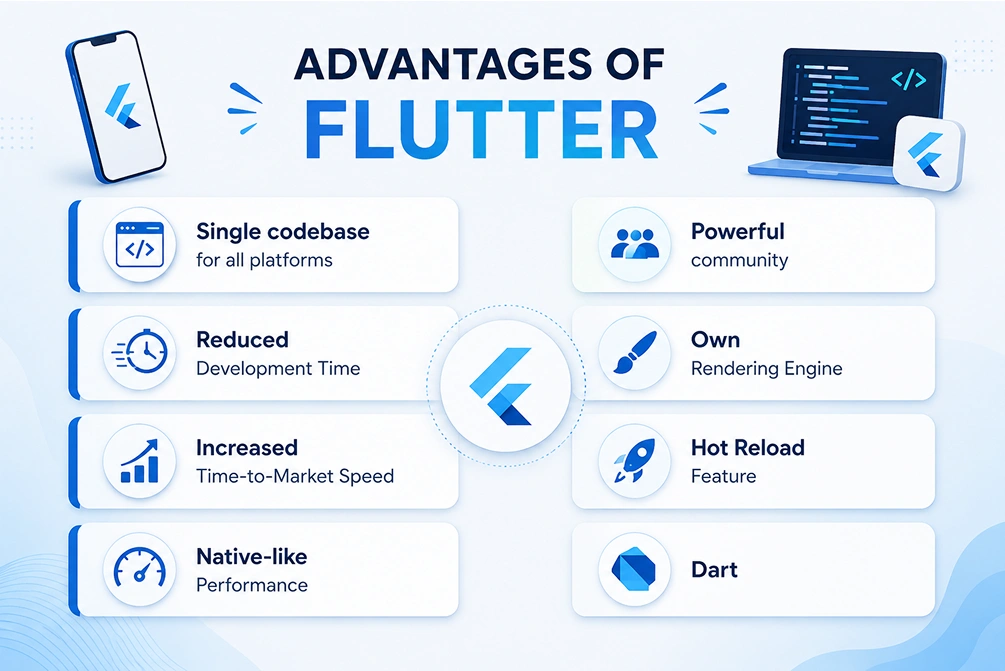
Flutter is basically chosen when you prioritize UI quality, branding, and user engagement. The widget-based architecture of this framework allows the professionals to develop highly customized and visually consistent interfaces without majorly relying on native UI components.
Flutter is theoretically beneficial when:
- UI differentiation is essential
- Visual branding drives user engagement
- Smooth animations and custom interactions matter
Flutter is particularly valuable for:
- eCommerce apps
- Fintech platforms
- Fitness applications
- Entertainment apps
For startups focused on visually rich experiences and long-term UI consistency, Flutter offers strong advantages in cross-platform mobile app development.
Flutter vs React Native for Enterprise Apps
Enterprise applications require architectural stability, maintainability, and integration flexibility.
Large organizations often manage complex workflows, legacy systems, high security standards, and multi-platform ecosystems.
React Native for Enterprise Scalability
React Native works exceptionally well for enterprises because:
- JavaScript ecosystems are mature
- Native integrations are flexible
- Engineering hiring is easier
- Code reusability improves scalability
It is commonly used for internal enterprise tools, CRM platforms, logistics applications, and business dashboards.
Flutter for Enterprise UX Systems
Flutter is preferred in enterprise products where:
- Consistent branded experiences matter
- Complex dashboards require smooth rendering
- Advanced UI systems are central to the product
Its rendering engine ensures consistent visuals regardless of operating system variations.
Final Perspective: Which Framework Should You Choose?
The best cross-platform framework in 2026 depends less on market trends and more on your product strategy, business priorities, and long-term technical goals. Both React Native and Flutter have matured into powerful frameworks capable of delivering scalable, production-grade applications with near-native performance.
Choose React Native If You Need:
- Faster engineering scalability
- Easier developer hiring and onboarding
- Rapid MVP development and faster iteration cycles
- Strong web-to-mobile development synergy
- Flexible enterprise integrations and business-focused scalability
React Native is theoretically ideal for businesses prioritizing speed, operational efficiency, and rapid market validation.
Choose Flutter If You Need:
- Superior animation and rendering performance
- Consistent UI across platforms and devices
- Advanced design systems and branded experiences
- Highly customized user interfaces
- Better performance for graphics-intensive applications
Flutter is theoretically better suited for products where visual consistency, interaction quality, and immersive user experiences are central to success.
In practice, both frameworks now meet modern cross-platform app performance standards in 2026.
The right choice ultimately depends on balancing:
- Product goals
- User expectations
- Development resources
- Budget constraints
- Long-term scalability and maintenance plans
For modern startups and enterprises alike, both React Native and Flutter offer reliable foundations for building high-performance cross-platform mobile applications.
FAQs on React Native vs Flutter
Which is better in 2026: React Native or Flutter?
Both frameworks are highly capable in 2026. React Native is often preferred for faster development, easier hiring, and enterprise scalability, while Flutter is favored for visually rich applications, smooth animations, and consistent UI rendering across platforms.
Is React Native still relevant in 2026?
Yes. React Native remains one of the most widely used cross-platform frameworks because of its large JavaScript ecosystem, improved Fabric architecture, strong community support, and faster time-to-market advantages for businesses.
Is Flutter faster than React Native in 2026?
Flutter generally performs better in graphics-heavy and animation-intensive applications due to the Flutter Impeller rendering engine. However, React Native’s Fabric renderer has significantly narrowed the performance gap in modern applications.
Which framework is better for startups and MVP development?
React Native is usually better for startups that need rapid MVP development, lower hiring costs, and faster iterations. Flutter is ideal for startups where UI quality, branding, and interactive experiences are central to the product.
Which is easier to learn: Flutter or React Native?
React Native is easier for developers already familiar with JavaScript and React. Flutter requires learning Dart and understanding the widget tree architecture, but it offers a highly structured and consistent development experience.
Which companies use Flutter and React Native?
Many global companies use both frameworks in production. React Native is commonly used for social media, marketplace, and enterprise applications, while Flutter is widely adopted for eCommerce, fintech, and design-focused mobile applications.