
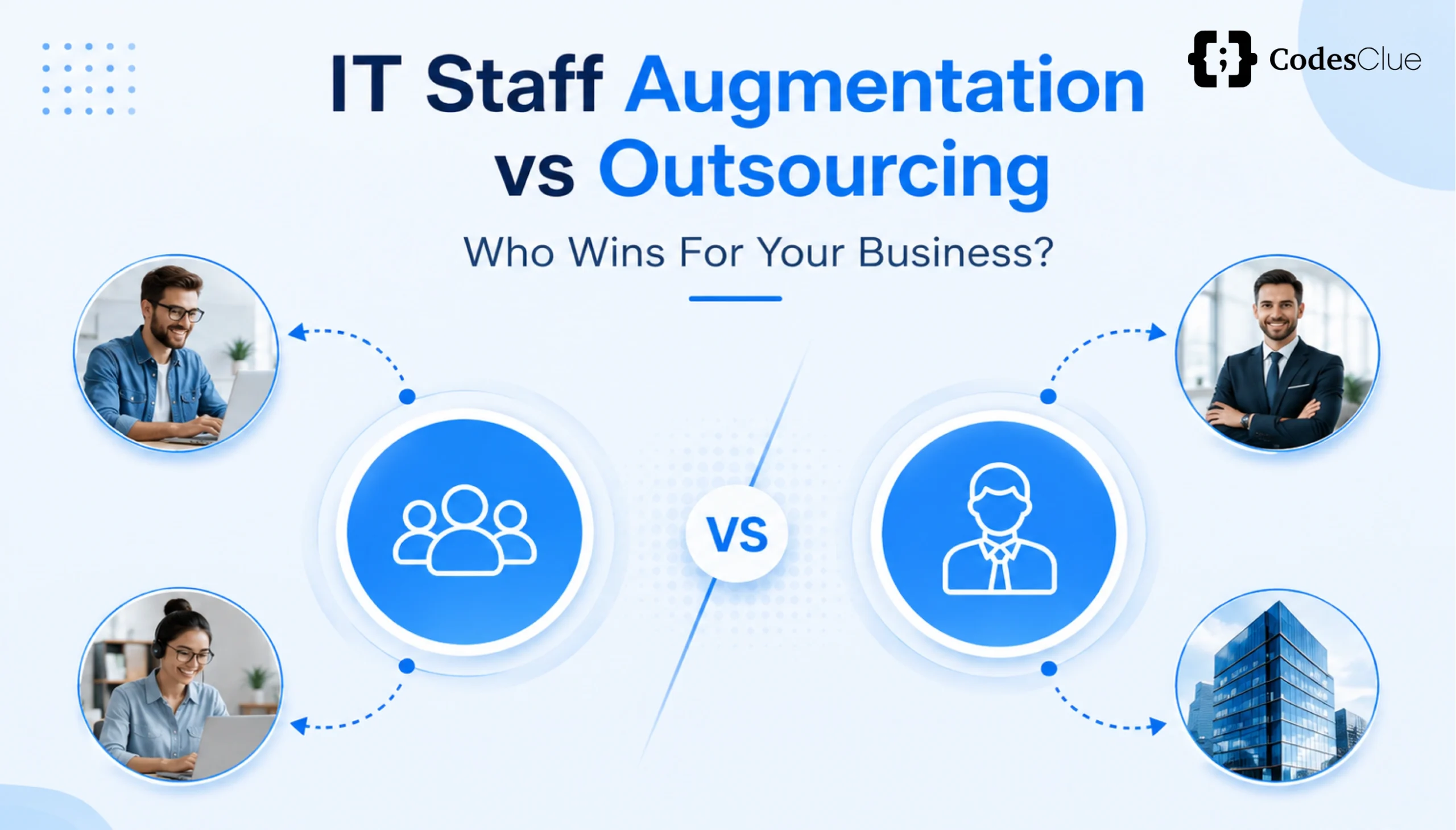
IT Staff Augmentation vs Outsourcing: Which Model Scales Your Tech Team Faster?
Compare IT staff augmentation vs outsourcing to choose the right model for faster hiring, lower costs, and greater control over your tech team.
Scaling a tech team is harder than it looks. You need a senior React developer in two weeks, but traditional hiring for experienced engineers can take 60–90 days, putting product launches and development timelines at risk.
The talent shortage isn’t making things any easier. According to ManpowerGroup’s 2026 Global Talent Shortage Survey, 72% of employers worldwide struggle to fill skilled tech roles. To keep projects moving, many organizations turn to two proven tech team scaling models: IT staff augmentation and IT outsourcing.
But which one is the better fit for your business? In this guide, we will compare IT staff augmentation vs outsourcing, highlight the pros and cons of each approach, and provide a practical decision framework to help you scale your development team with confidence.
What Is IT Staff Augmentation?
Need to scale your engineering team quickly without waiting months for new hires? That’s where IT staff augmentation comes in.
IT staff augmentation is a flexible hiring model where experienced external developers temporarily join your in-house team. They work under your management, use your tools, follow your sprint cycles, and collaborate just like full-time employees.
The staffing partner handles recruitment, payroll, HR, and compliance. Your team stays in control of technical decisions, project priorities, and day-to-day execution.
How does IT Staff Augmentation Work?
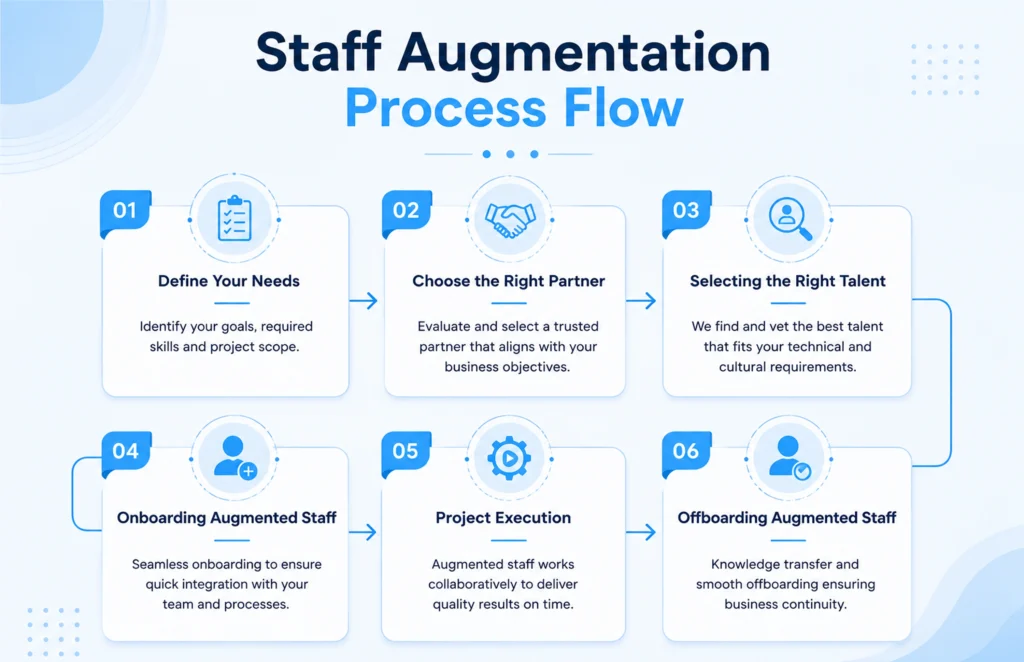
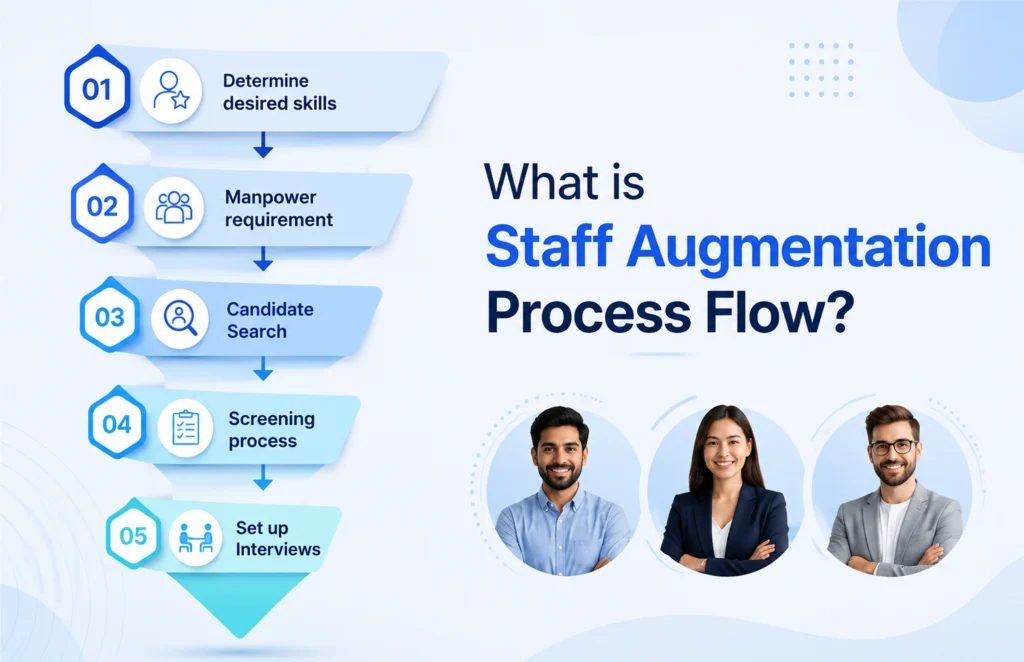
The process is simple:
- Identify the skills your project needs.
- Partner with an IT staff augmentation provider.
- Interview and select developers who fit your requirements.
- Onboard them into your team, often within 1–2 weeks.
This allows you to increase engineering capacity without the delays and long-term commitment of permanent hiring.
IT Staff Augmentation in 2026: Beyond Software Developers
Staff augmentation has evolved significantly. It’s no longer just about hiring extra developers for short-term projects.
Today, companies use IT staff augmentation services to bring in highly specialized talent, including:
- AI & Machine Learning Engineers
- Cloud Architects
- DevSecOps Specialists
- Platform & Data Engineers
- Cybersecurity Experts
- Senior Full-Stack Developers
- Solution Architects
This gives businesses access to niche expertise exactly when they need it, without expanding their permanent workforce.
Quick Example
Imagine your SaaS product is six weeks away from a major release, but your frontend team is overloaded.
Instead of pausing development to hire full-time employees, you add two frontend developers, one DevOps engineer, and one QA automation specialist through staff augmentation.
They plug into your existing workflow from day one, helping your team ship on time while your engineering manager remains in complete control.
What Is IT Outsourcing?
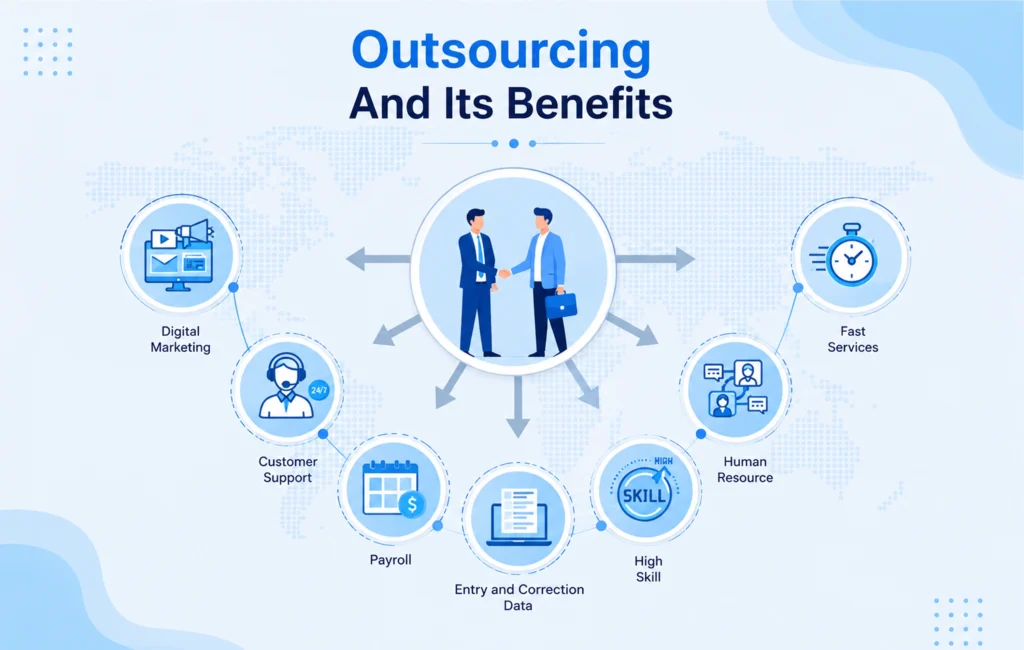
If you want to focus on business goals instead of managing developers, IT outsourcing may be the better choice.
With IT outsourcing, you hand over an entire project or business function to a third-party vendor. You define the requirements, budget, timeline, and expected outcomes, and the vendor decides how to deliver them.
Unlike staff augmentation, here the outsourcing partner builds and manages the team, oversees development, ensures quality, and delivers agreed milestones.
Instead of attending daily stand-ups, you review progress through milestone meetings and regular status updates.
When Does IT Outsourcing Make Sense?
IT outsourcing works best when the scope is well-defined and doesn’t require your team to manage day-to-day development.
Common use cases include:
- Legacy application maintenance
- Help desk and IT support
- Infrastructure management
- Software testing
- Cloud migration
- Fixed-scope product development
- Application modernization projects
Quick Example
Think if your manufacturing company needs to modernize its warehouse management system. Instead of assembling and managing a new engineering team, you’d better outsource the entire project to a technology partner.
Your vendor will handle the design, development, testing, and deployment, while the company’s internal IT team stays focused on strategic business initiatives and reviews progress at key milestones.
IT Staff Augmentation vs Outsourcing: Key Differences
When we talk about the difference between the two, it is simply said, “With staff augmentation, you manage the engineers. With IT outsourcing, you manage the outcome.”
Although both models help organizations scale faster than traditional hiring, they serve different business needs.
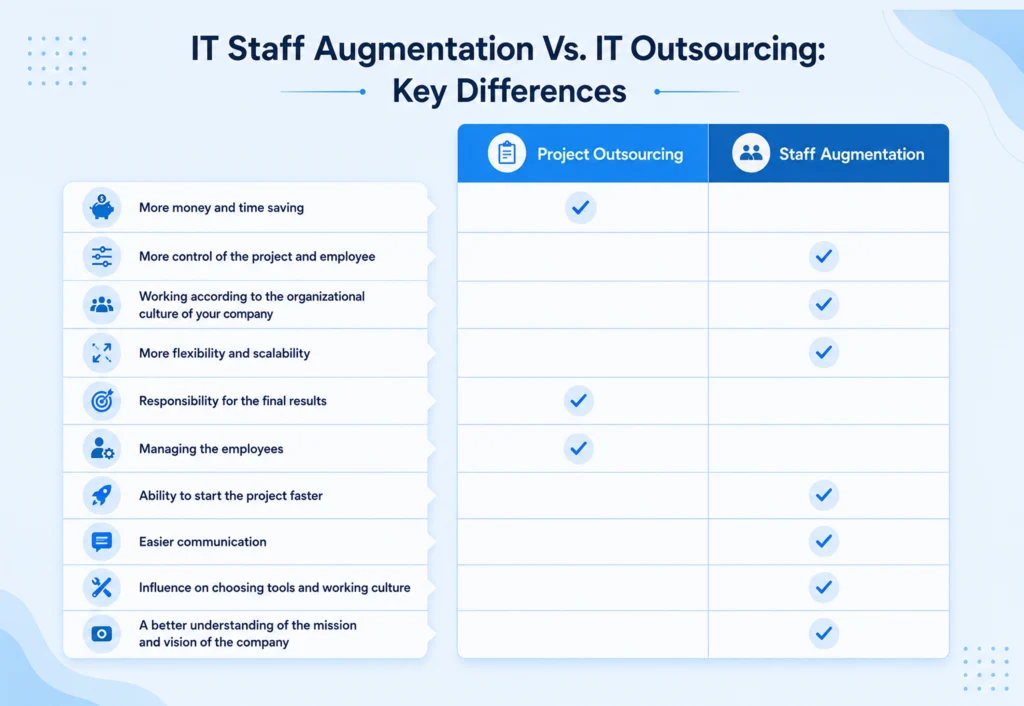
Check out the table given below for comparing both processes.
| Factor | IT Staff Augmentation | IT Outsourcing |
|---|---|---|
| Project Control | Full control remains with your team | Vendor manages execution |
| Team Management | Internal managers lead developers | Vendor manages the team |
| Typical On-boarding | 7–14 days | 2–4 weeks |
| Traditional Hiring Benchmark | 60–90 days | 60–90 days |
| Pricing Model | Hourly or monthly | Fixed-price, milestone, or managed service |
| Flexibility | High, ideal for evolving projects | Best for fixed-scope projects |
| Knowledge Retention | High | Moderate, depending on documentation |
| Intellectual Property | Typically retained internally | Defined by contract |
| Best Fit | Core product development | Non-core or well-defined projects |
Software Outsourcing Cost Comparison
Development costs also vary by engagement model and location.
| Region | Typical Hourly Rate |
|---|---|
| Offshore | $40–80/hour |
| Nearshore | $45–80/hour |
| Onshore (U.S.) | $90–150/hour |
Rates vary depending on technology stack, developer seniority, and project complexity.
At a glance, outsourcing may appear more economical. However, total cost should be evaluated alongside factors such as engineering oversight, product knowledge, flexibility, and long-term maintenance, not hourly rates alone.
In the next section, we will explore when each model delivers the greatest business value and introduce a practical decision framework that technology leaders can use to choose the right approach.
Staff Augmentation vs Managed Services vs Consulting: How Are They Different?
IT staff augmentation vs outsourcing isn’t the only comparison technology leaders face. Two other models often get confused with augmentation: managed services and consulting.
Quick Comparison
| Feature | Staff Augmentation | Managed Services | Consulting |
|---|---|---|---|
| Primary Goal | Scale capacity or add niche skills. | Outsource an entire function. | Get expert strategy and advice. |
| Management | You manage the day-to-day work. | The Provider manages the team. | Independent advisory. |
| Pricing Model | Time and materials (Hourly/Monthly). | Fixed recurring subscription (SLA-driven). | Flat project fee or retainer. |
| Accountability | You are responsible for results. | Provider guarantees the outcome. | The advisor is responsible for recommendations. |
| Engagement | Short to medium-term. | Long-term and continuous. | Short-term (Project-based). |
Staff augmentation vs managed services:
With staff augmentation, your team directs the work day-to-day. With managed services, an external provider owns an entire function, such as infrastructure or security, on an ongoing basis, and reports on agreed service levels rather than daily tasks.
Staff augmentation vs consulting:
Consultants are typically engaged to advise, audit, or design a strategy, and they hand over recommendations rather than write production code. Staff augmentation, by contrast, embeds hands-on engineers directly into your sprints to build and ship the product itself.
Dedicated team vs outsourcing:
A dedicated team works exclusively on your project, often functioning like an extension of your own engineering org, while traditional outsourcing hands a vendor full ownership of a defined scope with less day-to-day involvement from your side.
If your goal is strategic advice, consulting fits best. If you need an external function fully managed for you, look at managed services. If you need hands-on engineers under your direction, staff augmentation is the right call.
In-House vs Outsourced Development: What’s the Real Tradeoff?
| Feature | In-House Development | Outsourced Development |
|---|---|---|
| Control | Absolute control over daily work and culture. | Managed through milestones and deliverables. |
| Cost Structure | High fixed costs (salaries, benefits, tech stack). | Variable costs (pay only for active project work). |
| Hiring Speed | Slow (months to recruit, onboard, and train). | Fast (can start within days or weeks). |
| Product Knowledge | Deep, long-term institutional memory. | Highly technical, but domain knowledge varies. |
| Scalability | Hard to scale down; requires layoffs. | Highly flexible; scale up or down instantly. |
Beyond augmentation and outsourcing, many leaders also weigh in-house vs outsourced development as a broader question.
Building entirely in-house gives you maximum control, deep product knowledge, and full IP ownership, but it comes with longer hiring timelines and higher fixed costs. Outsourced development trades some of that control for speed, lower overhead, and access to specialized skills on demand.
Staff augmentation sits between these two extremes. It gives you the control of in-house development with the speed and flexibility usually associated with outsourcing.
When Is IT Staff Augmentation the Right Choice?
Not every project needs outsourcing. If your product requires speed, flexibility, and technical control, IT staff augmentation is often the smarter choice.
Here are the situations where it delivers the most value.
1. Your Requirements Change Frequently
Agile products rarely follow a fixed roadmap. Customer feedback, new features, or regulatory changes can shift priorities overnight.
With IT staff augmentation, you can scale your team without renegotiating contracts or disrupting development.
2. You Need Full Control Over Engineering
If your software is a competitive advantage, you should stay in control of the codebase, architecture, and engineering decisions.
Augmented developers work within your existing processes. Your tech leads continue to own code quality, sprint priorities, and technical direction.
3. Knowledge Should Stay In-House
Every sprint generates valuable business and technical knowledge.
Because augmented engineers work alongside your internal team, knowledge transfers naturally through code reviews, pair programming, and daily collaboration. This makes future maintenance much easier.
4. You Already Have Strong Technical Leadership
Staff augmentation works best when you have experienced engineering managers or architects leading the project.
Instead of replacing your leadership team, augmented engineers strengthen it by adding capacity where you need it most.
5. Need Specialized Skills?
Today’s IT staff augmentation services give you access to experts who are difficult to hire through traditional recruitment, including:
- AI & Machine Learning Engineers
- Cloud Architects
- DevSecOps Specialists
- Senior Full-Stack Developers
- Platform & Data Engineers
Quick Example
Suppose your fintech startup is building a new payment module. The product must meet strict security and compliance requirements, and the architecture continues to evolve.
Instead of outsourcing the project, your company augments its team with a Cloud Architect, two Senior Backend Developers, and a DevSecOps specialist.
It will help the internal tech leads retain complete control over the architecture while the expanded team accelerates development.
When Does IT Outsourcing Make More Sense?
If your priority is delivering a project, not managing developers, IT outsourcing is often the better choice.
It works best when the scope is clear, deadlines are fixed, and your internal team wants to focus on business outcomes instead of day-to-day engineering.
1. Your Project Has Fixed Requirements
Outsourcing is ideal for projects with well-defined deliverables and predictable timelines.
Typical examples include:
- Website redesigns
- ERP implementations
- Legacy application modernization
- Fixed-scope mobile app development
- Cloud and infrastructure migration
When requirements are clear from the start, outsourcing vendors can plan resources, estimate costs accurately, and deliver against agreed milestones.
2. You Don’t Have Bandwidth to Manage Engineers
Managing developers requires experienced engineering leaders and ongoing involvement.
If your team lacks the time or capacity for sprint planning, code reviews, and daily coordination, outsourcing shifts these responsibilities to the vendor. Your team stays focused on strategy while the vendor manages execution.
3. The Work Isn’t Core to Your Business
Not every technology function needs to stay in-house. Many organizations outsource routine or operational work such as:
- Legacy application maintenance
- IT help desk services
- Basic QA and regression testing
- Infrastructure monitoring
- Application support
- Routine cloud administration
This frees internal engineering teams to focus on innovation and revenue-generating initiatives.
4. You Care More About the Outcome Than the Process
With IT outsourcing, success is measured by delivered results, not by how the work gets done. You define the goals, budget, and timeline. The vendor owns the delivery.
Quick Example
Your large enterprise is investing in AI-powered customer experiences but still needs to support a legacy ERP system. Instead of stretching your engineering team across both initiatives, you’d better outsource legacy system maintenance to a specialized vendor.
The vendor keeps critical systems running, while the internal team focuses on building new products and driving innovation.
How to Decide: A 4-Question Framework for CTOs and Tech Leads
Still deciding between IT staff augmentation vs outsourcing? Ask yourself these four questions. Your answers will quickly point you toward the right engagement model.
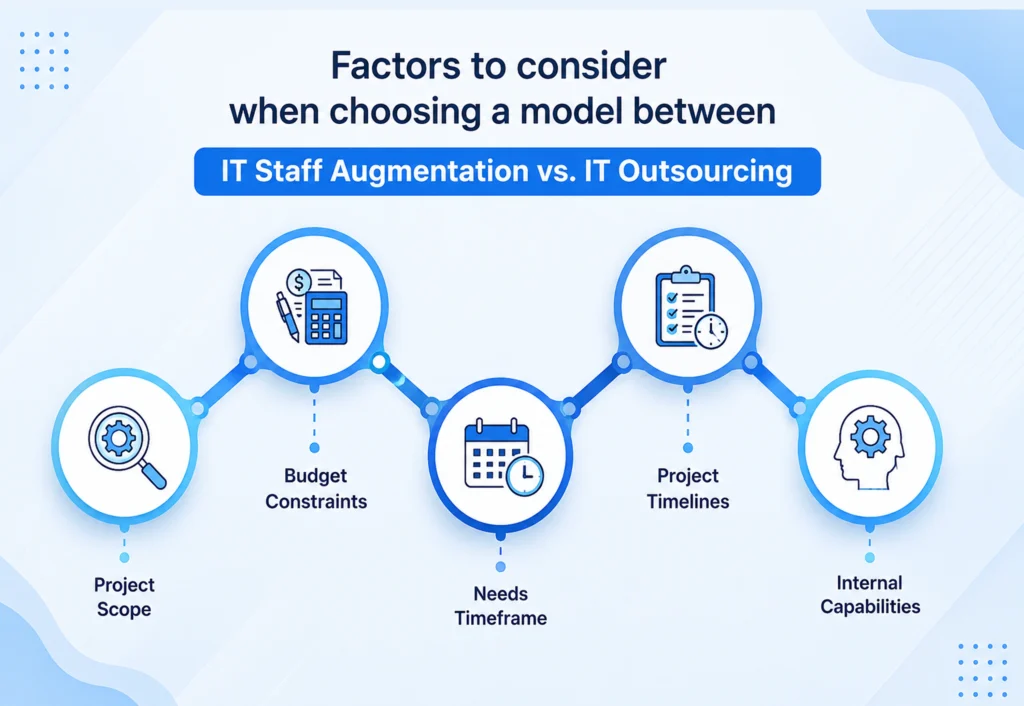
1. Is Your Project Scope Fixed or Evolving?
- If requirements change frequently, choose IT staff augmentation. It gives you the flexibility to adapt without disrupting development.
- If the scope is fixed and clearly defined, IT outsourcing is usually the better fit.
2. Do You Want to Control Execution or Just the Outcome?
- Choose staff augmentation if you want to oversee architecture, code quality, and sprint execution.
- Choose outsourcing if your priority is receiving a completed solution on time and within budget.
3. Does Your Team Need to Retain Technical Knowledge?
- If the product is a long-term business asset, keep the knowledge in-house with staff augmentation.
- If long-term knowledge transfer isn’t a priority, outsourcing can be a cost-effective option.
4. Do You Have Technical Leaders to Manage External Engineers?
- If you have engineering managers or tech leads who can guide external developers, staff augmentation works well.
- If your team lacks that leadership capacity, IT outsourcing is often the safer and more efficient choice because the vendor manages the delivery.
Quick Rule of Thumb
- Choose IT Staff Augmentation if your project evolves, you need technical control, and your team can manage external engineers.
- Choose IT Outsourcing if your requirements are fixed, you want predictable delivery, and you prefer the vendor to own execution.
The Hidden Cost of Choosing the Wrong Model
The wrong engagement model rarely fails on day one. The real costs appear later, when you start witnessing missed deadlines, growing technical debt, and expensive course corrections.
Outsourcing an Evolving Product
Outsourcing works best for fixed-scope projects. If requirements change frequently, you may face constant change requests, delayed releases, and, eventually, an inherited codebase that your internal team struggles to understand.
Staff Augmentation Without Strong Leadership
IT staff augmentation gives you more engineering capacity, but it also requires clear technical leadership.
Without experienced managers or tech leads, projects can suffer from communication gaps, shifting priorities, and inconsistent code quality.
Don’t Overlook These Risks
No matter which model you choose, watch out for these common pitfalls:
- Knowledge drains when augmented developers leave without proper documentation or handovers.
- Intellectual property risks caused by weak outsourcing contracts.
- Scope creep that increases delivery time and project costs.
- Vendor dependency when critical technical knowledge stays with the outsourcing partner.
The best decision isn’t always the lowest-cost option. It’s the one that aligns with your product strategy, internal capabilities, and long-term business goals.
Why Leading Companies Use Both: IT Staff Augmentation vs Outsourcing
The best technology companies don’t choose between IT staff augmentation and IT outsourcing. They use both where each delivers the most value.
As products grow, different stages of the roadmap demand different engagement models. Core innovation needs close collaboration, while routine operations benefit from specialized external teams.
A Common Approach
Many SaaS companies use IT staff augmentation to strengthen their core engineering teams with AI engineers, Cloud Architects, and Senior Full-Stack Developers.
At the same time, they outsource legacy system maintenance, infrastructure monitoring, or technical support to reduce operational overhead.
Another Real-World Example
A fintech company building a digital payments platform keeps architecture and product development in-house through staff augmentation. Meanwhile, it relies on a managed services provider for infrastructure and security monitoring.
This approach lets the internal team focus on innovation while specialists handle ongoing operations.
Rule of Thumb
- Use IT staff augmentation for anything that directly impacts your core product, customer experience, or competitive advantage.
- Use IT outsourcing for standardized, repeatable, or non-core functions that don’t require constant engineering oversight.
Conclusion: Which Model Scales Your Tech Team Faster?
There is no one-size-fits-all answer to the IT staff augmentation vs outsourcing debate. The right choice depends on your project scope, the level of control you need, and your internal team’s capacity.
Choose IT staff augmentation for evolving products, faster iterations, and complete engineering control. Choose IT outsourcing for fixed-scope projects, predictable delivery, and non-core operations.
When businesses align the right model with the right project, they can accelerate time-to-delivery by up to 40% while reducing hiring delays. The smartest companies don’t choose one. They use both strategically.
Frequently Asked Questions
What is the difference between IT staff augmentation and outsourcing?
Staff augmentation adds external professionals to your existing team under your management, whereas outsourcing transfers responsibility for delivering a project or function to an external vendor.
Is staff augmentation better than managed services?
Not necessarily. The staff augmentation vs managed services choice depends on your need: staff augmentation is better for collaborative product development, while managed services are ideal for ongoing operational functions such as infrastructure, cybersecurity, and cloud monitoring.
Which model is more cost-effective?
The answer depends on project complexity and management requirements. Outsourcing may reduce operational overhead, while staff augmentation often provides better long-term value for evolving products by improving flexibility and knowledge retention.
Can startups use staff augmentation?
Yes. Many startups use staff augmentation to quickly access senior engineering talent without the long recruitment cycle or permanent hiring costs.
Can businesses combine staff augmentation and outsourcing?
Absolutely. Many organizations use staff augmentation for core product engineering while outsourcing legacy maintenance, application support, and managed IT services.
What is the difference between a dedicated team and outsourcing?
In the dedicated team vs outsourcing comparison, a dedicated team works exclusively on your project and collaborates closely with your business, while traditional outsourcing gives the vendor full responsibility for delivering the agreed project scope.
How do I choose the best IT outsourcing company?
Look for a partner with proven technical expertise, relevant industry experience, transparent communication, strong security practices, positive client reviews, and a delivery model that aligns with your business goals.
How do I find the right staff augmentation companies for my project?
Evaluate staff augmentation companies on their talent vetting process, time-to-onboard, domain expertise, contract flexibility, and track record of integrating engineers into client teams without disrupting existing workflows.