

You request quotes from three development agencies for the same Angular app. The first comes back at $18,000. The second says $65,000. The third? A staggering $220,000.
Same project. Same specs. Wildly different numbers.
So what’s actually going on here?
Here’s the truth: Angular app development costs swing wildly based on a dozen different factors, but almost no agency will walk you through what you’re really paying for. App complexity, feature set, team structure, third-party integrations, testing depth, and long-term maintenance all quietly shape that final number, whether anyone explains it to you or not.
This guide pulls back the curtain. You’ll discover what actually drives Angular development costs in 2026, the key factors that make or break your budget, the hidden expenses that blindside most businesses after the contract is signed, and practical strategies to cut costs without cutting corners.
By the end, you won’t just understand the numbers, you’ll know exactly how to read between the lines of any quote that lands in your inbox.
Angular App Development Cost in 2026: The Real Numbers
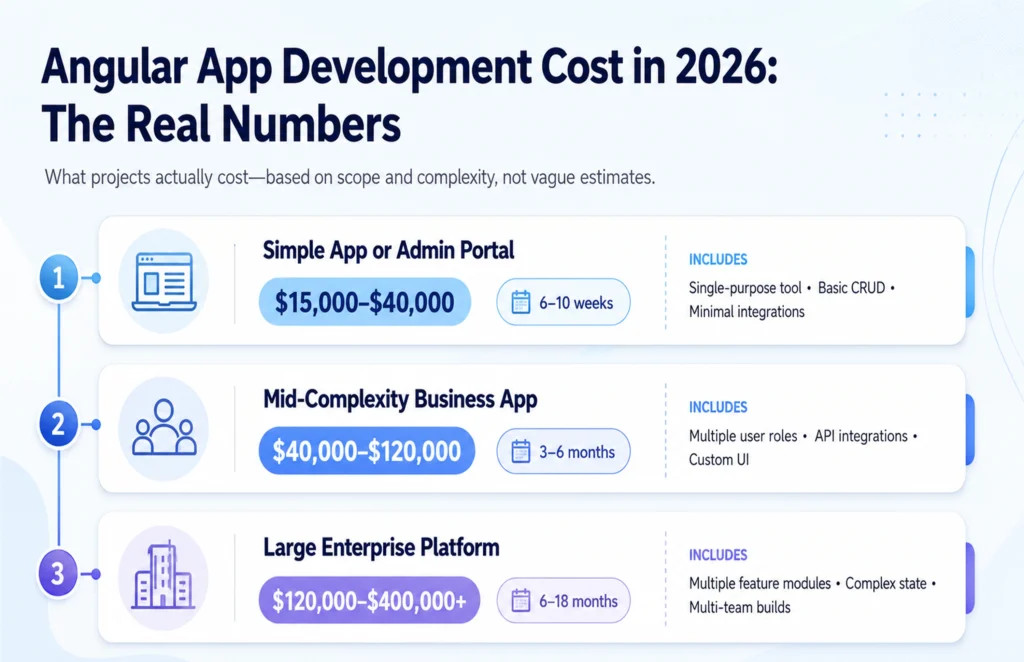
Here’s what projects actually cost, based on scope and complexity, not vague estimates:
|
Project Type |
Typical Cost |
Timeline |
What’s Included |
| Simple app or admin portal | $15,000-$40,000 | 6-10 weeks | Single-purpose tool, basic CRUD, minimal integrations |
| Mid-complexity business app | $40,000-$120,000 | 3-6 months | Multiple user roles, API integrations, custom UI |
| Large enterprise platform | $120,000-$400,000+ | 6-18 months | Multiple feature modules, complex state, multi-team builds |
Most business applications fall into the mid-range cost category. This is where decisions about features, integrations, and overall scope have the biggest impact on your budget. Spending a little more time defining your requirements before requesting quotes can save you thousands of dollars later.
Angular Developer Hourly Rates by Region
The cost of building an Angular app comes down to two things:
- The number of development hours
- The hourly rate of your development team.
While project scope determines the hours, developer rates vary significantly by region, making location one of the biggest factors affecting your total development cost.
|
Region |
Typical Hourly Rate |
Notes |
| United States | $50-$100+/hr | Senior specialists often exceed $100/hr |
| Western Europe | $45-$90/hr | UK and Germany trend toward the higher end |
| Eastern Europe | $30-$80/hr | Strong price-to-skill ratio; popular nearshore option for US/UK clients |
| Latin America | $20-$45/hr | Favorable time-zone overlap for US clients |
| India / South Asia | $15-$45/hr | Largest talent pool; wide quality range, so vetting matters more here |
According to Upwork marketplace data, Angular developers typically charge $16–$30 per hour, with a median rate of $24 per hour. In the US, full-time Angular developers earn around $78,000–$102,000 per year, which works out to roughly $40–$50 per hour after accounting for employer costs.
The key takeaway? The lowest hourly rate doesn’t always mean the lowest project cost. A developer charging $15 per hour may take much longer to complete the work or require multiple rounds of fixes. In contrast, an experienced developer charging $60 per hour can often deliver faster, write better code, and reduce costly rework, making the overall project less expensive.
What Drives Web Application Development Costs?
Most web application development costs come down to five key factors. The more complex your project is in these areas, the higher your development cost will be.
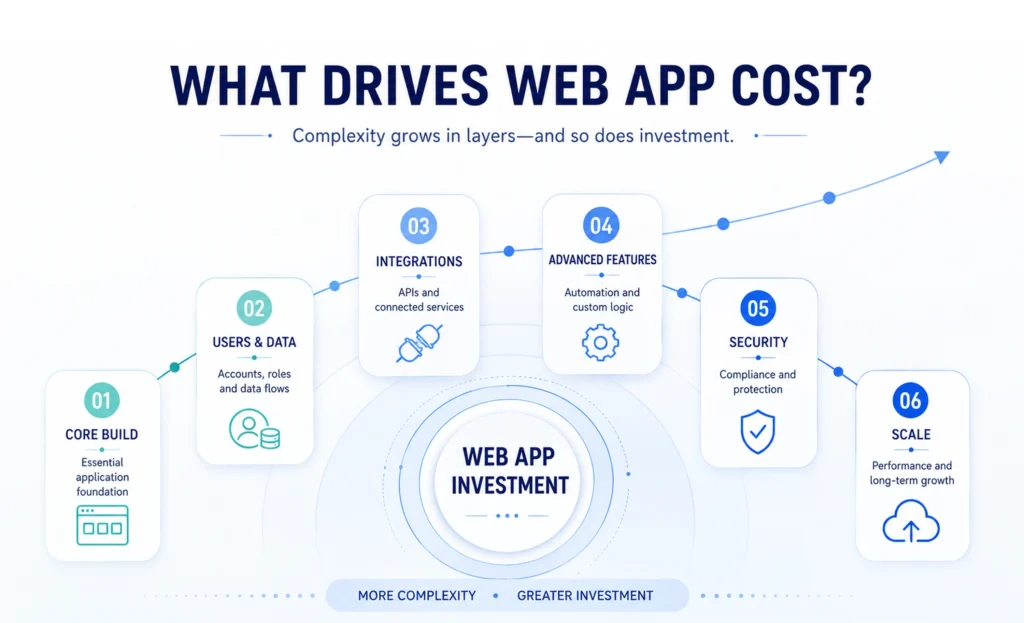
- Feature complexity: Basic features like user login are quick to build. Advanced functionality such as role-based access, real-time updates, dashboards, AI features, or payment processing requires more development time and testing.
- Third-party integrations: Every integration adds work. Whether you’re connecting to a payment gateway, CRM, ERP, maps, or analytics platform, developers need time to build, test, and maintain those connections.
- Design quality: A detailed, developer-ready UI/UX design speeds up development. Vague requirements or frequent design changes slow the project down and increase costs.
- Development team: Who builds your app matters. Freelancers usually cost less upfront, while agencies and dedicated teams charge more but often deliver faster, provide better quality, and offer long-term support.
- Project scope: The biggest cost increases happen when requirements change after development begins. Every new feature affects development, testing, and timelines. A well-defined scope from the start keeps your project on budget and avoids expensive rework.
Hidden Angular App Development Costs Nobody Warns You About
This is the section most quotes skip entirely, and it’s where budgets quietly blow up:
- Maintenance and updates: Angular apps need dependency patches, security updates, and small feature additions after launch. Budget 15-20% of your build cost per year, or your “finished” app becomes a liability within eighteen months.
- Testing and QA time: Rushed timelines often compress testing first. That trade-off shows up later as production bugs, which cost far more to fix than they would have during development.
- DevOps and hosting setup: CI/CD pipelines, staging environments, and deployment infrastructure rarely appear in an initial quote, but someone has to build and maintain them.
- Third-party license fees: Premium UI kits, analytics tools, and specialized libraries carry ongoing subscription costs that don’t show up in a one-time development quote.
- Project management overhead. Someone coordinates the team, reviews progress, and keeps scope in check. With freelancers, that someone is usually you, and your time has a cost too.
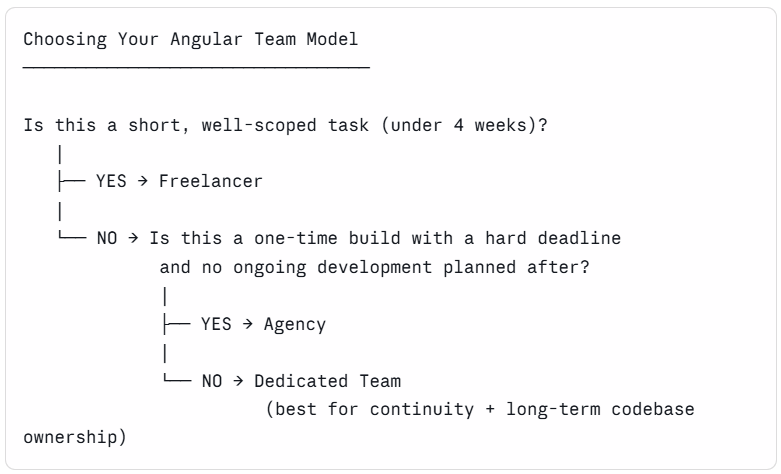
Angular App Development Services: Freelancer vs. Agency vs. Dedicated Team
Not every project needs the same kind of team. Here’s how the three main Angular app development services compare:
|
Model |
Best For |
Cost Structure |
Main Risk |
| Freelancer | Small, well-defined tasks | Cheapest hourly rate | Turnover, inconsistent quality, no backup |
| Agency | Large, complex, one-time builds | Higher fixed quotes, full overhead included | You pay for structure you may not fully use |
| Dedicated team | Ongoing product development | Mid-range monthly rate per developer | Requires a longer initial commitment |
How to Reduce App Development Costs Without Cutting Corners
Cutting costs the wrong way means cutting testing, documentation, or code quality, and paying for it later in bug fixes and rewrites. Here’s how to reduce app development costs the right way:
- Start with an MVP: Ship the core feature set first, validate it with real users, and build the rest based on actual feedback instead of assumptions.
- Nail down requirements before development starts: Every change made after coding begins costs more than the same change made on a whiteboard.
- Reuse a component library: Angular Material or a documented internal design system cuts UI development time dramatically versus building every component from scratch.
- Choose fixed-price contracts for well-scoped work: They protect your budget when requirements are clear and stable.
- Invest in test coverage early. It feels slower in week one. It saves weeks of debugging by month three.
Reduce Angular Development Costs with Built-in Framework Advantages
Good project planning helps control costs, but Angular also includes features that reduce development effort and long-term expenses.
Standalone components: Modern Angular uses standalone components by default, eliminating much of the boilerplate required with older NgModule-based projects. Developers write less code, spend less time on setup, and deliver features faster.
TypeScript’s strict typing: Angular catches many coding errors during development instead of after deployment. Fixing issues early reduces testing time, minimizes production bugs, and lowers maintenance costs.
Angular Signals: Signals simplify state management for many use cases, replacing much of the RxJS code previously needed. Less code means faster development, easier debugging, and lower maintenance effort.
Angular CLI and schematics: The built-in CLI automates repetitive tasks such as creating components, services, routing, and project structure. This improves developer productivity and reduces manual work.
The savings continue after launch. Angular’s opinionated architecture keeps large applications organized and easier to maintain. As your application grows, developers spend less time fixing inconsistent code or restructuring the project.
Although Angular may require a slightly higher upfront investment than some other frameworks, its structured approach often leads to a lower total cost of ownership, fewer costly rewrites, and reduced maintenance expenses over the long term.
Angular vs. React: Which Costs Less Over Time?
This question comes up in nearly every budget conversation, so it deserves a direct answer:
|
Factor |
Angular |
React |
| Initial build cost | Similar, sometimes slightly higher | Similar, sometimes slightly lower |
| Learning curve for new hires | Steeper upfront | Faster to onboard junior developers |
| Long-term maintenance cost | Lower, due to enforced structure and TypeScript | Higher, since architecture varies more by team |
| Best fit | Large, long-lived enterprise applications | Smaller apps or teams prioritizing flexibility |
Neither framework is “cheaper” in every scenario. Angular tends to win on total cost of ownership for applications with a three-year-plus lifespan. React tends to win on speed for smaller, shorter-lived projects.
Conclusion:
Angular app development cost isn’t one number. It’s a range shaped by scope, team model, region, and how disciplined you are about requirements before the first line of code gets written.
Know your real cost drivers, budget for the hidden costs upfront, choose the right team model for your project size, and plan for maintenance from day one, not as an afterthought.
At CodesClue, we help businesses scope Angular projects accurately and build them efficiently, with a dedicated team that sticks around after launch.
If you’re planning an Angular app development project and want a realistic number instead of a guess, feel free to contact us about your budget.