

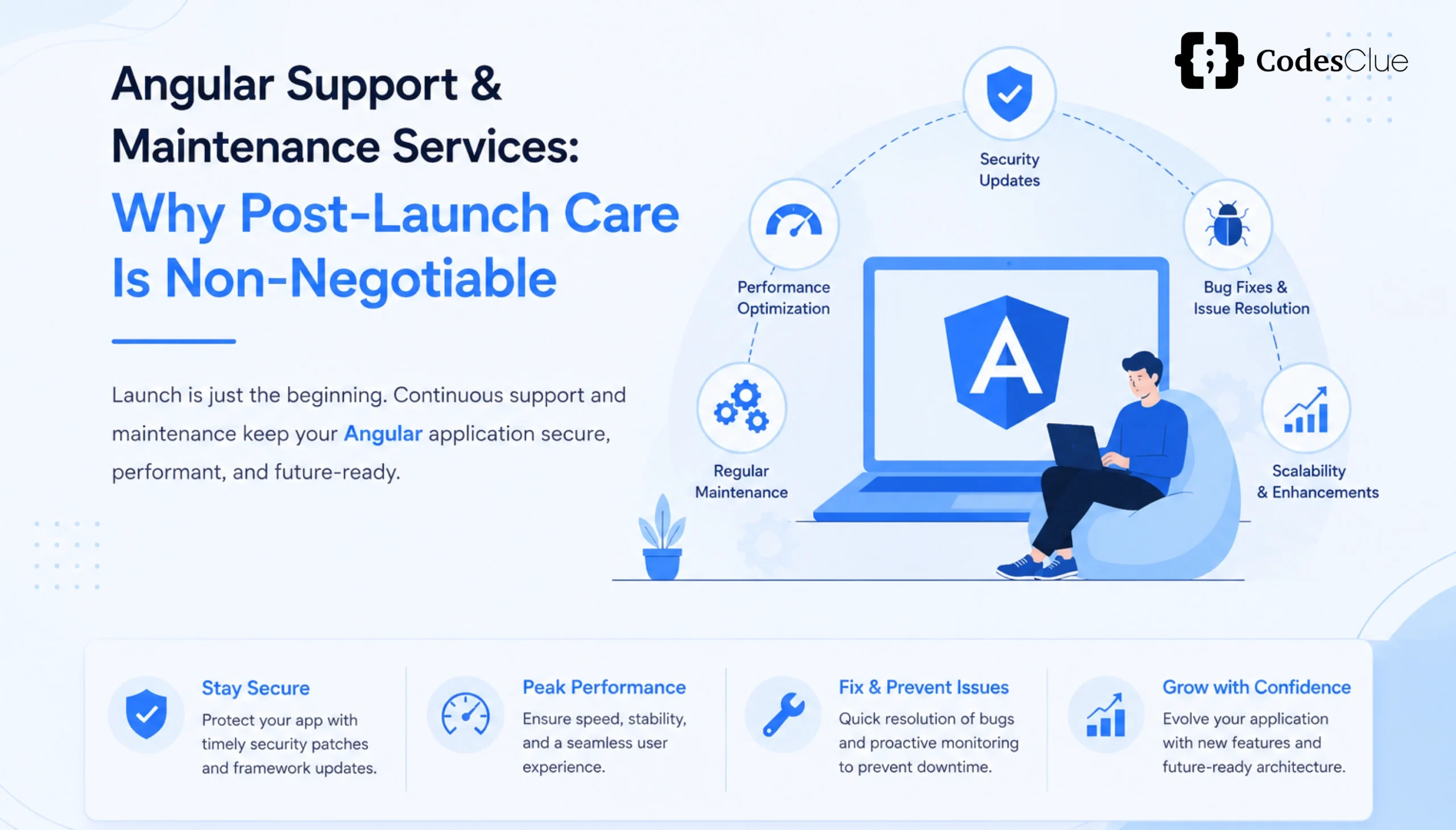
Launching your Angular app feels like the finish line. It isn’t. It’s the starting gun. The moment real users start clicking, typing, and pushing your app in directions your QA team never tested, the real work begins. This is exactly why Angular support and maintenance services aren’t a nice-to-have add-on. They are the difference between an app that scales for years and one that quietly breaks, slows down, and loses users within months.
If you’re a founder, CTO, or IT decision-maker who just shipped an Angular product, this blog breaks down what post-launch care actually involves, what it costs you if you skip it, and how to structure a maintenance plan that protects your investment.
Key Takeaways
- Angular support and maintenance services protect your app from version drift, security risk, and performance decay long after launch.
- Skipping maintenance doesn’t save money. It defers cost into a much larger bill later.
- Angular performance monitoring should be continuous, not something you only think about during a crisis.
- Choosing between an in-house team and an offshore Angular support team depends on your budget, speed needs, and internal bandwidth.
- If you’re running an Angular legacy support situation, plan your migration path now rather than waiting for a forced rewrite.
- A strong Angular maintenance contract package clearly defines scope, pricing, and an enforceable Angular support service level agreement.
- When you hire Angular developers for maintenance, prioritize experience with upgrades and monitoring over pure feature-building speed.
Launch Is Not the End. It’s Day One.
Most teams treat “go-live” as the reward for months of hard work. But users behave unpredictably. They’ll find edge cases your team never imagined. They’ll hit bugs. They’ll expect faster load times than your MVP delivers. Every one of these moments is a test of whether your business is ready to listen, fix, and improve fast.
Skip that step, and your app risks joining the graveyard of abandoned products that never evolved past version one.
What Happens When You Skip Angular Maintenance
Angular apps don’t break overnight. They erode slowly, and by the time you notice, the damage is already expensive to fix.
- Version drift: Angular ships frequent updates. Skip too many, and your app becomes incompatible with newer libraries, tools, and even browsers.
- Performance decay: Unused code piles up. Bundle sizes grow. Load times creep from two seconds to eight.
- Security exposure: Outdated dependencies and unpatched code are the easiest entry points for attackers.
- Bug pileup: Small glitches left unresolved compound into major user-trust problems.
- Talent gaps: Your in-house team is busy building new features, not babysitting old code.
Every one of these problems is preventable with a structured maintenance plan, and every one of them gets more expensive the longer you wait to fix it.
What Angular Support and Maintenance Services Actually Cover
A proper maintenance engagement isn’t just “we’ll fix it if it breaks.” It’s a full lifecycle commitment. Here’s what a serious Angular support services provider should deliver:
|
Service Area |
What It Involves |
Why It Matters |
| Bug Fixes | Rapid diagnosis and resolution of functional issues | Protects user experience and retention |
| Version Upgrades | Migrating to the latest stable Angular release | Keeps app compatible and secure |
| Angular Performance Monitoring | Tracking load times, memory usage, and rendering speed | Catches slowdowns before users notice |
| Security Patching | Scanning dependencies and applying fixes | Reduces exposure to vulnerabilities |
| Third-Party Integration Support | Keeping APIs, payment gateways, and plugins in sync | Prevents integration failures |
| UX Enhancements | Iterating design based on real usage data | Keeps the product feeling modern |
| Reporting & SLAs | Monthly summaries and defined response times | Gives you visibility and accountability |
This scope broadly mirrors what established providers like DITS outline in their own service breakdowns, where bug fixing, version upgrades, performance tuning, security, third-party support, and UX all sit under one maintenance umbrella.
Angular Performance Monitoring: The Silent Deal-Breaker
Most businesses only think about performance when users start complaining. By then, you’ve already lost trust. Angular monitoring should be continuous, not reactive.
A good monitoring setup tracks:
- Change detection cycles and how often they trigger unnecessarily
- Lazy-loading efficiency across modules
- Bundle size growth over time
- API response times feeding into your components
- Memory leaks from unsubscribed observables
When you catch a memory leak in week two instead of month six, you save both engineering hours and user goodwill. This is the core value proposition of ongoing monitoring: problems get fixed while they’re still cheap.
In-House Team vs. Offshore Angular Support Team
This is the decision every growing company eventually faces. Do you build an internal team, or do you bring in an offshore Angular support team?
Here’s a quick breakdown to help you decide:
|
Factor |
In-House Team |
Offshore Support Team |
| Cost | Higher fixed salaries and overhead | Lower cost, pay-for-scope models |
| Speed to hire | Slow, competitive market | Fast onboarding through agencies |
| Specialization | Often spread thin across projects | Dedicated Angular focus |
| Coverage | Limited to business hours | Can offer 24/7 coverage |
| Scalability | Hard to scale up or down quickly | Flexible based on workload |
If your core team is focused on building new features, handing maintenance to a dedicated offshore team lets your product keep moving forward without sacrificing app health.
AngularJS Legacy Support: A Different Kind of Challenge
If your app was originally built on AngularJS (the 1.x version), your maintenance needs look different. AngularJS reached end-of-life years ago, which means official support and security patches from Google have stopped entirely.
This is where an experienced Angular legacy support company becomes critical. The right partner should be able to:
- Keep your legacy app secure through custom patching
- Plan and execute a phased migration to modern Angular
- Rewrite components without breaking existing functionality
- Balance business continuity with long-term modernization
Migrating from AngularJS isn’t optional forever. It’s a matter of when, not if, and the businesses that plan early avoid emergency rewrites later.
Building an Angular Maintenance Contract That Actually Protects You
A vague maintenance agreement helps no one. Before you sign anything, make sure your Angular maintenance contract package clearly defines the following.
1. Scope of Work
What’s included: bug fixes, upgrades, monitoring, security, UX work. What’s excluded: new feature development, major redesigns.
2. Angular Support Service Level Agreement
Your Angular support service level agreement should spell out:
- Response time for critical bugs (ideally under a few hours)
- Response time for minor issues
- Escalation process for production-down scenarios
- Monthly reporting cadence and format
3. Pricing Model
Most providers offer three structures:
- Hourly: Best for occasional, unpredictable fixes
- Monthly retainer: Best for ongoing, predictable support needs
- Fixed package: Best for defined scopes with clear deliverables
4. Review Cycles
Maintenance shouldn’t be static. Quarterly reviews let you adjust scope as your app grows and your business priorities shift.
Why You Should Hire Angular Developers for Maintenance, Not Just Development
There’s a common mistake businesses make: they hire developers purely for building features and assume maintenance will just happen alongside. It rarely does well. Maintenance requires a different mindset. It rewards meticulous developers, patient with legacy code, and comfortable working within existing architecture rather than starting fresh.
When you hire Angular developers for maintenance, look for:
- Proven experience with Angular version migrations
- Familiarity with performance profiling tools
- A track record of security patching, not just feature shipping
- Clear communication habits for ongoing reporting
The Regulus. team frames this well: post-launch care is when user feedback becomes your product roadmap, and the businesses that respond fast to that feedback are the ones that build lasting trust.
Final Words:
Your Angular app is a business asset, not a one-time project. Treating it that way, with structured support, active monitoring, and a clear maintenance agreement, is what separates apps that scale for years from the ones that quietly fade out.