

Website Redesign Cost in 2026: What You Pay For and Why
What a website redesign costs in 2026 by project type, what drives the price, hidden costs quotes leave out and how to keep your Google rankings at launch.
Your website looks dated, loads slowly on phones or no longer matches what you sell. You know it needs work. Yet the quotes swing from a few thousand dollars to six figures for what sounds like the same job. Below, we break down the real website redesign cost in 2026. Read on for what drives the price, what each band buys and which costs surprise buyers later.
Key Takeaways
- The type of redesign matters more than page count. A visual refresh, a redesign on the same platform and a full rebuild are three different budgets.
- Unique page templates, integrations and content work drive most of the price, not the number of pages.
- Protecting search traffic is part of the job. A redirect map and a launch checklist cost far less than lost rankings.
- Accessibility and speed are now legal and commercial requirements, so budget for them from the start.
- Give every vendor one written scope to price, or the numbers will not line up.
How much does a website redesign cost in 2026?
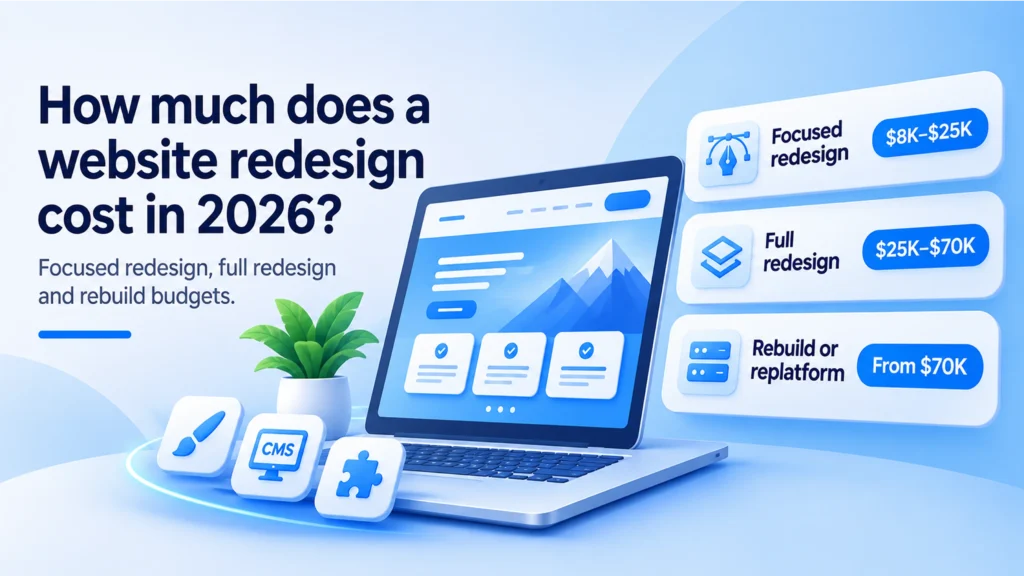
The honest answer is that the website redesign cost depends on how much of the site you change underneath the design. Published guides from US agencies put most business redesigns somewhere between low five figures and well over $100,000, with tiers that frequently clash. A clearer way to budget is by the kind of work your site needs.
| Type of redesign | What changes | Typical scope | Our usual range |
|---|---|---|---|
| Focused redesign | New look, layout and copy on the same platform | Up to about 15 key pages, a few templates, forms and analytics | $8K to $25K |
| Full redesign | New design system, content structure and CMS setup | Many templates, CRM or marketing tool links, content migration | $25K to $70K |
| Rebuild or replatform | New platform, custom features, portals or multiple languages | Large sites, logged-in areas, complex integrations, compliance | From $70K |
A very small site that only needs a new theme may not need a development partner at all. Website builders and good templates handle that well. The bands above are for businesses where the site generates leads or sales and has to work with other systems.
What drives website redesign cost
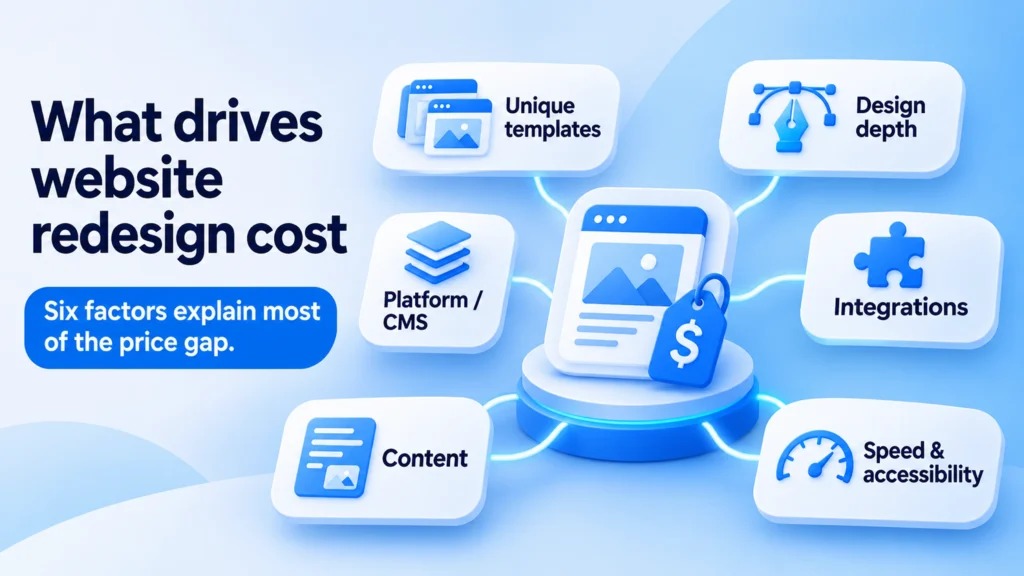
Two sites with the same page count can land at very different prices. Six factors explain most of the gap.
1. Unique templates, not total pages
A blog with 300 articles uses one article template. A services site with 20 pages may need eight different layouts. Each unique template goes through design, build, responsive checks and content entry, so templates are a better measure of effort than pages.
2. Design depth
Adapting a theme is quick. A custom design system with components, states and a style guide takes longer. It pays back when your team adds pages later without breaking the look.
3. Platform and CMS work
Staying on your current CMS keeps the budget down. Moving from one platform to another, or to a headless CMS, adds content modelling, migration scripts and editor training. Read our comparison of Webflow vs WordPress vs a custom website before you decide to switch.
4. Integrations
Contact forms and analytics are standard. Links to a CRM, marketing automation, booking engine, ERP or payment gateway each need mapping, testing and error handling. Old systems without a clean API cost the most.
5. Content
Content is the most underestimated line in any redesign. Someone has to decide what stays, rewrite what is weak, write what is missing and move the rest. On content-heavy sites this work can rival the design itself.
6. Speed, accessibility and security
These used to be extras. In 2026 they belong in the base scope, for reasons covered further down.
Website redesign cost by project type
Here is what usually sits inside each budget band, so you can match your project before you ask for quotes.
| Item | Focused redesign | Full redesign | Rebuild or replatform |
|---|---|---|---|
| Discovery and sitemap | Short workshop | Full content audit | Audit plus technical discovery |
| Design | Theme adapted to your brand | Custom design system | Custom system with complex flows |
| CMS | Current platform | Current or new CMS | New platform or headless setup |
| Integrations | Forms, analytics | CRM, email, booking | ERP, payments, portals, single sign-on |
| Content | Key pages rewritten | Structured migration | Large migration, often multilingual |
| Typical timeline | 4 to 8 weeks | 2 to 4 months | 4 months or more |
Pro tip: Count your unique page types before you call anyone. Open your site, list each layout that looks different and note what each one must do. That list alone makes every quote more accurate.
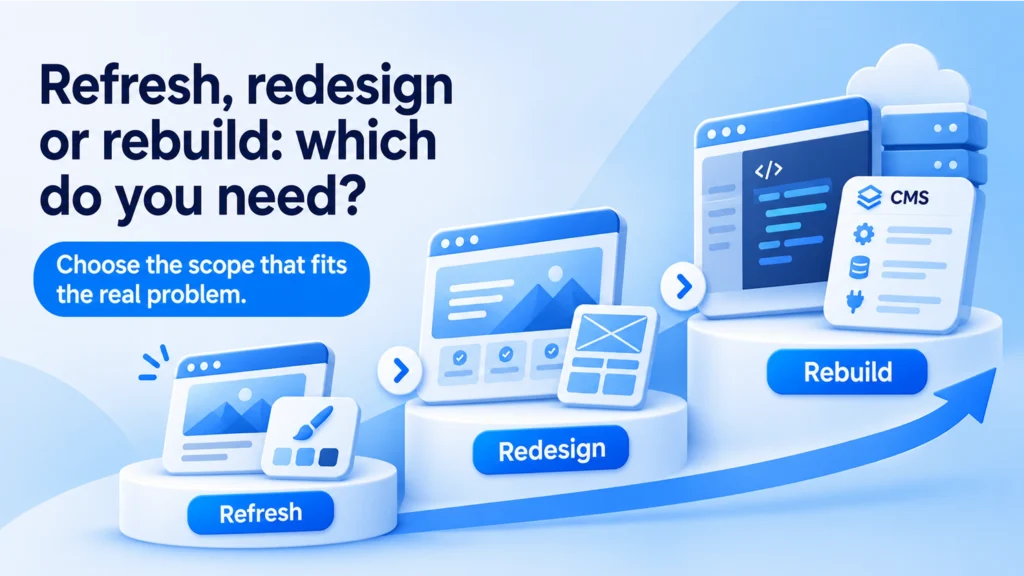
Refresh, redesign or rebuild: which do you need?
Many buyers pay for a rebuild when a redesign would do, and the reverse. Use the problem you are solving to decide.
| Your main problem | Usually enough | Why |
|---|---|---|
| Looks dated, works fine | Visual refresh or focused redesign | The platform is not the issue |
| Visitors arrive but do not enquire | Focused redesign with new copy and page structure | The message and next step need work, not the code |
| Slow, hard to edit, plugin trouble | Full redesign or cleanup of the current build | Technical debt sits under the design |
| Needs logins, portals or heavy integrations | Rebuild | A brochure platform cannot carry an application |
| Brand or business model changed | Full redesign | Structure and content both change |
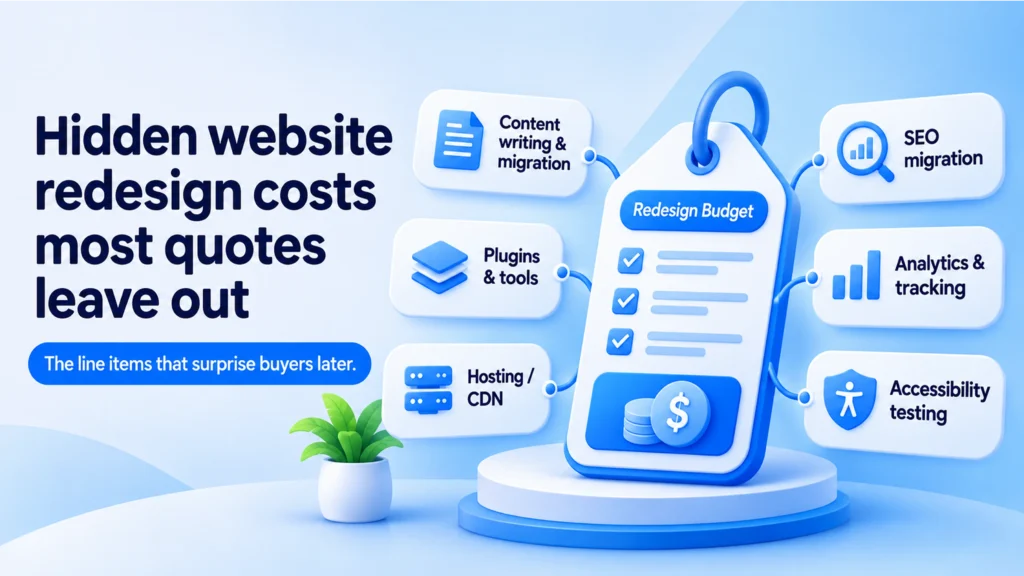
Hidden website redesign costs most quotes leave out
Plenty of quotes look low because they cover design and build only. Ask whether each of these is in or out.
- Content writing and migration: who rewrites pages, and who moves posts, images and downloads.
- Photography, video and icons: stock licences or a shoot.
- Paid plugins and tools: forms, search, translation, security and backups often carry yearly fees.
- Hosting changes: a faster host or CDN may be part of the speed work.
- SEO migration: redirect map, metadata transfer and checks after launch.
- Analytics and tracking: tags, conversion events and cookie consent rebuilt and tested on the new pages.
- Accessibility testing: keyboard, screen reader and contrast checks, not only an automated scan.
- Training and handover: how your team edits pages without breaking the design.
- Support after launch: bug fixes in the first weeks, then plugin, security and content updates for as long as the site runs.
Pro tip: Keep 10 to 15 percent of the budget unallocated. Something always surfaces during content migration, and a buffer stops it from cutting into testing.
Protect your search traffic during a redesign
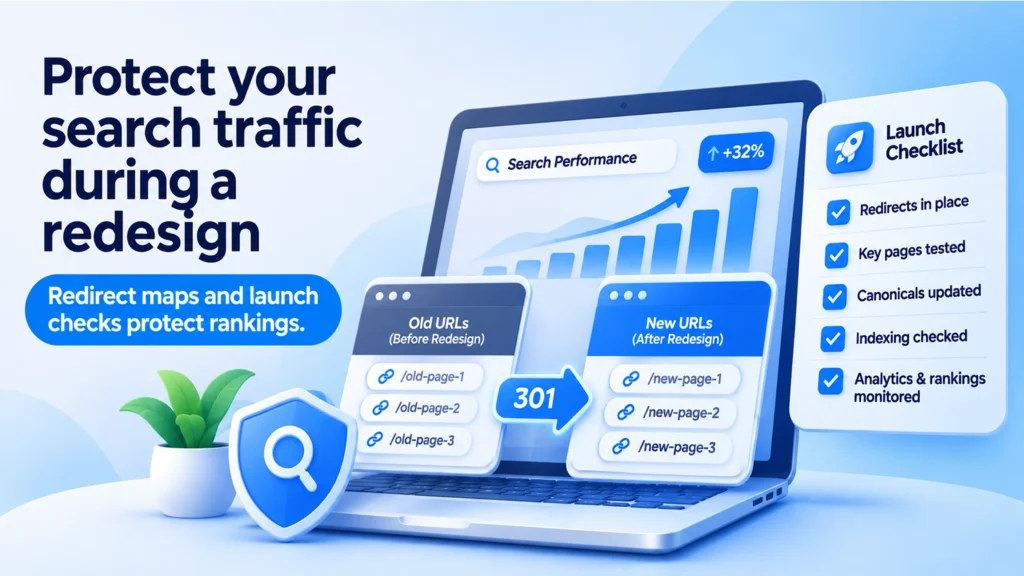
The most expensive redesign mistake does not show on the invoice. It shows a month later, when organic leads drop because old addresses return errors. If any page address changes, map every old address to its closest new page with a permanent 301 redirect before launch.
Keep those redirects in place for a long time. Google’s John Mueller has said, “we recommend keeping the redirect in place for at least one year” (opens in a new tab), and longer is fine.
- Export every indexed address and its traffic from Search Console and analytics.
- Keep addresses that rank well unchanged wherever you can.
- Build the redirect map and test it on the staging site.
- Carry over titles, descriptions, headings and structured data for pages that bring traffic.
- After launch, crawl the site, submit the new sitemap and watch Search Console for errors daily for two weeks.
Speed and accessibility belong in the base budget
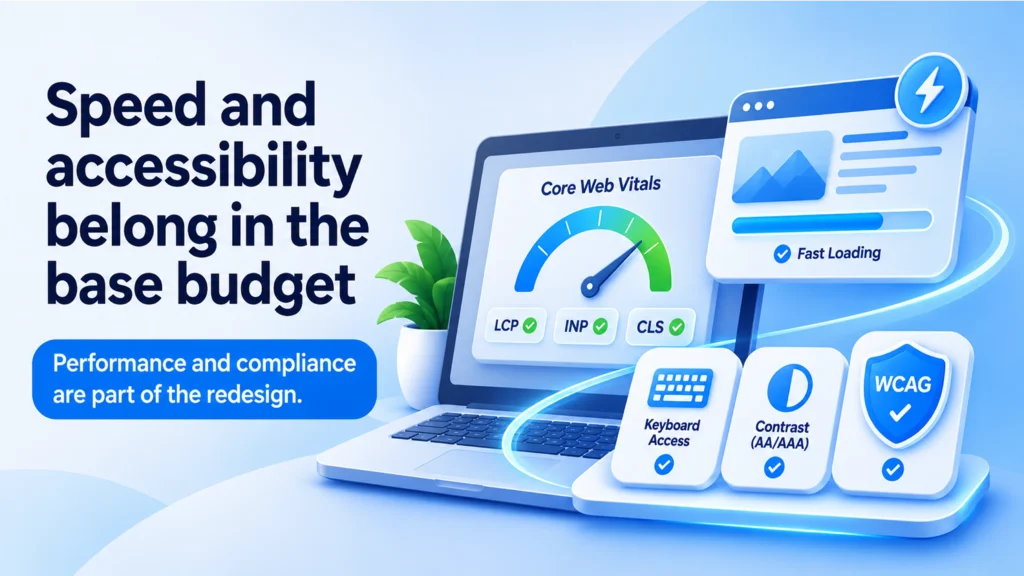
Google’s Core Web Vitals set clear targets for a good page experience. Per web.dev (opens in a new tab), the largest content should load within 2.5 seconds and the page should respond to input within 200 milliseconds. Layout shift should stay at 0.1 or less, measured at the 75th percentile of real visits. A redesign is the best moment to hit those numbers, because images, fonts and scripts are being rebuilt anyway.
Accessibility now carries legal weight in key markets:
- European Union: the European Accessibility Act took effect on 28 June 2025 (opens in a new tab). It covers e-commerce and consumer banking services, among others, with an exemption for some microenterprises.
- United States: the Department of Justice rule for state and local governments requires WCAG 2.1 Level AA. In April 2026 it moved the deadlines (opens in a new tab) to 26 April 2027 for larger entities and 26 April 2028 for smaller ones. Private businesses also face accessibility claims under the ADA.
Building to WCAG AA during the redesign costs far less than fixing a finished site later. See our WCAG compliance guide for what an audit covers.
A real example from our own site
In mid October 2026 we shipped a set of fixes on codesclue.com covering image weight, redirects and duplicate address rules. We changed no design at all. By 19 October, Google’s field data from 28 days of real visits put our Largest Contentful Paint at 1.9 seconds. Before the fixes it sat at about 2.9 seconds. Much of the value of a redesign comes from this kind of work under the surface, so measure it rather than assume it.
How to get comparable redesign quotes
Send every vendor the same short brief. It should cover:
- Your goal in one line, such as more demo requests or fewer support calls
- Your current platform and whether you want to keep it
- The list of unique page types and roughly how many pages of each
- Every system the site must connect to
- Who writes and moves the content
- Languages, accessibility level and your target launch date
Then compare the answers line by line. A quote that skips SEO migration, testing or content is not a better deal. It is incomplete.
Common mistakes that raise the cost
- Starting design before anyone agrees on the sitemap and content
- Changing platform because a competitor did, not because the current one fails
- Leaving content until the last two weeks
- Launching without a redirect map
- Treating accessibility as a plugin rather than a build standard
- Approving designs on desktop only when most visitors use phones
Plan your website redesign cost with CodesClue
A good estimate for your website redesign cost starts with your goal, your current platform and the systems the site must work with. We plan redesigns in short Agile sprints, so you review working pages every week or two instead of one big reveal at the end. Engineering happens in Ahmedabad, while people on the ground in Germany and the USA stay close to buyers in Britain, Europe and North America.
Send us your current site address, your main goal and any must-have integrations. Expect an answer within one business day listing the first questions we would ask and the budget band your project most likely fits. See our website redesign services or contact us to start.
FAQs
How long does a website redesign project usually take?
A focused redesign on the same platform usually takes four to eight weeks. A full redesign with a new design system and content migration takes two to four months. Rebuilds with portals or complex integrations take longer. Content approval is the most common cause of delay, so start writing early.
Will a website redesign hurt my Google rankings?
It can if page addresses change without redirects or if ranking content is removed. Keep strong addresses where possible, map every changed one to a 301 redirect, carry over titles and headings, and watch Search Console closely for two weeks after launch. Done this way, rankings usually hold or improve.
Does a redesign cost less than building a new website?
Redesigning on your current platform usually costs less, because the hosting, CMS and integrations already work. A rebuild makes sense when the platform itself blocks you, for example slow plugins you cannot replace, no way to add logins or an editor your team avoids. Fix the real problem, not the newest one.
What should I prepare before asking for redesign quotes?
Write your main goal in one line, list your unique page types, note every tool the site connects to and decide who will write the content. Add your target launch date and any accessibility or language needs. That way every vendor quotes the same work, and you can weigh the answers side by side.