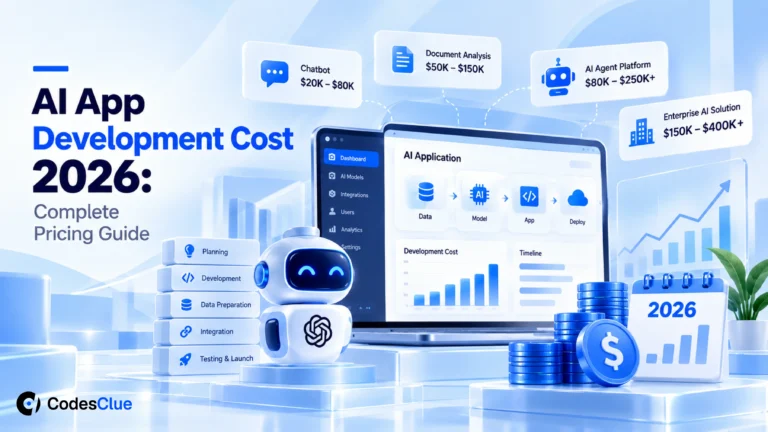

AI in Logistics: Predictive Supply Chain Optimization Guide
Predictive analytics in supply chain, explained: where AI in logistics pays off first, the data you need, and when to wait. With a 6-step plan.
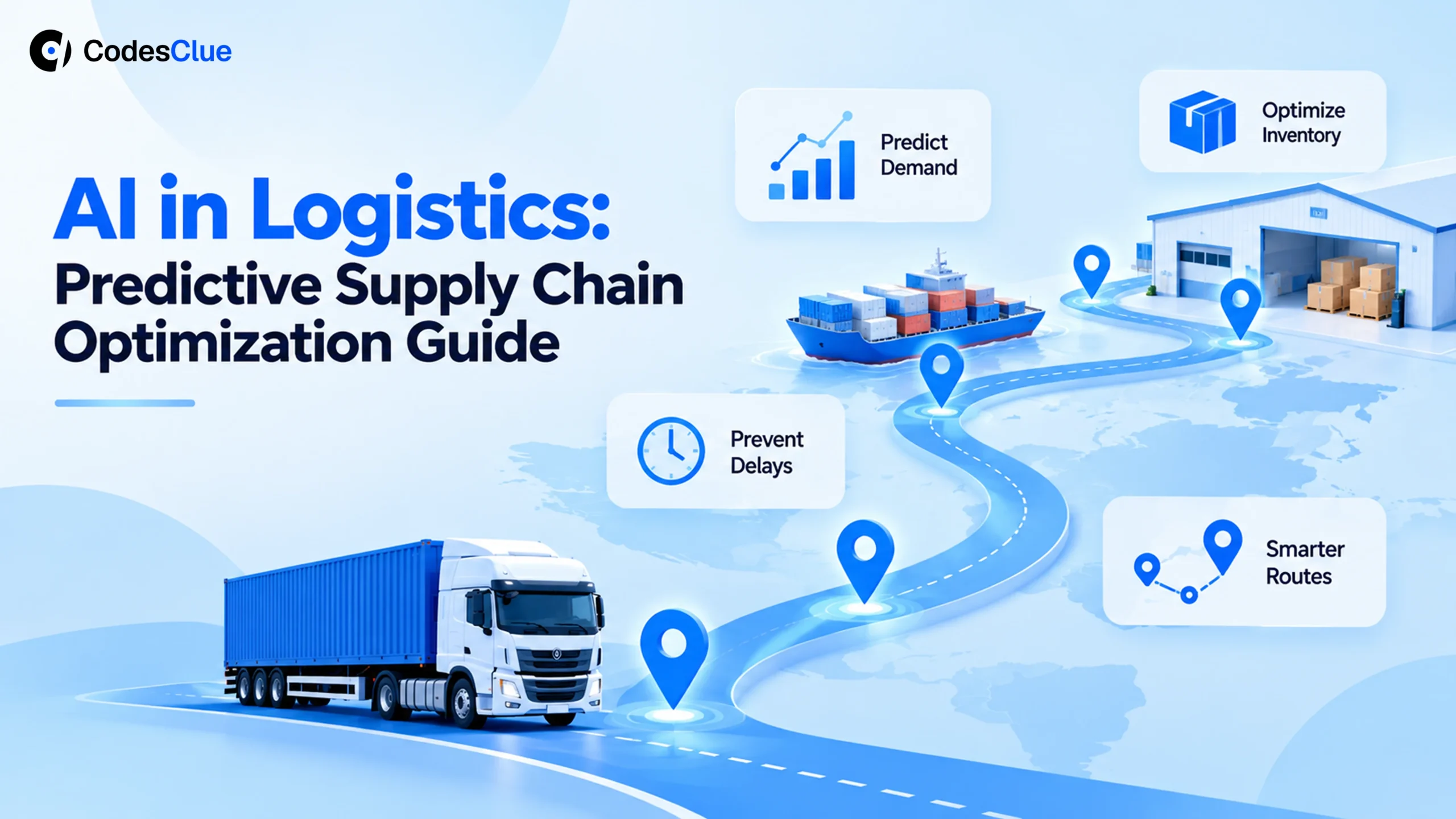
A truck is stuck at a port, a key customer wants their order today, and the warehouse shows stock that is not on the shelf. Your team finds out when the phone rings. That is the gap predictive analytics in supply chain work is meant to close.
This guide shows how AI in logistics turns the data you already collect into early warnings and better plans. You will see where it pays off first, what data it needs, and where people should stay in charge. We also share what we learned building tracking software for a delivery business.
Key Takeaways
- Predictive analytics in supply chain uses past orders, live tracking and outside signals to warn you about stockouts, delays and supplier problems before they hit.
- Demand forecasting and late-delivery alerts usually pay back first, because the data already sits in your ERP and tracking tools.
- McKinsey found early adopters of AI-enabled supply chain management improved logistics costs by 15%, inventory by 35% and service levels by 65%.
- AI agents can act on routine problems, but Gartner advises full automation only for low-risk decisions for now.
- Start with one lane, one warehouse or one product group, prove the forecast beats your current plan, then grow.
What is predictive analytics in supply chain?
Predictive analytics in supply chain uses historical data, live data and machine learning to forecast what will happen next. It predicts demand, delivery times, supplier delays and stock levels. Instead of reporting last month’s problems, it tells your team which orders, lanes or items need action today, while there is still time to act.
Traditional reports answer “what happened?”. A predictive model answers a more useful question: “what is likely to happen next, and what should we do about it?”
To do that, the model reads data from many places at once:
- Sales and order history
- ERP and inventory records
- Supplier lead times and on-time rates
- Shipment scans, GPS and carrier updates
- Weather, holidays and local events
- IoT sensors in trucks and warehouses
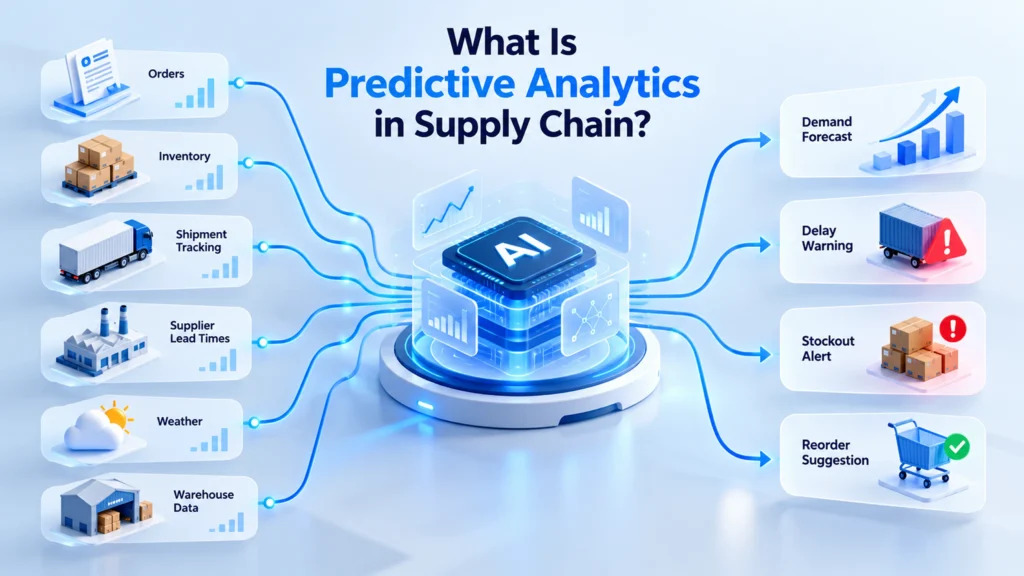
When these sources feed one model, you get a predictive supply chain. It flags a likely stockout ten days out, not on the day the shelf is empty.
How AI in supply chain improves daily decisions
Most planning still runs on averages and spreadsheets. That worked when demand was steady. Today a single storm, strike or viral product can break the plan in a day.
AI in supply chain work spots patterns across millions of records that no planner could read by hand. It also updates forecasts as new data arrives, so the plan moves with the week.
| Business area | What AI predicts | What changes for the team |
|---|---|---|
| Demand planning | Orders by product, region and week | Fewer stockouts and less dead stock |
| Inventory | When each item needs a reorder | Lower carrying costs, fewer rush orders |
| Transport | Late shipments and arrival times | Customers hear about delays before they call |
| Procurement | Which suppliers are likely to slip | Backup orders placed early |
| Warehousing | Staff needed per shift | Fewer idle hours and missed cut-offs |
This is what AI for supply chain optimization looks like in practice: many small, faster decisions instead of one big plan per quarter. The gains add up. In its 2021 supply chain study (opens in a new tab), McKinsey looked at early adopters of AI. They improved logistics costs by 15%, inventory levels by 35% and service levels by 65% against slower rivals.
Pro tip: Before you build a model, write down today’s forecast error for one product group. Without that number, nobody can prove the new forecast is better.
Predictive analytics supply chain benefits by problem
The clearest way to judge predictive analytics supply chain benefits is to start from the problem that costs you most. Each one has a matching prediction and a clear result to measure.
| Problem | Prediction that helps | Result to measure |
|---|---|---|
| Demand swings | Weekly demand forecast per item | Forecast error, stockout days |
| Late deliveries | Delay risk per shipment | On-time delivery rate |
| Supplier problems | Lead-time risk per supplier | Orders delayed by suppliers |
| Excess stock | Reorder point per location | Inventory days, storage cost |
| Warehouse queues | Order volume per shift | Orders shipped by cut-off |
Good supply chain predictions also change how teams plan. People argue less about gut feel because the forecast and its error are on the screen. Planners spend their time on the exceptions, not on rebuilding the same spreadsheet each Monday.
Where predictive analytics pays off first
You do not need every use case at once. Pick the one where the data is ready and the loss is visible. This table ranks them by data readiness and effort.
| Use case | Data you need | Effort | Typical first win |
|---|---|---|---|
| Late-delivery alerts | Shipment scans, carrier ETAs | Low | Customers warned before the call |
| Demand forecasting | 2+ years of orders | Medium | Fewer stockouts on top sellers |
| Reorder points | Stock levels, lead times | Medium | Less cash tied up in stock |
| Supplier risk | Supplier on-time history | Medium | Backup orders placed earlier |
| Fleet maintenance | Sensor and repair logs | High | Fewer breakdowns on the road |
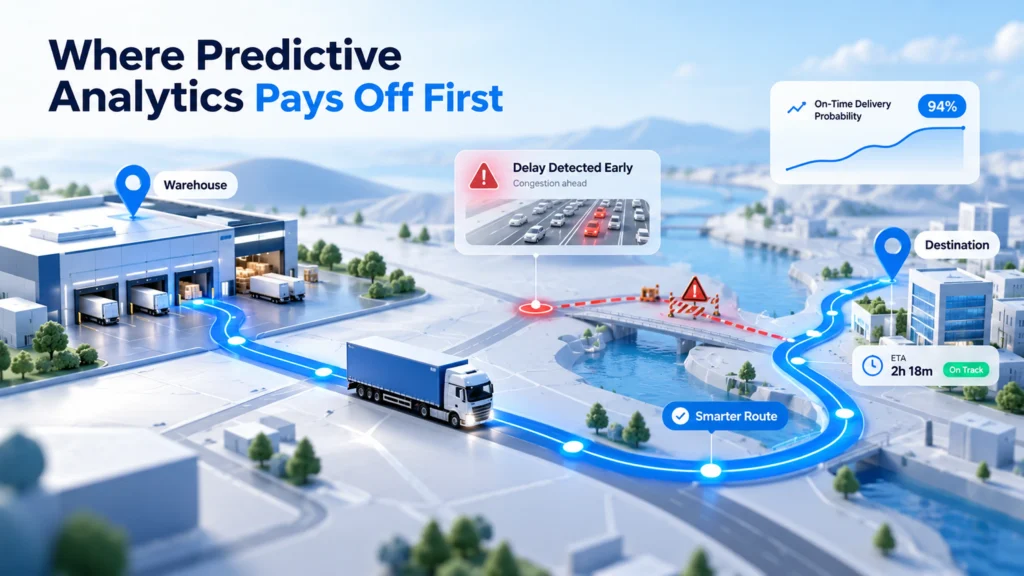
Late-delivery alerts often come first because tracking data already exists. On TracknTake, a shipment tracking platform we built, every item gets a scan at pickup, transit and delivery. The case study reports on-time delivery reached 94%, with more than 1,200 packages tracked every day. A clean scan history like that is exactly what a delay model needs.
Pro tip: If your drivers still phone in their status, fix tracking first. A model cannot predict a delay from data nobody recorded.
Not sure which use case fits your operation? Tell us about your supply chain and we will point to the first one worth testing.
Agentic AI in supply chain: from alerts to actions
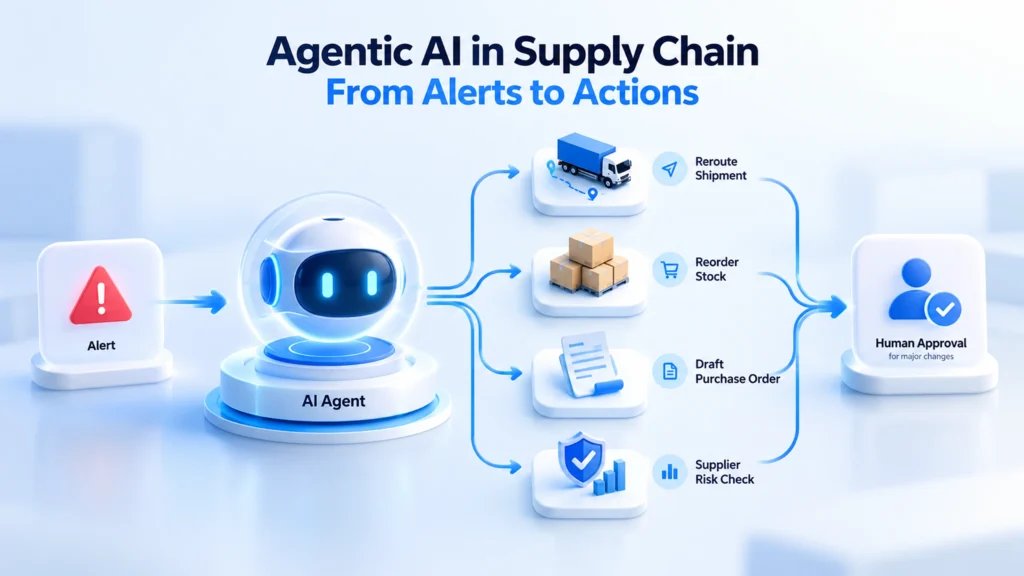
A forecast tells you a problem is coming. Agentic AI in supply chain work goes one step further: an AI agent reads the alert, checks its rules and takes the next step itself.
Say a storm will delay a shipment. An agent can spot the risk, compare other routes, move the delivery slot, tell the customer and suggest a backup supplier. A planner then approves the bigger moves.
Typical agent tasks include:
- Reordering stock when it falls below a set point
- Flagging and rerouting late shipments
- Drafting purchase orders for a planner to approve
- Scoring suppliers on new delivery data
Spending is moving fast. Gartner forecasts (opens in a new tab) that supply chain software with agentic AI will grow from less than $2 billion in 2025 to $53 billion by 2030. Gartner also predicts that 60% of supply chain disruptions (opens in a new tab) will be resolved without human action by 2031.
Its advice for today is careful, though: automate low-risk decisions fully, and let AI support people on the costly ones.
That rule makes sense. An agent can reorder packing tape on its own. It should not cancel a large customer order without a person saying yes. For a sense of what agents cost to build, see our AI agent development cost guide.
Generative AI in logistics: help for the people doing the work
Predictive models forecast. Generative AI in logistics helps staff read, write and search faster. It does not replace planners or dispatchers. It removes the busywork around them.
- Summarising the day’s late shipments in plain words
- Drafting delay emails to customers
- Answering “where is order 4471?” from live data
- Turning supplier reports into a short weekly brief
A manager can ask, “Which shipments will miss today’s promise?” and get a short list with reasons, instead of opening five dashboards. The answer is only as good as the data behind it, so tracking and stock records still come first.
How AI supply chain visibility platforms connect the picture
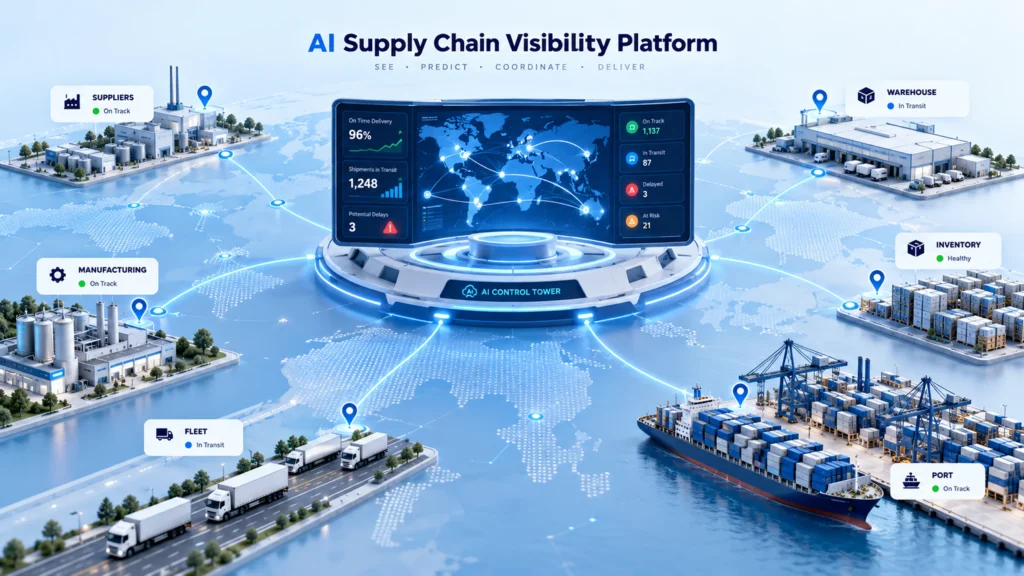
Most supply chains spread data across an ERP, a warehouse system, a transport system and a carrier portal or two. Each shows part of the truth. AI supply chain visibility platforms pull these feeds into one live view and score each order for risk.
Typical features include live shipment tracking, stock by location, supplier scorecards and alerts for weather or port delays. The value is in the early warning. A dispatcher who sees a delay at 9 am can still fix it. At 4 pm, all they can do is apologise.
Many companies also need a shared portal so suppliers can update their own dates. We cover that in our guide to why your supply chain needs a vendor partner portal.
How to start with predictive analytics for supply chain
The best results come from small, measured steps. This is the order we follow on predictive analytics for supply chain projects, from proof of concept to MVP to production.
- Pick one problem. Choose the loss you can count, such as stockouts on your top 50 items.
- Measure today. Record the current forecast error or on-time rate as your baseline.
- Connect the data. Pull orders, stock and tracking data into one place and clean the gaps.
- Build a proof of concept. Train a first model on past data and test it against what really happened.
- Put it in the workflow. Show the forecast where planners already work, inside the ERP or a simple dashboard.
- Watch and retrain. Track accuracy weekly and retrain when demand patterns shift.
At CodesClue, a proof of concept like this usually runs about $8K to $25K. A production system runs $25K to $70K, and a multi-site platform starts from $70K. Our machine learning development team handles the models, and our data analytics services cover the dashboards around them.
Pro tip: Show planners the forecast next to their own number for a month before you switch. Trust grows when people see the model win on their own products.
Data readiness checklist
- At least two years of order history, with returns marked
- Stock levels by location, updated daily or better
- Supplier lead times recorded per order, not as one average
- Shipment scans with times at each stage
- One product code used across every system
- A named owner for each data source
When predictive analytics is not the right move yet
In a few cases, it is better to wait. If your stock counts never match the shelf, fix the counting first. If you sell a few large custom orders a year, a forecast has too little history to learn from. And if nobody owns the decision a forecast would change, the model will sit unused.
In those cases, a better tracking app or a clean warehouse system often brings more value than AI. Our logistics software development services cover that groundwork.
Common mistakes to avoid
- Starting with the model. Teams buy a tool before they know which decision it should change.
- Skipping the baseline. Without today’s error rate, nobody can show the gain.
- Feeding in dirty data. Duplicate product codes and missing scans teach the model the wrong lessons.
- Hiding the forecast. People ignore a prediction that sits in a separate app. Put it where they already work.
- Letting agents act alone too soon. Give AI full control only over low-risk actions you can undo.
- Never retraining. Demand shifts. A model trained last year slowly drifts out of date.
The future of AI-driven supply chain optimization
AI-driven supply chain optimization is moving from monthly plans to decisions made every hour. Digital twins let teams test a new route or warehouse on screen before they spend money. Control towers combine tracking, stock and supplier data in one place. Fleet sensors predict repairs before a truck breaks down.
As AI supply chain optimization matures, the planner’s job changes. Less time goes on building the plan. More goes on setting the rules, checking the exceptions and talking to customers and suppliers.
Turn your supply chain data into early warnings
Predictive analytics in supply chain work pays off when it starts small: one problem, one baseline and data you trust. Prove the gain there, then add agents and wider visibility as the results come in.
CodesClue is an AI-first software company with engineering in Ahmedabad and offices in India, the USA and Germany. We build tracking, warehouse and forecasting software for logistics teams, from proof of concept to production. Talk to our team about the first prediction your supply chain needs.
If you want your own data experts on the project, you can also hire data scientists, and development starts within 48 hours.
FAQs
How accurate are AI supply chain forecasts?
Accuracy depends on your data, how steady demand is and how often the model is retrained. Fast sellers with long histories forecast well. New products and rare custom orders do not. Always compare the model with your current forecast on the same items for a few weeks before you trust it, and track the error every week after go-live.
How much data do we need to start predictive analytics in logistics?
For demand forecasting, two years of order history is a good start, because it shows seasonality at least twice. For delay alerts, a few months of clean shipment scans can be enough. What matters more than volume is consistency: one product code across systems, real timestamps and returns marked clearly.
Can predictive analytics work with our existing ERP or WMS?
Yes. Most projects read data from the ERP, WMS and TMS you already run and write the forecast back into them or into a simple dashboard. You rarely need to replace those systems. The work is in connecting them, cleaning the data and agreeing which system holds the truth for each field.
Should a small logistics company invest in AI yet?
Only if a clear loss exists and the data to predict it is already recorded. If drivers still phone in their status or stock counts never match, a tracking app or warehouse system will bring more value first. Once that data is clean, a small proof of concept on one lane or product group is a sensible next step.