

Software Development Consulting: A Buyer’s Guide to Getting It Right
Software development consulting explained: when you need it, what a technical discovery delivers, how to pick a partner, pricing models and contract terms.
You have a product idea, a project that keeps slipping or an old system nobody wants to touch. Every vendor you call wants to start coding next week, yet you still have open questions about scope, cost and risk. Software development consulting exists for exactly this gap. This guide shows what a good consultant hands you and how to judge one before you sign. It also maps out the first month, so the budget stays in your hands.
Key Takeaways
- Good consulting ends with decisions written down: scope, architecture, risks, a budget range and a plan. A slide deck alone is not a result.
- Buy a short discovery first. It costs a small slice of the build and catches the mistakes that cost the most later.
- Choose the engagement model by who owns the outcome: advice only, a team you manage or a team that delivers.
- Keep the code, cloud accounts and documents in your company’s name from day one.
- Test a partner with your hardest question on the first call and watch how they answer it.
What is software development consulting?
Software development consulting is paid expert advice on what to build, how to build it and how to run the work. A consultant studies your goals, users, current systems and limits. Then they turn all of it into a scope, an architecture, a delivery plan and a cost range you can act on.
Many firms also build the product afterwards, but the advice should hold up even if you hire someone else to build.
Picture it as the step between “we have an idea” and “we signed a build contract”. Skip that step and the build team ends up making those calls under deadline pressure, with your money.
When does a software development consultant pay off?
A software development consultant earns the fee when a wrong call is expensive and nobody on your side has made that call before. These six moments come up most often:
| Your situation | The question to settle | What you should walk away with |
|---|---|---|
| New product, no tech team yet | What is the smallest version worth launching? | MVP scope, stack choice, budget range, hiring plan |
| Project late or over budget | Why is it slipping, and is the code worth saving? | Code and process review, recovery plan |
| Legacy system holding you back | Rewrite, refactor or swap for a ready product? | Modernization options with risks and phases |
| Adding AI to a product | Which use case pays back, and what data does it need? | Ranked use cases, data check, pilot plan |
| Choosing a vendor | Can these proposals be compared, and are they realistic? | Proposal review, scoring, follow-up questions |
| Growth is breaking the system | Where will it fail first under load? | Architecture review, scaling plan, cloud cost view |
Pro tip: Write down the one decision you need help with before you call anyone. “Should we rebuild the booking engine or patch it?” gets a far sharper answer than “we need a tech partner”.
Types of software consulting services
Software consulting services fall into four groups, and most real engagements mix two of them.
- Product and scope: user flows, feature priority, MVP boundaries and a release plan.
- Technical: stack choice, architecture, integrations, security and a software architecture review of code you already have.
- Delivery: team shape, process, estimates, quality gates and vendor selection.
- Modernization and AI: upgrade paths for old systems, cloud moves and AI pilots tied to one business number.
General IT consulting covers networks, licenses and internal tools. If your problem is a product your customers touch, pick a firm that ships software for a living.
Build, buy or extend: the call consultants get asked most
Before anyone designs a custom system, a good consultant checks whether you should build at all. Ready-made products win more often than vendors like to admit. Run every option through the same five checks:
- Five-year cost. Licenses, hosting, support and the people needed to run it, not only the first invoice.
- Fit with how you work. How much of your process would bend to suit the product, and whether staff will accept that.
- Integrations. Which of your systems it must talk to, and whether those APIs exist today.
- Room to change. How hard it is to add the feature your sales team will ask for next year.
- Exit risk. What happens to your data and workflows if the vendor raises prices or shuts down.
A common honest answer is “extend”: keep a ready product for the standard parts and build only the piece that makes you different.
Consulting vs staff augmentation vs a delivery team
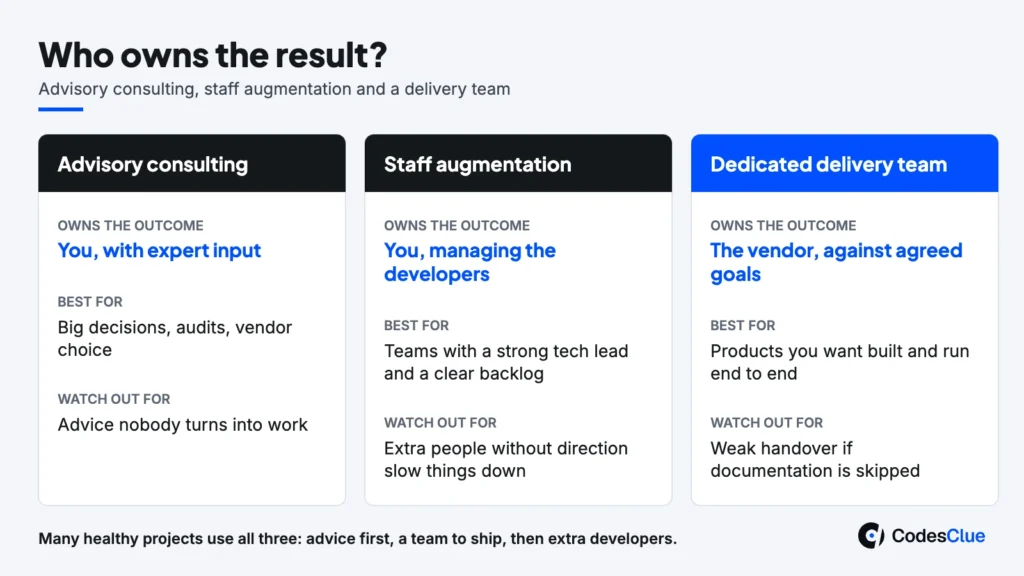
Buyers often mix these up, then feel let down when the model does not suit the need. The deciding question is simple: who owns the result?
| Model | Who owns the outcome | Best for | Watch out for |
|---|---|---|---|
| Advisory consulting | You, with expert input | Big decisions, audits, vendor choice | Advice nobody turns into work |
| Staff augmentation | You, managing the developers | Teams with a strong tech lead and a clear backlog | Extra people without direction slow things down |
| Dedicated delivery team | The vendor, against agreed goals | Products you want built and run end to end | Weak handover if documentation is skipped |
Plenty of healthy projects pass through all three. A short advisory phase sets the plan, a delivery team ships the first release, and augmented developers later join your own staff. Our guide to staff augmentation vs outsourcing goes deeper on the last two.
What a good technical discovery delivers
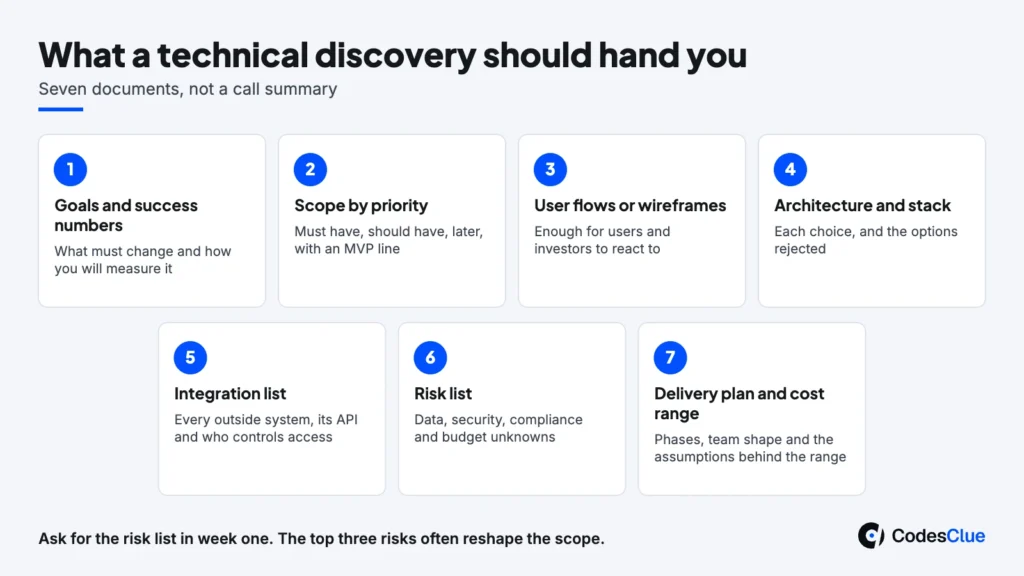
A technical discovery is the most useful first purchase in consulting. It usually runs a few weeks, depending on the size of the system. When it ends, you should hold these seven documents, not a call summary:
- Goals and success numbers. What the software must change, and how you will measure it.
- Scope by priority. Must have, should have and later, with a clear MVP line.
- User flows or clickable wireframes. Enough for users and investors to react to.
- Architecture and stack. The reason behind each choice and the options that were rejected.
- Integration list. Every outside system, the state of its API and who controls access.
- Risk list. Data, security, compliance and the unknowns that could move the budget.
- Delivery plan and cost range. Phases, team shape and a range with its assumptions spelled out.
Pro tip: Ask for the risk list in week one rather than at the end. The top three risks often reshape the scope more than any feature debate.
Why the early decisions matter so much
Big software projects rarely fail in the code. They fail in the plan. A McKinsey and University of Oxford study of more than 5,400 IT projects found that, on average, large IT projects run 45% over budget and deliver 56% less value than predicted (opens in a new tab). The fixes it names start with clear strategy, the right talent and short delivery cycles. Those are the very questions a consultant should close before the build begins.
Your project may be far smaller than the ones in that study. The pattern still applies: a fuzzy goal and an untested estimate cost more than any single bug.
How to choose a software consulting partner
Score every firm on the same five points, then weight them by what matters most to you. For a longer checklist on the build side, see how to choose a custom software development company.
| What to check | How to check it | Red flag |
|---|---|---|
| Relevant work | Ask for two live products close to yours and open them yourself | Logos only, nothing you can click |
| Quality of thinking | Bring your hardest open question to the first call | A sales script that dodges the question |
| Honesty on scope | Ask what they would cut from your feature list | “We can build all of it” before any discovery |
| Who does the work | Ask to meet the lead engineer, not only sales | Seniors at the pitch, juniors on the project |
| Client reviews | Read verified reviews and ask for a reference call | No third-party reviews anywhere |
Questions to ask on the first call
- What would you need from us in week one?
- Which part of our idea worries you most?
- How do you handle a change of scope mid-sprint?
- Who owns the code, designs and cloud accounts?
- What happens if we stop after the discovery?
Listen closely to the last answer. A confident partner hands over every discovery document, even if you go on to build elsewhere.
Warning signs inside a proposal
- A hidden product tie. The firm resells one platform and every recommendation leads back to it.
- Scope written as activities. “Workshops and analysis” with no list of documents you will own.
- No client homework. A plan that never says what your team must supply, or by when.
- Advice only they can carry out. An architecture so tied to the firm that nobody else could build it.
Fixed price vs time and materials in consulting
The fixed-price vs time and materials choice is less about cost and more about who carries the risk of change. Pick the model by how settled your scope is.
| Model | How it works | Fits when |
|---|---|---|
| Fixed price | One price for a defined scope | Discovery, audits and small, well-defined builds |
| Time and materials | You pay for time used, reviewed each sprint | Products where you learn from users as you go |
| Retainer | A set block of advice each month | Ongoing architecture or CTO-level guidance |
| Phased hybrid | Fixed discovery, then sprints under a budget cap | Most new products and modernization work |
For the build that follows, our projects tend to land in three bands. Expect $8K to $25K for a focused MVP or pilot, $25K to $70K for a full product with integrations, and from $70K for platforms with several user roles or heavy compliance. Discovery tells you which band your project belongs in. Our custom software cost guide breaks those bands down further.
Contract points that protect you
- Code ownership: all code, designs and documents pass to you on payment.
- Your accounts: the repository, cloud and app store accounts are registered to your company.
- NDA and data handling: who sees which data, where it lives and for how long.
- Change process: how a new request gets estimated and approved in writing.
- Exit terms: a notice period and a handover checklist if you part ways.
Pro tip: Ask for read access to the code repository from the first week of any build. Looking at the commits yourself is the simplest quality check you have.
A first 30 days with a consultant
- Week 1, listen: interviews with owners and users, system access, a look at any code and data.
- Week 2, shape: scope by priority, user flows and the first risk list.
- Week 3, design: architecture, stack, integration plan and a proof of concept for the riskiest part.
- Week 4, decide: delivery plan, cost range, team shape and a go or no-go meeting.
Small projects squeeze this into two weeks, and systems with many integrations need longer. Either way, the month should end with a decision, not one more report.
What our billing platform work taught us
On InvoiceMinds, a billing platform we built, the design followed real billing and payment workflows rather than a screen list. The dashboard had to show which invoices were paid, pending or overdue at a glance, and automated calculations and status updates hung off those states. That is the kind of rule worth pinning down during discovery, because so much of the build depends on it.
Mistakes buyers make with consultants
- Asking five vendors for a fixed quote on a one-page idea
- Choosing the stack before anyone has written down the goals
- Letting the vendor open the cloud and code accounts in its own name
- Treating discovery as a free sales step
- Interviewing managers only and never talking to the people who will use the software
- Paying for advice, then ignoring the parts that sting
Save the fee in these cases
You can skip paid consulting when you already have a strong tech lead and a scope users have tested. The same goes for small changes to a system your team knows well. In those cases, hire dedicated developers against your backlog and put the money into the build.
Getting started with software development consulting at CodesClue
The best software development consulting leaves you with fewer unknowns and a plan your board can trust. Our engineers are based in Ahmedabad, and our offices in the USA and Germany keep planning calls inside your working day. We bring AI in where it earns its place. Each project starts as a small proof of concept, grows into an MVP and then reaches production, in short sprints you can watch.
A good first message is short: the decision you are stuck on, the systems involved and any deadline you face. One of our engineers reads it and replies within one business day. The reply holds the questions we would ask first and an outline of a discovery scope sized to your project. Start on our software development consulting page, look through the portfolio, or send us your message.
FAQs
How much does a technical discovery usually cost?
It depends on the size of the system and how many integrations need checking. For a new MVP, a focused discovery costs a small part of the build that follows. Ask for a fixed price with a written list of the documents you receive, so you can compare offers and keep the work even if you build with another team.
Can a consultant review code that another vendor wrote?
Yes, and it is one of the most useful checks you can buy. The reviewer reads the repository, runs the build and looks at tests, security and structure. You get problems ranked by risk and a view on whether to keep, refactor or rewrite each part. Give read-only access to the code, never admin rights.
Do we need a consultant if we plan to hire in-house developers?
Often yes, for a short period. A consultant can set the architecture, write the first technical tasks and sit in on candidate interviews. Your new hires then join a project with a clear direction instead of a blank page. Once your own tech lead is in place, the consultant steps back to occasional reviews.
Should the firm that plans the project also build it?
It can, and it often saves time because nothing gets lost in a handover. Protect yourself by buying discovery as a separate, fixed-price piece of work that you own outright. If the plan is good, any capable team could build from it. If only the planner can follow it, treat that as a warning sign.
How does consulting work across US, UK and Indian time zones?
Agree on a short daily overlap for calls and quick decisions, and keep everything else written down in the project board. Book sprint demos at a time that suits your team. Run this way, a question you send at the end of your day often has an answer waiting the next morning.