
How to Hire HTML CSS Developers: A 2026 Screening Guide
How to hire HTML CSS developers in 2026: what the role covers, five skills to check, a 90-minute screen with a broken page, and the hiring model to pick.
Your team signed off the design in Figma, the launch date is on the calendar, and the first build looks fine on the designer’s laptop. Then someone opens it on an older iPhone. The menu covers the checkout button, and a keyboard user cannot reach the form at all.
That gap between a design and a page that works for everyone is the whole job. This guide shows how to hire HTML CSS developers who close it. You get a 90-minute screening method and the questions that show real front-end skill.
Key Takeaways
- An HTML CSS developer in 2026 owns layout, accessibility and page speed, not only “slicing” a design.
- Accessibility is now a legal topic in Europe: the European Accessibility Act has applied to many online services since 28 June 2025.
- Screen with a broken page, not a quiz. Ask the candidate to find and fix real faults while you watch.
- Check three things in every portfolio link: keyboard use, a phone-width view and the page’s own speed report.
- Pick the hiring model after you know if the work is a one-off conversion or a steady flow of pages and components.
How to hire HTML CSS developers: the direct answer
To hire HTML CSS developers who ship clean pages, define the work first. List the design files, target browsers, framework and accessibility level. Then review two live sites they built, run a short screen on a broken page, and finish with a paid task that matches your stack. Choose freelancer, agency or dedicated developer last.
Most hiring guides stop at “look for responsive design skills”. Every résumé says that. The useful question is narrower. Can this person turn your design into markup that a screen reader, a slow phone and a search engine all read correctly?
What the role covers today
Ten years ago the job was turning a PSD into static pages. Today the same title can mean very different work. Match the profile to your situation before you post the role.
| Your situation | Profile to look for | Skills to test |
|---|---|---|
| New marketing site or landing pages from Figma | Design-to-code specialist | Semantic HTML, CSS Grid and Flexbox, fluid type, image sizing |
| React, Vue or Next.js product with a design system | UI component developer | Component markup, design tokens, Tailwind CSS or CSS Modules, Storybook |
| WordPress, Shopify or another CMS theme | Theme developer | Template files, block or section markup, editor-friendly styling |
| HTML email templates | Email developer | Table layouts, inline styles, testing across mail clients |
| Old site that fails audits | Accessibility and performance fixer | WCAG review, ARIA used sparingly, Core Web Vitals work |
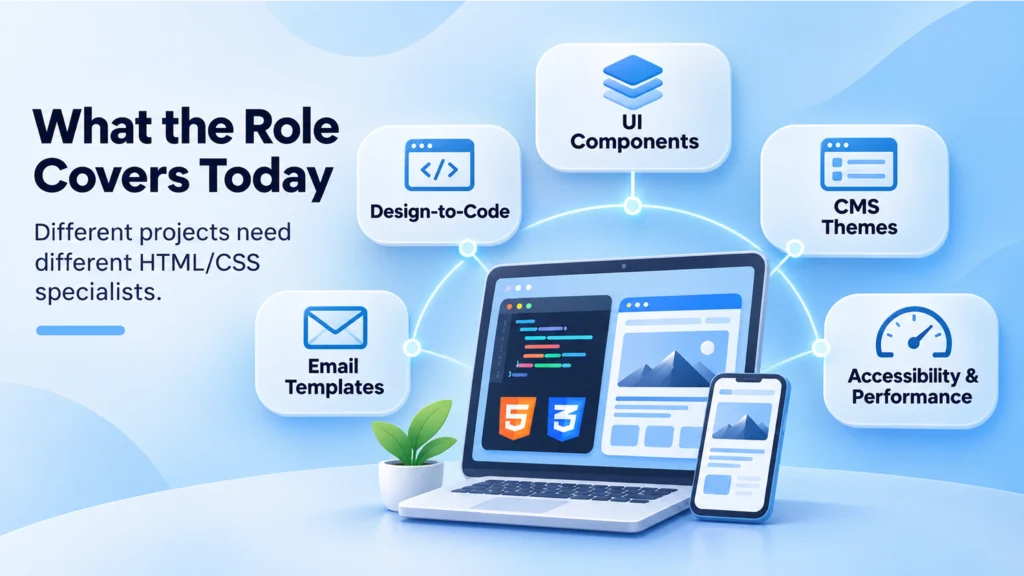
Email is the row people forget. Mail clients still ignore much of modern CSS, so a strong web layout developer can struggle with a newsletter template. If you need both, ask for samples of both.
Pro tip: Paste the link to one existing page into your job post and say “this is the kind of page you will build”. Candidates who reply with notes about that page are usually the ones who read briefs carefully.
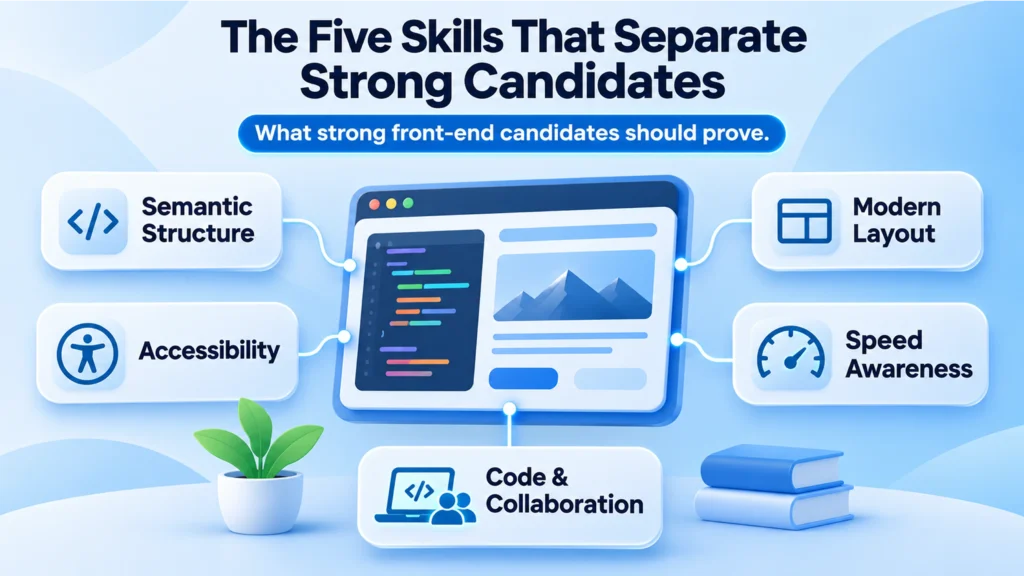
The five skills that separate strong candidates
Use this list to read portfolios and to plan your screen. Each skill comes with a quick way to check it.
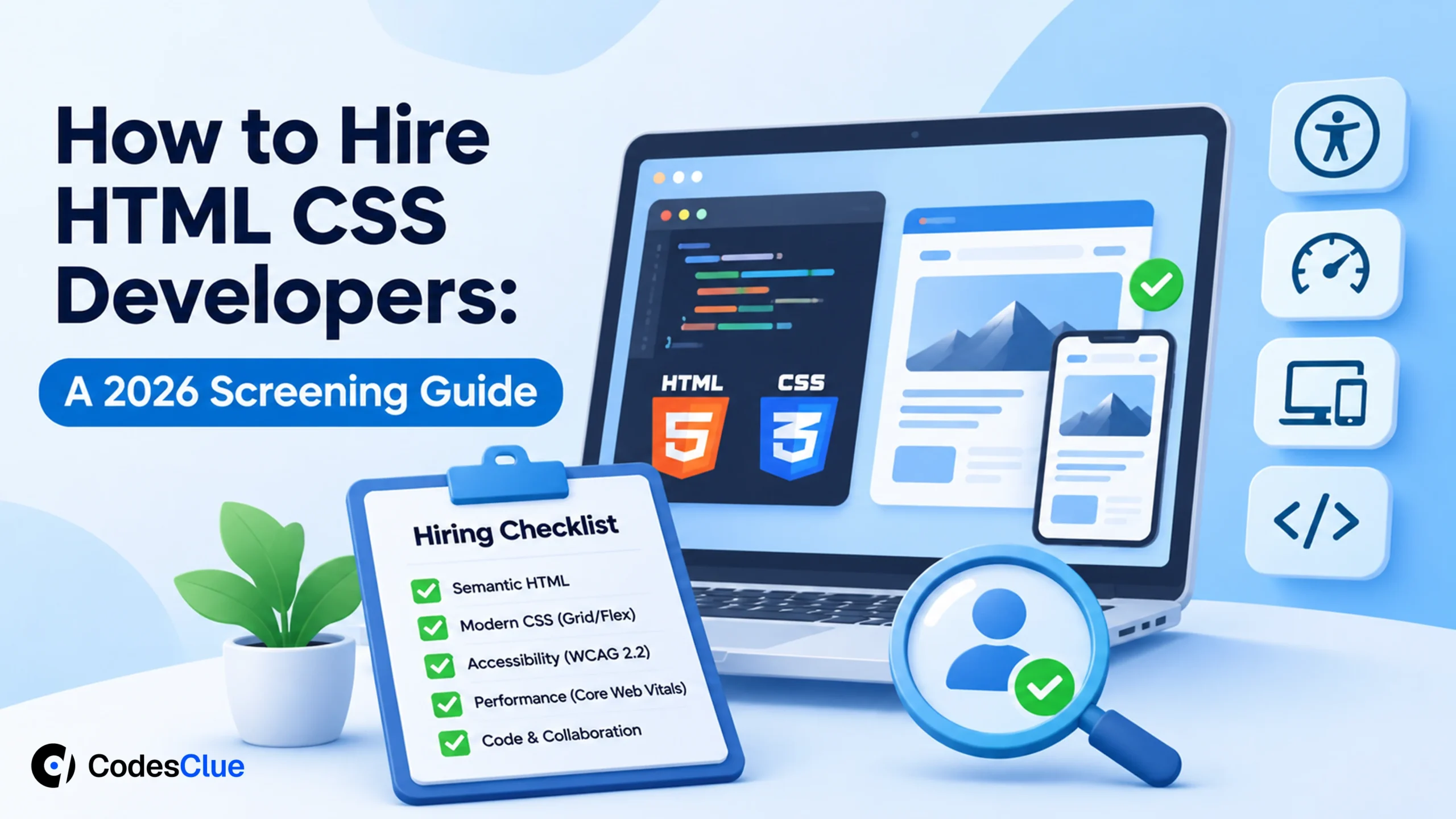
- Semantic structure. Headings in order, real buttons and links, labelled form fields, lists that are lists. Check it: open their live work, turn off CSS in the browser, and see if the page still reads in a sensible order.
- Modern layout. Grid and Flexbox used on purpose, container queries where a component must adapt to its slot, and few fixed pixel widths. Check it: drag the browser from wide to narrow and watch for overlap or sideways scrolling.
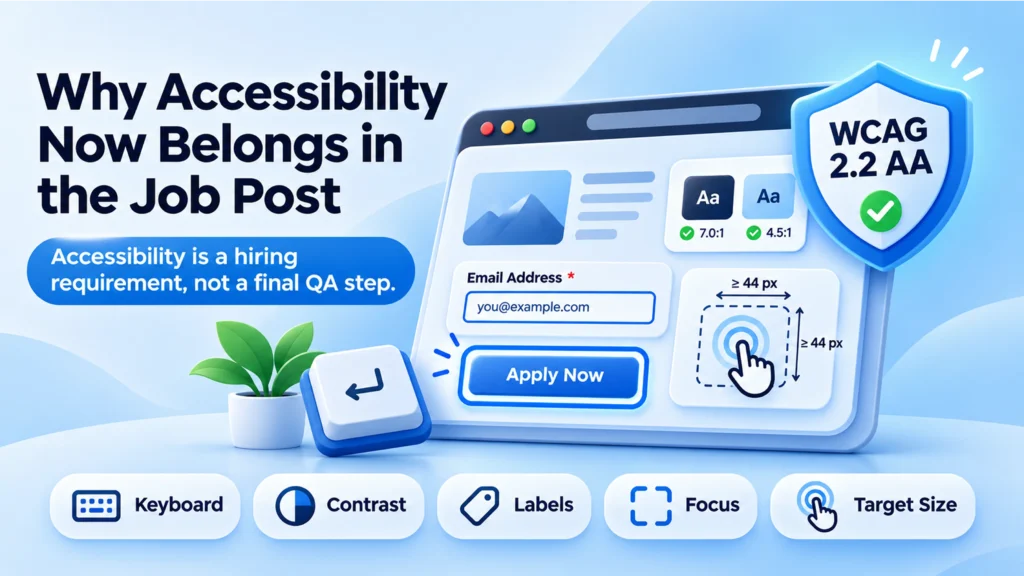
- Accessibility to a named level. The current standard is WCAG 2.2, a W3C Recommendation since 5 October 2023 (opens in a new tab). It adds nine criteria to 2.1, such as visible focus and target size. Check it: tab through their page with the keyboard only.
- Speed awareness. Correctly sized images, no layout shift as fonts load, and light CSS. Interaction to Next Paint became a Core Web Vital on 12 March 2024 (opens in a new tab). Heavy scripts on buttons and menus now show up in Google’s report. Check it: run a speed report on one of their pages and ask them to explain the result.
- Working in your codebase. Git, small pull requests, and respect for the naming rules already in place. Check it: ask how they would add a new component to a project that uses BEM or utility classes they did not choose.
Skill four matters for your search traffic as much as for users. A page that looks right but loads a 3 MB hero image will lose visitors on mobile before they see the offer.
Pro tip: Ask every candidate for one page they are not proud of and what they would change. Good developers answer at once and name specific faults, such as a heavy font file or a menu that traps focus.
Why accessibility now belongs in the job post
For teams selling into Europe this is no longer a nice extra. The European Accessibility Act has applied since 28 June 2025 (opens in a new tab) and covers services such as online shops, banking and e-books.
US buyers face their own rules, so ask your lawyer what applies to your product in each market. The hiring point is simple. The person who writes your markup decides most of your accessibility result, so test for it before you hire, not after an audit.
Write the target into the brief in one line, for example “WCAG 2.2 level AA for all public pages”. Our guide to WCAG compliance services explains what an audit covers. That one line filters out a large share of applicants who have never worked to a standard.
A 90-minute screen that replaces the quiz
Questions like “What is semantic HTML?” test memory. A better method puts the candidate in front of a real problem. Prepare one small page with planted faults and use it for every candidate.
| Time | What happens | What you learn |
|---|---|---|
| 0 to 15 min | They walk you through one live site they built, on a phone-width view | Whether the portfolio is really theirs and how they explain choices |
| 15 to 60 min | They fix a page with six planted faults while sharing their screen | How they debug, which tools they open, what they notice first |
| 60 to 80 min | You ask two “what would you do” questions about your own product | Judgement on trade-offs, not textbook answers |
| 80 to 90 min | Their questions for you | Interest in users, deadlines and code review |
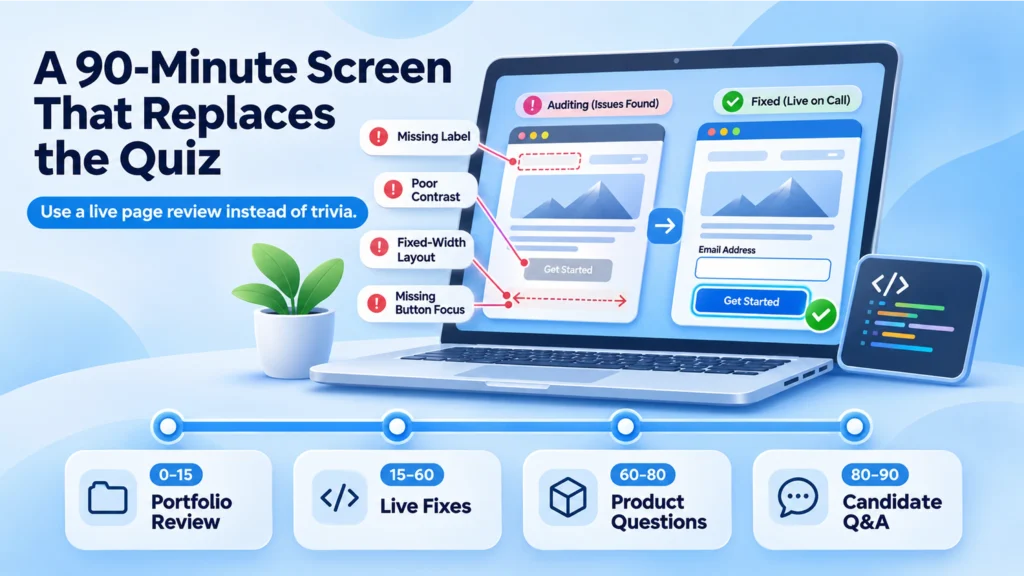
Good planted faults for the broken page:
- A plain box element made clickable instead of a real button, so a keyboard user cannot reach it.
- An input with placeholder text but no label.
- Text with poor contrast against its background.
- A fixed-width container that causes sideways scrolling at 375 pixels.
- An image with no width and height, which makes the layout jump.
- Heading levels that skip from H1 to H4.
Score each candidate from 1 to 3 on structure, layout, accessibility and communication. Use the same sheet for everyone so the decision rests on notes, not on who was most confident.
Pro tip: Tell candidates they may use AI coding tools during the screen, then watch how they check the output. In 2026 the useful skill is spotting the wrong suggestion, not typing every line by hand.
Freelancer, agency or dedicated developer?
| Model | Best fit | Risk to manage |
|---|---|---|
| Freelancer | A fixed set of pages with a clear end date | Availability for fixes after launch, mixed code quality |
| In-house hire | Front-end work every week for the long term | Weeks of recruiting, cover during leave |
| Dedicated developer from a partner | Steady flow of pages and components, fast start | You still set priorities and approve designs |
| Agency project | Full redesign with design, build and testing included | Scope changes need a clear change process |
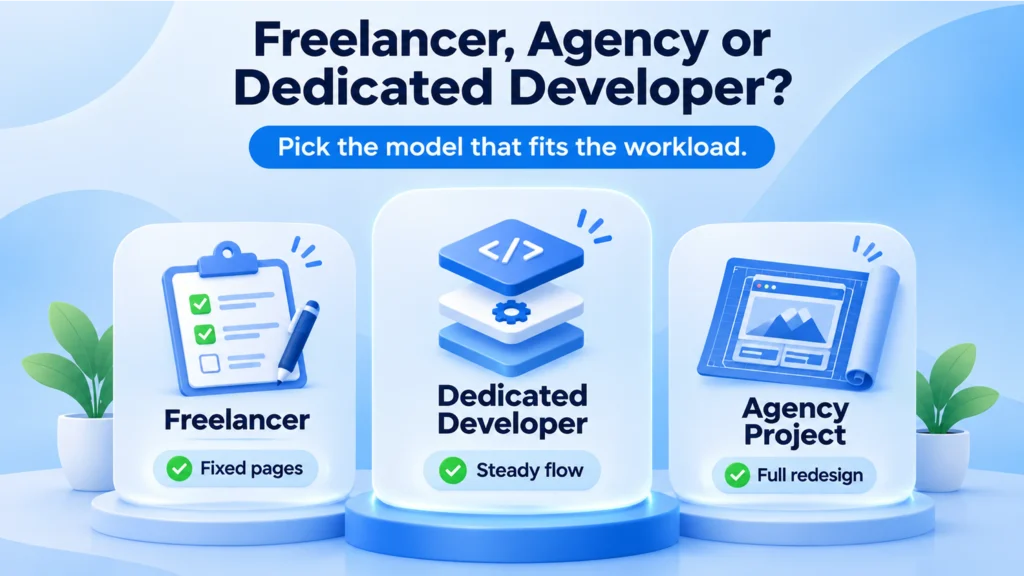
If your need sits between a one-off and a permanent role, a dedicated developer is often the practical middle.
At CodesClue, development starts within 48 hours once we discuss the requirements and you approve the person. Our front-end engineers work from Ahmedabad, India, and planning calls run from our offices in the USA and Germany. We work AI-first: the team uses AI tools to speed up markup and testing, and a person reviews every line before it ships.
The details are on our page to hire HTML CSS developers.
For larger restyles, look at the wider service instead. Our CSS development services cover design systems, animation and clean-ups of old style sheets. Teams on Tailwind can hire Tailwind CSS developers directly.
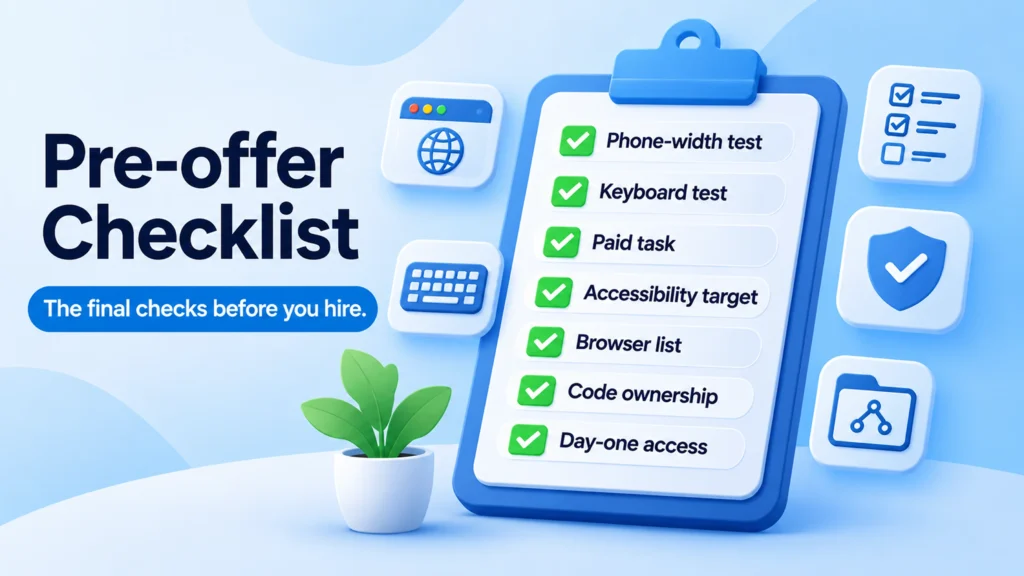
Pre-offer checklist
- You tested two of their live pages with a keyboard and at phone width.
- You wrote down their screen scores next to the other candidates.
- They have worked in your framework or CMS, or showed they can learn it quickly in the paid task.
- Your accessibility target is in the contract or statement of work.
- You agreed which browsers and devices count as “done”.
- Code ownership and access removal at exit are in the contract.
- Day-one access is ready: repository, design files and a staging site.
Common mistakes to avoid
- Judging by images. A polished design shot says nothing about markup. Always open the live page.
- Calling it “just HTML”. Teams that treat markup as junior work end up paying for an accessibility retrofit later.
- Leaving browsers undefined. “Works everywhere” is not a requirement. Name the browsers and the smallest screen width.
- Hiring a JavaScript specialist for a CSS problem. Many strong React engineers write weak CSS. Test layout skills on their own.
- Skipping the paid task. Two or three paid hours in your real stack cost far less than a month of rework.
What to expect in the first month
Give a new front-end developer a short, visible path. In week one, they set up the project and fix one small layout bug through your normal review. In weeks two and three, they build one full page or component from your design files. By week four, they should run their own accessibility and speed checks before asking for review.
A real example helps set the bar. On GreenReleaf, a dispensary platform we built with Angular and HTML, product pages show live stock and prices synced from the shop’s POS. Fast load times with a large catalog were one of the main challenges. Look for that same habit in any candidate: they ask how much data a page carries before they style it.
Next step
Have a design ready and want it built by someone who tests with a keyboard and a phone? Share two things with us: a link to the design file and the URL of one page on your current site.
We will look at both and suggest the developer profile that fits, usually within one business day. It is the quickest way to hire HTML CSS developers who match your stack. You can also read how to hire dedicated developers if you are still comparing models.
FAQs
Is an HTML CSS developer the same as a front-end developer?
Not always. A front-end developer often spends most of the day in JavaScript frameworks and state logic. An HTML CSS developer focuses on markup, layout, accessibility and visual accuracy. Many people do both, but test the CSS side on its own, because strong framework skills do not guarantee clean, accessible layouts.
Which accessibility level should I ask for?
Most teams set WCAG 2.2 level AA for public pages, since it is the current W3C standard and the level most audits use. Put it in the brief and the contract so everyone works to the same target. If you sell into the EU, check how the European Accessibility Act applies to your service with your lawyer.
What should a paid HTML CSS test task include?
Keep it to two or three paid hours in a small copy of your real stack. Ask for one responsive section from your own design file, built to your accessibility target, with a short note on browser testing. Review the pull request together afterwards. How the candidate explains choices tells you as much as the code.
Can one developer convert my Figma file and also build the email templates?
Sometimes, but treat them as two skills. Email clients support far less CSS than browsers, so email work relies on tables and inline styles. Ask for a live sample of each, and test the email in two or three common mail clients before you decide.
How fast can a hired HTML CSS developer start?
An in-house hire usually takes several weeks once you count sourcing, interviews and notice periods. A dedicated developer from a partner can start much sooner because screening is already done. With CodesClue, development starts within 48 hours after we discuss your requirements and you approve the developer.