
AI in Oil and Gas: Use Cases, Data Readiness and How to Start
AI in oil and gas for operators: use cases from wellhead to refinery, a SCADA data checklist, build vs buy, cost bands and a 6-step pilot plan.
Your pumps and compressors already send thousands of readings a minute to SCADA. Most of those numbers land in a historian, and nobody looks at them until something trips. Then a crew drives two hours to a site to fix a failure the data hinted at last week.
This guide shows where AI in oil and gas earns its keep and where it does not. You will see use cases across upstream, midstream and downstream, a data readiness checklist, and a build or buy decision. We also cover cost, safety rules and a six-step plan to start small.
Key takeaways
- Predictive maintenance on rotating equipment is the most common first win, because the data already exists in SCADA and the historian.
- Data quality decides the result. Clean tags, synced clocks and real failure records matter more than the choice of model.
- Most operators should extend the systems they run today before they buy a new platform or build from scratch.
- Keep AI advisory near safety systems. People and certified controls make the final call on anything that can hurt someone.
- Start with one asset class at one site, prove a number, then scale.
What AI in oil and gas means in plain terms
AI in oil and gas uses sensor, production and maintenance data to predict failures, forecast output, spot leaks and guide field work. Models read readings from SCADA, historians and inspection images, then flag a risk or suggest a next step. Operators, pipeline companies and refiners use it to cut unplanned stops and send crews where they matter.
The sector has a long head start with computing. The IEA Energy and AI report (opens in a new tab) counts 11 oil and gas supercomputers among the world’s 500 fastest in 2000. By 2024, that number had reached 24. It lists subsurface data processing, reservoir simulation, predictive maintenance and leak detection among the main AI uses.
In practice, three kinds of AI show up. Predictive models forecast failures and output. Computer vision reads drone, camera and satellite images. Generative AI drafts reports and answers questions from old well files and manuals.
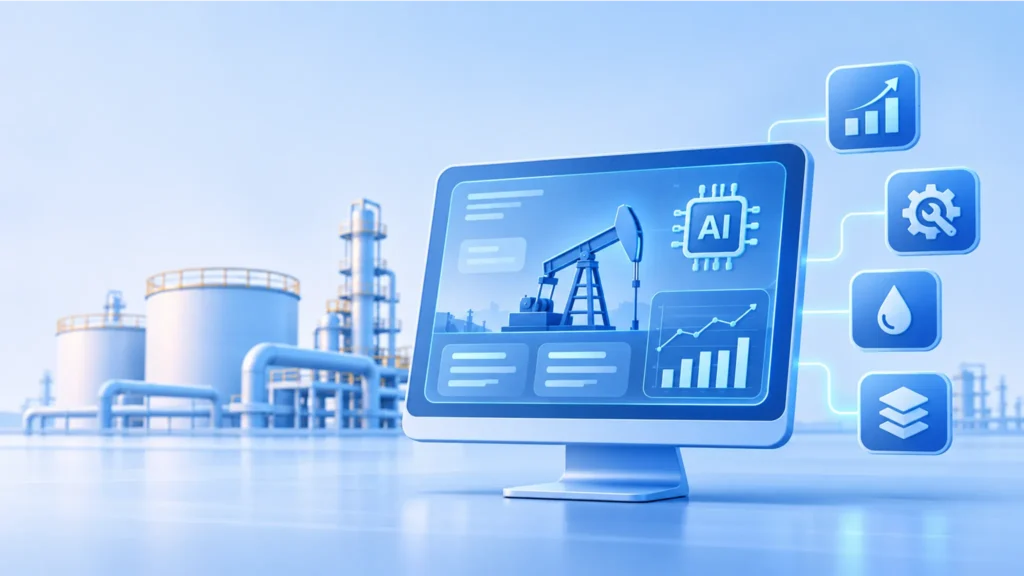
AI use cases in oil and gas, from wellhead to refinery
Each part of the chain has its own data and its own owner. Pick use cases where both are clear.
| Segment | AI use case | Data it needs | Team that owns it |
|---|---|---|---|
| Upstream | Seismic interpretation and well placement | Seismic volumes, well logs | Subsurface team |
| Upstream | Drilling alerts for stuck pipe and kicks | Live rig sensor feeds, drilling reports | Drilling engineering |
| Upstream | Production forecasts and artificial lift tuning | Well tests, pressures, pump speeds | Production engineering |
| Midstream | Compressor and pump failure prediction | Vibration, temperature, pressure, work orders | Reliability and maintenance |
| Midstream | Leak and methane detection | Flow balance, pressure, gas sensors, aerial images | Integrity and environment |
| Midstream | Corrosion risk ranking | Inspection results, coating data, soil and flow data | Asset integrity |
| Downstream | Process tuning and energy use in units | Historian tags, lab results | Process engineering |
| Downstream | Fuel demand forecasts for terminals and stations | Sales history, weather, events | Supply and planning |
Predictive maintenance in oil and gas
A model learns how a healthy pump or compressor behaves. It watches vibration, bearing temperature, discharge pressure and power draw. When the pattern drifts, it raises an alert days before a likely trip.
The alert only helps if it becomes a work order. Link the model to your CMMS (the maintenance system) so a planner sees the risk, the asset and the likely cause in one place.
Pro tip: Ask your reliability team for the last 20 real failures on one asset class. If nobody can list them with dates, fix the failure records before you train anything.
Drilling and production support
On the rig, AI compares live readings with past wells and warns the driller about trouble early. In production, it spots wells that produce less than expected and suggests changes to pump speed or gas lift. A person still approves every change to the well.
Generative AI for documents and field crews
Many sites hold decades of PDFs, scanned logs and handwritten notes. A language model can search them and answer a technician’s question with a link to the source page. It can also draft shift handovers and incident summaries for a supervisor to check.
Is your data ready? A checklist for operators
Most oil and gas AI projects stall on data, not on models. Walk through this list with the owner of each system first.
- SCADA tags. Do tag names follow one standard across sites? Can you tell a dead sensor from a real zero?
- Historian. Does your OSIsoft PI, now AVEVA PI, or other historian keep raw data, or only averages? Models need the raw signal.
- Time sync. Do field devices and servers share one clock? A five-minute drift can hide the cause of a trip.
- Failure history. Does the CMMS or ERP record what failed, when and why, with the asset ID?
- Connectivity. Can remote sites send data in near real time? If not, plan edge devices that run the model on site.
- Access and security. Can you read data without opening the control network to the internet?
- Ownership. Who will act on an alert at 2 a.m., and who can switch the model off?
Want a second opinion on your stack? Share a short list of your systems with us, and we will say which use case your data can support first.
Buy a platform, build custom or extend SCADA: which option fits you?
Pick a route per use case, not once for the whole company. Most operators end up mixing all three.
| Route | Fits you when | Watch out for |
|---|---|---|
| Buy a SaaS platform from a big vendor | You run common equipment and want a proven model fast | Licence cost, data leaving your network, limited changes |
| Extend SCADA, the historian and ERP | Your systems work well but nobody joins their data | Old interfaces, vendor licence terms, change control |
| Build custom | Your assets, process or field workflow are unusual | You own upkeep, retraining and support |
| Fix the data first | Tags differ by site and failure records are thin | Any model on top will give confident wrong answers |
Large vendors such as SLB, Halliburton, Baker Hughes, AspenTech, AVEVA, Cognite and C3 AI sell ready platforms. They suit majors with many similar assets. A mid-size operator often gets more from AI integration that joins the historian, the CMMS and a field app into one view.
Pro tip: Before you sign a platform deal, ask who owns the trained model and the cleaned data if you leave. Get the answer in the contract.
When we would not use AI
- A small field with few assets and steady output, where simple alarm limits already catch problems.
- Any safety instrumented function. Certified logic should stay in charge there, with AI only as an extra pair of eyes.
- Assets with no failure history at all. Start with condition monitoring and good records, then return in a year.
What does an AI project in oil and gas cost?
Custom work at CodesClue falls into three bands. A pilot or MVP, such as failure alerts for one compressor fleet, usually sits between $8K and $25K. A mid-size system with several integrations and a field app runs $25K to $70K. Larger platforms across many sites start from $70K.
Platform licences, cloud hosting, edge hardware and yearly retraining come on top. Ask each vendor to price per site or per asset, which puts the quotes side by side.
Safety and rules to plan for
Rules depend on where the system runs and what it controls. Three points shape most designs for US and European buyers.
- EU high-risk rules. Recital 55 of the EU AI Act (opens in a new tab) treats AI used as a safety component in the supply of gas as high-risk. The reason given is that a failure could harm many people at once.
- US risk guidance. The NIST AI Risk Management Framework (opens in a new tab) is voluntary. It groups the work into Govern, Map, Measure and Manage, a simple way to record risks and checks.
- Your own permits. Pipeline, emissions and worker safety rules still apply to whatever the AI suggests. Check each one with your compliance lead.
Pro tip: Keep a log of every alert, who saw it and what they did. Auditors and your own engineers will ask for it after the first near miss.
How to start with AI in the oil and gas industry: 6 steps
- Pick one asset class. Choose equipment that fails often and costs real money, such as produced water pumps or a compressor fleet.
- Agree the number. Name the owner and the metric that must move, for example unplanned stops or hours of warning.
- Audit the data. Run the checklist above and fix the worst gap before any model work.
- Test on history. Build a proof of concept on past data and check how many known failures it would have caught.
- Run a live MVP at one site. Send alerts to planners as advice only, and log each one they accept or reject.
- Scale to production. Add sites once the results hold for a few months, with monitoring and a retraining plan.
For step six, our AI prototype to production checklist goes deeper.
Example: a pump failure pilot at a mid-size operator
This is a hypothetical scenario to show the steps, not a CodesClue client.
A mid-size operator runs about 60 electric submersible pumps across two US fields. Failures cost a crew visit, lost output and sometimes a full repair rig. Its SCADA feeds an AVEVA PI historian, and work orders live in the ERP.
The team starts with one field. Engineers pull three years of motor current, intake pressure and temperature, then match them with past failures from the work orders. A first model runs on that history and shows which failures it would have flagged in time.
Next, alerts go to the production planner each morning as a ranked list. The planner decides who visits which well. After three months, the team compares unplanned stops and wasted trips with the other field before it adds a second site.
What our nearest projects teach, and our limits
To be plain, CodesClue has no oil and gas client yet. Our energy software development page says the same. The closest work uses the same building blocks.
- AirShield. An IoT platform for air quality in hospitals, clinics and other buildings. Its machine learning layer spots early signs of device wear and pushes maintenance alerts. Apps buffer data offline and sync once the signal returns.
- Nexus PTT. Push-to-talk software for stadium, campus security and emergency teams, built for a client in US sports and live events. It pairs field devices, controls access by role and gives administrators live device status.
Across these builds, one lesson repeats. The links to devices and existing systems take longer than the model, so we plan them first. If your data is thin, we will tell you to fix it before you spend on AI.
Common mistakes to avoid
- Training on averaged data. Averaged readings hide the short spikes that come before a failure.
- Skipping the work order loop. An alert that nobody turns into a job is just noise.
- Letting AI write to control systems. Keep it read-only until engineers trust it, and never near safety logic.
- Ignoring sensor health. A frozen reading looks like a calm asset to a model.
- Judging the pilot on a demo. Measure it on real field results for at least one maintenance cycle.
Getting started with AI in oil and gas
AI in oil and gas pays off when it uses data you already collect to prevent one costly failure. Keep people in charge of safety, start with one asset class, and scale only after the field results hold.
We plan AI into the design from day one and build in short Agile sprints. A quick proof of concept tests the risky part, an MVP goes live at one site, and production follows.
Engineers in Ahmedabad do most of the build, and our offices in Malvern, Pennsylvania, and Dortmund keep us close to US and European teams.
Our machine learning development and data engineering teams can work as one squad. For model basics, read our AI predictive analytics guide. Need people inside your own team? Our data engineers can sit with your staff. Development starts within 48 hours.
Tell us about your assets and the failure that costs you most. We will suggest a first pilot and the cost band it fits. See how we handle telemetry, field apps and maintenance on our energy software services page.
FAQs
Can AI models run on remote well pads with weak or no internet?
Yes. A small industrial computer at the site can score each reading locally and raise an alarm without a live link. It then sends only alerts and short summaries over satellite or cellular when a signal returns. You update the model on a schedule, not in real time. Pick hardware rated for heat, dust and the hazardous area class of that site.
Will AI replace control room operators?
No. It works more like a second set of eyes that never gets tired. It sorts alarms by risk, points to the likely cause and suggests a next step. The operator still decides and acts. In our view, the best setups show why the model raised a flag, so the operator can trust it or overrule it quickly.
How much history does a failure prediction model need?
Count failures, not years. A model learns from real breakdowns of the same type, so a few dozen recorded events on similar pumps beat ten years of quiet data. If you have very few failures, start with anomaly detection instead. It learns normal behaviour and flags anything unusual, which needs no failure labels at first.
Is it safe to send SCADA data to a cloud AI service?
It can be, with the right design. Copy data out through a read-only path, such as a historian replica in a separate network zone, so nothing can write back to the plant. Keep the data in a cloud region your contracts allow. Pick private model endpoints that keep your data out of training, and review access logs every month.
Can AI work with older PLCs and SCADA systems?
Usually, yes. Most older sites already push data into a historian, and the model can read from there without touching the controllers. Where no historian exists, an OPC UA gateway or a protocol converter can collect readings. The hard part is often tag naming and missing documentation, not the hardware. Budget time to map what each tag really measures.