
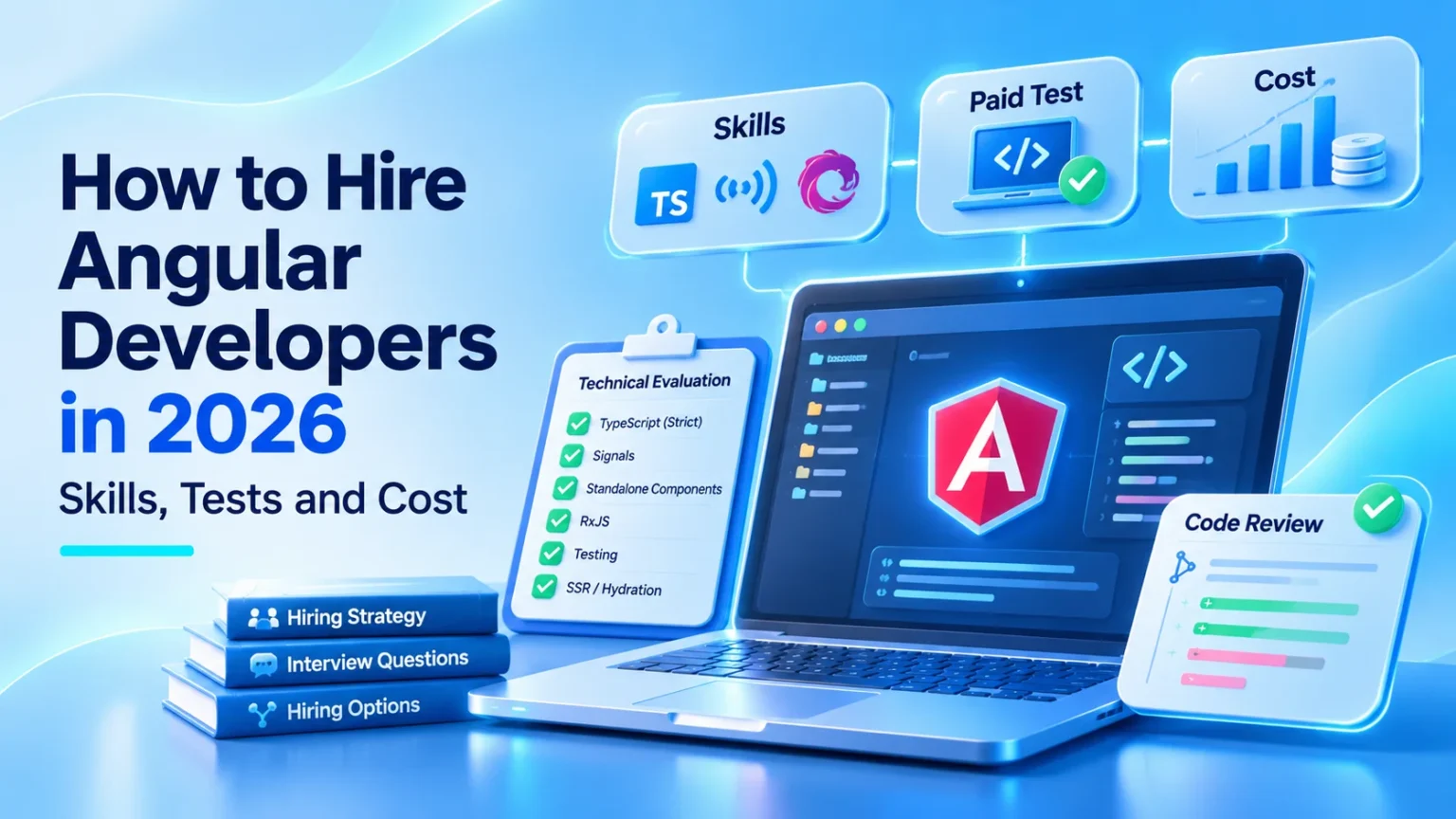
How to Hire Angular Developers in 2026: Skills, Tests and Cost
How to hire Angular developers in 2026: check your version first, test signals and RxJS, run a paid task and compare 4 hiring routes and costs.
You posted an Angular role three weeks ago. Fifty CVs came in, and every one lists TypeScript, RxJS and “Angular 2+”. Two candidates passed your quiz, then froze when you showed them your real codebase. Sound familiar?
This guide explains how to hire Angular developers who can work on the app you actually have. You will see which skills matter in 2026 and which hiring route fits your situation. You also get the questions and paid task that reveal real judgement, plus what the hire will cost.
Key takeaways
- Check your Angular version first. Angular v20 leaves long-term support on 28 November 2026, so many teams now need upgrade skills, not only feature skills.
- Test for signals, standalone components, RxJS and testing habits. A CV keyword list tells you very little.
- A short paid task on a copy of your own code beats any quiz.
- Pick the route by need: in-house for a long product, a dedicated developer for steady work, a freelancer for a small fix.
- Write a one-page brief before you talk to anyone. It cuts the screening time more than any tool.
How to hire Angular developers: the short answer
To hire Angular developers well, start with your app’s Angular version and the work it needs. Write a one-page brief, pick a hiring route, then screen with questions about decisions, not syntax. Finish with a short paid task on your own code. Score the result against a written rubric before you make an offer.
The rest of this guide covers each step in order. Skip to the cost section if budget is your first question.
Which Angular version does your app run?
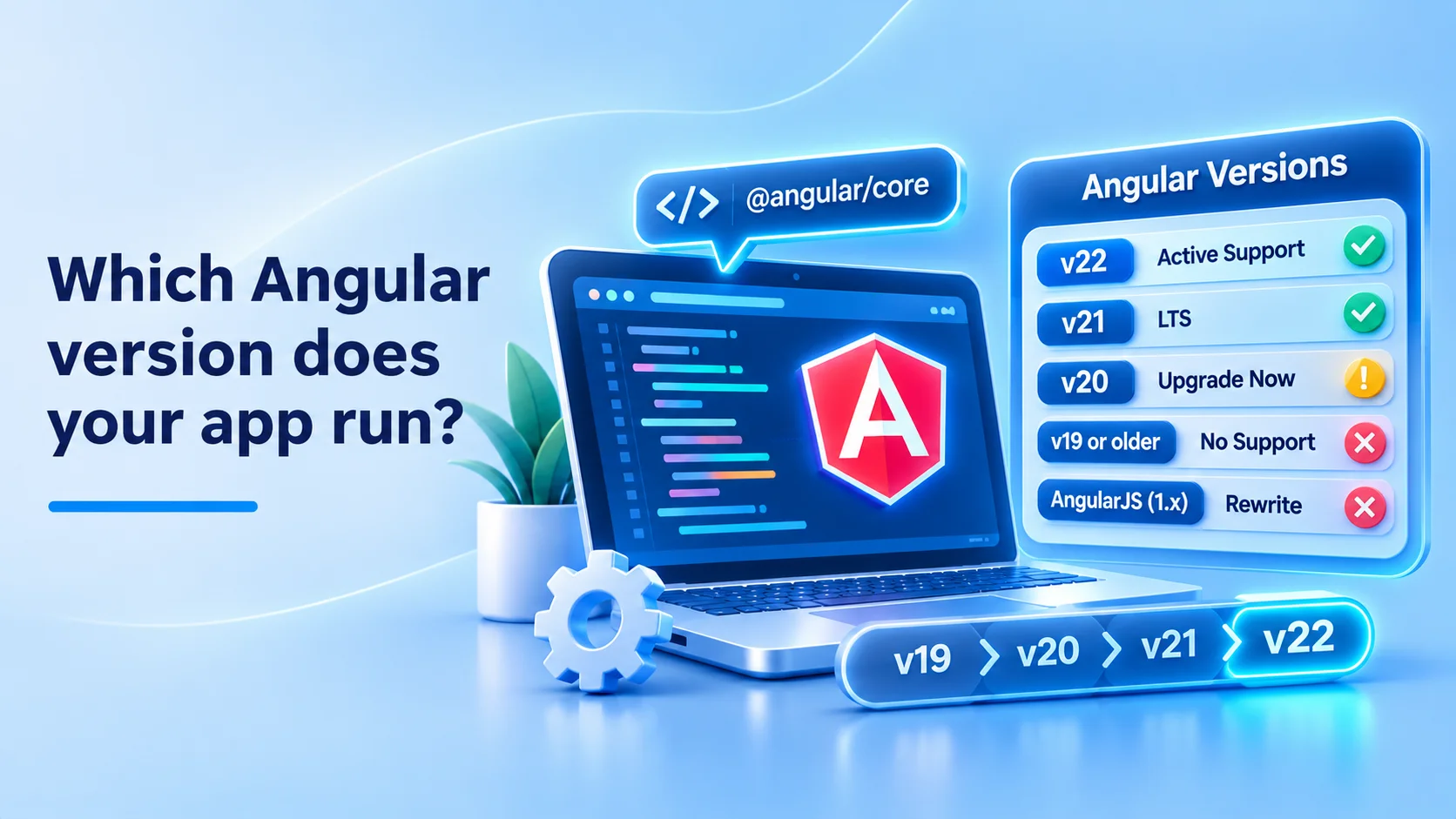
Open your package.json and look for @angular/core. That one number shapes the whole hire, so any plan for how to hire Angular developers starts here.
Angular changed its release rhythm in 2026. The official Angular release page (opens in a new tab) now plans one major version every 12 months. Each version gets 12 months of active support, then 12 months of long-term support (LTS). Here is where the supported versions stand today.
| Version | Released | Status in November 2026 | What it means for your hire |
|---|---|---|---|
| v22 | June 2026 | Active support until June 2027 | New features. Look for current signals and zoneless experience. |
| v21 | November 2025 | LTS until June 2027 | Security fixes only. Plan the move to v22 within a year. |
| v20 | May 2025 | LTS ends 28 November 2026 | Upgrade now. Hire someone who has run version upgrades. |
| v19 or older | 2024 or earlier | No official support | Upgrade skills come first. Expect test gaps and old libraries. |
| AngularJS (1.x) | 2010 to 2018 | No updates from Google | This is a rewrite, not a hire for feature work. |
If your app is on AngularJS, read our AngularJS to Angular migration guide before you write a job post. The skills and the budget are different.
Pro tip: Put the exact version in the first line of your job post. Strong candidates filter themselves in or out, and you get fewer CVs that waste your time.
Angular developer skills that matter in 2026
A CV can claim any keyword. What you need to know is how a candidate uses each skill on a real screen. The table pairs every skill with a fast check you can run in an interview.
| Skill | Why it matters now | How to check it in 10 minutes |
|---|---|---|
| TypeScript in strict mode | Catches errors before users see them | Ask them to type an API response without using “any” |
| Signals | The modern way Angular tracks state and updates the screen | Ask when they would use a signal and when they would keep an observable |
| Standalone components | The default since v19. Older apps still use NgModules | Ask how they would move one feature off an NgModule |
| RxJS | Still runs HTTP calls, streams and many libraries | Show a nested subscribe and ask them to fix it |
| Zoneless change detection | Stable since v20.2, and new v21 apps ship without zone.js | Ask what breaks when an app drops zone.js |
| SSR and hydration | Faster first load and better search visibility | Ask how they would find a hydration mismatch |
| Testing | Upgrades fail without tests | Ask which tools they use for unit and end-to-end tests |
| Accessibility | Keyboard and screen reader users are your customers too | Ask how they test a custom dropdown with a keyboard |
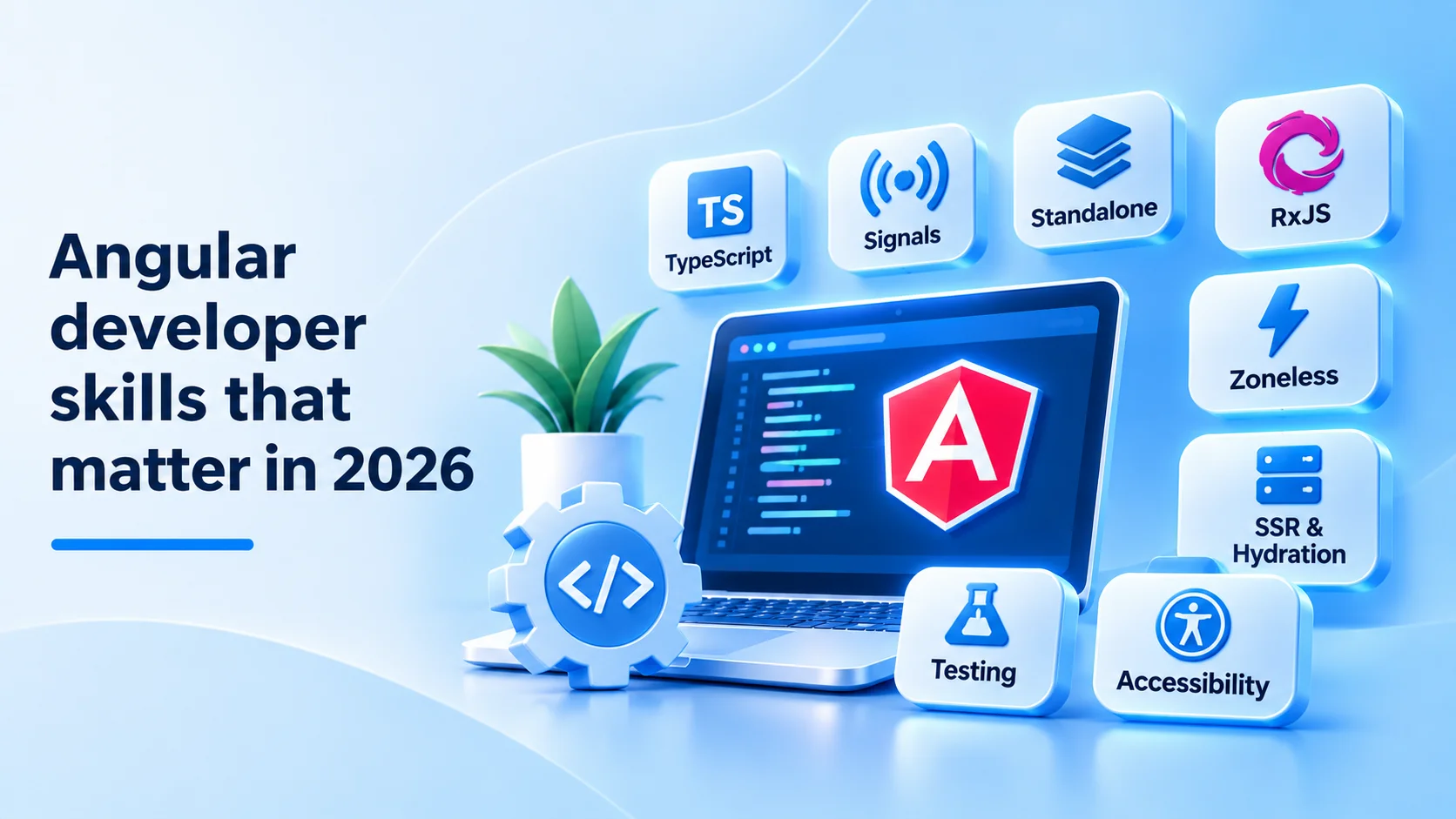
One red flag is easy to spot. Protractor, the old end-to-end test tool, reached end of life in September 2023, according to the Angular team’s deprecation update (opens in a new tab). A candidate who still recommends it for new tests has not kept up.
For a deeper look at server rendering, see our guide to Angular SSR and incremental hydration.
Pro tip: Ask every candidate what changed in the last two Angular releases. People who work with Angular daily answer in seconds. Those who learned it once and moved on go quiet.
Choose the right route to hire Angular developers
There are four common routes. Each one solves a different problem, so match the route to the work, not to habit.
| Route | Best for | Time to start | Main risk |
|---|---|---|---|
| In-house hire | A core product you will grow for years | Weeks to months of recruiting | Slow to start and hard to undo |
| Freelancer | A small, clearly scoped fix | Days | Knowledge leaves when the contract ends |
| Agency project team | A fixed scope with a clear end date | Usually a few weeks | Less control over who writes the code |
| Dedicated developer | Steady feature work or an upgrade program | Development starts within 48 hours with CodesClue | You still need to own the roadmap |
Which option fits you?
- You run a SaaS product on v20 and need the upgrade done this quarter: a dedicated developer with upgrade experience.
- You need one form fixed and a library updated: a freelancer, with a written scope.
- You plan a new internal portal with a launch date: an agency project team on a fixed scope.
- Angular is the heart of your business for years: hire in-house, and add outside help while you recruit.
We compare these models in more depth, with costs, in our comparison of a dedicated Angular team, a freelancer and an agency.
Write a brief that strong Angular developers will answer
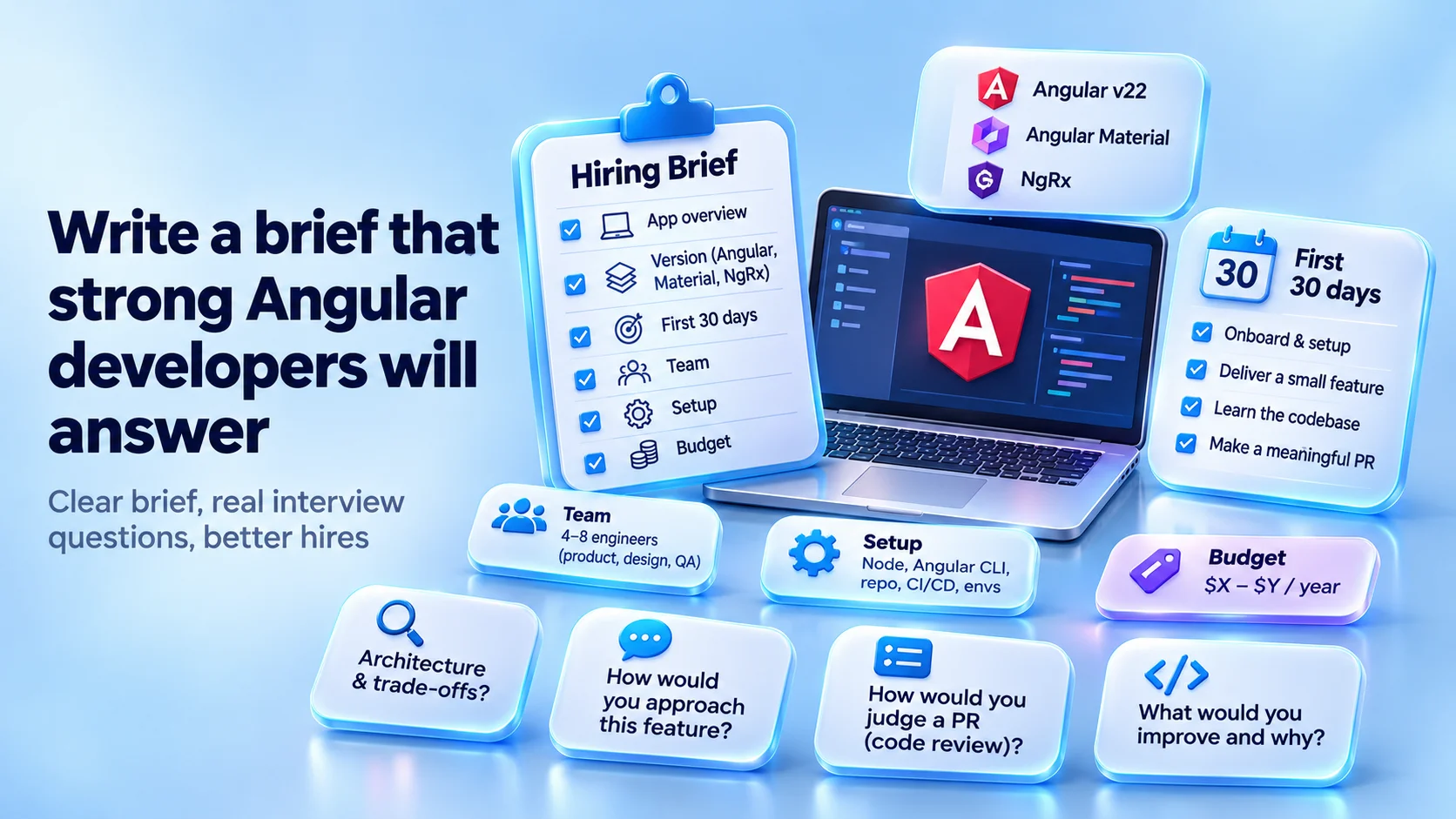
Good developers pick briefs that show a clear problem. A vague post attracts vague applicants. Keep it to one page and cover these points:
- The app: what it does, its users and the rough screen count.
- The version: the Angular version, plus any big libraries such as NgRx or Angular Material.
- The first 30 days: the one result you expect, for example “move the billing module to standalone components”.
- The team: who reviews their code and which time zone overlap you need.
- The setup: tests in place, CI pipeline, and who owns the backend APIs.
- The budget range: even a rough one saves both sides a week of calls.
Pro tip: Name one thing in your code that you know is messy. Honest briefs attract developers who like fixing real problems, and they spot your best candidates early.
Interview questions that show real Angular judgement
Skip trivia such as “what is a directive”. Ask questions where the answer depends on context. You will hear how the candidate thinks.
- Our app is on v20. How would you plan the move to v22, and what would you check first?
- A list page re-renders far too often. How would you track down the cause?
- When would you keep an RxJS observable instead of moving state to a signal?
- How would you split a large feature module so two developers can work on it without conflicts?
- A page loads fast on your laptop but slowly for customers on phones. What do you measure?
- Tell me about a pull request you sent back. What was wrong and how did you explain it?
Listen for trade-offs, not perfect answers. “It depends, and here is what it depends on” is a good sign. A long list of buzzwords with no example is not.
Short on time to screen? Meet our Angular developers and compare profiles before you interview anyone.
Run a paid trial task on your own code
A small trial on a clone of your repository tells you more than three interviews. Keep it small and pay for it. Unpaid tasks put off the senior people you most want.
- Copy one real feature into a clean repository, with secrets removed.
- Pick a task that takes 3 to 4 hours, such as converting one component to signals and adding tests.
- Share the brief, the repository and the scoring rubric up front.
- Ask for a short written note on what they changed and why.
- Review the pull request with the candidate on a 30-minute call.
Score every candidate the same way.
| Area | Strong result | Weak result |
|---|---|---|
| Correctness | Works, with tests that would catch a regression | Works on the happy path only |
| Readability | Small commits and clear names | One large commit with no notes |
| Angular practice | Uses current patterns and explains the choice | Copies old patterns without a reason |
| Communication | Flags risks and asks good questions | Stays silent until the deadline |
Pro tip: Watch how candidates react to review comments on the call. Teams live with that habit every day, long after the trial task is forgotten.
What does it cost to hire an Angular developer?
Cost depends on the route more than on the framework. For an in-house hire in the US, start with a public benchmark. Web developers earned a median annual wage of $92,650 in May 2025, per the US Bureau of Labor Statistics (opens in a new tab). Benefits, recruiting fees and equipment come on top.
These factors move the price up or down whatever route you choose:
- Seniority: upgrades and architecture work need senior people.
- Version debt: an app three versions behind takes longer to change safely.
- Test coverage: no tests means slower, riskier work.
- Time zone overlap: more shared hours often means a higher price.
- Scope clarity: a clear brief shortens every estimate.
Pricing a whole project rather than a person? Our written estimates use three bands. A small first MVP sits between $8K and $25K. Mid-size builds land between $25K and $70K, while large platforms begin at $70K. Our Angular app development cost guide breaks those numbers down by feature.
Checklist before you make an offer
The last step in how to hire Angular developers is the quiet one: a final check before you sign. Run through this list.
- Did the candidate pass the paid task against your written rubric?
- Have they worked on an app at your Angular version, or a newer one?
- Can they explain one upgrade they ran, step by step?
- Did you check two references who saw their code, not only their manners?
- Do they overlap with your team for at least three working hours a day?
- Is the contract clear on code ownership and notice period?
- Do you have access set up for day one: repository, CI and a test account?
Example: an upgrade hire before LTS runs out
Here is an example scenario, not a client story. A US fintech startup runs its customer dashboard on Angular v20. The app has 40 screens, NgRx for state and almost no end-to-end tests. LTS ends on 28 November, and the security team wants a plan.
The founder writes a one-page brief with one 30-day goal: v20 to v22 on a branch, with tests around payments first. She skips the job board and asks two vendors for a dedicated developer with upgrade history. Both candidates get the same 4-hour paid task on a copy of the payments module.
One candidate converts the component and adds three tests. The other also writes a note that a date library blocks the upgrade. The second candidate gets the role, because that note saves a week of surprises.
Payment apps like this one are familiar ground for us. We built EmberPay, a payments platform on Angular and MySQL, with five core modules for payments, transactions, accounts, alerts and reports in one dashboard.
Lessons from real Angular work, and our limits
A lot of Angular hiring is not about new builds. Live apps need upgrades, speed fixes or extra hands for a busy quarter. That is why our advice keeps coming back to one rule: hire for the app you have, not the app in a tutorial.
We build AI-first, release in short Agile sprints, and grow a product in stages: proof of concept, then MVP, then the production release. Our engineering hub is in Ahmedabad, and we keep people in the USA and Germany close to clients.
Hiring is not always the answer, though. If your app is small and stable, a one-off upgrade project may cost less than a new team member. If the real problem is product direction, a developer will not fix it. In that case, start with a short review of your app and roadmap first.
Common mistakes to avoid
- Hiring for “Angular” without a version: AngularJS and Angular v22 are different worlds.
- Testing syntax instead of decisions: quizzes reward memory, not judgement.
- Skipping the paid task: a short task on your code is the best predictor you have.
- Ignoring tests: a fast coder who never writes tests makes every upgrade slower.
- Hiring for a rewrite when you need an upgrade: most apps only need steady, safe steps.
- Leaving onboarding to luck: write down the first two weeks of work before the start date.
Next step: hire Angular developers with a plan
Now you know how to hire Angular developers in a way that fits your real app. Check the version, write the brief, pick the route, and let a short paid task make the final call.
Want a shortcut? Send us your Angular version and your first 30-day goal. We reply within one business day. Say yes to the person you like, and development starts within 48 hours. Talk to our Angular team.
Frequently Asked Questions
How long does it take to hire an Angular developer?
It depends on the route. An in-house hire runs through sourcing, interviews and notice periods, so plan for weeks to months. A freelancer can start within days for a small scoped job. With a dedicated developer from CodesClue, you approve the person first and development starts within 48 hours. That pace suits deadlines such as the end of Angular v20 support.
Should I hire an Angular developer or a full-stack developer?
Hire an Angular specialist when the front end is complex: many screens, shared state, strict accessibility needs or a version upgrade. A full-stack developer suits a small app where one person handles both the API and the screens. If your backend team is already strong, a front-end specialist usually adds more to the product than a second generalist.
Can a React developer work on our Angular app?
Yes, for simple tasks, after a ramp-up. Both use components and TypeScript, so the basics transfer. Angular adds its own patterns for dependency injection, routing, forms and RxJS that take weeks to learn well. For an upgrade or an architecture change, choose someone with recent Angular work rather than paying for that learning time.
Is AngularJS experience still useful when hiring in 2026?
Only if you still run an AngularJS app. Google no longer updates it, so that experience mainly helps with migration work: reading the old code, mapping each feature and moving it to modern Angular step by step. For a modern Angular app, ask about recent versions instead. Old AngularJS habits can slow down a current codebase.
What should a paid Angular trial task include?
Use a copy of one real feature from your own code, with secrets removed. Keep the task to three or four hours, for example moving a component to signals and adding tests. Share a scoring rubric up front and ask for a short note that explains each change. Then review the pull request together on a 30-minute call.