
DevOps Automation: What to Automate First and How to Measure It
DevOps automation in the order that pays off: build, tests, scans, deploys and IaC, plus the DORA metrics to prove it, tool choices and a 90-day plan.
Your team ships on Friday nights, someone runs a checklist by hand, and a rollback means three people on a call until midnight. Meanwhile AI coding tools help developers write more code than ever, so more changes reach that fragile release step each week. DevOps automation fixes the step, not the people. This guide ranks what to automate first, shows how to measure the result and lists the mistakes that waste the first three months.
Key Takeaways
- Automate in the order that removes the most risk per week of work: build and tests first, then deployment and rollback, then infrastructure.
- Measure one service at a time with the five DORA metrics, and compare it only with its own past.
- AI coding tools raise change volume. Without automated tests and fast rollback, that extra volume turns into incidents.
- Start with the pipeline you already pay for. Most teams do not need a new tool to begin.
- Your team must own every pipeline, secret and runbook at the end, even when a partner builds it.
What is DevOps automation?
DevOps automation means using scripts, pipelines and code to run the repeatable steps between a commit and a healthy production service. Builds, tests, security scans, deployments, environment setup and alerts all qualify. People still decide what to build and when to release. The machine does the same steps the same way every time, and it records what happened.
DevOps itself is a way of working where developers and operations share the goal of a working product. Automation is the part you can install, review and measure.
Why DevOps automation matters more in the AI coding era
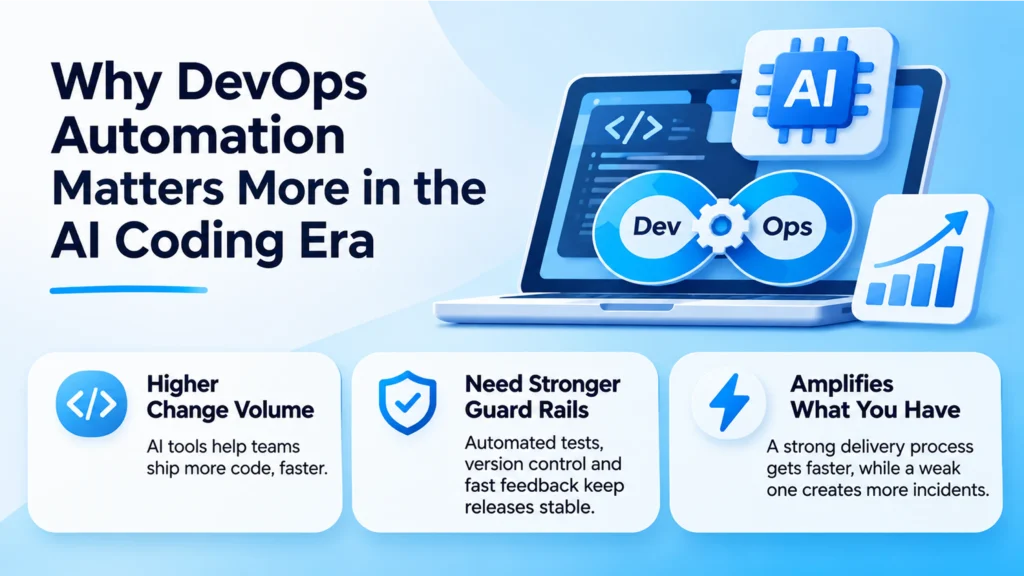
The 2025 DORA report from Google Cloud (opens in a new tab) surveyed nearly 5,000 technology professionals. 90% of them now use AI at work. The report found AI adoption linked to higher delivery throughput, but still linked to lower delivery stability. Its authors point to the missing guard rails: strong automated testing, mature version control and fast feedback loops.
Put simply, AI makes a strong delivery process faster and a weak one louder. If your release path depends on careful humans, more code means more chances for a tired person to skip a step. That is the business case for automating now, before the volume grows further.
What to automate first: a ranked order
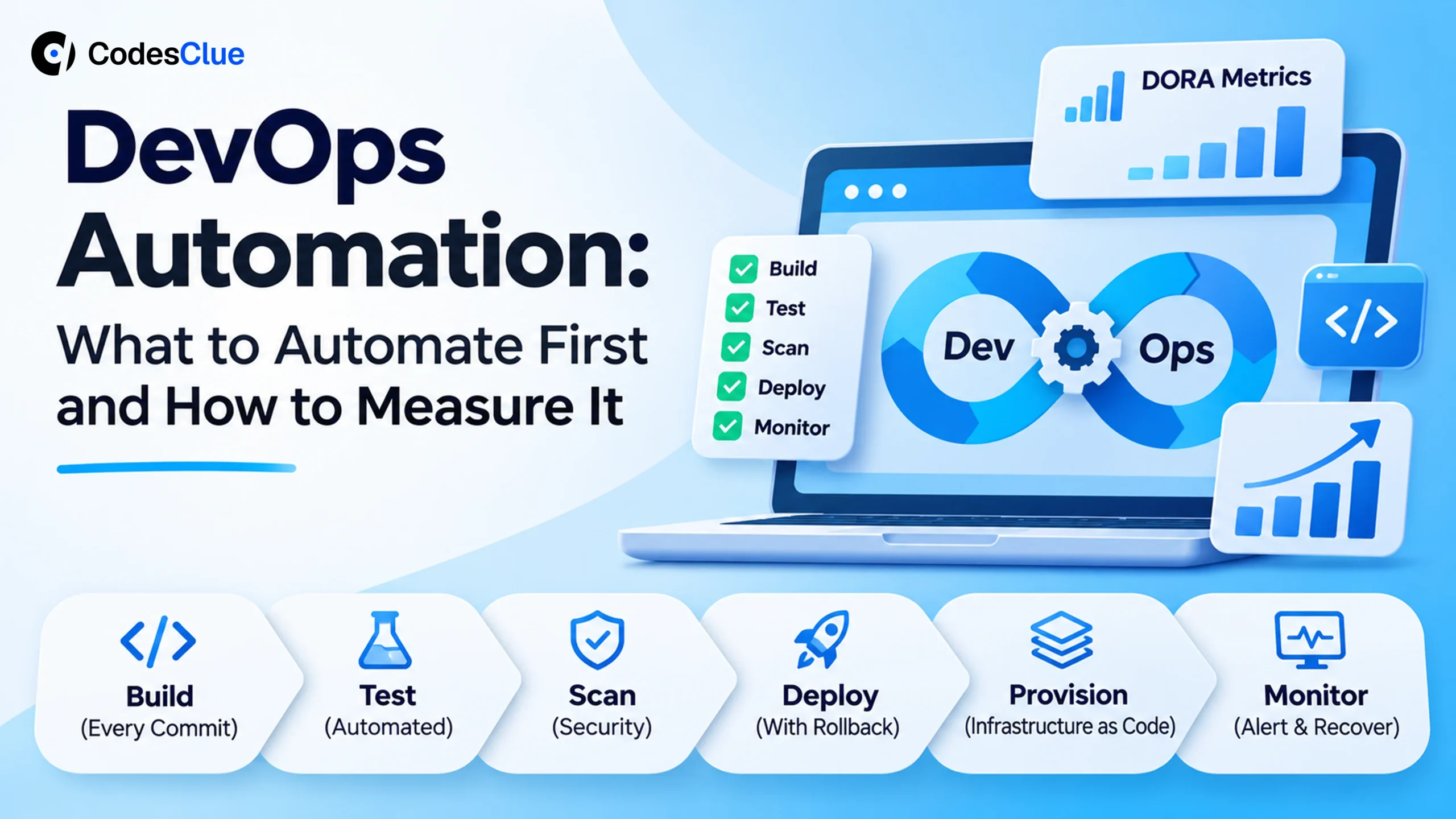
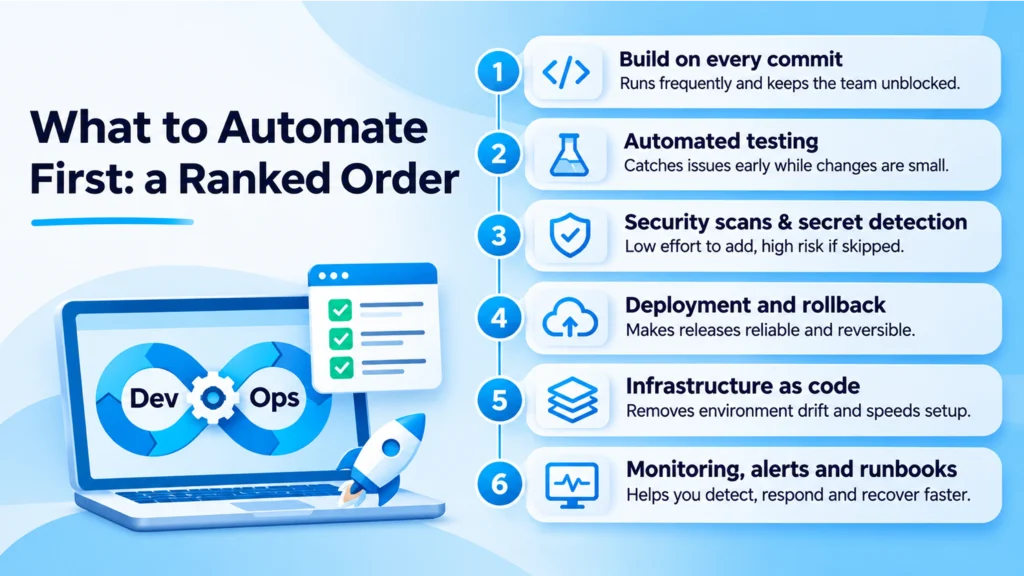
Every source agrees on what can be automated. Few tell you the order. Rank each candidate by two questions: how often does this step run, and how much does it cost when someone gets it wrong? High on both means automate it first.
| Order | What to automate | Why it comes here | Typical first win |
|---|---|---|---|
| 1 | Build on every commit | Runs dozens of times a day, and broken builds block everyone | “Works on my machine” disappears |
| 2 | Automated testing in the pipeline | Catches defects while the change is still small and fresh | Fewer bugs found by customers |
| 3 | Security scans and secret detection | Little extra work once a pipeline exists, costly to skip | Leaked keys stopped before merge |
| 4 | Deployment and rollback | Releases stop depending on one person’s memory | Releases on a Tuesday afternoon, not Friday night |
| 5 | Infrastructure as code | Ends drift between test and production | New environments in minutes, not days |
| 6 | Monitoring, alerts and runbooks | Shortens recovery when something still fails | The right person gets paged with context |
Pro tip: Before you automate anything, time one full release by hand and write down every step. That list becomes your backlog, and the slowest step is usually not the one people complain about.
The DevOps automation pipeline, step by step
A working CI/CD pipeline turns the ranked list into one path every change follows. Here is the shape we build toward on client projects.
- Commit and review. Every change goes through a pull request with at least one reviewer and a short template.
- Build once. The pipeline builds a single versioned artifact, such as a container image, and every later stage reuses it.
- Test in layers. Fast unit tests first, then integration tests, then a small set of end-to-end checks on the paths that earn money.
- Scan. Dependency checks, static analysis and secret detection run in the same pipeline, with clear pass or fail rules.
- Deploy to staging from code. The environment comes from Terraform or a similar tool, so staging matches production.
- Release with a safety net. A canary or blue-green release sends a slice of traffic first, and a failed health check rolls back on its own.
- Watch and learn. Dashboards and alerts ship with the service, and every incident adds a test or a check to the pipeline.
How to measure DevOps automation with DORA metrics
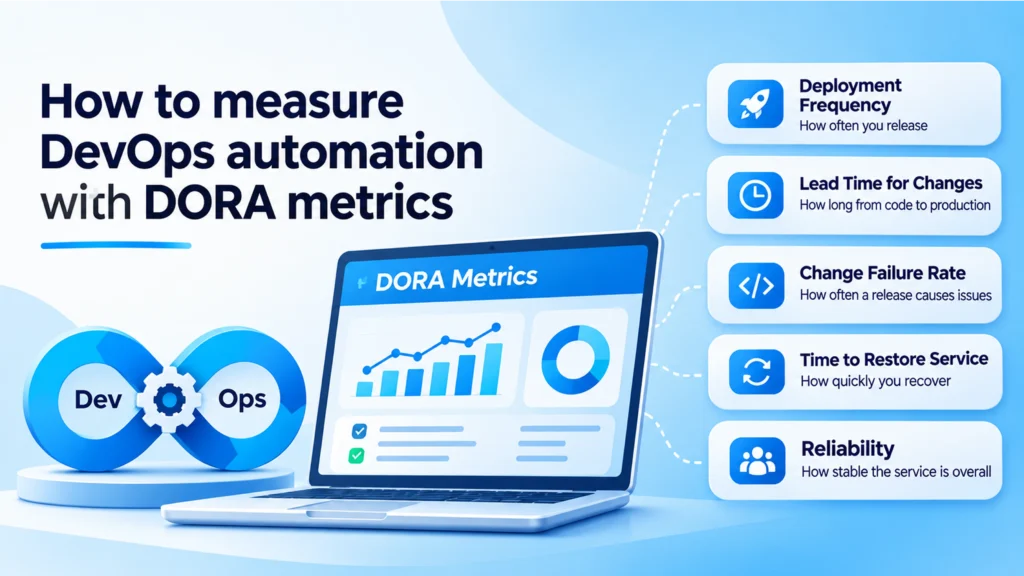
Automation is only worth its cost if delivery gets faster and steadier. The research group DORA defines five software delivery metrics (opens in a new tab), and they make a good scorecard. People still call them the four keys, but DORA now lists five.
| DORA metric | What it tells you | Which automation moves it |
|---|---|---|
| Change lead time | Time from commit to running in production | Build, tests, automated deployment |
| Deployment frequency | How often you release | Smaller changes and one-click releases |
| Failed deployment recovery time | How fast you recover from a bad release | Automated rollback, alerts, runbooks |
| Change fail rate | Share of releases that need a rollback or hotfix | Test layers, staging from code, canary releases |
| Deployment rework rate | Share of releases that were unplanned fixes for incidents | Security scans, better tests, monitoring |
Two rules from DORA itself save a lot of arguments. Measure one application or service at a time. Never turn the numbers into team targets or compare teams with each other. People then game the number instead of fixing the process.
Pro tip: Record a baseline in week one, even a rough one from your release notes. Without it, nobody can prove the pipeline paid for itself six months later.
What manual releases really cost you
Build minutes are cheap. People’s time is not. A quick sum shows what the manual path costs before you spend anything on tools.
Multiply three numbers: people on each release, hours each one spends, and releases per month. Then add the hours lost to every failed release and its cleanup. Here is a made-up example to show the method. Four people spend three hours on each of eight monthly releases, which is 96 hours. Two bad releases a month cost another 12 hours each. That team loses about 120 engineering hours a month to a path a pipeline could run.
The hidden part is technical debt. Every manual hotfix on a server makes the next release a little less predictable. Use your own numbers from the last three months, not our example, and keep the result next to the DORA baseline.
DevOps automation tools by job
Pick tools by the job and by what your team already runs. A mixed stack your engineers understand beats a perfect stack nobody maintains.
| Job | Common choices | Choose by |
|---|---|---|
| CI/CD | GitHub Actions, GitLab CI, Azure DevOps, Jenkins | Where your code already lives |
| Infrastructure as code | Terraform, Pulumi, AWS CloudFormation | One cloud or several, and your team’s languages |
| Configuration | Ansible | Servers you still manage by hand |
| Containers and release | Docker, Kubernetes, Helm, Argo CD | Number of services and how often they change |
| Code quality and scans | SonarQube plus dependency and secret scanners | What your auditors and customers ask for |
| Test automation | Cypress, Selenium, Postman, JMeter | Web, API or load testing needs |
Tool prices change, so check them before you commit. GitHub, for example, cut its hosted runner prices by up to 39% from 1 January 2026. It then postponed a planned charge for self-hosted runners (opens in a new tab). Engineering time to set up and maintain the pipeline is the large cost.
Security belongs inside the pipeline
Teams often treat DevSecOps as a later phase. In practice it is the easiest stage to add, because the pipeline already runs on every change. Start with four checks: known vulnerable packages, static analysis, container image scans and secret detection. Block the merge only on high-risk findings at first, then tighten the rules as the noise drops.
Pro tip: Move every password and API key into a secrets manager before you write the first deployment job. A pipeline that copies secrets around in plain text spreads the risk faster than any person could.
A 90-day DevOps automation plan
- Weeks 1 and 2: map the release path, record the DORA baseline and pick one service to start with.
- Weeks 3 to 6: build on every commit, the first test layer and security scans for that service.
- Weeks 7 to 10: automated deployment to staging and production, with a tested rollback.
- Weeks 11 to 13: environments as code, alerts with runbooks, then compare the metrics with the baseline.
Only then copy the pattern to the next service. The second service usually takes a fraction of the time, because the templates already exist.
Build it in-house or bring in a partner?
| Your situation | Better fit |
|---|---|
| You have a platform or DevOps engineer with spare time | In-house, with an outside review of the plan |
| Developers run releases as a side job | A partner builds the first pipeline and trains the team |
| Audit or customer deadline in under three months | A partner for speed, with full handover written into the contract |
| Many services and several clouds | A partner for the design, then your own platform team |
For scope, we price this work in three bands. $8K to $25K covers one product’s first pipeline or a focused pilot. $25K to $70K covers several services with infrastructure as code. Larger platforms across teams or with heavy compliance start from $70K. A one-week assessment of your release path places you in a band.
Common mistakes to avoid
- Automating a broken release process instead of fixing the steps first
- Buying a new platform before using the CI features you already have
- Writing end-to-end tests for everything, then ignoring the slow, flaky suite
- Keeping manual hotfixes on production servers, so drift comes straight back
- Letting one engineer own the pipeline with no documentation
- Judging success by the number of tools instead of the DORA metrics
Start your DevOps automation with CodesClue
DevOps automation pays off when every change takes the same safe path and your team can prove it with numbers. Our DevOps engineers work from Ahmedabad, with colleagues in our US and German offices, so release reviews can happen during your own working hours. AI tools help us write tests and pipeline code faster. We start with one service as a proof of concept, then roll the same pipeline out to the rest once the numbers improve.
Tell us how a release happens today, step by step, and which part your team dreads. An engineer who builds pipelines reads it and writes back by the next business day. You get the two or three steps we would automate first for your stack, and the questions we still need answered. See our DevOps automation services, read how we approach DevOps implementation or contact us to start.
FAQs
Can we automate deployments if our app still runs on a single server?
Yes. A pipeline can build the app, run the tests and deploy to one server over SSH or a cloud agent, with a backup step before each release. You do not need Kubernetes to start. Move to containers later, when you run several services or need to scale parts of the app on their own.
Will a CI/CD pipeline slow our developers down?
Only if it is slow or flaky. Keep the first feedback under about ten minutes by running unit tests and scans in parallel and leaving long suites for later stages. Fix or remove any test that fails at random. Developers trust a fast pipeline and work around a slow one.
How do we automate releases for a mobile app?
The same pipeline idea works. Each commit builds the iOS and Android apps, runs tests and signs the builds with keys kept in a secrets store. The pipeline then sends test builds to TestFlight and Google Play internal testing. Store review still adds time, so plan releases around it.
What do we need to hand over before a partner starts?
Read access to the code repository, a list of every environment and who owns it, your current release steps and the last few incident notes. Admin rights can wait until the plan is agreed. Keep all cloud, repository and secrets accounts in your company’s name from the first day.