How Much Does SaaS Development Cost in 2026?
SaaS development costs vary widely. This 2026 guide breaks down what you'll actually pay based on product stage, team size, and feature set.
 Ketan PatelFounder, CodesClue
Updated
9 min read
The SaaS market is booming. According to Grand View Research (opens in a new tab), the global SaaS market is projected to grow from $530 billion in 2026 to about $1.1 trillion by 2033.
Yet one question continues to challenge founders and product leaders:
How much does it actually cost to build a SaaS product in 2026?
The answer depends on factors such as product complexity, technology stack, development team, security requirements, and scalability goals.
In this guide, we will break down SaaS MVP costs, development costs by growth stage, hidden expenses, maintenance budgets, and practical strategies to optimize your investment, helping you plan your product roadmap with confidence.
Key Takeaways
- SaaS development cost runs from about $1,000 for a no-code MVP to $500,000+ for an enterprise platform; most custom MVPs cost $15,000 to $60,000.
- Features, multi-tenant architecture, integrations, compliance and AI drive most of the budget.
- Plan 15% to 20% of the build cost each year for hosting, maintenance and tools.
- Start with an MVP, prove demand, then grow the product in short sprints.
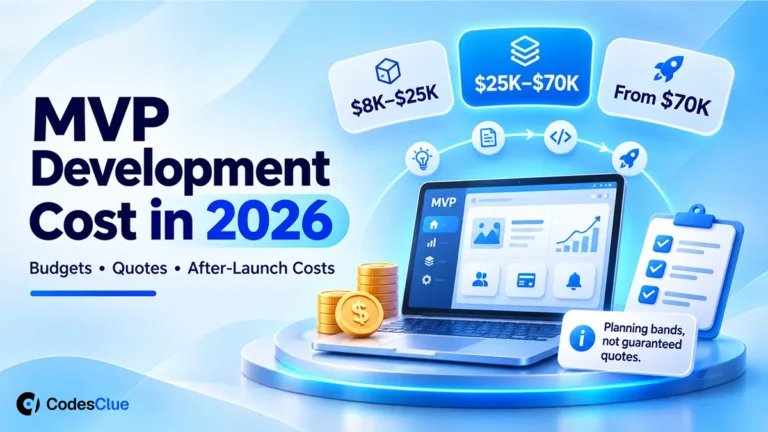
- At CodesClue, SaaS work is priced in three bands: an MVP build at $8K to $25K, a growing product at $25K to $70K, and a full platform from $70K.
What Is SaaS Development?
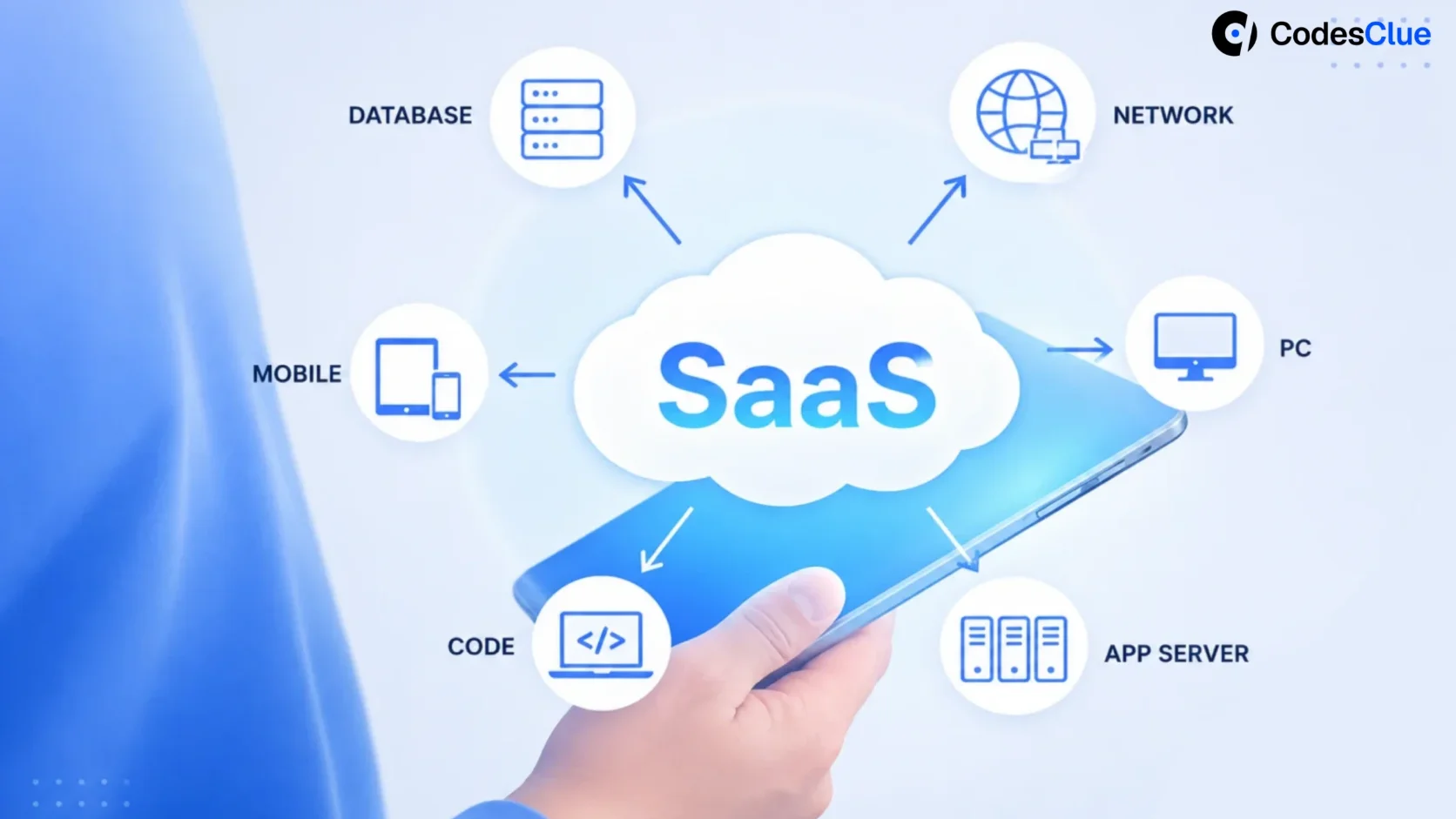
SaaS (Software as a Service) is a cloud-based software model that delivers applications through a subscription instead of a one-time purchase.
Unlike a standard web application, SaaS products are built for scalability and continuous delivery, requiring capabilities such as:
- Multi-tenant architecture
- Cloud infrastructure
- Secure authentication
- Subscription billing
- Automatic updates
- High availability and enterprise-grade security
These additional layers increase development complexity but enable recurring revenue, a smoother user experience, and long-term business growth.
SaaS Development Cost at a Glance
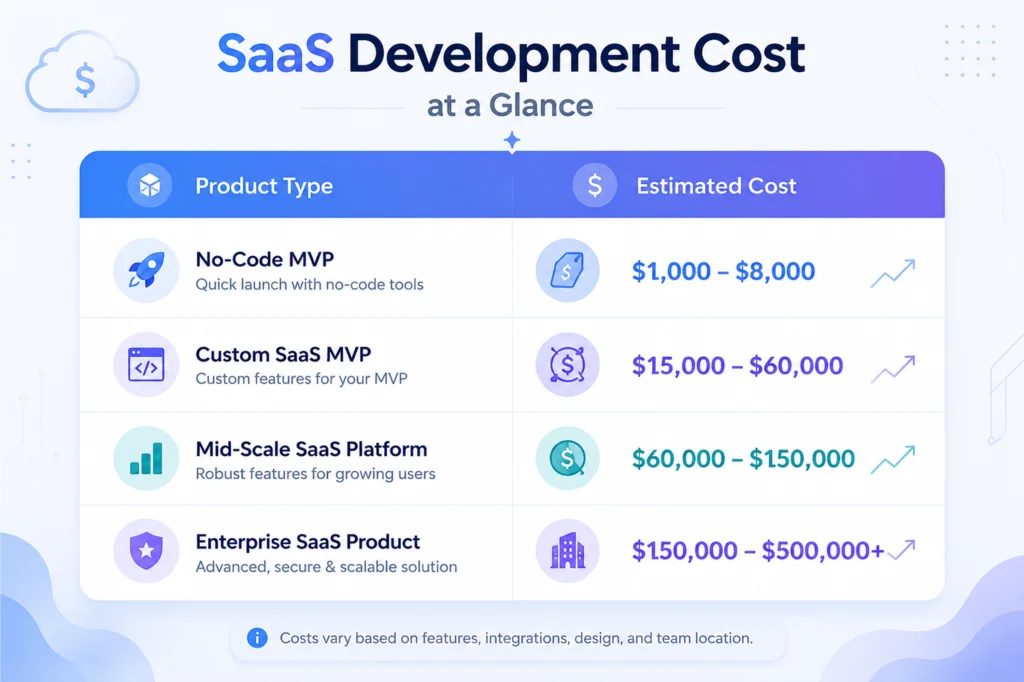
SaaS development cost ranges from about $1,000 for a no-code MVP to $500,000 or more for an enterprise platform. Most custom-built SaaS MVPs cost $15,000 to $60,000.
| Product type | Typical cost | What it usually includes |
|---|---|---|
| No-code MVP | $1,000 to $8,000 | Built on tools like Bubble or Glide to test demand |
| Custom SaaS MVP | $15,000 to $60,000 | Login, core workflow, subscriptions, admin panel |
| Mid-scale SaaS platform | $60,000 to $150,000 | Team features, roles, integrations, reporting |
| Enterprise SaaS product | $150,000 to $500,000+ | Compliance, SSO, high availability, AI features |
On top of the build, plan 15% to 20% of the build cost each year for hosting, maintenance and tools.
Factors That Drive SaaS Development Cost
No two SaaS products development cost the same. The final investment depends on the product’s complexity, scalability requirements, integrations, and compliance needs. Here are the biggest cost drivers to consider.
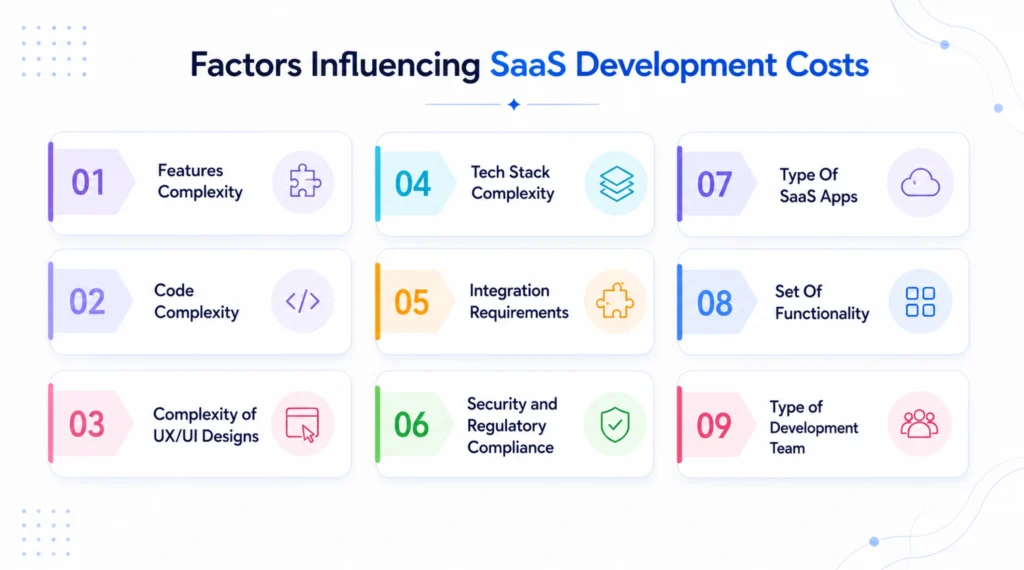
1. Feature Scope & Complexity
The number and complexity of features have the greatest impact on the development cost of a software product. Every new feature requires additional design, backend logic, testing, documentation, and long-term maintenance.
Example:
- Basic email login is a low-complexity service
- Role-based access, SSO, MFA, and permission management come under higher complexity
Cost Impact: The broader the feature set, the higher the development timeline and budget.
2. UI/UX Design
A well-designed interface improves user adoption and retention. It makes a business investment in design rather than an optional expense.
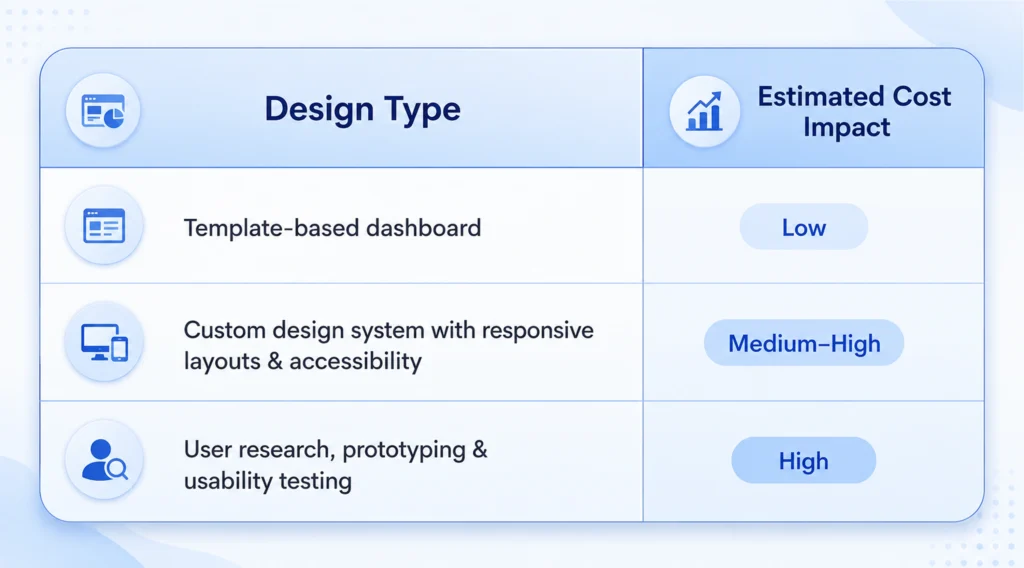
Cost Impact: Custom UI/UX can account for 10–20% of the total project budget while significantly improving customer experience.
3. Technology Stack
The technologies you choose influence hiring costs, development speed, and future scalability.
Popular SaaS Stack
- React / Next.js
- Node.js or Python
- PostgreSQL
- AWS or Google Cloud
However, using widely adopted technologies makes it easier to hire developers, reduce hourly rates, and simplify long-term maintenance.
4. Multi-Tenant Architecture
A SaaS platform must securely serve multiple customers from shared infrastructure while keeping their data completely isolated.
This requires:
- Tenant isolation
- Role-based permissions
- Scalable databases
- Backup and disaster recovery
- Resource management
Cost Impact: Multi-tenancy can increase backend development effort by 20–40% compared to a single-tenant application.
5. Third-Party Integrations
Most SaaS products rely on external services for payments, communication, analytics, and automation.
Common Integrations
- Stripe
- Salesforce
- Slack
- Google Workspace
- Zoom
- OpenAI APIs
Each integration requires authentication, testing, monitoring, error handling, and ongoing maintenance.
Cost Impact: A typical API integration can add $2,000–$10,000+, depending on complexity.
6. Security & Compliance
For regulated industries, compliance is a mandatory investment rather than an optional feature.
Common Standards
- GDPR
- HIPAA
- SOC 2
- PCI DSS
Security audits, encryption, logging, documentation, and compliance testing significantly increase development effort.
Cost Impact: Compliance requirements can raise total development costs by 25–40%.
7. AI & Machine Learning Features
AI-powered capabilities are becoming standard across modern SaaS products, from intelligent search to automated workflows.
Popular AI Features
- AI chat assistants
- Document analysis
- Recommendation engines
- Content generation
Cost Impact
- AI functionality typically increases development costs by 15–30%. Our AI app development cost guide shows typical ranges by app type.
- Third-party AI APIs may cost $500–$5,000/month in usage fees.
- Building custom ML models can add $50K–$150K+ to the initial investment.
Key Takeaway
The biggest SaaS cost drivers are feature complexity, architecture, integrations, compliance, and AI capabilities. Prioritizing an MVP, choosing a proven tech stack, and scaling features incrementally can significantly reduce both upfront investment and long-term maintenance costs.
SaaS Development Cost by Stage
SaaS development service cost depends on its maturity. Most successful companies start with an MVP, validate demand, and invest incrementally as the product and customer base grow.
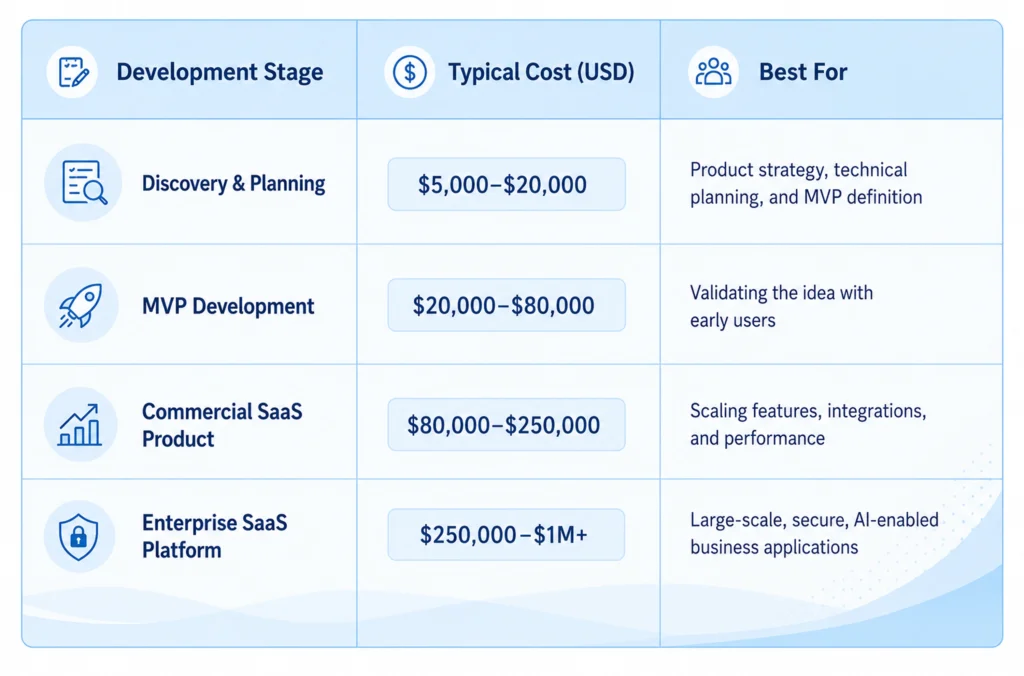
Stage 1: Discovery & Planning ($5K–$20K)
The discovery and planning come under the initial phase that focuses on reducing risk before writing a single line of code.
Typical Deliverables
- Market and competitor research
- Product strategy & feature prioritization
- Technical architecture
- Wireframes & user flows
- Development roadmap
Investing in discovery helps avoid costly scope changes and rework during development.
Stage 2: SaaS MVP Development ($20K–$80K)
An MVP (Minimum Viable Product) includes only the features required to validate the business idea and acquire early customers.
Typical Features
- User authentication
- Dashboard
- Core business workflows
- Subscription & payment integration
- Admin panel
- Basic analytics
Launch quickly, gather user feedback, and iterate instead of overbuilding.
Stage 3: Commercial SaaS Product ($80K–$250K)
Once product-market fit is established, the focus shifts to scalability, collaboration, and automation.
Common Additions
- Team collaboration features
- Role-based access control
- Public APIs & third-party integrations
- Performance optimization
- Workflow automation
- Advanced reporting & analytics
This is the stage where many startups turn into revenue-generating businesses.
Stage 4: Enterprise SaaS Platform ($250K–$1M+)
Enterprise-grade products prioritize security, reliability, compliance, and the ability to serve thousands of organizations simultaneously.
Typical Capabilities
- Multi-region cloud deployment
- High availability & disaster recovery
- Enterprise security & SSO
- GDPR, HIPAA, SOC 2, or PCI DSS compliance
- AI-powered features & automation
- Advanced analytics & large-scale integrations
According to enterprise software development cost benchmarks, complex platforms with AI, compliance, and large-scale integrations frequently exceed $250,000, with many enterprise implementations reaching $500,000–$1M+ depending on scope and infrastructure requirements.
SaaS Development Cost by Team Model
Who builds your SaaS shapes the price as much as the features do.
| Team model | How you pay | Best for | Watch out for |
|---|---|---|---|
| In-house team | Salaries, benefits, hiring and tools | Funded companies with a long roadmap | Hiring takes months before any code ships |
| Software development agency | Fixed price or milestones per phase | MVPs and products that need a full team quickly | Ask for real SaaS case studies and a written estimate |
| Freelancers | Per task or per hour | Small, well-defined tasks | You manage quality, security and handover yourself |
| Hybrid | Your product lead plus an external team | Startups that want control without a full in-house team | Agree early who owns the code and the decisions |
In-House vs Agency vs Freelancer
Hiring internally provides long-term ownership but comes with recruitment, benefits, onboarding, and retention costs.
The fully loaded cost of an in-house developer in 2026 is often 40–60% higher than an equivalent agency engagement once salaries, infrastructure, and management overhead are considered.
Many startups now adopt a hybrid approach:
- Internal product leadership
- External development team
- Specialized freelancers for niche work
This model offers flexibility while controlling costs.
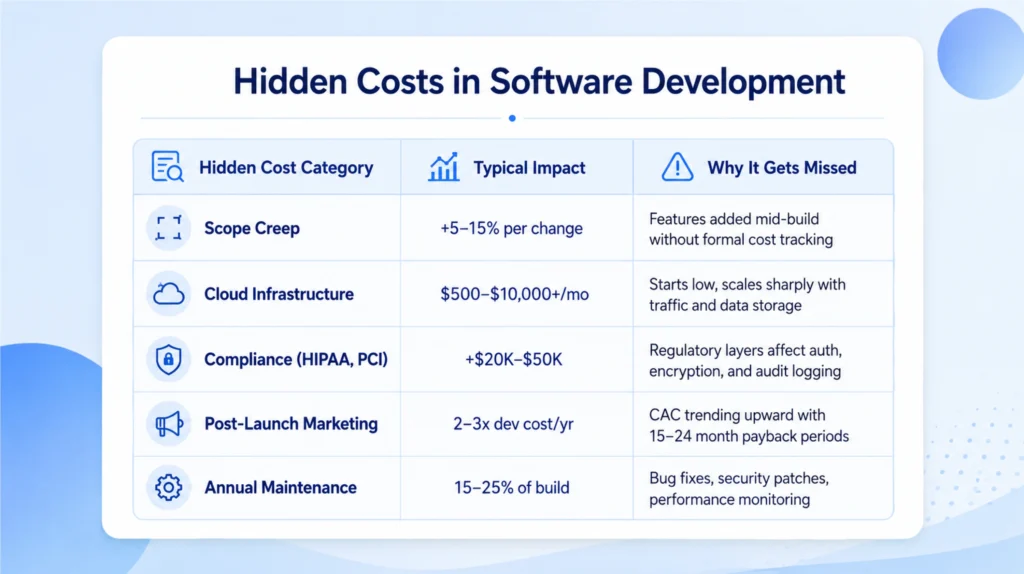
Hidden SaaS Development Costs Most Founders Miss
Beyond development, several recurring expenses can significantly impact your total cost of ownership.
Post-Launch Maintenance:
Covers bug fixes, security updates, performance optimization, and minor feature enhancements. (15–20% of development cost/year, accounting for $10,000–$20,000 approximately for a project)
Cloud Infrastructure:
AWS, Azure, or Google Cloud costs increase with user growth and include compute, storage, CDN, backups, and monitoring.
Quality Assurance & Testing:
Cutting QA may reduce upfront costs, but it often leads to expensive production issues and poor user experience.
Security & Compliance:
Maintaining SOC 2, GDPR, HIPAA, or PCI DSS compliance requires regular audits, monitoring, and documentation.
Customer Support & Operations:
Help desks, live chat, onboarding, CRM tools, and knowledge bases become ongoing operational expenses.
Scope Creep:
Continuously adding unplanned features can increase project costs by 30–50% while delaying launch and reducing ROI.
No-Code vs Custom Development
No-code platforms like Bubble, Glide, Softr, and Webflow are ideal for MVPs, internal tools, and early market validation, enabling startups to launch quickly with minimal investment.
Many successful SaaS startups validate their product and generate their first $100K–$1M in ARR using no-code platforms before investing in custom development to support growth and scalability.
Custom development is a better choice when your product requires high performance, advanced security, scalability, complex integrations, or unique features that create a competitive advantage.
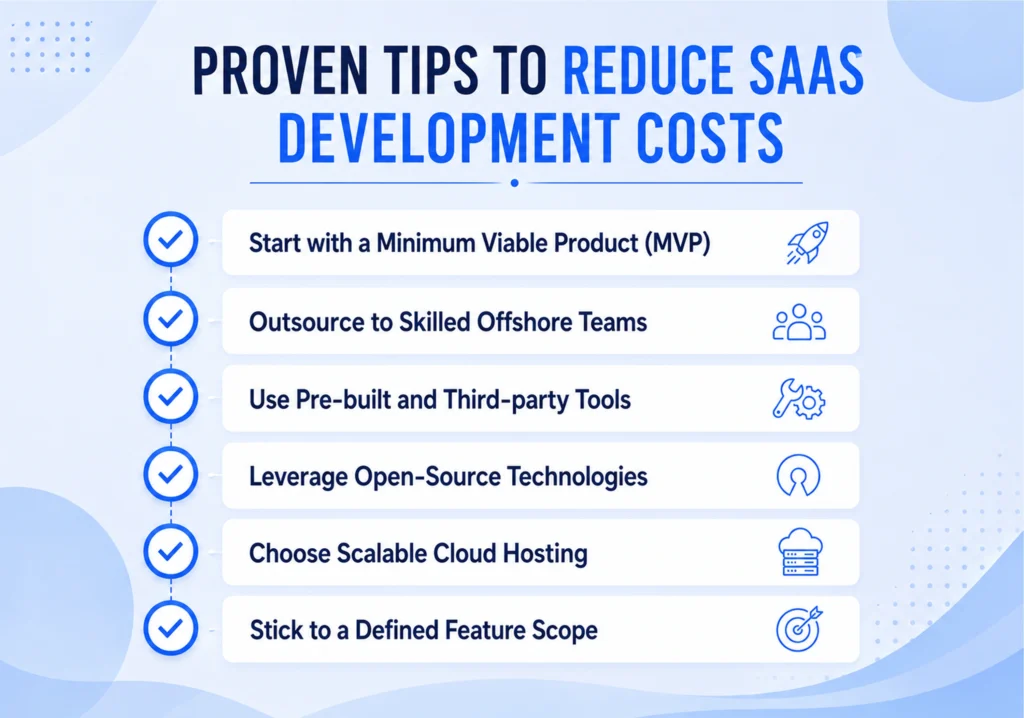
How to Reduce SaaS Development Costs?
Keeping costs under control isn’t about spending less; it’s about investing wisely.
Start with an MVP:
Build only the core features needed to validate your idea before investing in advanced functionality.
Choose Proven Technologies:
Popular tech stacks are easier to hire for, reducing development costs and long-term maintenance.
Plan Billing & Payments Early:
Integrating subscriptions and payment workflows from the start avoids costly rework later.
Invest in Product Discovery:
Clear requirements, wireframes, and technical planning help prevent scope changes and budget overruns.
Use AI-Assisted Development:
Tools like Cursor and Claude Code speed up coding, testing and documentation when an experienced engineer reviews what they produce. Our comparison of GitHub Copilot, Claude Code and Cursor shows what each one does well.
Build for Your Current Stage:
Focus on solving today’s business needs instead of overengineering for future scale.
Best Practice:
Launch fast, validate with real users, and scale your investment as your product and revenue grow.
Real-World SaaS Development Cost Examples
The following estimates illustrate how product complexity directly influences development costs.
| SaaS product type | Typical investment | Common features |
|---|---|---|
| Productivity or scheduling app | $30,000 to $75,000 | Login, calendars, notifications, subscription billing, admin dashboard |
| B2B collaboration platform | $100,000 to $200,000 | Team workspaces, roles, APIs and integrations, real-time collaboration |
| Fintech or healthcare SaaS | $200,000 to $500,000 | HIPAA, GDPR or PCI DSS compliance, encryption, audit logs, high availability |
What CodesClue Charges for a SaaS Product
The figures above are typical market prices. Our own SaaS development services projects usually land in one of three bands:
- SaaS MVP: $8,000 to $25,000
- Growing SaaS product (roles, billing, integrations, reporting): $25,000 to $70,000
- Full SaaS platform: from $70,000
Adding AI features can move a product into a higher band, depending on how much of the model work is custom.
You get a written estimate with milestones before anything is signed. The build team sits in Ahmedabad, with CodesClue offices in Germany and the USA as well. We start with the smallest version that proves the idea, then build the rest in short sprints you can see and test.
Share your SaaS idea and an engineer will reply within one business day.
Conclusion
SaaS success is driven by smart investment, not the lowest development cost.
The most successful companies start with a focused MVP, validate their assumptions with real users, and scale their product only when the market proves the opportunity.
This approach minimizes risk, accelerates time-to-market, and ensures every development dollar contributes to measurable business growth.
Want a SaaS development cost estimate for your own product? Send us four details: who your first paying customer is and the one job they need done, the must-have integrations (payments, single sign-on, a CRM or an AI model), how many users you expect in year one, and any launch date you are working to.
An engineer reads it and answers within one business day with a price range, what belongs in release one and the technical risks we would test before you commit. Nothing gets signed until you have that in writing.
For a real example, see Therapix.AI, the AI documentation platform we built that cut administrative workload for therapists by 70%. You can also read about our SaaS development services or send your four details now.
Frequently Asked Questions
How much does it cost to build a SaaS app from scratch?
A custom SaaS MVP typically costs $15,000–$60,000, while enterprise platforms can exceed $500,000 depending on complexity and compliance requirements.
How long does SaaS development take?
Most MVPs take 3–6 months, while enterprise SaaS products often require 9–18 months or longer.
Is it cheaper to outsource SaaS development?
Usually, yes, in the early stages. An experienced agency gives you a full team (design, development, testing, DevOps) from week one, without months of hiring. Many startups keep product leadership in-house and outsource the build, then hire a core team once the product earns revenue.
What is the cheapest way to build a SaaS product?
Starting with a no-code MVP on platforms like Bubble or Webflow is typically the lowest-cost approach for validating an idea.
How much does SaaS maintenance cost?
Plan 15% to 20% of the original build cost per year for maintenance, security updates and small improvements, plus hosting that grows with your users. For a $60,000 MVP, that is roughly $9,000 to $12,000 a year before hosting.
Do I need to budget for AI features in my SaaS in 2026?
In many industries, yes. AI-powered search, automation, assistants, and analytics have become standard expectations, making AI planning an important part of modern SaaS budgeting.