
MVP Development Cost in 2026: Budget Bands, Quotes and After-Launch Costs
MVP development cost for US founders: three budget bands, what each line of a quote pays for, fixed price vs time and materials, and costs after launch.
You have an idea, a rough feature list and maybe a pitch date. Before anyone writes code, you need a number you can defend to a co-founder or an investor. MVP development cost is hard to pin down because two quotes for the “same” product can be three times apart. Here is what drives that gap, what each line of a quote pays for and how to budget for version two.
Key takeaways
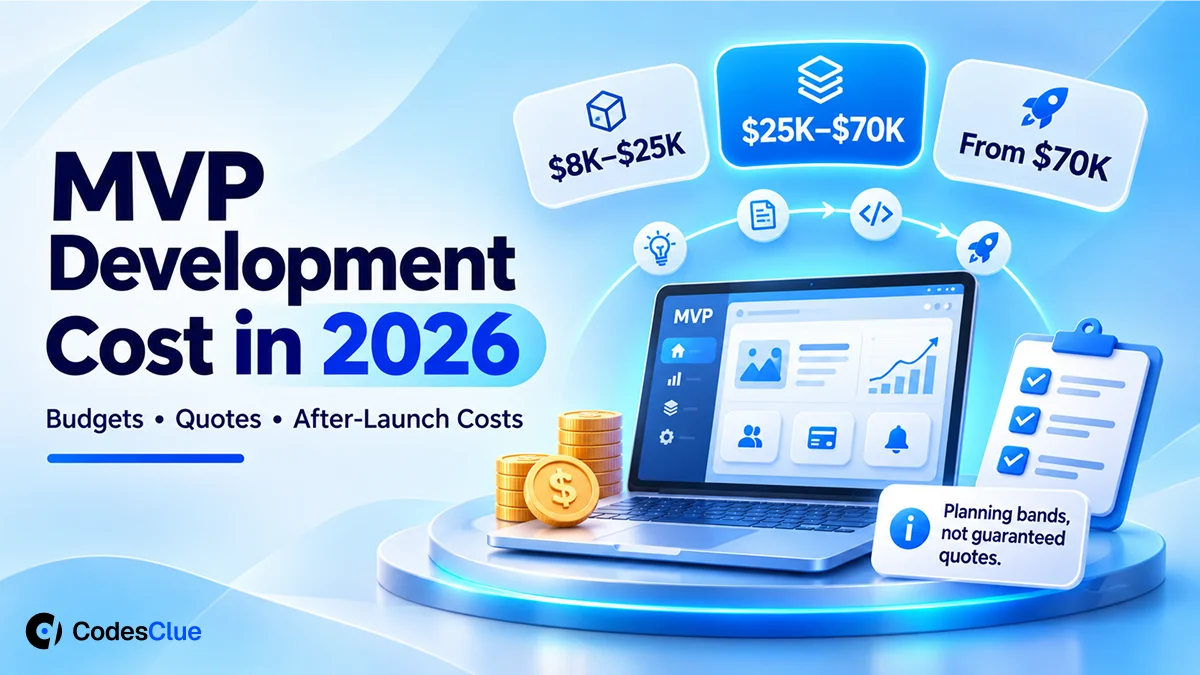
- CodesClue plans MVP budgets in three bands: $8K to $25K, $25K to $70K, or above $70K.
- User roles and outside integrations decide more of the price than screen count does.
- Have each vendor break its quote into discovery, design, build, testing and launch.
- Keep money aside for the first months after launch. That is when real users tell you what to fix.
- Fixed price suits a tight, written scope. Time and materials suits a product that will change week to week.
How much does MVP development cost?
MVP development cost for a custom build usually falls between $8K and $70K. A single-workflow web app with one type of user sits at the low end. Two or three user roles, payments and a few integrations push it into the middle band. Hardware, regulated data or AI on your own data can take it above $70K.
Here is how those three bands look in practice.
| Budget band | What it usually covers | Typical example |
|---|---|---|
| $8K to $25K | One core workflow, one user type, simple admin screens, web first | A booking tool for a single clinic, or an internal approval app |
| $25K to $70K | Several user roles, payments, notifications, two or three integrations | A two-sided marketplace, or a SaaS product with team accounts and billing |
| From $70K | Native iOS and Android apps, connected devices, compliance work, AI on your data | A health monitoring product with sensors, or a field app that works offline |
These are planning bands, not quotes. To find yours, a one-page brief plus a short scoping call is usually enough.
Each product type has its own cost pattern. We break them down in separate guides on SaaS development cost, web application cost and mobile app development cost.
Where the money goes in an MVP quote
A good quote reads like a plan. If yours is one total with no breakdown, you can’t tell what you are buying or what to cut. These are the lines we expect to see, and the question worth asking about each.
| Line in the quote | What it pays for | Question to ask the vendor |
|---|---|---|
| Discovery and scoping | User flows, the feature list for version one, technical risks | Will I get a written “in v1 / later / never” list? |
| UX and UI design | Wireframes, clickable prototype, final screens | How many rounds of changes are included? |
| Development | Front end, back end, database, admin panel, integrations | Which features are the biggest part of the build? |
| Testing | Manual checks, automated tests on the core flow, device testing | Who tests, and on which phones and browsers? |
| Launch | Cloud setup, domains, app store submission, monitoring | Are the cloud and store accounts in my company’s name? |
| Project management | Planning, demos, written updates, risk tracking | How often will I see working software? |
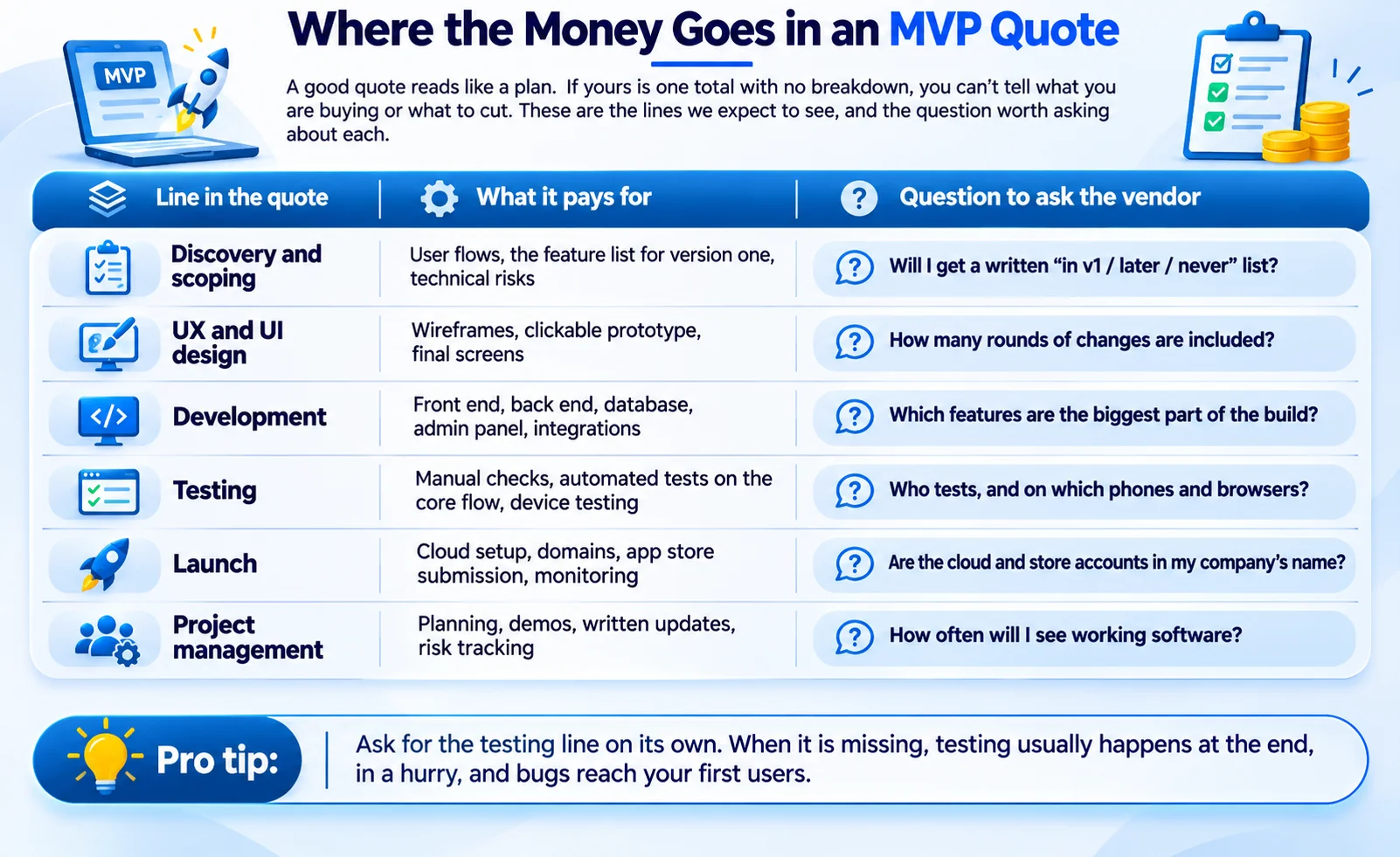
Pro tip: Ask for the testing line on its own. When it is missing, testing usually happens at the end, in a hurry, and bugs reach your first users.
What pushes the cost of MVP development up
Screen count gets the attention, but it rarely decides the price. These six factors do most of the work.
- User roles. A product for buyers, sellers and an admin is really three products that share a database. Every role adds screens, access rules and test cases.
- Integrations. Payments, calendars, CRMs and shipping APIs each bring their own error cases. Plan for failed calls and retries, not only for the happy path.
- Platforms. A responsive web app is one codebase. Native iOS plus Android is two, and store review adds a few days to every release.
- Hardware. Bluetooth sensors, radios or firmware need devices on the desk and field testing. That time does not shrink much, however small the app is.
- Regulated data. Health or financial records bring access logs, encryption and audit trails. A HIPAA-ready MVP takes longer than the same app without patient data.
- AI features. A demo on sample data is quick. An AI feature that has to be right on your real data needs testing rounds, and those rounds cost money.
Pro tip: Write down which of the six apply before you ask for quotes. Vendors can then price the same product, and you can compare the numbers fairly.
Fixed price or time and materials?
Both models work for an MVP. The right one depends on how firm your feature list is.
| Fixed price | Time and materials | |
|---|---|---|
| Best when | The feature list is written and agreed | You expect to change direction after early user tests |
| Your risk | Every change becomes a change request with its own price | The total can grow if nobody holds the scope |
| Vendor’s risk | Overruns come out of their margin, so quotes include a buffer | Low, so the rate usually carries less padding |
| What protects you | A detailed scope and clear acceptance criteria | A weekly budget report and a cap per milestone |
A split often works well. You pay a fixed fee for discovery and design, then move the build to time and materials with a monthly ceiling. That gives you a firm number for the plan and room to adjust once the product meets real users.
Some founders already have a product lead and only need engineers. In that case you can hire software developers to join your team and manage the backlog yourself.
Pro tip: On a fixed-price deal, agree how change requests are priced before you sign. A small change that costs a full week of work is a sign the scope was too loose.
A real example: what three months of MVP work looks like
Numbers mean more next to a real project. HEOS, an AI-guided platform for executive discovery and maturity scoring, took us three months to build from nothing for a US client. Five people did the work: three developers, a QA engineer plus a project manager.
Look at the mix, not only the headcount. Testing and project management are real lines in the cost. When a quote leaves them out, that work usually lands on you.
The work did not stop at launch on AirShield, an air quality product for healthcare facilities. Facility staff with no technical background used the first version, and their feedback drove the next round of UX changes. Plan your budget for that second round. It is often where the product starts to fit its users.
Want a budget band for your own idea? Send us three lines about the product, your first users and when you hope to launch. We will suggest a budget band and the questions to settle first.
Costs that start after launch
Paying for the build does not end the spending. These items arrive once real users sign in.
- Cloud hosting. Small at first, then it grows with users, stored files and background jobs.
- Third-party services. Email, SMS, maps, payments and analytics tools often charge per use.
- App store accounts. Apple charges a yearly developer fee and Google charges a one-time sign-up fee.
- Fixes and small changes. Users find bugs and gaps that no test plan covered.
- Version two. The features you moved to “later” during scoping will come back as requests.
Once the product is live, our product maintenance and support team can take over that running work.
How to estimate your MVP budget in 5 steps
- Name the one question the MVP must answer. For example: will clinic managers pay for automated reminders?
- List the smallest set of features that answers it. Everything else goes on a “later” list.
- Mark the cost drivers. Go through the six factors above and tick the ones your product has.
- Pick the budget band. Use the table above, then add a reserve for the first months after launch.
- Get two or three quotes against the same brief. Compare them line by line with the checklist below.
Checklist: comparing two MVP quotes
- Both quotes price the same feature list, and each list is attached.
- Discovery, design, development, testing and launch are separate lines.
- The quote names who owns the code, the designs and the cloud accounts.
- You know how often you will see a working build.
- Change requests have a written pricing rule.
- Support after launch is either included for a set period or priced separately.
- The team size and roles are listed, including QA.
Common mistakes to avoid
- Building the full product and calling it an MVP. If version one needs a year, the plan is too big to teach you anything quickly.
- Choosing the lowest total. A low quote often leaves out testing or launch work, and you pay for it later.
- Skipping discovery to save money. A week of scoping costs far less than rebuilding a feature nobody needed.
- Spending the whole budget before launch. With nothing left, you can’t act on what your first users tell you.
- Leaving accounts in the vendor’s name. Moving the product to another team becomes slow and expensive.
Plan the MVP development cost around what you need to learn
The best budget is the one that answers your riskiest question with the least code. Keep version one small and choose a contract type that fits how firm your feature list is. Then hold money back for what users teach you after launch. That approach keeps your MVP development cost under control, and it leaves you a product worth growing.
If you are still choosing what to build, our guide to MVP app development walks through the steps. When you are ready to talk numbers, our software product development team can scope your MVP. You get a written plan with a budget band. Book a 30-minute call and bring your feature list.
Frequently asked questions
Can I build an MVP for under $10K?
Yes, if version one does one job for one type of user. A web app with a single workflow, basic login and a simple admin screen can fit. Payments, several user roles or native mobile apps usually push the budget higher. A no-code prototype costs less again, but you may need to rebuild it once real users arrive.
How long does an MVP take to build?
It depends on scope more than on team size. A single-workflow web MVP is the quickest kind. Native apps, hardware and regulated data each add weeks. For reference, HEOS took our five-person team three months, starting from nothing. Ask any vendor for a launch week in writing, not only a total cost.
Is it better to hire freelancers or an agency for an MVP?
A freelancer can suit a small, well-defined MVP if you can manage the work yourself. An agency gives you design, development, QA and project management under one contract, which matters once the product has several roles or integrations. Either way, make sure the code and accounts are in your company’s name.
What should be included in an MVP development quote?
Each phase should have its own line: discovery, design, development, testing and launch. The quote should also name the team roles and attach the feature list it prices. Check that it says who owns the code, how often you see working builds and how change requests are priced. If any of this is missing, ask before you compare totals.
How much should I keep aside after the MVP launches?
Keep a reserve for hosting, paid services, bug fixes and the first round of changes users ask for. On AirShield, feedback from facility staff after launch shaped the next round of UX work. Without that reserve, you learn what to fix but cannot pay to fix it.