
Stop Doubting, Start Scaling: The Ultimate Flutter App Migration Guide
Ready to migrate to Flutter? This ultimate guide covers everything, from planning and code migration to testing and deployment

Are you still maintaining separate iOS and Android apps? That means you build every single feature twice. You test every single feature twice. This process doubles your development costs. It slows down your product releases. It adds heavy complexity to your daily operations.
Flutter offers a much smarter path for your business. You get a single codebase for multiple platforms. This change accelerates your development speed by 50%. It reduces your total costs by 40% to 70%.
At CodesClue, we help businesses migrate native apps to Flutter. We ensure minimal disruption and maximize your final business returns. This comprehensive Flutter migration guide helps you master the transition. You will unlock faster and more scalable app development.
Why Are Smart Companies Moving to Flutter?
Flutter Development Cost Savings Without Compromising Performance
Maintaining separate native codebases increases your overall expenses. You pay double for both development and regular maintenance. Flutter eliminates this duplication through one shared codebase. It drives massive Flutter development cost savings for companies. You can reduce development expenses by up to 55% quickly. You also accelerate your feature delivery cycles significantly.
More importantly, you never sacrifice your core user experience. Flutter delivers near-native performance for consumer and B2B apps. Users enjoy smooth animations and incredibly fast startup times. It ensures consistent brand experiences across all digital platforms. This makes it the perfect choice for expanding businesses.
How Native to Flutter Migration Impacted Real Companies?
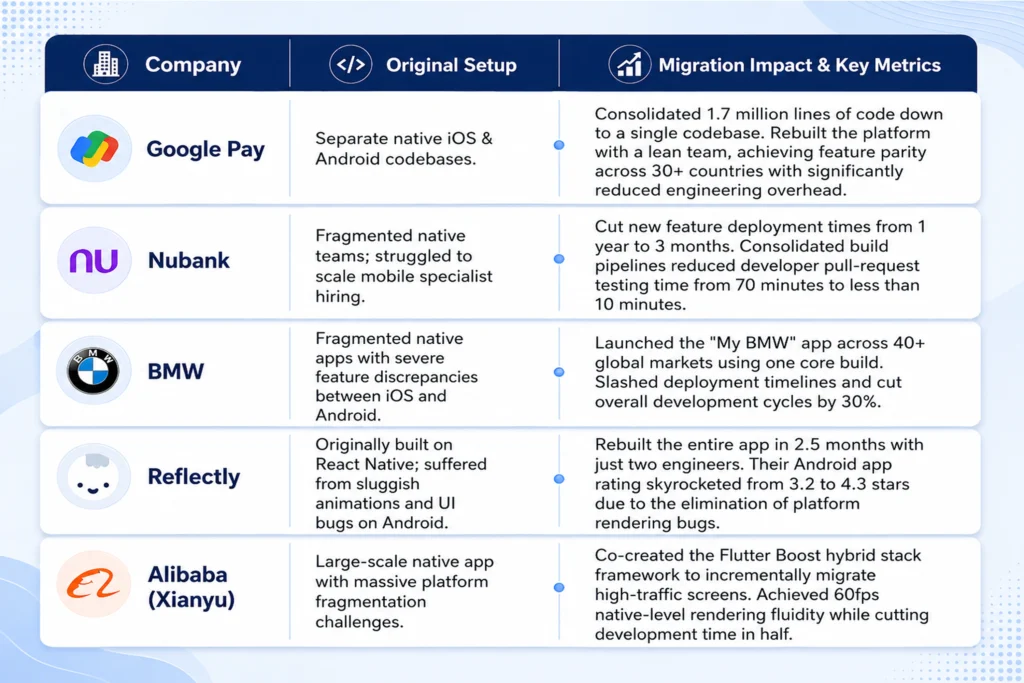
Native to Flutter migration delivers proven results in real markets. Many global companies successfully migrate native apps to Flutter every day.
Look at these powerful real-world success stories:
How to Minimize the Downtime?
When you choose cross-platform app development, choose wisely. Your specific approach must reduce runtime risks and downtime.
The Dreaded Full Rewrite
Never choose a complete rewrite for your mobile application. A full rewrite takes your app offline for months. Users cannot access your digital services during this time. Your business revenue stops flowing immediately. This strategy brings high risk and extreme operational stress. You will definitely regret this decision later.
The Smarter Way: Incremental Migration
CodesClue uses a strategic Flutter migration strategy for clients. We embed Flutter modules into your existing native app. We gradually replace your old features one by one. Your application remains fully functional during Flutter app modernization. This smart process reduces transition risks by 60% to 70%.
How does it actually work?
Keep your native app running during the process. Embed a dynamic Flutter module into the existing framework. Start with read-only paths while monitoring system latency. Switch your write-paths to Flutter after stabilizing performance. Move gradually from 10% to 100% Flutter code.
Where to Start: Best Pilot Modules?
Do not migrate your core checkout flow first. Start with low-risk features that users visit regularly.
Professional Flutter migration services recommend these specific modules:
- User Profile/Settings: eBay Motors chose this for their beta.
- Onboarding Sequences: Google Pay tested with a basic version.
- Help/Support Centers: Swiss Marketplace Group started right here.
- New Feature Flows: Wendy’s built new features in Flutter first.
Pick one simple module today. Test its performance. Learn from user data. Then move to the next feature confidently. CodesClue specializes in this Flutter app development services approach.
How to Plan for the Real Timelines in Flutter Migration?
Real-world timelines vary based on your business approach.
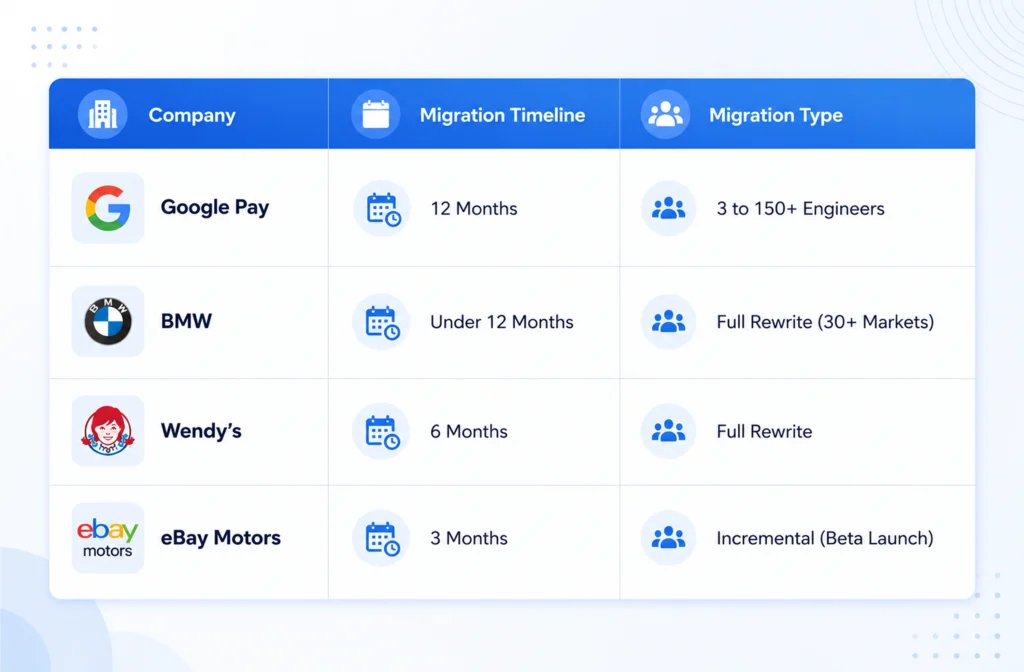
Most development teams finish migration within 3 to 6 months. Incremental methods always yield faster and safer launches.
Let us check the timeline data of top brands:
Your Step-by-Step Migration Roadmap at CodesClue
We follow a highly structured and low-risk roadmap. We help you transition efficiently while controlling your costs.
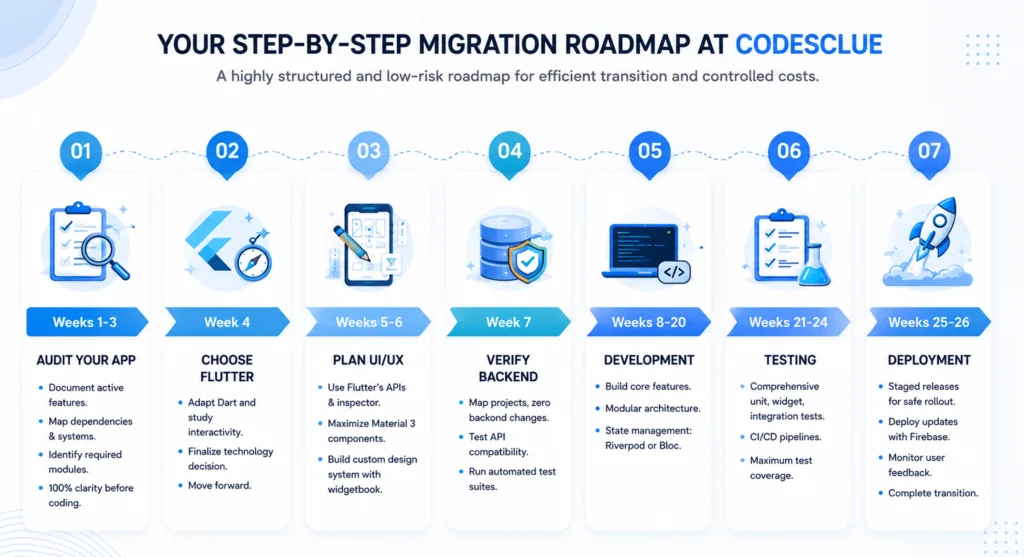
1. Week 1–3: Audit Your App
Document every active feature inside your current app. Map out all complex dependencies and connected systems. Identify tightly coupled modules within your native codebase. Aim for 100% clarity before writing code.
2. Week 4: Choose Flutter
Many developers prefer Flutter for modern cross-platform applications. Adopt Dart null safety from the very first day. Make your final technology decision and move forward.
3. Week 5–6: Plan UI/UX
Utilize the latest Flutter 4 APIs for rendering. Leverage the Impeller engine and modern Material 3 components. Build a custom design system using the Widgetbook tool.
4. Week 7: Verify Backend
Most migration projects require zero backend database changes. Test API compatibility with your existing web endpoints. Run your automated test suites to ensure stability.
5. Week 8–20: Development
Build your core application features during this phase. Use modular architecture to keep the code clean. Implement reliable state management using Riverpod or Bloc tools.
6. Week 21–24: Testing
Run comprehensive unit, widget, and integration tests daily. Set up automated CI/CD pipelines for deployment. Achieve maximum test coverage to prevent future bugs.
7. Week 25–26: Deployment
Use staged refactoring techniques for a safe release. Deploy your app updates gradually using Firebase tools. Monitor user feedback closely and complete the transition.
Maximizing ROI with Flutter App Migration Services
Native development costs businesses over $200K annually on average. A successful Flutter app migration changes your financial outlook. It reduces overall maintenance costs by 30% to 50%. It accelerates feature delivery speed by up to 46%.
You consolidate separate teams into one efficient unit. This yields smaller teams and highly simplified testing processes. You enjoy faster software releases and lower ownership costs. Most companies achieve full payback within 24 months. You unlock massive long-term Flutter ROI after that.
When Flutter May Not Be the Right Choice?
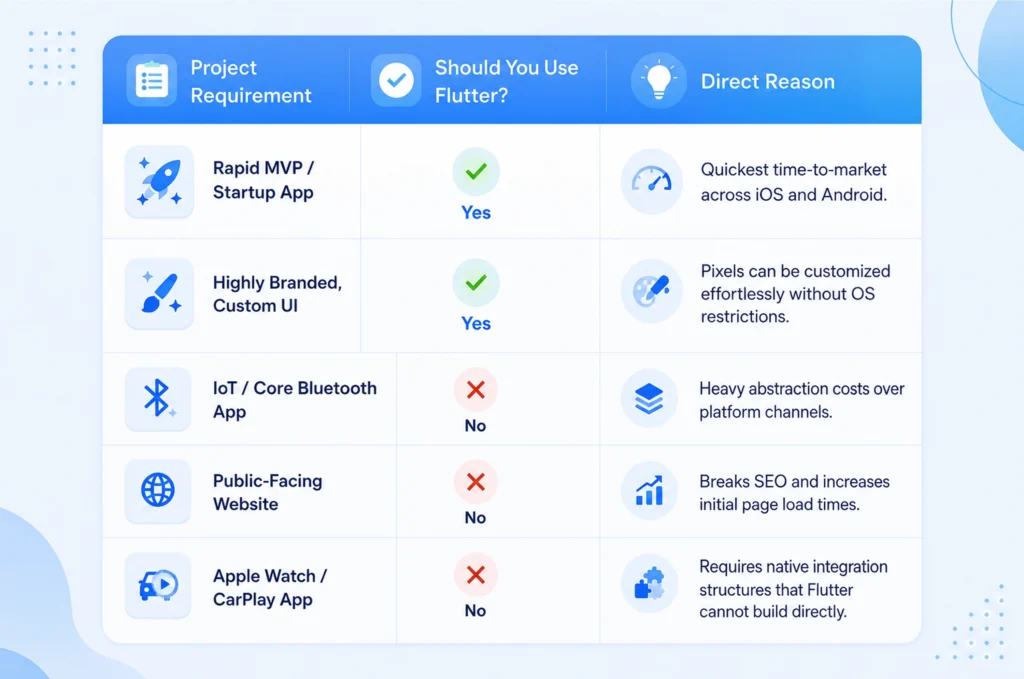
Flutter is not always perfect for every single application. Avoid it if you need deep operating system integration. Avoid it for heavy AR tools or 3D graphics. High-performance native apps might not need this transition. A technical assessment helps clarify your long-term roadmap. We analyze your business goals before recommending any changes.
Decision Matrix: When to Stay vs. When to Pivot
Common Challenges in Flutter App Migration
Migration projects bring distinct technical and operational challenges.
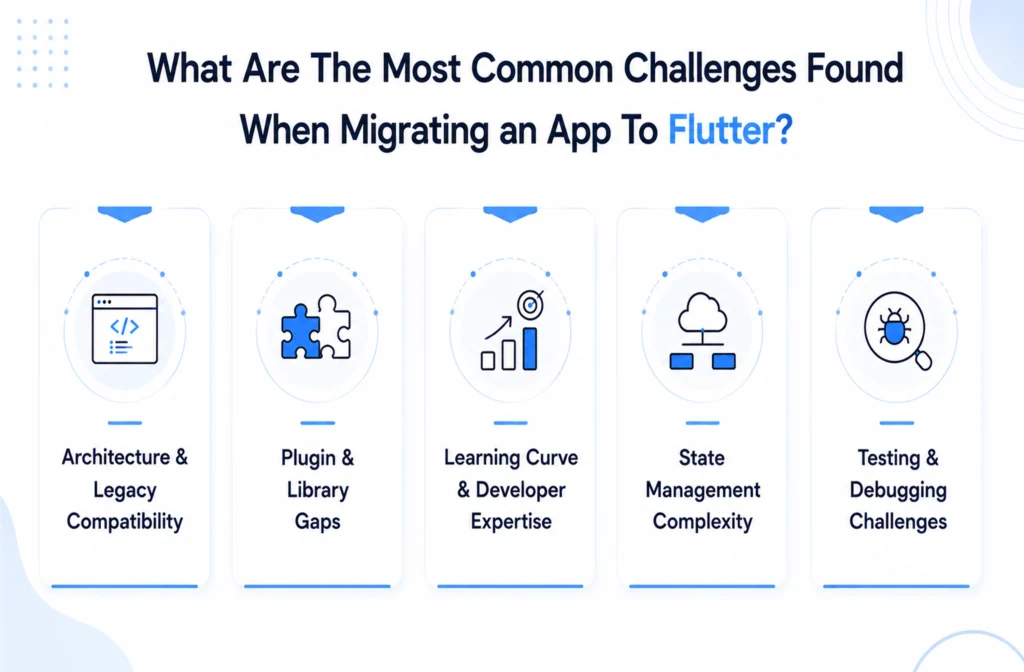
- Breaking SDK Changes: Upgrading Flutter or Dart introduces framework shifts that break legacy codebases.
- Dependency Conflicts: Third-party packages often become unmaintained or incompatible with newer Flutter versions.
- Native Integration Breaks: Complex Gradle configurations, CocoaPods setups, and custom native bridges frequently fail.
- Architectural Technical Debt: Outdated state management systems require complete code rewrites to scale.
- UI & Rendering Inconsistencies: Framework layout updates can break responsive designs and cause pixel overflows.
- Testing Pipeline Failures: Legacy automated test suites break due to changes in internal rendering timing.
How CodesClue Mitigates Migration Challenges?
CodesClue navigates these technical hurdles seamlessly using proven, production-tested mitigation strategies.
- Team Adoption: We provide intensive, hands-on Flutter training to quickly upskill your developers.
- Native Integrations: Our team builds custom, robust platform channels to preserve core native functionality.
- State Management: We implement predictable, scalable application behavior using modern Riverpod or Bloc architectures.
- Testing & CI/CD: Automated testing pipelines eliminate human error and reduce release risks during migration.
- UI Consistency: We leverage Flutter’s high-performance rendering engine to ensure identical, beautiful layouts across all devices.
Ready to Make the Move?
Flutter helps you minimize costs and maximize business growth. It simplifies application maintenance through a single shared codebase. CodesClue provides expert guidance throughout your modernization journey. We ensure smooth transitions and measurable positive business outcomes.
If you struggle with rising costs, act now. Start with a low-risk pilot module today. Validate your performance results and scale up production incrementally. Contact CodesClue for a free technical assessment today. Discover the most efficient path to upgrade your app.
Frequently Asked Questions
Is Flutter migration suitable for enterprise applications?
Yes. Large global brands manage complex applications using Flutter. It reduces their operational overhead and maintenance costs significantly.
How long does it take to migrate a native app to Flutter?
Most businesses complete the process within 3–6 months. The timeline depends on your app’s complexity and features.
Will my app experience downtime during migration?
Not if you use our incremental migration approach. Your native app remains live while adding new modules.
Does Flutter provide native-level performance?
Yes. Flutter delivers fast, smooth performance for business apps. Users enjoy responsive interfaces and great digital experiences.
How much can businesses save by migrating to Flutter?
Organizations save 30% to 70% on development costs. Shared codebases allow for much smaller engineering teams.
Can Flutter work with my existing backend and APIs?
Yes. Around 85% of projects require no backend modifications. This makes the system integration straightforward and highly cost-effective.
Why should I choose CodesClue for Flutter migration?
CodesClue follows a safe, low-risk incremental migration strategy. We minimize business disruption and maximize your long-term financial returns.