
What is React Native? Why Businesses Choose It in 2026
What is React Native? A plain 2026 guide: how it works, why businesses use it, real apps, costs, and when Flutter, native or a PWA fits better.
Your developer says “let’s build it in React Native,” and you nod without being sure what you just agreed to. Will the app feel slow, and will you need two teams anyway?
This guide answers what is React Native in plain words, how it works in 2026 and why businesses choose it. You will also see when it is the wrong pick, what it costs and how to start.
Key takeaways
- React Native lets one team build an iPhone app and an Android app from one shared codebase, written in JavaScript or TypeScript.
- The screens are real native buttons, lists and menus, so users get the look and feel they expect on each phone.
- The old “bridge” that made early apps feel slow is gone. The New Architecture has been the default since late 2024.
- It fits most business apps: shops, booking, banking, field and on-demand apps. Heavy AR, games or watch-first apps are better native.
- At CodesClue, a React Native MVP usually costs about $8K to $25K. Scope and integrations move the budget far more than the framework.
What is React Native?
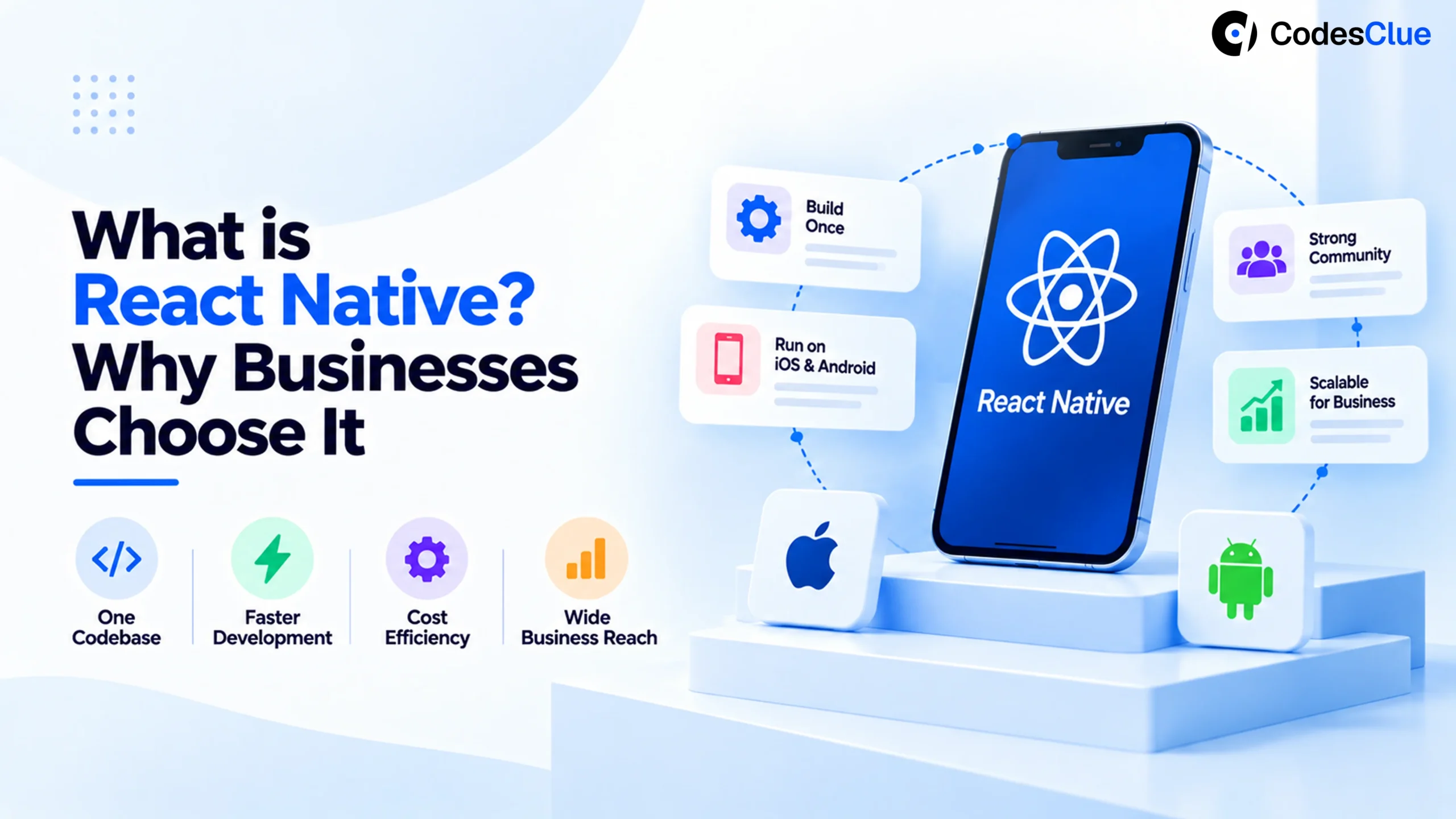
React Native is a free, open-source framework for building mobile apps for iOS and Android from one codebase. Developers write the app in JavaScript or TypeScript using React, and React Native shows real native screens on each phone. You get two store apps for roughly the effort of one, with a native look on both.
Meta created React Native and open-sourced it in 2015. Since February 2026, React and React Native belong to the React Foundation, an independent body under the Linux Foundation. No single company controls its future any more.
The name trips people up. React builds web pages; React Native uses the same ideas and skills to draw phone screens.
How React Native works in 2026
Your team writes each screen once. At run time, React Native turns each button in your code into a real native button on Android and on iPhone. The logic runs in JavaScript, while everything users touch is native.
A lot has changed since the older articles you may find online:
- No more bridge. Early versions passed every message through a slow “bridge”. The New Architecture replaced it and became the default in version 0.76 (October 2024). Version 0.82 was the first to run only on it.
- Three new parts. JSI lets JavaScript call native code directly. Fabric is the new screen renderer, and TurboModules load native features only when needed.
- A faster engine. Hermes V1, the JavaScript engine built for React Native, has been the default since version 0.84.
- Expo as the starting point. The official React Native docs recommend starting new apps with a framework such as Expo.
- Fast Refresh. Developers see most code changes on the phone almost at once, which speeds up every sprint.
The current release is React Native 0.88, out on 19 October 2026. You can follow every release on the official React Native blog (opens in a new tab).
Pro tip: If an article or a vendor still blames “the bridge” for slow apps, check its date. It describes a version of React Native that no longer exists.
React Native vs native, hybrid and PWA
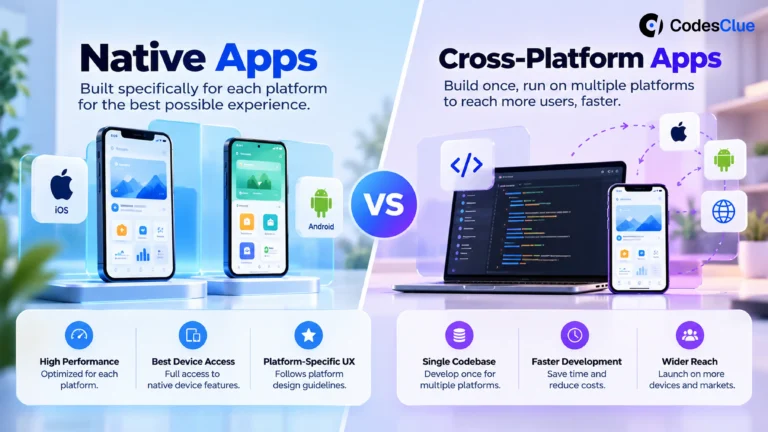
Think of it as the middle ground between fully native apps and web-based apps. Here are the main ways to build a mobile product.
| Approach | How it works | Codebases | Feel on the phone | Best for |
|---|---|---|---|---|
| Native | Swift for iOS, Kotlin for Android | Two | Fully native, most direct device access | AR, games, heavy video, watch apps |
| React Native | JavaScript logic, real native screens | One | Native look on each platform | Most business and consumer apps |
| Flutter | Dart code, its own engine draws every pixel | One | Identical custom design everywhere | Brand-led, animation-heavy apps |
| Hybrid (WebView) | Web pages inside an app shell | One | Can feel like a website | Simple content apps |
| Progressive web app | A website that installs like an app | One, no store needed | Good for forms and dashboards | Internal tools, quick launches |
Choosing between the two cross-platform options? Our React Native vs Flutter guide compares them point by point.
Why businesses choose React Native
So why use React Native at all? Most teams pick it for five practical reasons.
- One team, two apps. One group of developers ships iOS and Android together, with fixes landing on both in the same release.
- Skills you may already have. In the Stack Overflow Developer Survey 2025, 66% of respondents used JavaScript. React web developers can move to React Native quickly. If your website runs on React, people and code can move between the two.
- Real device features. Apps can use the camera, GPS, biometrics, Bluetooth, NFC and push notifications. That matters as soon as you build more than forms.
- Faster fixes. Expo’s EAS Update can push small JavaScript fixes straight to users. Bigger changes still go through app store review.
- A safe long-term bet. It has an independent home, steady releases and a huge library ecosystem.
That is why clients come to our React Native app development team: one budget, one backlog, two stores.
Pro tip: Before you commit, list the three device features your app cannot live without. Ask your team to confirm a maintained library exists for each one.
React Native for business: what teams build by industry
Almost every sector can use it. The framework stays the same; the must-have features change.
| Industry | Typical apps | Features you cannot skip |
|---|---|---|
| Healthcare | Telemedicine, patient portals, medication reminders | HIPAA-ready backend, secure messaging, video calls, FHIR records |
| eCommerce | Storefronts, marketplaces, B2B ordering, subscriptions | Fast search, filters, secure checkout, order tracking, offers |
| FinTech | Banking, wallets, trading, lending, insurance | Biometric login, KYC, live alerts, PCI DSS, fraud checks |
| On-demand | Food delivery, rides, home services | Live GPS tracking, chat, ratings, dynamic pricing |
| Logistics | Fleet, driver, shipment and warehouse apps | Barcode and QR scanning, proof of delivery, offline mode |
Three questions come up again and again:
- Is it secure enough for fintech or health? Yes, when you build the whole system for it: encrypted APIs, secure token storage, multi-factor login and monitoring. The framework is rarely the risk; the architecture is.
- Can it handle live tracking and chat? Yes, through WebSockets, Firebase or GraphQL subscriptions and native maps.
- What if drivers lose signal? Build offline-first. Store data on the phone with SQLite and sync it in the background when the network returns.
Companies using React Native
You are in good company. These examples come from the React Native showcase (opens in a new tab) and from the companies’ own blogs:
- Meta: Facebook, Facebook Ads Manager, Meta Horizon and the Meta Quest app.
- Microsoft: Office, Outlook, Teams and Xbox Game Pass on iOS and Android.
- Amazon: Amazon Shopping, Alexa, Photos and Kindle.
- Shopify: the showcase states that all of Shopify’s mobile apps use React Native.
- Coinbase: moved its iOS and Android apps from native code to React Native in 2020 and 2021, according to its own blog.
The lesson scales down: a small team gains even more from one codebase.
Is React Native right for you?
Knowing what React Native is covers only half the decision. The other half is your product, so find the row closest to your situation.
| Your situation | Best fit | Why |
|---|---|---|
| Startup MVP for iOS and Android, team knows JavaScript | React Native | Fastest start, one codebase, easy hiring |
| You already run a React website or web app | React Native | Shared skills, tools and some logic |
| Business app built from lists, forms, maps and payments | React Native | Native feel, large library choice |
| Brand-led app with heavy custom animation | Flutter | Draws every pixel the same on all devices |
| AR, 3D, real-time video or watch-first product | Native iOS and Android | Fewest layers between code and hardware |
| Internal tool or simple forms, no app store needed | Progressive web app | One web build, instant updates |
A progressive web app is often the quickest route for internal tools. Pick React Native when you need the app stores and device features.
What a React Native app costs
Scope decides the budget, not the framework. Here is the CodesClue price ladder:
| Project size | Typical budget | What it usually includes |
|---|---|---|
| MVP | $8K to $25K | Core flows, sign-in, one or two integrations, both app stores |
| Mid-size app | $25K to $70K | Payments, user roles, admin panel, custom design |
| Large platform | From $70K | Many user types, compliance, ERP or CRM links, web and TV apps |
For a full breakdown by app type and hidden costs, read our guide to React Native app development cost.
Want a number for your own idea? Tell us what you are building, and an engineer will send a written estimate with milestones.
How to start a React Native project in 6 steps
- Write the one-page brief. Name your users, the core job of the app and the three features that matter most.
- Pick platforms for launch and year two. iOS and Android first, then decide on web, tablet or TV.
- Check device needs. List the SDKs you need, such as payments, maps, Bluetooth or health data.
- Design the key screens. Agree on five or six core screens first.
- Build the MVP in short sprints. Ship a test build every one or two weeks.
- Launch, measure and improve. Watch crashes and drop-offs, then plan the next release.
Our React Native development process guide covers each stage in detail.
Pro tip: Keep the first release small. A live MVP teaches you more than a perfect plan; see our notes on MVP app development.
What we see in real projects
For Akcru, a film launch platform, we used React Native. People send a Movie Invite Ticket, chat opens once the other person accepts it, and they watch the film together in sync. The product runs on iOS, Android, Android TV and the web.
One API and one sign-in service sit behind every app. The Android TV premiere app is also React Native, built around a single film and driven by the remote. One team covered the phones and the big screen, which kept the brand and rules the same everywhere.
Now the honest limits. We would not choose React Native for heavy AR, real-time video processing or a smartwatch-first product. If users only need a few forms, a web app may beat any store app.
Checklist: choosing a React Native partner
Ask these before you sign:
- Have they shipped React Native work in your industry, and can you try it?
- Do they build on the New Architecture and a current version?
- How do they handle security and rules like HIPAA or PCI DSS?
- What does their testing look like on real devices?
- Which engagement fits you: fixed scope, a dedicated team or added developers?
- Who looks after updates and store releases after launch?
Need people inside your own team? You can hire React Native developers from CodesClue, and development starts within 48 hours.
Common mistakes to avoid
- Judging by old articles. Many still describe the removed bridge and outdated speed problems.
- Skipping the SDK check. One missing payment or hardware library can cost weeks of native work.
- Building every feature first. A bloated first release delays real feedback and burns budget.
- Ignoring upgrades. Apps that skip several versions become slow and costly to update.
- Forcing it on the wrong product. AR, games and watch apps deserve native code.
FAQs
Is React Native still worth using in 2026?
Yes. React Native released version 0.88 on 19 October 2026, and it now lives under the independent React Foundation. Meta, Microsoft, Amazon and Shopify run major apps on it. The New Architecture removed the old bridge, so modern React Native apps feel smooth on today’s phones. For most business apps, it remains one of the safest cross-platform choices.
Is React Native good for startups?
Often, yes. A startup can launch on iOS and Android with one small team, and JavaScript skills are easy to find. At CodesClue, a React Native MVP usually costs about $8K to $25K, and scope decides the timeline. Pick Flutter instead if your design is the main selling point, or native for AR and games.
Does a React Native app feel native to users?
Yes, for most apps. React Native draws real platform components, so a date picker looks like an iPhone picker on iOS and an Android one on Android. Lists, forms, chat and checkout feel as smooth as native when the code is clean. Heavy 3D or video work can still need native code.
Can React Native share code with my website?
Partly. If your website uses React, your team reuses its skills, tools and much of the business logic, such as API calls and validation. Screens usually differ, because phone and web layouts work differently. React Native Web can share some screens too, but most teams keep separate layouts and share the logic underneath.
How long does it take to build a React Native app?
It depends on the number of screens, integrations and user types far more than on the framework. Good teams work in short sprints and share a test build every one or two weeks, so you see progress early. A clear brief and a small first release cut the time most. Ask any partner for a milestone plan with the estimate.
Who maintains React Native now?
Meta created React Native and open-sourced it in 2015. Since February 2026, React and React Native belong to the React Foundation, part of the Linux Foundation. Meta engineers still contribute, alongside Microsoft, Expo and many others. Releases arrive every few months, and each version receives fixes for a set support period.
What is React Native worth to your business? Your next step
Now you know what React Native is, why businesses choose it and when another option fits better. Send us your app idea, and our React Native team will reply with a recommendation, a budget range and a first milestone. Book a free consultation, and an engineer will reply within one business day.