


All digital businesses are majorly survived by their mobile applications, significantly contributing to their growth strategy. Businesses in 2026, prioritize cost-efficient engineering models, seamless user experiences, and faster delivery.
React Native app development, in this landscape, has emerged as the most preferred and widely adopted solutions to develop high-quality mobile applications across Android and iOS platforms. Statista reports that as of October 2024, 790 apps using the software development kit (SDK) React Native framework generated a monthly revenue ranging from 10 thousand to 100 thousand U.S. dollars.
In this article, we will break down how React Native works, its advantages over native and hybrid approaches, and why businesses continue to choose it as a long-term mobile development strategy in 2026.
What is React Native?
Introduced by Meta, React Native is a powerful open-source framework that enables developers to create mobile applications using a single codebase while achieving near-native performance at the same time. Thus, this platform has become a preferred choice for the businesses aiming to quickly scale their production without investing in separate development teams for different platforms.

React Native is especially relevant in 2026 due to its ability of balanced performance with productivity on multi-development platforms. With advancements like the new architecture (Fabric and Turbo Modules), improved rendering speed, and stronger integration with native modules, React Native now supports complex, enterprise-grade applications with greater efficiency than ever before.
From the companies started initially to established businesses modernizing legacy systems, React Native framework is increasingly adopted by many organizations for their mobile application development needs. The reason being, it reduces time-to-market, lowers operational costs, and maintains consistent user experiences across different devices.
React Native Framework and How it Works?
The React Native framework for mobile app development simplifies and accelerates the app creation process. It uses React, a JavaScript library for building user interfaces, along with native platform capabilities.
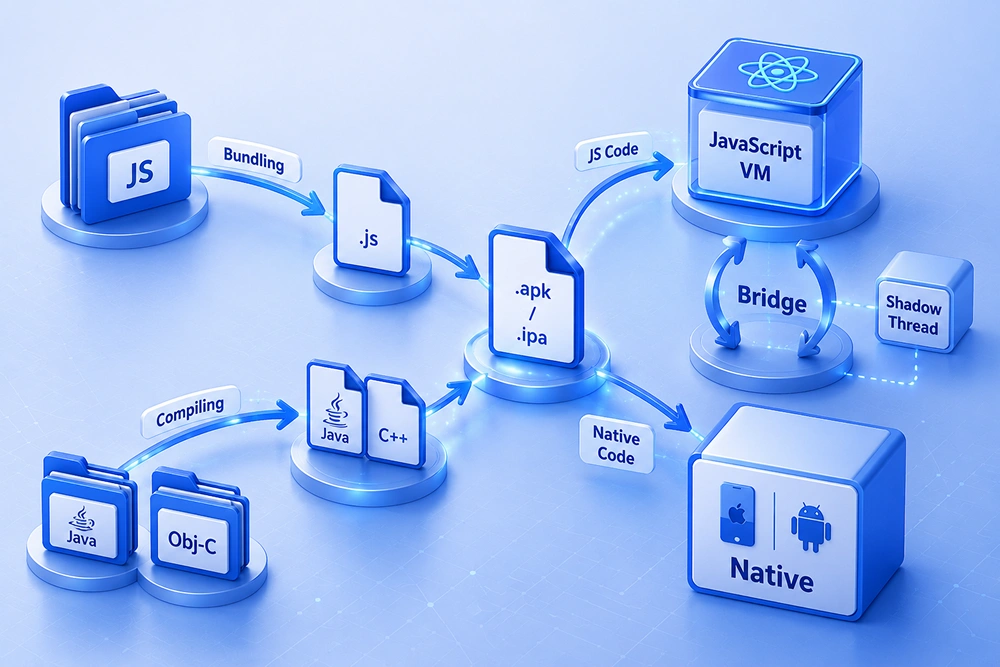
With React Native developers can write application logic in JavaScript while rendering real native UI components for Android and iOS devices. This approach delivers near-native performance with significantly reduced development effort.
Key Components of the React Native Framework
- Single codebase for Android and iOS
- Reusable UI components
- Native APIs and modules support
- Hot reloading for faster development
- Third-party plugin integration
- Strong developer community support
- Scalable architecture for enterprise applications
Because of these capabilities, businesses increasingly choose React Native for building modern mobile applications that need scalability and rapid deployment.
How React Native Works?
Businesses evaluating gcross-platform technologies should always understand how React Native works.
Basically, it operates using a bridge architecture for connecting the JavaScript code with native platform modules. The applications are written by the developers in Type Script or JavaScript, and it is further translated by React Native into native UI elements.
For example:
- A React Native button becomes a native Android button on Android devices.
- The same component becomes a native iOS button on Apple devices.
This architecture supports applications maintaining native performance while enabling the re-usability of the source code across multiple platforms.
Key technologies used in React Native include:
- JavaScript
- TypeScript
- React
- Native APIs
- Metro Bundler
- Hermes JavaScript Engine
In 2026, React Native’s new architecture, including Fabric and TurboModules, has further improved rendering speed, memory optimization, and app responsiveness.
How React Native Differs from Native and Hybrid Apps?
Many businesses evaluating mobile technologies often compare native development, hybrid apps, and React Native.
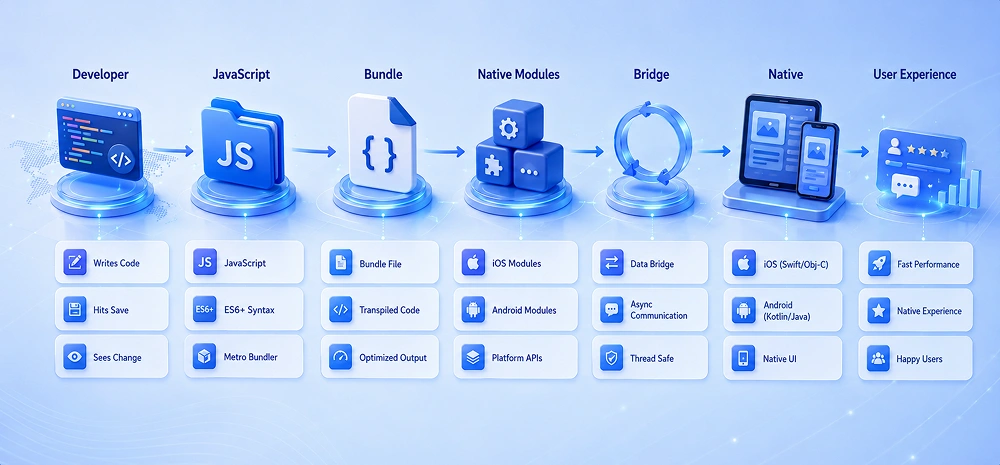
Here is a simplified breakdown:
Native Development
Native apps are developed mainly for a single platform using Swift for iOS and Kotlin for Android as technologies. Their performance standard is always up-to-the-mark, but they require separate development teams and higher budgets.
Hybrid Development
Hybrid apps are web based applications that often use WebViews for content displays. Though they facilitate faster development, performance and user experience do take a backseat due to the complexity of the application.
React Native Cross-Platform Development
React Native cross-platform development combines the best aspects of both approaches. It allows businesses to create apps using a shared codebase while still accessing native functionalities such as camera, GPS, push notifications, and device APIs.
This balance between performance and efficiency is one of the biggest reasons why businesses choose React Native in 2026.
Key Benefits of React Native Development
Today, businesses prioritize speed, scalability, and cost optimization. The best thing is, React Native aligns perfectly with these goals.
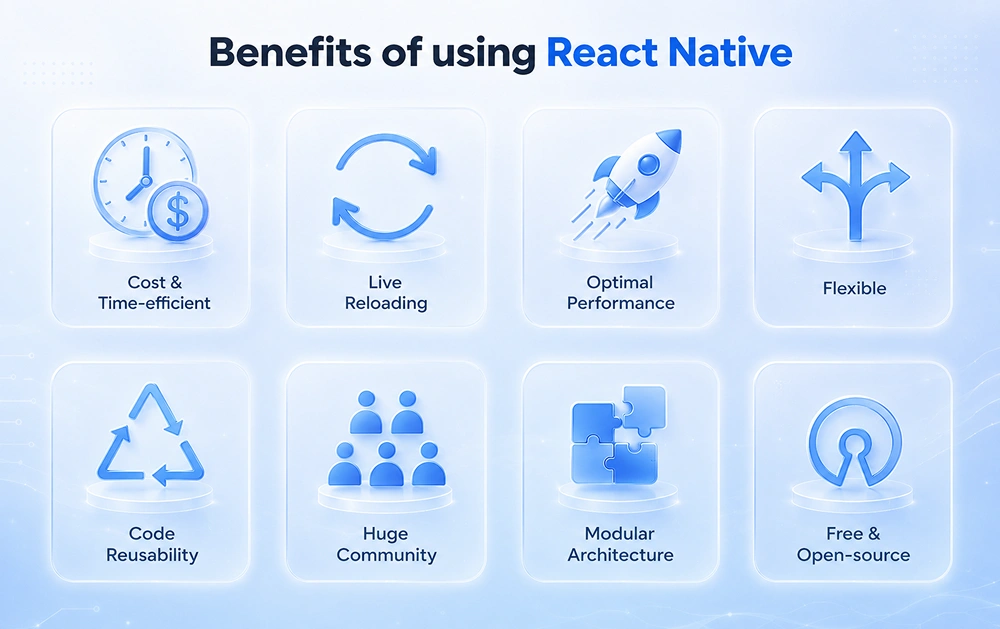
1. Single Codebase for Multiple Platforms
One of the biggest benefits of React Native development is that it enables a single codebase to be used for both Android and iOS applications.
This means:
- Faster development cycles
- Reduced maintenance efforts
- Consistent UI across platforms
- Easier updates and bug fixes
This reduces up to 30-40% of development efforts for the businesses compared to separate native app development.
2. Faster Time-to-Market
In today’s competitive market, launching faster matters a lot. React Native brings this capability by supporting:
- Hot Reloading
- Reusable components
- Pre-built libraries
- Faster testing cycles
These capabilities allow businesses to launch MVPs and full-scale applications much faster.
3. Cost-Efficient Development
Maintaining separate Android and iOS teams can significantly increase project costs. With React Native:
- One development team can manage both platforms
- Maintenance costs are reduced
- Updates become simpler
- Resource allocation improves
This makes React Native especially attractive for startups and growing businesses.
4. Near-Native Performance
Modern React Native applications provide smooth performance for most business applications. They help achieve high responsiveness and features such as:
- Native rendering
- Hardware acceleration
- Optimized animations
- Improved JavaScript engines
5. Strong Community and Ecosystem
React Native benefits from a massive open-source ecosystem supported by Meta and a global developer community. It offers businesses access to:
- Thousands of libraries
- Active community support
- Continuous updates
- Long-term scalability
React Native vs Flutter vs Ionic: Quick Comparison
Businesses often compare React Native with Flutter and Ionic before choosing a mobile framework.
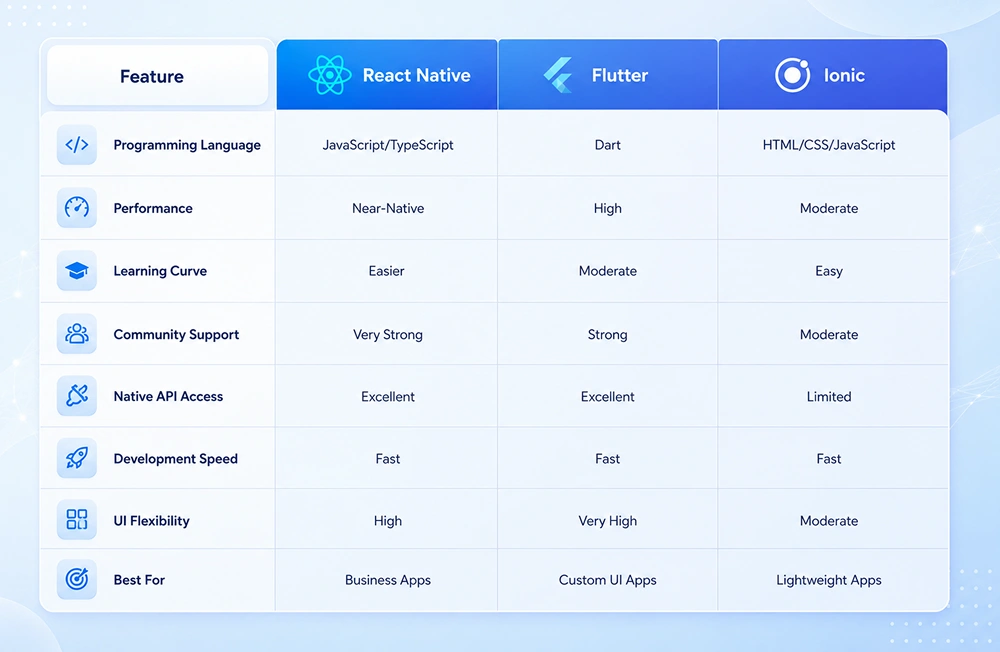
React Native vs Other Frameworks
When evaluating React Native vs other frameworks, businesses often choose React Native because:
- JavaScript talent is widely available
- React ecosystem is mature
- Integration capabilities are extensive
- Enterprise adoption is higher
- Maintenance is easier for long-term projects
Flutter performs excellently for highly customized UI experiences, while Ionic suits better for lightweight applications. However, React Native remains a preferred choice for scalable business applications.
Who Should Use React Native?
One of the biggest strengths of React Native is its flexibility across industries and business sizes.
Startups:
Speed and budget matter the most for the startups. React Native enables startups to:
- Launch MVPs faster
- Validate ideas quickly
- Reduce initial investment
- Scale applications efficiently
SMBs:
Small and medium-sized businesses benefit from React Native development incurring:
- Lower operational costs
- Easier maintenance
- Faster feature releases
- Consistent user experiences
Enterprises:
Large enterprises use React Native for:
- Internal business apps
- Customer engagement platforms
- E-commerce applications
- Financial and healthcare solutions
The framework supports scalability, security integrations, and enterprise-grade architectures.
Who Should Use React Native?
Businesses that should strongly consider React Native include e-commerce brands, SaaS companies, fintech startups, healthcare providers, logistics companies, education platforms, and on-demand service providers.
Real-World React Native Use Cases for Business
Several global brands use React Native successfully for mobile application development.
Meta: Meta continues to use React Native extensively across its mobile products.
Shopify: Shopify migrated many mobile experiences to React Native to improve developer efficiency and maintainability.
Walmart: Walmart leveraged React Native to improve app performance and streamline cross-platform development.
Bloomberg: Bloomberg adopted React Native for faster deployment and better cross-platform consistency.
These examples demonstrate practical React Native use cases for business across retail, media, social networking, and enterprise platforms.
Why Businesses Choose React Native in 2026
With the growing reliance of human lives on technology, the demand for mobile applications continues to grow rapidly. Thus, businesses require frameworks that balance performance, scalability, and cost.
Here are the major reasons why businesses choose React Native in 2026:
- Faster Digital Transformation: Companies can launch products quickly without managing multiple development pipelines.
- Cost Optimization: Shared development reduces engineering costs significantly.
- Easier Maintenance: A single codebase simplifies updates, debugging, and long-term support.
- Better Developer Availability: JavaScript developers are easier to hire compared to platform-specific native developers.
- Improved Performance with Modern Architecture: React Native’s latest architecture improvements continue to close the gap between cross-platform and native performance.
- Enterprise Scalability: React Native supports enterprise integrations, cloud services, APIs, and scalable architectures.
Conclusion
React Native has evolved far beyond being just another cross-platform framework. In 2026, it stands as one of the most reliable solutions for businesses aiming to build scalable, high-performance, and cost-effective mobile applications.
From startups building MVPs to enterprises scaling customer experiences globally, React Native continues to deliver strong business value through faster development, code reusability, and near-native performance.
If your business is planning to build a modern mobile application, investing in professional React Native app development can help accelerate growth while reducing development complexity and operational costs.
Build Scalable Mobile Apps with CodesClue
At CodesClue, we deliver custom React Native app development solutions tailored for startups, SMBs, and enterprises. Our team specializes in scalable cross-platform mobile app development focused on performance, user experience, and long-term business growth.