
AI App Development Cost 2026: Complete Pricing Guide
AI app development cost in 2026: real price ranges by app type, what drives the budget, running costs after launch and what CodesClue charges.
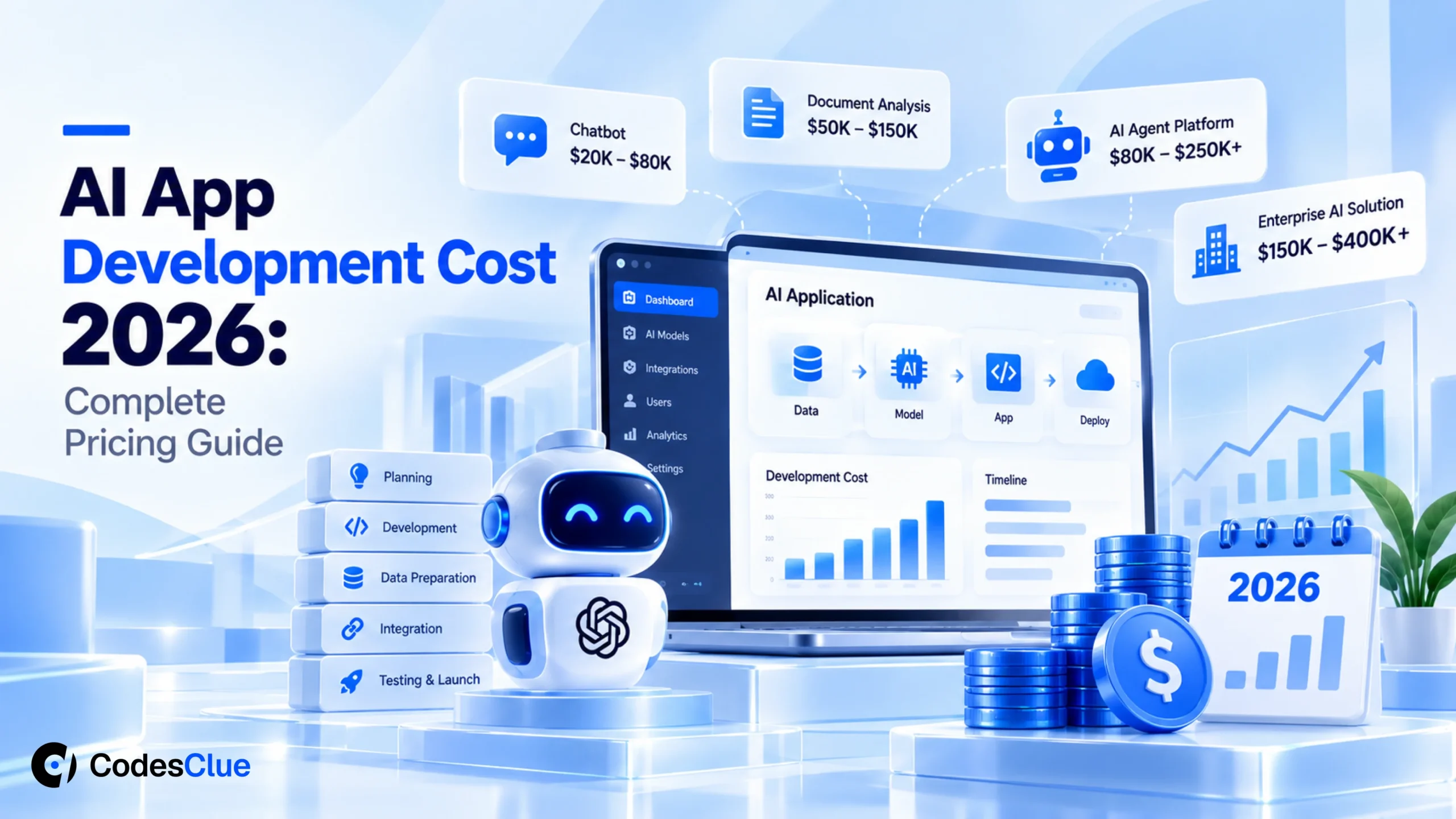
You have an AI idea and a budget question. One agency quotes $20K, another quotes $200K, and both say “it depends”. Below, we break down the real AI app development cost in 2026: what each type of AI app costs, what pushes the price up and how to start without overspending. If you need a number you can plan around, this is for you.
Key Takeaways
- Published 2026 guides put AI app development cost between about $15,000 for one AI feature and $400,000 or more for an enterprise platform.
- The model is rarely the biggest cost. Data work, integrations, security and testing decide most of the budget.
- A chatbot that answers questions costs far less than an AI agent that takes actions in your systems.
- Plan 15% to 25% of the build cost per year for running and improving the app, plus the monthly model bill.
- At CodesClue, an AI proof of concept or MVP runs about $8K to $25K, a production AI feature $25K to $70K, and a full AI platform starts from $70K.
How much does it cost to develop an AI app in 2026?
How much does it cost to develop an AI app? Most AI apps cost $15,000 to $150,000 to build, and enterprise AI platforms often pass $400,000. A single AI feature on a ready-made model sits at the low end. A platform with custom models, many integrations and strict security sits at the top. Running costs come on top of the build every month.
Almost every company uses AI somewhere now. In McKinsey’s State of AI 2026 survey (opens in a new tab), nearly nine in ten respondents said their organizations use AI regularly in at least one business function. Only 44% said AI is scaling across their enterprise. The gap between a demo and a working product is where most of the money goes.
A production-ready AI app needs more than a model connection:
- Clean, well-organized data
- The right model for the job
- The app itself: screens, accounts and admin tools
- Security and access control
- Cloud hosting
- Testing and monitoring of AI answers
Each item on that list shows up in your AI development cost.
AI app development cost by app type
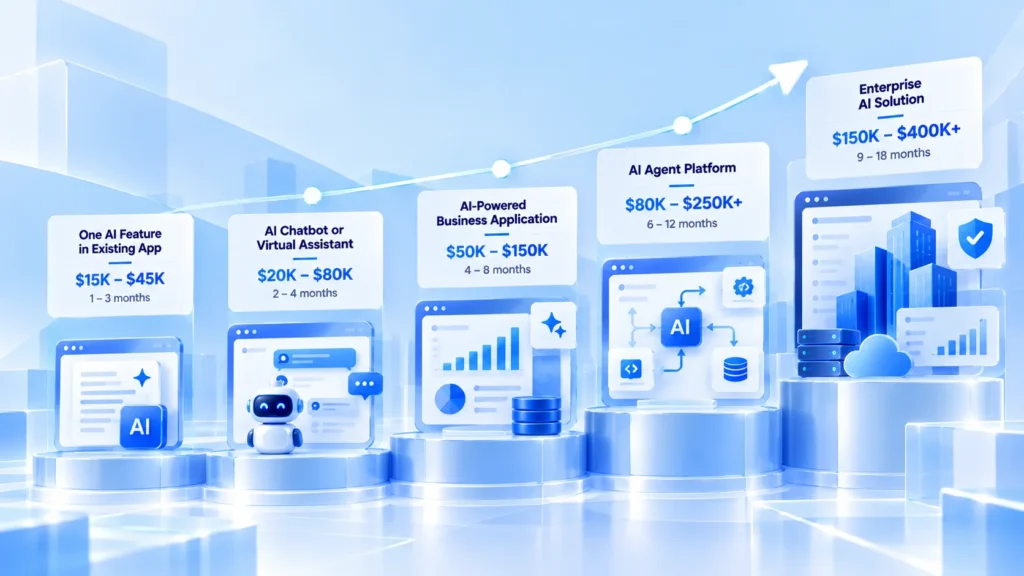
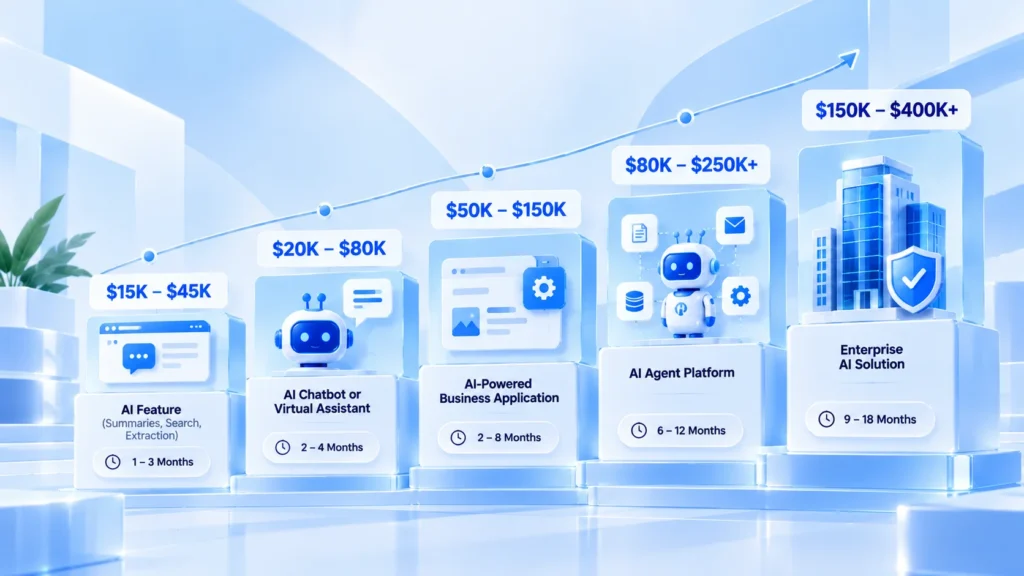
The table below combines the ranges published in 2026 by Riseup Labs, Miquido, Biz4Group, Emerline and Iternal. We grouped them by the type of app most buyers ask us about.
| AI app type | Typical cost | Typical timeline |
|---|---|---|
| One AI feature in an existing app (summaries, search, extraction) | $15,000 to $45,000 | 1 to 3 months |
| AI chatbot or virtual assistant | $20,000 to $80,000 | 2 to 4 months |
| AI-powered business application | $50,000 to $150,000 | 4 to 8 months |
| AI agent platform | $80,000 to $250,000+ | 6 to 12 months |
| Enterprise AI solution | $150,000 to $400,000+ | 9 to 18 months |
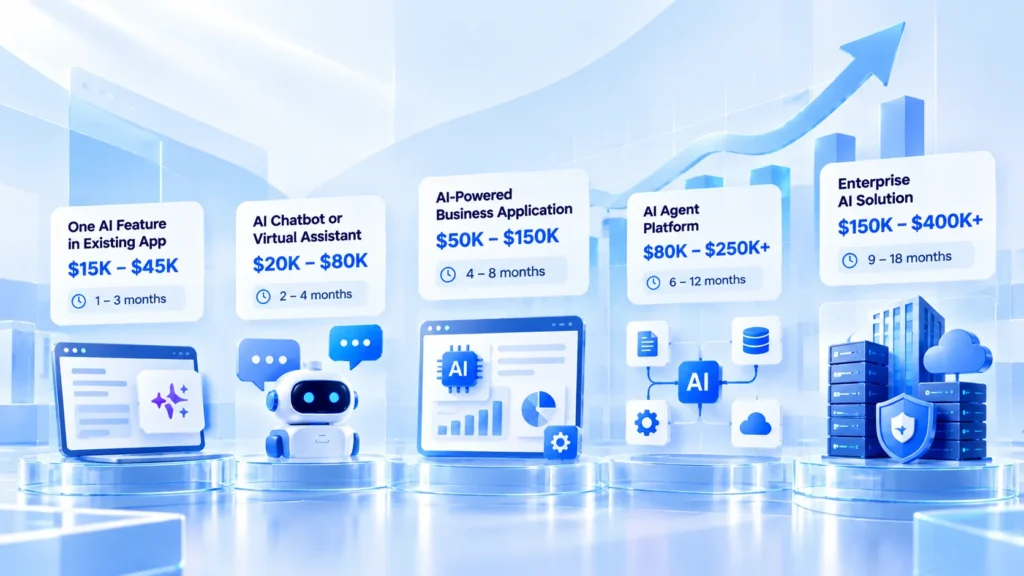
These ranges move with your data, your integrations and where your team works. Treat them as a map, not a quote.
Basic AI apps
Basic AI apps call an existing model through an API. Think of a writing assistant, a simple recommendation feature, an FAQ chatbot or smarter search. Nobody trains a model here. The work covers the API connection, the screens, testing and release, which makes this the lowest-cost level.
Mid-level AI apps
Mid-level apps connect AI to your own data and processes. Typical examples are support automation, document analysis and personalized recommendations. They usually need retrieval-augmented generation (RAG), so the AI answers from your documents. They also need user accounts, admin dashboards and database work. Here the AI software development cost rises, because the AI has to fit how your business already runs.
Enterprise AI apps
Enterprise apps run important work for many users. They include autonomous agents, industry-specific AI and large automation platforms. They often need custom or fine-tuned models, large datasets, audit logs and constant monitoring. At this level, the systems around the model cost more than the model itself.
Pro tip: Write down the one decision or task your AI app must improve before you ask for quotes. Vendors can only price what you can describe, and a clear task often cuts the first estimate in half.
What drives the cost of AI app development?
Buyers often underestimate how many parts an AI app has. These AI app development cost factors decide most of your budget.
1. The AI model you choose
You can use an existing AI API, an open-source model, a fine-tuned model or a model built from scratch. Ready-made models cost the least to start. Custom models need data collection, training, testing and tuning, so they cost much more. Our LLM integration cost guide compares these options in detail.
2. Data preparation
AI gives poor answers on poor data. Data work covers collection, cleaning, labeling, storage and security. Riseup Labs puts data work at 15% to 40% of the total budget. For many enterprise projects, it is the biggest part of custom AI development costs.
3. Features and complexity
The more your app has to understand and do, the more it costs.
| AI feature | Cost impact |
|---|---|
| Basic chatbot | Low to medium |
| Voice recognition | Medium |
| Predictive analytics | Medium to high |
| Computer vision | High |
| AI agents | High |
| Custom machine learning model | Very high |
Take a chatbot. One that answers common questions costs little. One that reads your database, processes documents and completes tasks costs several times more.
4. Integrations
Most AI apps connect to a CRM, an ERP, payments, file storage or analytics tools. Each connection needs secure access, error handling and its own tests. The connections also have to work together, so every new one adds testing for the others.
5. Security and compliance
Healthcare, finance and legal apps need audit logs, access rules, data residency and extra review. That work keeps you compliant and protects your users, so put it in the first estimate, not the last.
Not sure which of these factors applies to you? Send us your idea and we will tell you which ones drive your budget.
How much does AI cost by solution?
Many buyers ask, “How much does AI cost?” The better question is what the AI has to do. These published ranges show how the job changes the price.
| AI solution | Typical investment |
|---|---|
| Website support chatbot | $20,000 to $80,000 |
| Recommendation system | $30,000 to $120,000 |
| AI assistant inside a CRM | $50,000 to $150,000 |
| Document processing platform | $60,000 to $200,000 |
| Computer vision application | $80,000 to $250,000+ |
| AI agent automation system | $80,000 to $250,000+ |
An app that does one task well costs less than a platform that runs many business operations. Start with the task that saves the most time.
Chatbot, copilot or AI agent: which one do you need?
How much does it cost to develop an AI chatbot? Usually $20,000 to $80,000. A copilot that works inside your tools costs more, and an agent that acts on its own costs the most. The AI chatbot development cost stays lower because a chatbot answers. An agent decides, uses tools and finishes multi-step tasks.
| Solution | What it does | Typical cost |
|---|---|---|
| AI chatbot | Answers questions from your content | $20,000 to $80,000 |
| AI copilot | Drafts, suggests and summarizes inside your tools | $40,000 to $120,000 |
| AI agent | Plans steps, uses your systems and completes tasks | $80,000 to $250,000+ |
An agent needs parts a chatbot does not: memory, tool connections, workflow rules, permission controls and tests for every action it can take. That is why the agentic AI development cost sits higher. A narrow agent that handles one task with one or two tools can start far lower, from about $15,000. Our AI agent cost guide breaks down the AI agent development cost with a worked example and payback math.
If you need answers for customers, a chatbot is often enough. If you need work done across systems, an agent gives more value over time.
Hidden costs after launch
Many buyers compare build quotes and forget the running costs. Published guides agree on one rule: plan 15% to 25% of the build cost every year for upkeep.
- Model bill: you pay per use. In our LLM guide, 20,000 questions a month cost $14 on a small model and $1,400 on a top model.
- Cloud hosting: computing power, storage, databases and logs grow with your users.
- Monitoring: someone has to check answer quality, cost spikes and failures every week.
- Model changes: providers retire models, so prompts and tests need updates.
- Integration upkeep: CRM and ERP updates can break connections.
- Security patches: AI apps handle sensitive data and need regular fixes.
Pro tip: Ask every vendor for two numbers: the build price and the expected monthly running cost at your real usage. A low build quote with a high monthly bill can cost more within a year.
What CodesClue charges for an AI app
We price AI projects in three bands. Every estimate comes in writing after a short scoping call, with the monthly running cost next to the build price.
| Project | What you get | Typical cost |
|---|---|---|
| Proof of concept or MVP | One AI workflow on your real data, a simple interface, human review of AI output | $8K to $25K |
| Production AI feature or app | RAG on your documents, user accounts, admin tools, one or two integrations, monitoring | $25K to $70K |
| AI platform | Several AI workflows or agents, many integrations, compliance work, custom or fine-tuned models | From $70K |
Why does our MVP band start lower than the market table? An MVP is deliberately narrow. It covers one workflow, keeps a person approving key steps and skips extras like voice or multi-system sync. A proof of concept usually takes 1 to 3 weeks and an MVP 4 to 10 weeks.
Our team is AI-first and works in short Agile sprints, so every sprint delivers something you can use. We move each project from proof of concept to MVP to production. Engineering runs from Ahmedabad, with offices in India, the USA and Germany. Read how our Agile development process works, see our AI development services, or hire AI developers to join your own team.
Real example: AI clinical notes for Therapix.AI
For Therapix.AI, we built a platform that turns therapy session input into structured clinical notes and SOAP reports. It runs on the web, iOS and Android. The case study reports 62% less documentation time and a 70% lower administrative workload.
The budget lesson: the clinician review step and the security work were not extras. In healthcare they make the AI safe to use. Price them in from the first estimate, or the project grows later.
How to reduce custom AI development costs
A good AI app does not need a huge budget. These steps cut custom AI development costs without cutting quality.
- Start with a proof of concept. Test the AI on your real data in a few weeks before you commit to a full build.
- Launch an MVP that solves one problem. Learn what users really use before you spend more.
- Use existing models first. Train a custom model only when a ready-made one cannot reach the accuracy you need.
- Fix your data early. Clean, current documents make every later step cost less.
- Build high-impact features first. Each feature should save time, cut cost or win revenue you can measure.
Pro tip: Set a cost alarm on your model account from day one. A loop or a traffic spike can raise the monthly bill in hours, and an alarm catches it before the invoice does.
Our AI prototype to production checklist lists what to test before you scale.
Common mistakes that raise the cost of AI development
- Building features nobody asked for. Every extra AI feature adds testing and running cost.
- Ignoring data quality. Bad data leads to rework after launch, the most expensive time to fix it.
- Choosing the architecture too early. Pick the model and setup after a proof of concept, not before.
- Skipping human review. Errors that reach customers cost more than a review step.
- Forgetting upkeep. A budget with no line for monitoring and model updates is incomplete.
Plan your AI app development cost with a clear estimate
Your AI app development cost depends on what the app must do, the data it uses and how much it must connect to. One AI feature can go live on a small budget. A big platform is best built in stages, so each stage pays for the next.
Our advice is simple: pick one clear use case, prove it on your data, then grow what works. Tell us about your AI idea, and we will send a written estimate with the build price, the monthly running cost and the first step we would take.
FAQs
Why do two AI apps with similar features cost so differently?
Two apps can look alike on screen and need very different work underneath. An internal assistant that reads a few clean documents is a small build. A customer-facing app needs real-time answers, strict security, many integrations and support for thousands of users. Data quality, model choice and compliance rules widen the gap further, so always compare quotes against the same written scope.
Should we build a custom AI model or use an existing AI platform?
Start with an existing model for common jobs like chat, summaries, content and basic automation. It costs less and ships faster. Choose a custom or fine-tuned model when you need industry-specific accuracy, must process private data in your own environment or need full control over how the AI behaves. Many teams use a mix: a ready-made model plus their own data through RAG.
How do we calculate ROI before investing in an AI app?
Tie ROI to the problem, not the feature. Measure the hours the task takes today, its cost per case and its error rate. Then estimate what the AI saves after the build price and the monthly running cost. Add revenue effects, such as faster replies that win more deals. If the payback period runs past two years, narrow the scope first.
Is AI app development a one-time cost or an ongoing expense?
It is both. You pay once for the build, then every month for the model, hosting and monitoring. AI apps also need regular care that normal software does not: prompts and tests change when a provider retires a model, and answers drift as your data changes. Give the app an owner and a yearly budget, and review answer quality at least once a month.
When should we start with an AI MVP instead of a full AI app?
Start with an MVP when you are not yet sure users will adopt the AI, or whether it can solve the problem on your data. A narrow MVP answers three questions fast: do people use it, does it work on real cases and what must change before you scale. It limits your spend while you learn what the full app needs.