
Machine Learning Development Cost in 2026: Budget, Data and Build vs Buy
Machine learning development cost in 2026 by project type, what data and running costs add, and a build, buy or API table to pick your path.
Your team has years of data and a question it might answer. Which customers are about to leave, or which machine will fail next week? Then the quotes come in, and one says $20K while another says $300K. This guide explains machine learning development cost in 2026, what drives it and whether you need a custom model.
Key takeaways
- At CodesClue, a first model or proof of concept runs about $8K to $25K. A model built into one product or workflow costs $25K to $70K, and a platform with several models starts from $70K.
- Published market ranges run from about $10K for a narrow model to $1M or more for large enterprise systems.
- Data work is often the biggest line. Collecting, cleaning and labeling data can cost more than the model.
- Plan for life after launch: hosting, monitoring and retraining when your data changes.
- Check first whether a ready API or a feature in a tool you already pay for solves the problem.
How much does machine learning development cost in 2026?
Machine learning development cost usually starts at $8K to $25K for a proof of concept on data you already have. A model built into one product or workflow runs $25K to $70K. A platform with several models, data pipelines and monitoring starts from $70K. These are CodesClue’s project ranges for machine learning development services.
Other published guides give wider ranges. ITRex puts ML development between $10,000 and more than $1,000,000. Netguru lists $40K to $250K for a traditional ML build. PerfectionGeeks quotes $15,000 to $250,000 or more for a full project.
Why such a spread? A churn score on clean CRM data and a vision system trained on thousands of labeled photos are both “machine learning”. They share very little. Treat every range, ours included, as a starting point until someone has looked at your data.
Machine learning development cost by project type
The kind of problem you solve sets the base of your bill. Find the row closest to your idea.
| Project type | Examples | What drives the cost | Typical CodesClue tier |
|---|---|---|---|
| Prediction on business data | Churn score, demand forecast, lead scoring | Data quality, number of data sources | $8K to $25K for a first model, $25K to $70K in production |
| Anomaly and failure detection | Predictive maintenance, unusual payments | Sensor or streaming data, cost of false alarms | $25K to $70K |
| Recommendations | Product or content suggestions | Size of user history, real-time serving | $25K to $70K |
| Text and documents | Sort emails, pull fields from invoices | Labeled examples, number of languages | $8K to $25K with an API, $25K to $70K custom |
| Image and video | Defect checks, image review | Labeled images, devices at the edge | From $70K for custom training |
| Platform with several models | Shared pipelines, many teams, model monitoring | Integrations, governance, uptime | From $70K |
Most first projects sit in the top two rows. That is good news. Data you already own, in tables, is the least costly place to start. Image work costs more because someone has to label the pictures first; our computer vision page covers that path.
Where the money goes in an ML project
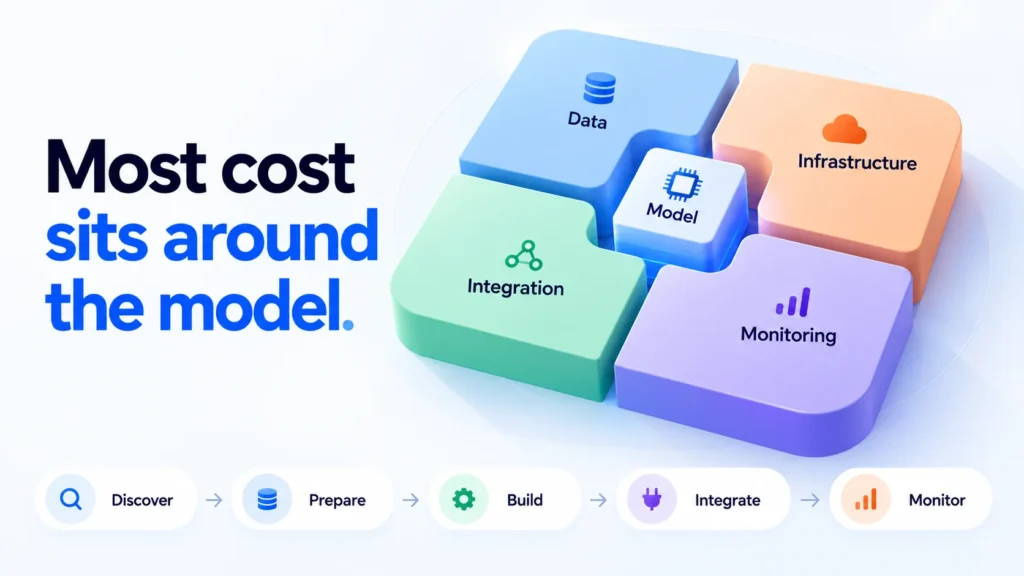
The model itself is a small part of the bill. Most of the cost sits in the data and in the parts around the model. Google researchers made the same point in a well-known paper, Hidden Technical Debt in Machine Learning Systems (opens in a new tab). Their picture shows the model code as a small box inside a much larger system.
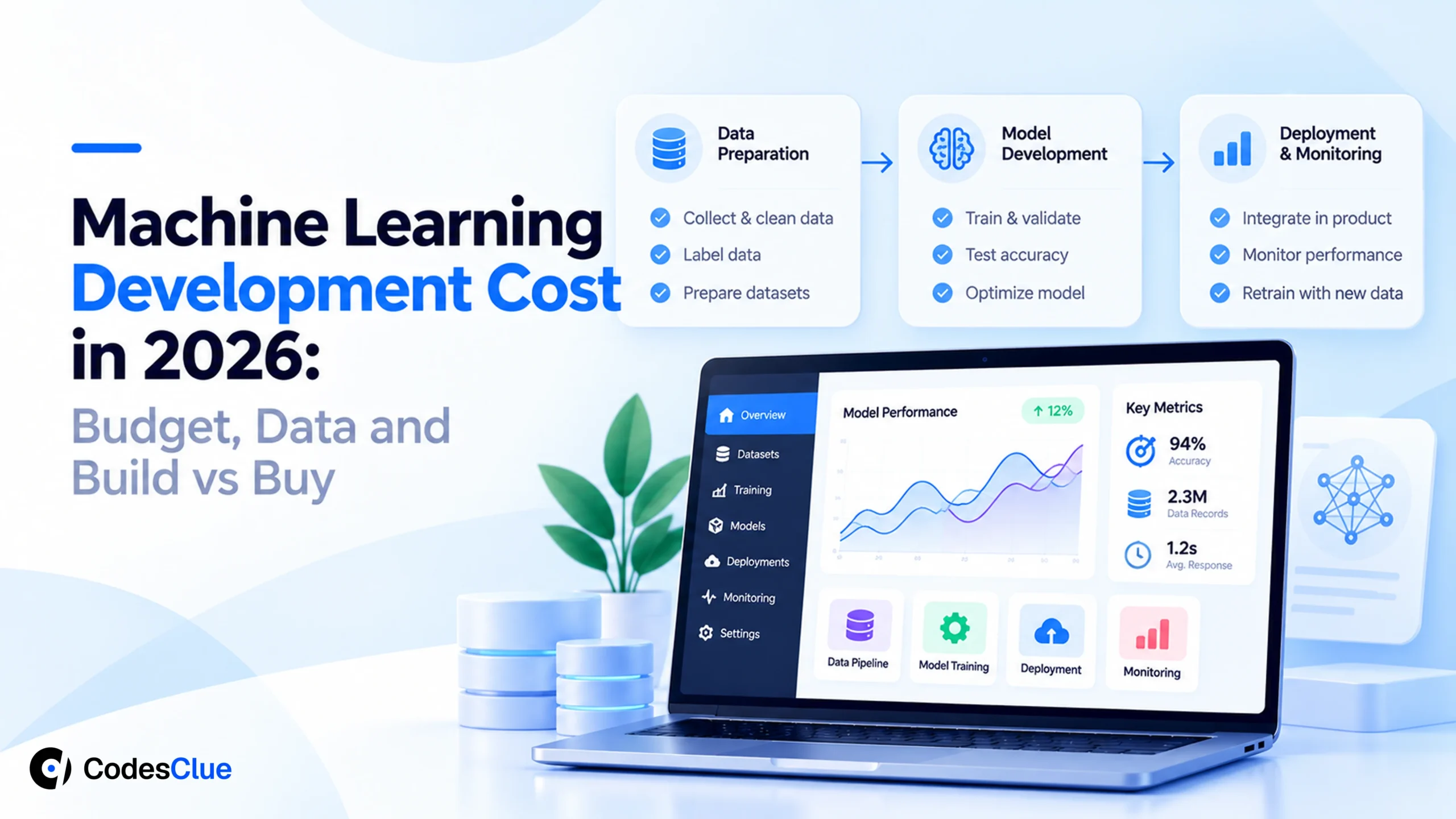
A typical project moves through five phases:
- Discovery and data audit. Agree on the question, check the data you have and decide what “good enough” accuracy means.
- Data preparation. Collect, clean, join and label the data the model will learn from.
- Model building. Start with a simple baseline, then test stronger models against it.
- Integration. Put predictions where people work: your app, CRM, dashboard or alerts.
- Monitoring and retraining. Watch accuracy after launch and refresh the model when the data changes.
Pro tip: Ask every vendor to split the quote by these five phases. A quote that is mostly “model development” with little for data or integration is usually missing work.
Labeling is the line people forget. If people need to tag 20,000 support tickets or photos by hand, that takes weeks and real money. ITRex and Debut Infotech both estimate $25,000 to $65,000 for a high-quality training dataset. Our data annotation services page explains how that work runs.
Running costs after launch
A model is not finished when it goes live. Customer habits shift, prices change and sensors age. Accuracy slowly drops unless someone watches it.
Budget for four things every year:
- Hosting and compute for the model and its data pipeline.
- Monitoring that alerts you when accuracy or input data drifts.
- Retraining on fresh data, then testing before the new model goes out.
- People time to review the cases the model gets wrong.
Cloud platforms charge for compute by the hour and by the request. Amazon SageMaker AI pricing (opens in a new tab) is a good example to check against your own volume.
Pro tip: Ask what one prediction costs to serve at your expected volume. A model that costs little to train can still cost a lot to run if it scores every page view.
Build, buy or use an API: which option fits you?
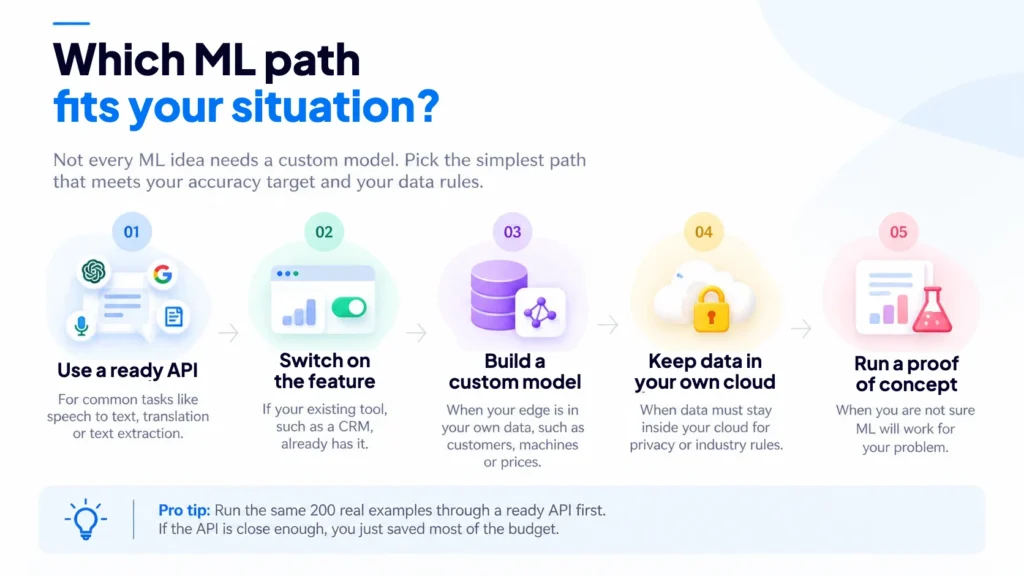
Not every ML idea needs a custom model. Pick the simplest path that meets your accuracy target and your data rules.
| Your situation | Best option | Why |
|---|---|---|
| A common task such as speech to text, translation or general text extraction | Use a ready API | Large providers already trained these models. You pay per use. |
| A tool you already pay for has the feature, such as CRM lead scoring | Switch on the feature | No build and no hosting to run. |
| Your edge is in your own data: your customers, your machines, your prices | Build a custom model | Ready models do not know your patterns. |
| Data must stay in your own cloud for privacy or industry rules | Build, or host an open model yourself | You control where the data lives. |
| You are not sure ML will work for your problem | Run a proof of concept first | At $8K to $25K it answers the question before a big spend. |
If a language model fits your task, our LLM integration cost guide compares the token bill with a custom build. For agents that act on your systems, see AI agent development cost. For chatbots, copilots and complete AI apps, see our AI app development cost guide.
Pro tip: Run the same 200 real examples through a ready API before you commission a custom model. If the API is close enough, you just saved most of the budget.
A real example: predictive maintenance in AirShield
AirShield is an air quality platform CodesClue built for hospitals and clinics. More than 50 connected IoT devices send sensor readings to a serverless AWS backend.
We added a machine learning layer that watches device performance trends and flags early signs of wear before a failure. Facility teams get the warning as a push notification, so they can act before readings cross critical levels.
The lesson for your budget: the model only helps because the rest is in place. The telemetry pipeline feeds it, and the apps put its warnings in front of people. Price all three, not just the model.
Judge any AI work by the result it brings. Therapix.AI, an AI clinical documentation platform we built, turns session inputs into structured SOAP notes. Its case study reports a 70% decrease in administrative workload for clinicians.
Not sure which tier your idea falls into? Send us a short brief and an engineer will tell you what data you need first.
Honest limits: when ML is not worth the cost
Sometimes the right answer is no model at all. We would not build one if:
- You have only a few hundred past examples of the outcome you want to predict.
- A clear rule already works, such as “flag every order over $5,000”. Write the rule instead.
- Nobody will act on the prediction. A score no one reads is worth nothing.
- A wrong answer is costly and you cannot add a human check.
Pro tip: Write down the decision the model will change and what one better decision is worth. If you cannot put a rough number on it, wait.
Checklist before you ask for a quote
Bring these answers to the first call and your estimate gets much tighter:
- The one question the model should answer.
- Where the data lives and who owns it.
- How many past examples you have with a known outcome.
- What accuracy is good enough, and what a wrong answer costs.
- Where the prediction should show up: app, CRM, report or alert.
- Privacy or industry rules that apply, such as GDPR or HIPAA.
- Who will check accuracy after launch.
Common mistakes to avoid
- Starting with the model, not the data. Messy data will undo even a strong algorithm.
- Budgeting only for the build. Monitoring and retraining are part of the cost of machine learning, every year.
- Skipping the baseline. Without a simple first model, you cannot tell whether the expensive one helps.
- Hiring the wrong skill first. If your data sits in many places, you may need data engineers before ML engineers.
- Judging on accuracy alone. Speed, cost per prediction and how easy the result is to explain matter too.
How to keep machine learning project cost under control
- Start with one question and a proof of concept.
- Use the data you already have before you buy or label more.
- Test a ready API or open model before you train from scratch.
- Agree on a go or no-go accuracy target before work starts.
- Build monitoring into the first release, not the second.
Our machine learning consulting team runs this kind of first step. For a look at forecasting in practice, read our guide to predictive analytics in manufacturing and retail.
Get a clear machine learning development cost for your project
Machine learning development cost comes down to three things: your data, where the model runs and who keeps it accurate. Send us your question and a sample of your data, and we will tell you which tier fits and what to fix first. Book a free scoping call with our ML team.
FAQs
How long does it take to build a machine learning model?
Time depends mostly on your data. Clean data in one place lets a proof of concept move fast. When data needs collecting or labeling, that work comes first and often takes longest. Integration and testing add time too. Ask for a milestone plan instead of one end date: data audit, first model, integration, then launch.
Does an API cost less than building a custom model?
For common tasks such as speech to text or translation, a ready API usually costs less to start. You pay per use and skip the build. A custom model wins when your edge sits in your own data. It also wins when high volumes make per-request fees add up. Test both on real examples first.
How much does it cost to maintain a machine learning model?
Plan for hosting, monitoring and retraining every year. Published guides vary a lot. ITRex puts yearly support and maintenance at $20,000 to $150,000. Keyhole Software estimates maintenance and retraining at 15% to 25% of the build cost each year. Your number depends on how often your data changes and how many predictions you serve.
What data do I need to start a machine learning project?
You need past examples of the thing you want to predict, with the outcome attached. For churn, that means customer records plus who actually left. More clean examples beat more messy columns. Unsure what you have? Start with a short data audit. It shows what is usable and what to collect first.
Can I hire machine learning engineers instead of outsourcing the whole project?
Yes. If you already have a product team and clear data, adding ML engineers to it can work well. You keep the roadmap and the code. With CodesClue, development starts within 48 hours after we discuss the requirements and you approve the engineer. If your data still needs work, add a data engineer to the team first.
Why do machine learning development quotes vary so much?
Vendors price different things. One quote may cover only model training on clean data. Another may include data collection, labeling, integration, monitoring and a year of retraining. Team location and seniority change the price too. Ask each vendor to split the quote by phase and list what they leave out. Then compare like with like.