

Data Governance Implementation: A 90-Day Plan for Growing Companies
Data governance implementation in 90 days for a 50 to 500 person company: who owns what, the first five rules, which tools fit, and mistakes to skip.
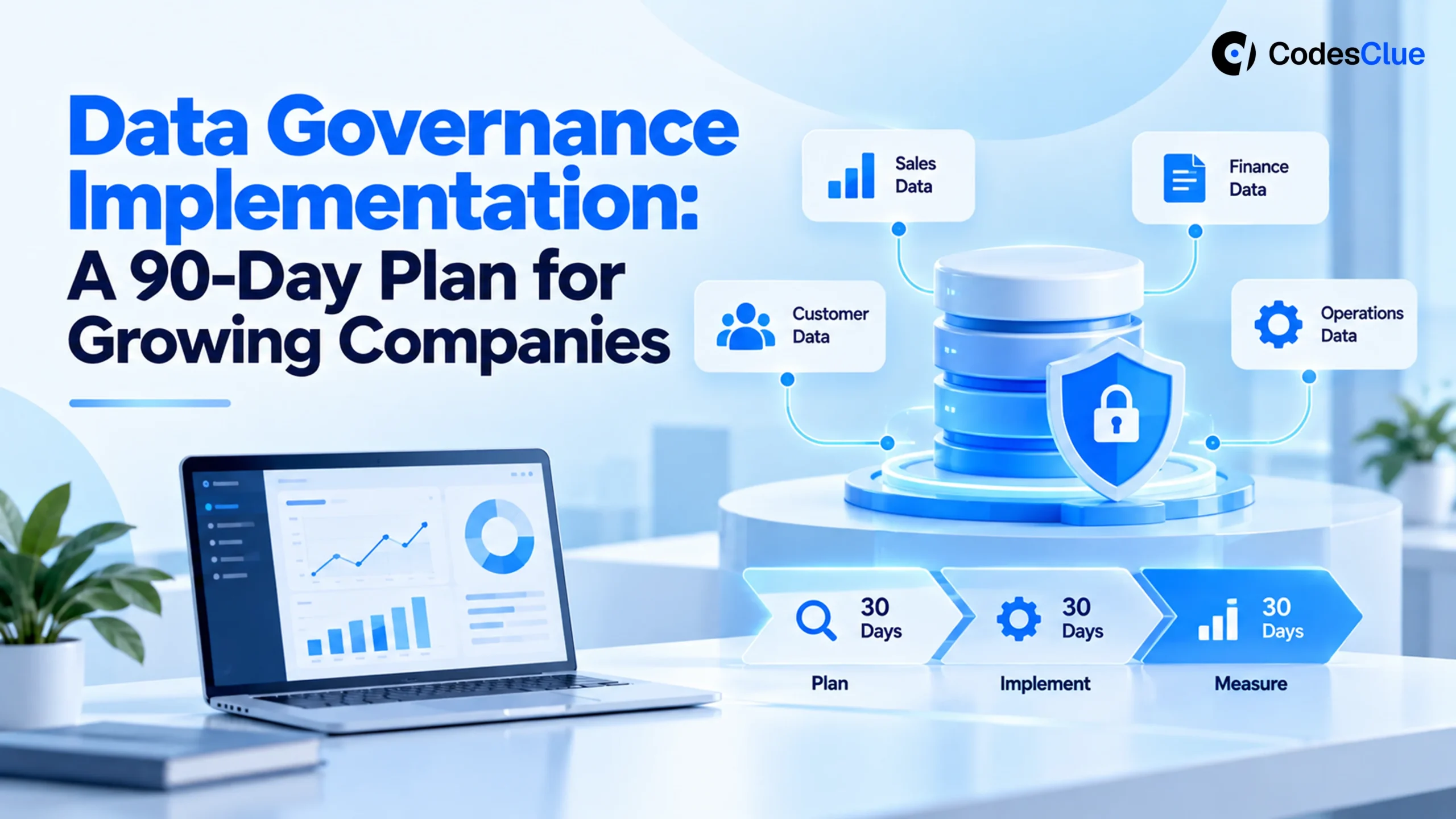
Your sales team and your finance team bring different revenue numbers to the same meeting. Nobody knows who can see the customer table. Now someone wants to plug that data into an AI assistant.
That is the moment most growing companies start looking at data governance implementation. This guide gives you a 90-day plan sized for a company of 50 to 500 people. You will see who should own what and which rules to write first. The guide also covers when a tool is worth paying for, and which mistakes sink most programs.
Key Takeaways
- A lean data governance implementation starts with one business problem and 10 to 20 critical data elements, not the whole company.
- In a mid-size company, one person often holds two or three roles. Write the names down anyway.
- Your first rules cover ownership, access, quality checks, retention and AI use.
- You can run the first 90 days on the tools you already have. Buy a data catalog when manual lists stop keeping up.
- Measure progress with a short scorecard: owners named, rules live, quality issues fixed and access reviews done.
What does data governance implementation mean for a growing company?
Data governance implementation means three things. You name owners for your key data. You write a few clear rules on how teams define, check, share and keep that data. Then you build those rules into the systems people already use. For a growing company, the payoff is numbers you trust and safe access in weeks, not a multi-year enterprise program.
Tool vendors write most of the guides you will find, and they write them for large enterprises. They assume a governance council, a full-time data office and an 18-month roadmap. A 200-person company has none of that. It has a few busy people and a real problem to fix.
So keep the goal narrow. Forget “governing all data”. Your job is to make a handful of numbers and tables trustworthy, and to control who can touch them.
Why most data governance programs stall
Gartner predicts that 80% of data and analytics governance initiatives will fail by 2027. The reason: no real or manufactured crisis behind them (Gartner, February 2024 (opens in a new tab)). In plain words: programs without a clear business reason fade out.
The cost of skipping it keeps rising. IBM’s 2025 Cost of a Data Breach report puts the global average breach at $4.44 million. It also found that 63% of breached organizations had no AI governance policy or were still writing one (IBM, July 2025 (opens in a new tab)).
Pro tip: Tie your program to one pain your leadership already feels. “Board reports disagree” or “We failed a customer security review” will keep the work funded. “Better data culture” will not.
Who owns what: roles in a 100-person company
Enterprise frameworks list a council, a chief data officer, owners, stewards and custodians. You need the same jobs done, just by fewer people. Here is how they usually map in a company of around 100 people.
| Role | What they decide or do | Who it usually is | Time needed |
|---|---|---|---|
| Sponsor | Picks the business problem, settles disputes, signs off rules | CEO, COO or CFO | 1 hour every 2 weeks |
| Data owner | Accountable for one data domain, such as customers or revenue | Head of sales, finance or operations | 1 to 2 hours a week |
| Data steward | Keeps definitions, fixes quality issues, answers questions | An analyst or ops lead close to the data | 3 to 5 hours a week |
| Data custodian | Runs storage, access and backups | Your engineer, DevOps lead or IT partner | 2 to 4 hours a week |
| Program lead | Runs the plan, tracks the scorecard | Often the steward or a data lead | Part of their week |
One person can be both owner and steward for a small domain. That is fine. What fails is a role with no name next to it.
Pro tip: Put the owner names in the same place people look up the data, such as the dashboard footer or the shared drive folder. A role nobody can find does not exist.
Your 90-day data governance implementation plan
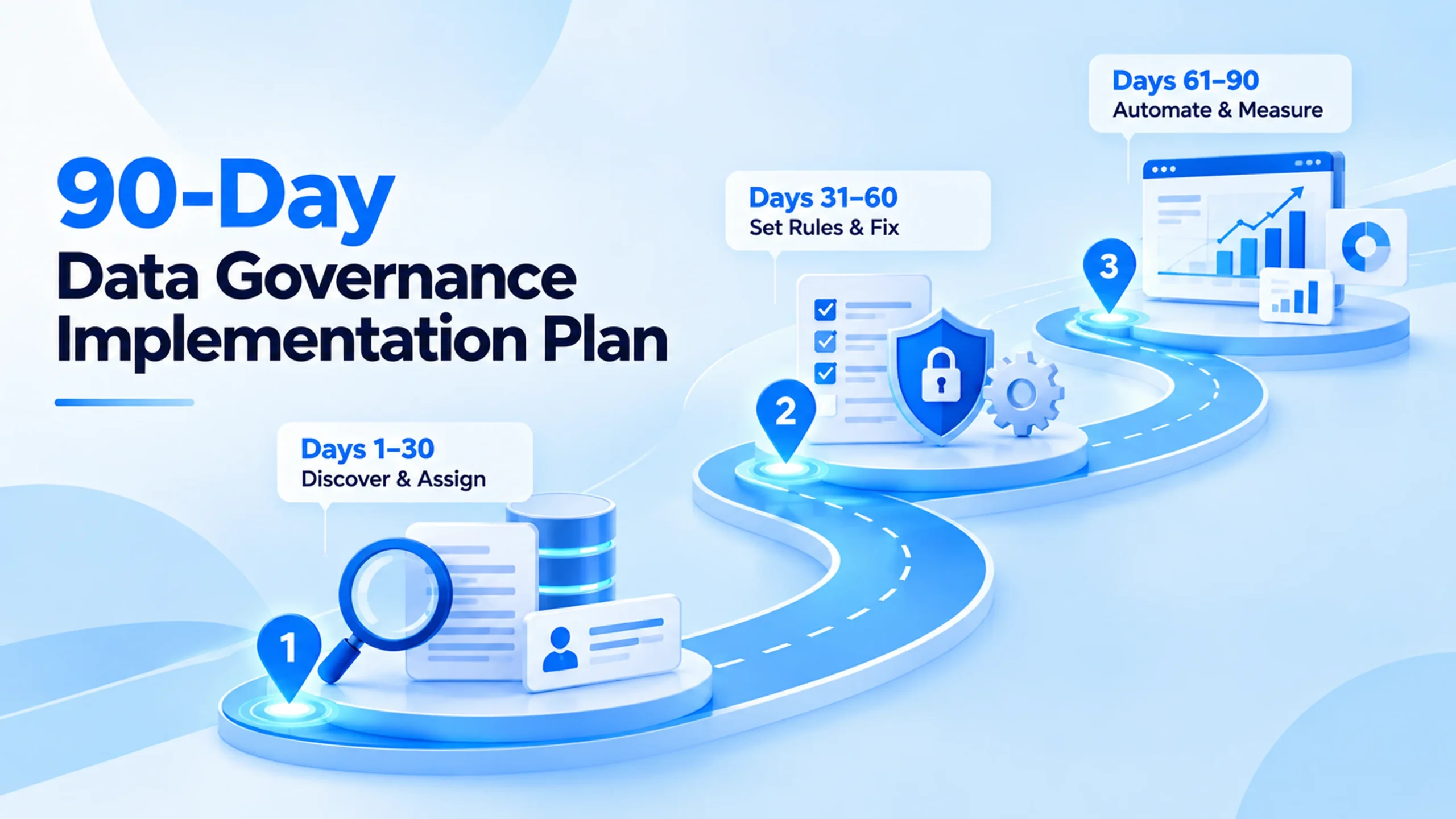
This plan runs in three 30-day phases. Each phase ends with something people can see and use.
Days 1 to 30: pick the problem and the data
- Write the business problem in one sentence, for example “Monthly revenue differs between the CRM and the finance system.”
- List the 10 to 20 critical data elements behind it: customer ID, contract value, invoice date, and so on.
- Map where each element lives and which systems copy it.
- Name an owner and a steward for each domain, and get the sponsor to confirm them.
- Agree one definition for each element and write it in a shared glossary.
Days 31 to 60: write the first rules and fix the worst issues
- Set quality rules for each critical element: required, unique, valid format, matches the source system.
- Run those checks on today’s data and count the failures. That count is your baseline.
- Review who can read and edit each sensitive table. Remove access nobody needs.
- Write retention rules: how long you keep each type of data and who deletes it.
- Fix the top issues at the source system, not in the report.
Days 61 to 90: automate, measure and extend
- Move the quality checks into your data pipeline so they run on every load.
- Send failed checks to the steward automatically, with the record and the rule it broke.
- Start a monthly access review for sensitive data.
- Publish a one-page scorecard to the sponsor.
- Choose the next domain, and reuse the same steps.
Want a second pair of eyes on your first 30 days? Tell us what you are working with and we will reply within one business day.
The first five rules every data governance plan needs
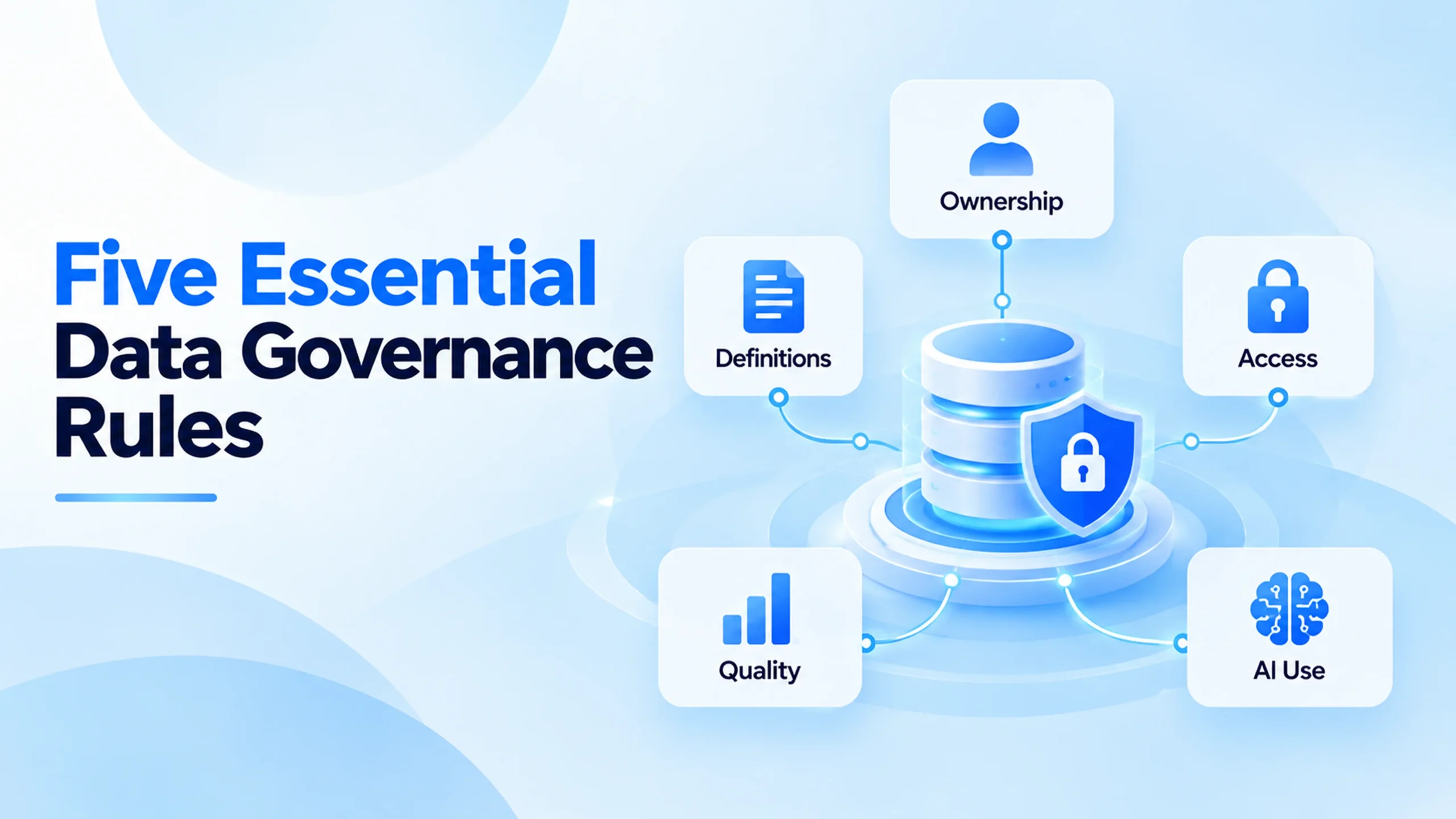
Your first data governance plan should fit on two pages. These five rules cover most of the risk in a growing company.
- Ownership: every critical table and report names its owner and steward.
- Definitions: each key metric has one written definition, and reports use it.
- Access: people get the least access their job needs, and the owner reviews sensitive data access every month.
- Quality: critical fields have automatic checks, and failures go to a named person.
- AI use: staff know which data may go into AI tools, and which tools the company has approved.
The AI rule matters more each month. IBM found that organizations with high levels of shadow AI, meaning tools staff use without approval, saw breach costs about $670,000 higher on average. If you plan to build AI features on your own data, your AI is only as trustworthy as the tables it reads.
Pro tip: Write the AI rule as a short list of “yes” and “no” examples. “Yes: product descriptions. No: customer contracts or patient notes.” People follow examples faster than policy language.
Which option fits you: tools for implementing data governance
You do not need to buy a platform to implement data governance. The right setup depends on how many data sources you have and how many people use the data.
| Your situation | Best fit | Why |
|---|---|---|
| Under 10 sources, one data team, one cloud | Shared glossary, the access controls already in your cloud and warehouse, quality checks in your pipelines | Little to buy, and the rules live where the data moves |
| 10 to 50 sources, several teams asking “where is this from?” | Add a data catalog with lineage | Manual lists stop keeping up; people need to search and trace data |
| Regulated data (health, payments, finance) in custom apps | Build controls into the apps: role-based access, audit logs, retention jobs | Auditors check the system that holds the data, not the policy document |
| Planning AI features on company data | Clean, owned source tables plus approved AI tools and logged access | Models repeat whatever errors and leaks the data has |
Many companies need a mix: a light glossary today, a catalog next year, and governance built into their own software from the start. If your sources do not talk to each other yet, data integration services come first. If the records themselves are messy, start with data cleaning.
What we see in real projects
The rules that last are the ones built into the software, not stored in a document. Two CodesClue projects show what that looks like.
For AirShield, a healthcare air-quality platform, we built versioned database schemas, so the team can add new sensor types without breaking existing data. The platform keeps a full audit trail and exports reports in a format ready for regulatory audits. Governance there is a feature of the product.
For Therapix AI, a clinical documentation platform, we designed data handling, storage and access controls around healthcare compliance from the first sprint. Clinicians review and edit every AI-generated note before the system saves it.
The honest limit: governance work cannot fix a process nobody follows. If teams keep their own spreadsheets, start by agreeing on one source of truth before writing quality rules.
Pro tip: When you build or rebuild an internal system, add an owner field, an audit log and retention settings in the first version. Adding them later costs far more.
Common mistakes to avoid
- Starting with a tool. A catalog with no owners and no rules becomes an expensive list.
- Governing everything at once. Pick one domain and 10 to 20 elements. Expand after it works.
- Policies nobody reads. Keep rules short, and put checks into pipelines and apps.
- Fixing data in reports. Correct the source system, or the error returns next month.
- No sponsor. Without a leader who settles disputes, definitions never get agreed.
- Ignoring AI tools. Staff already paste data into chat assistants. Write the rule now.
How to measure your data governance program
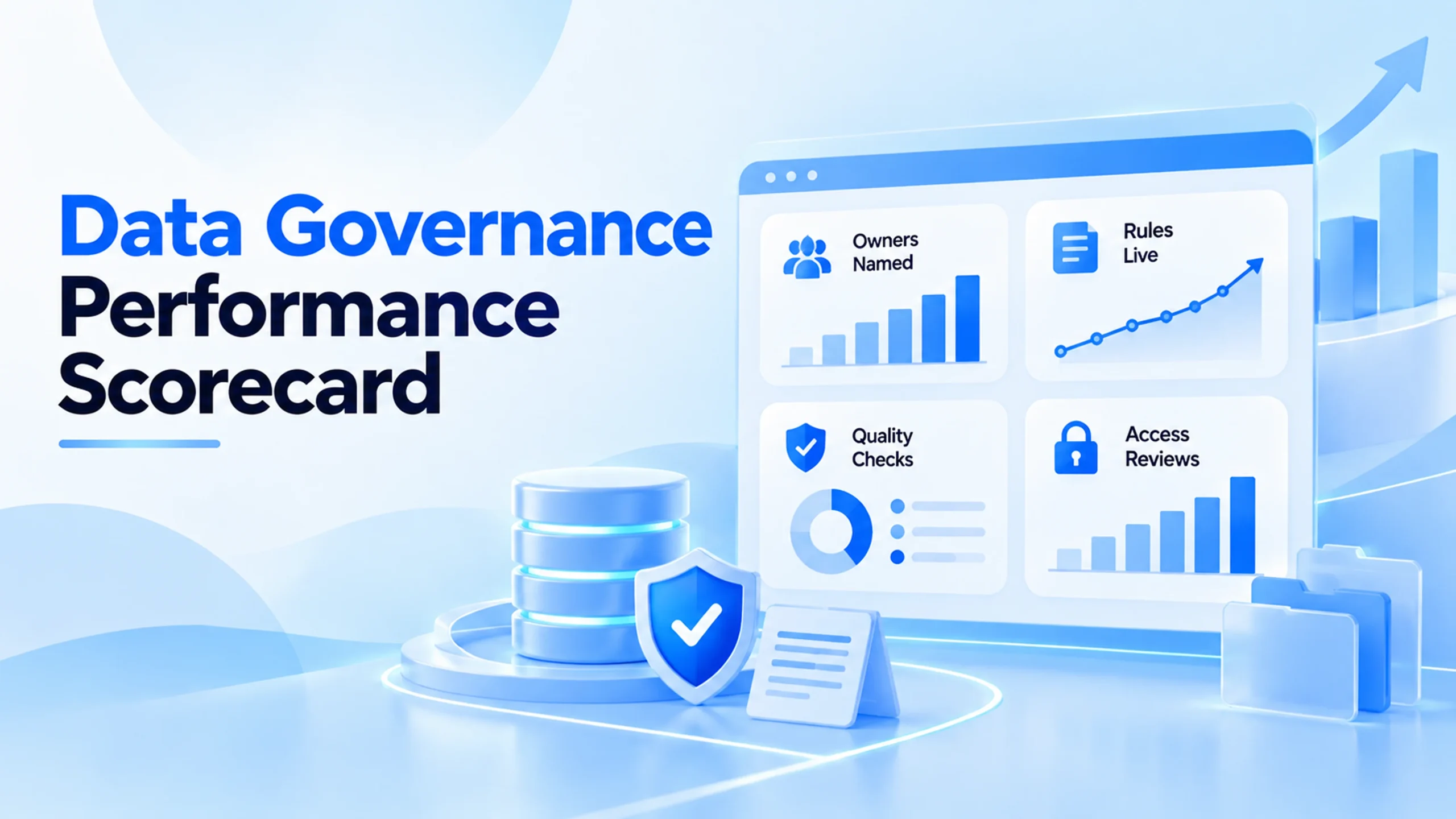
Keep the scorecard short so the sponsor reads it. Track these numbers each month:
- Critical data elements with a named owner and a written definition
- Quality checks running automatically, and how many failed this month
- Days to fix a reported data issue
- Access reviews completed on schedule
- Reports that use the agreed definitions
Use this checklist at the end of day 90:
- Business problem written and agreed
- Owners and stewards named for the first domain
- Glossary live with every critical element defined
- Quality checks running in the pipeline
- Access review done and unneeded access removed
- AI use rule shared with all staff
- Next domain chosen
Getting started with data governance implementation
A good data governance implementation is small, owned and built into your systems. Pick one problem, name the people, write five rules and automate the checks. In 90 days you can have numbers your leadership trusts and access you can explain to an auditor.
CodesClue is an AI-first software company with engineering in Ahmedabad and offices in India, the USA and Germany. We work in short Agile sprints, from a proof of concept to production. Our data governance services cover the plan, the pipeline checks and the access controls, and our data engineering services fix the data at the source. Short on hands? You can hire data engineers, and development starts within 48 hours. Our data security services cover access and audit controls. Regulated data? See our guide to HIPAA and PCI DSS compliance.
Tell us which numbers your teams argue about, and we will suggest a first 30-day scope. Talk to our data team.
FAQs
How long does data governance implementation take for a mid-size company?
A first working version takes about 90 days for one data domain: 30 days to pick the problem and name owners, 30 days to write rules and fix the worst issues, and 30 days to automate checks. Each further domain usually goes faster, because the glossary, checks and roles are already in place. Company-wide coverage often takes a year or more.
Do we need a data governance tool or data catalog to start?
No. Most companies with fewer than 10 data sources can start with a shared glossary, the access controls in their cloud and warehouse, and quality checks inside their data pipelines. A catalog becomes worth paying for when several teams keep asking where data comes from and manual lists stop keeping up.
What is the difference between a data owner and a data steward?
The data owner is accountable for a data domain and makes the decisions: who gets access, which definition wins, what quality level is acceptable. The data steward does the daily work: keeping definitions current, watching quality checks and fixing issues. In a small company one person can hold both roles for one domain.
How does data governance help with AI projects?
AI tools repeat whatever errors and gaps your data has, and they can expose data people should not see. Governance gives AI projects owned, checked source tables, clear rules on which data may be used, approved tools and logged access. That makes AI answers easier to trust and easier to explain to customers and auditors.