

React Native works well with backend technologies such as Node.js, Firebase, MongoDB, PostgreSQL, GraphQL, AWS, and Supabase, depending on application scalability and real-time requirements.
Complete Guide to React Native App Development Services
Learn everything about React Native app development services process, cost, benefits, and how to hire the right team.
Ketan PatelCodesClue
Updated
11 min read

Today, businesses increasingly desire faster, scalable, and cost-effective ways to launch different applications across multiple platforms. Companies are prioritizing frameworks that help them with rapid deployment without compromising performance and user experience. Among the available technologies, React Native App Development Services continue to dominate the cross-platform mobile app market.
Introduced and maintained by Meta, React Native allows developers to develop cross-platform mobile applications for both iOS and Android using a single JavaScript codebase. It is the 2nd most recommended cross-platform mobile app development framework with over 13% market share.
AppBrain’s statistics report that React Native is integrated into more than 20,000 Android applications with over 60 billion cumulative downloads. Even the Statista reveals that React Native remains one of the most widely used cross-platform frameworks globally because of its flexibility, developer ecosystem, and near-native performance.
This complete guide to React Native App Development explores everything businesses need to know in 2026 including the React Native framework for mobile apps, benefits, development process, technology stack, app development cost, security standards, and how to hire React Native developers for your next project.
What Is React Native and Why Does It Matter for Mobile Apps?
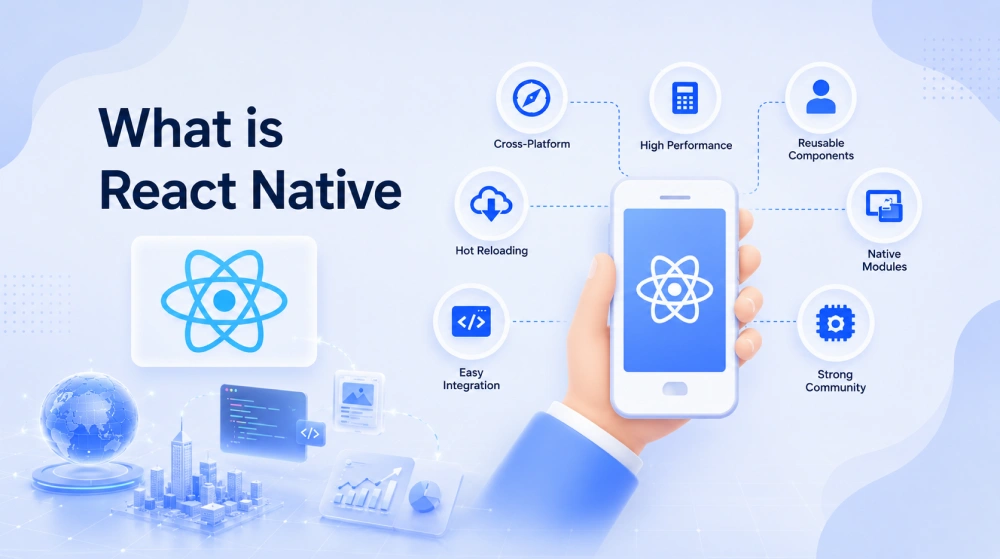
The need for cross-platform mobile applications has changed the way businesses develop software products. Companies now wish to proceed with a common development cycle for Android and iOS applications to save cost, time, and operational complexity. This is where the React Native framework for mobile apps has become a strategic technology choice.
React Native framework enables the developers to create mobile applications using JavaScript and React while delivering a native-like experience across platforms. Businesses choose this platform as it perfectly balances performance, scalability, development speed, and cost efficiency.
React Native Framework for Mobile Apps: A Quick Overview
As an open-source framework, React Native allows developers to build mobile applications using JavaScript and reusable UI components. It is different from the hybrid frameworks that rely heavily on web views. Instead, React Native communicates with native APIs directly, which improves responsiveness and overall performance.
The framework supports reusable components, third-party plugins, and native module integration, making it ideal for businesses building scalable mobile applications. Companies like Facebook, Instagram, Shopify, Discord, and Walmart have used React Native in production environments.
The growing popularity of React Native app development solutions is largely driven by its ability to reduce development effort while maintaining consistent UI and functionality across platforms.
How React Native Cross-Platform Performance Works?
The average smartphone has over 80 apps installed. Most of them are based on React Native due to their cross-functionality feature. Businesses investing in React Native fully trust the framework’s ability to deliver near-native performance on both iOS and Android.
React Native utilizes JavaScript as a bridge to communicate with native components, enabling apps to render native UI elements instead of web-based interfaces. This architecture improves performance while maintaining development flexibility.
Modern improvements in React Native architecture, including the Fabric renderer and Turbo Modules, have significantly enhanced app responsiveness and reduced rendering bottlenecks.
This makes React Native highly suitable for applications requiring:
- Real-time communication
- Push notifications
- Interactive dashboards
- Ecommerce experiences
- GPS and tracking systems
- Media streaming
Businesses looking for React Native near-native performance iOS Android capabilities often choose React Native because it provides a balance between development efficiency and application responsiveness.
React Native’s Benefits of Code Reusability
Code reusability of React Native is its one of the most valuable advantages. Businesses can reuse up to 90% of their code across Android and iOS applications based on the complexity of the project. Teams can launch products faster while keeping engineering budgets under control.
The React Native 90% code reuse cross-platform capability allows organizations to:
- Reduce engineering costs
- Accelerate deployment cycles
- Maintain consistent user experiences
- Simplify updates and bug fixes
- Improve scalability
Core Benefits of React Native Development
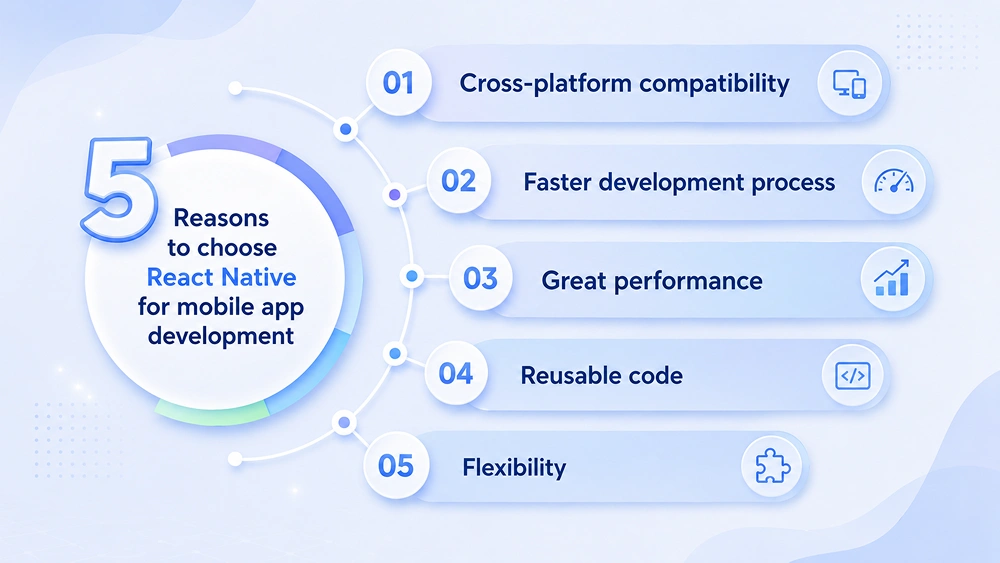
An average person uses 9 mobile apps. This percentage is growing with the initiation of the cross-functionality of the applications. The growing adoption of React Native Mobile App Development Services is driven by several strategic advantages that directly impact business growth, operational efficiency, and customer experience.
1. Cost Efficiency: Single Codebase for iOS and Android
Traditional native development requires separate Android and iOS development teams, which significantly increases development cost and maintenance overhead.
With Custom React Native App Development Services, businesses can build applications using a shared codebase, reducing development costs by up to 40% in many cases.
This cost efficiency is especially beneficial for:
- Startups launching MVPs
- Enterprises modernizing legacy apps
- Ecommerce businesses
- SaaS companies
- Service marketplaces
The shared architecture also simplifies maintenance and reduces long-term operational expenses.
2. Faster Time-to-Market with React Native
In competitive industries, launching products quickly can determine market success. React Native accelerates development through reusable components, extensive libraries, and faster iteration cycles.
Features like Hot Reloading allow developers to instantly preview code changes without rebuilding the application, improving development speed and collaboration.
Faster delivery timelines help businesses:
- Launch MVPs rapidly
- Validate business ideas quickly
- Respond to market changes
- Improve customer acquisition
- Reduce development bottlenecks
3. React Native for Startups and Enterprises
React Native app development for startups has become increasingly common because startups need scalable and budget-friendly technology stacks.
Startups benefit from:
- Lower development costs
- Faster MVP delivery
- Easier product iterations
- Simplified maintenance
- Faster scaling opportunities
At the same time, enterprise React Native mobile app development is also growing because large organizations require scalable applications capable of supporting millions of users.
Enterprises use React Native for:
- Customer-facing mobile apps
- Internal workflow systems
- Employee productivity apps
- Ecommerce platforms
- Fintech applications
4. React Native vs Flutter: Which Should You Choose?
The React Native vs Flutter comparison 2026 remains one of the most discussed topics in cross-platform development.
React Native is often preferred for:
- Large JavaScript ecosystems
- Faster hiring availability
- Easier web integration
- Strong community support
- Enterprise scalability
Flutter offers strong UI customization and rendering capabilities utilizing the Dart programming language. However, React Native remains more widely adopted among businesses due to its mature ecosystem and broader developer community.
For businesses already using React or JavaScript-based technologies, React Native generally provides faster adoption and smoother integration.
React Native App Development Solutions We Offer at CodesClue
Modern businesses require scalable and customized mobile applications that align with specific operational goals. A professional React Native Development Company typically offers a broad range of services designed to support startups, SMEs, and enterprises.
1. Custom React Native Application Development
Our Custom React Native App Development Services focus on building tailored mobile applications designed around unique business requirements.
Our custom cross-platform app development services include:
- Business applications
- Customer engagement apps
- Marketplace platforms
- SaaS mobile apps
- Enterprise mobility solutions
Custom development ensures scalability, flexibility, and future-ready architecture.
2. React Native UI/UX development
User experience plays a major role in mobile application success. React Native mobile UI design services focus on creating responsive, intuitive, and engaging interfaces that improve user retention and conversion rates.
Key UI/UX services include:
- Wireframing
- Mobile prototyping
- Responsive interface design
- Accessibility optimization
- Interactive user flows
3. React Native API & Backend Integration
Most modern applications require integration with APIs, databases, and third-party services.
React Native REST API integration services support:
- Payment gateway integration
- CRM and ERP connectivity
- Social media authentication
- Cloud infrastructure integration
- Real-time synchronization
- Analytics platforms
Backend integration ensures scalable and connected mobile ecosystems.
4. React Native App Migration Services
Businesses looking to modernize outdated applications often migrate apps to React Native from native architectures.
Migration services help organizations to:
- Reduce maintenance costs
- Improve scalability
- Simplify updates
- Enhance UI consistency
- Accelerate feature delivery
Migration projects typically involve code refactoring, UI redesign, testing, and performance optimization.
5. React Native Maintenance and Support
Post-launch support is critical for maintaining app stability and security.
React Native app maintenance and support services include:
- Performance optimization
- Security updates
- OS compatibility testing
- Bug fixes
- Feature enhancements
- Monitoring and analytics
Continuous maintenance ensures long-term app reliability.
6. Enterprise React Native solutions
Enterprise React Native mobile app development focuses on building secure, scalable, and high-performance applications for large organizations.
Enterprise solutions typically include:
- Multi-user architecture
- Advanced security layers
- Cloud integration
- Workflow automation
- Role-based access control
- Real-time reporting dashboards
These applications are designed to support operational efficiency and enterprise scalability.
React Native Technology Stack
Selecting the right React Native technology stack is essential for building scalable, secure, and high-performing applications.
1. Core Libraries and Tools (Redux, React Navigation, Expo)
The React Native ecosystem includes several widely adopted libraries and frameworks that simplify mobile app development. These tools improve development efficiency and scalability.
Common technologies include:
- Redux for state management
- React Navigation for routing
- Expo for rapid app development
- TypeScript for scalable code structure
- Axios for API requests
- Firebase integration tools
2. Backend Technologies That Work Best with React Native
Several backend technologies integrate effectively with React Native app development solutions. The choice of backend depends on scalability, real-time requirements, and business complexity.
Popular backend technologies include:
- Node.js
- Express.js
- Firebase
- MongoDB
- PostgreSQL
- GraphQL
- AWS
- Supabase
3. Real-time Features: Chat, Push Notifications, and Live Tracking
Modern mobile applications increasingly rely on real-time features. These capabilities make React Native ideal for ecommerce, fintech, logistics, healthcare, and social applications.
React Native supports:
- In-app chat systems
- Push notifications
- Live location tracking
- Video calling
- Real-time analytics
- Event streaming
Our React Native App Development Process
An efficient React Native app development process ensures smooth execution, faster delivery, and scalable outcomes.
1. Discovery and Requirement Gathering
A detailed discovery phase helps define project scope and reduce development risks. The process begins with understanding:
- Business objectives
- Target audience
- Technical requirements
- Competitor analysis
- Feature prioritization
2. UI/UX Prototyping for Mobile Apps
Before development begins, UI/UX teams create wireframes and interactive prototypes. Prototyping accelerates collaboration between stakeholders and development teams. This stage helps businesses:
- Validate user journeys
- Improve usability
- Reduce revisions
- Align design expectations
3. Agile React Native Development Sprints
Agile methodologies allow developers to build applications incrementally. This iterative approach improves flexibility and transparency. Development is typically divided into sprint cycles involving:
- Feature implementation
- Code reviews
- QA testing
- Client feedback
- Performance optimization
4. App testing and quality assurance
Testing is essential for delivering stable applications. Comprehensive QA ensures application reliability across devices and operating systems. QA teams conduct:
- Functional testing
- UI testing
- Device compatibility testing
- Security testing
- Performance testing
- Regression testing
5. Deployment and post-launch support
Once testing is complete, applications are deployed to app stores. Continuous support ensures long-term scalability. Post-launch services include:
- Monitoring
- Analytics tracking
- Bug fixing
- Feature upgrades
- Performance optimization
How Different Industries Use React Native Applications?
React Native apps for industries continue to expand because businesses across sectors require scalable mobile solutions.
1. React Native App Development for Healthcare
Healthcare organizations use React Native for:
- Telemedicine applications
- Patient portals
- Appointment booking systems
- Health monitoring apps
- Electronic health record access
Security and compliance remain critical in healthcare applications.
2. React Native for Ecommerce Platforms
Ecommerce businesses use React Native to create:
- Shopping applications
- Mobile marketplaces
- Loyalty programs
- Personalized shopping experiences
- Real-time inventory systems
Cross-platform development helps ecommerce brands maintain consistent user experiences.
3. React Native for Fintech Applications
Fintech companies use React Native to develop:
- Digital wallets
- Investment platforms
- Banking applications
- Payment systems
- Financial dashboards
React Native supports secure authentication and real-time transaction processing.
4. React Native for On-Demand Apps
On-demand businesses rely heavily on real-time mobile experiences.
Examples include:
- Food delivery apps
- Ride-sharing applications
- Service marketplaces
- Booking platforms
React Native’s real-time capabilities support operational efficiency.
5. React Native for Logistics and Tracking
Logistics companies use React Native for:
- Fleet tracking
- Delivery management
- Route optimization
- Warehouse management
- Driver applications
Live tracking and push notifications improve operational visibility.
Secure React Native App Development
Security remains one of the most important aspects of modern mobile application development.
Secure React Native app development involves implementing strong security practices throughout the application lifecycle.
1. Data Security and Encryption in React Native
Data encryption protects sensitive user information from unauthorized access. Organizations handling sensitive data must prioritize secure architecture. Security measures include:
- End-to-end encryption
- Secure storage APIs
- SSL/TLS communication
- Encrypted databases
- API protection layers
2. Authentication and authorization best practices
Authentication systems help protect applications from unauthorized access. Secure authentication improves user trust and regulatory compliance. Common practices include:
- Multi-factor authentication
- OAuth implementation
- JWT token security
- Biometric authentication
- Role-based permissions
3. HIPAA, GDPR, and PCI Compliance in React Native Apps
Businesses operating in regulated industries must comply with global standards. Compliance-focused architecture reduces legal and operational risks. React Native applications can support:
- HIPAA compliance for healthcare
- GDPR compliance for user privacy
- PCI DSS standards for payment systems
React Native App Development Cost
One of the most common questions businesses ask is related to React Native app development cost.
The cost of development depends on multiple technical and operational factors.
Key Factors Affecting React Native App Cost
Several factors influence development cost, including:
- App complexity
- Feature requirements
- UI/UX design scope
- Third-party integrations
- Backend infrastructure
- Security requirements
- Real-time functionality
- Development team location
Simple applications may cost significantly less than enterprise-scale platforms with advanced integrations.
Cost Comparison: React Native vs Native vs Flutter
React Native often offers lower development costs compared to fully native app development because of shared code architecture.
Typical observations include:
- React Native reduces duplicate development effort
- Flutter provides strong UI rendering but smaller talent pools
- Native development offers maximum platform optimization but higher costs
Businesses balancing scalability and cost efficiency often choose React Native.
Typical React Native App Development Timeline
Project timelines vary depending on app complexity. Agile methodologies help reduce delays and improve project visibility. Average timelines include:
- MVP applications: 2–4 months
- Mid-scale applications: 4–7 months
- Enterprise applications: 8–12+ months
Hire React Native Developers
Choosing the right development team is critical for project success.
Businesses looking to hire React Native developers should evaluate technical expertise, communication processes, scalability, and industry experience.
1. Hire Dedicated React Native Developers
Dedicated developers provide focused expertise for long-term projects. Dedicated teams are ideal for startups and growing businesses. Benefits include:
- Faster communication
- Better project ownership
- Scalable resource allocation
- Improved collaboration
2. Hire a Remote React Native Team
Remote development teams provide access to global talent while reducing infrastructure costs. Businesses often hire remote teams for:
- Cost optimization
- Faster scaling
- Specialized expertise
- Flexible engagement models
3. React Native Developer Engagement Models
Common engagement models include:
- Dedicated team model
- Fixed-price model
- Hourly development model
- Staff augmentation
The right model depends on project scope and business goals.
4. What to Look for When Hiring a React Native Developer?
Experienced developers help reduce technical risks and improve project quality. Businesses should evaluate:
- React Native portfolio
- API integration expertise
- UI/UX capabilities
- Security implementation experience
- Agile development process
- Communication transparency
Conclusion
React Native continues to be one of the most powerful frameworks for cross-platform mobile development in 2026. Its ability to combine cost efficiency, near-native performance, rapid development, and scalability makes it an ideal choice for startups, enterprises, and growing digital businesses.
From custom cross-platform app development services to enterprise React Native mobile app development, businesses increasingly rely on React Native to build scalable and future-ready mobile experiences.
Whether you are planning an MVP, modernizing an existing application, or launching a large-scale enterprise platform, partnering with an experienced React Native Development Company can help accelerate your mobile transformation journey.
React Native Development FAQs
What is React Native app development?
React Native app development involves building cross-platform mobile applications for Android and iOS using a single JavaScript codebase. It helps businesses reduce development time, lower costs, and deliver near-native user experiences across multiple devices.
How much does it cost to build a React Native app?
The cost of React Native app development depends on factors such as app complexity, UI/UX requirements, integrations, and feature scope. MVP applications generally cost less, while enterprise-grade solutions with advanced functionality require larger investments.
How long does it take to develop a React Native app?
A basic React Native MVP can take around 2–4 months, while mid-scale and enterprise applications may require 6–12 months depending on features, integrations, testing, and deployment requirements.
Is React Native good for startups and enterprises?
Yes. React Native is widely used by startups for faster MVP launches and by enterprises for scalable mobile solutions. Its shared codebase, scalability, and cost efficiency make it suitable for businesses of all sizes.
What is the difference between React Native and Flutter?
React Native uses JavaScript and native UI components, while Flutter uses Dart and a custom rendering engine. React Native is often preferred for its larger ecosystem, easier hiring availability, and strong community support.
Do React Native apps perform like native apps?
Modern React Native architecture delivers near-native performance for most business applications. With proper optimization, React Native apps can efficiently support real-time features, animations, and scalable user experiences.
What industries commonly use React Native applications?
Industries such as healthcare, ecommerce, fintech, logistics, education, travel, SaaS, and on-demand services widely use React Native for scalable and cost-effective mobile app development.