
How to Build a Multi-Tenant SaaS Architecture: The Complete Guide
A step-by-step guide to designing scalable, secure multi-tenant SaaS architecture from data isolation to deployment strategy."
The Problem: Single-Tenant Scaling Is Expensive and Brittle
Imagine onboarding one hundred enterprise customers, each requiring their own server, their own database, their own deployment pipeline, and their own monitoring stack.
Infrastructure bills balloon with every new signup. Engineering teams spend weeks deploying updates across hundreds of isolated environments. A bug fix that should take an afternoon turns into a coordinated rollout across dozens of separate codebases.
This is the reality of scaling a single-tenant SaaS application, and it breaks most teams before they reach serious growth.
The Solution: Multi-Tenant Architecture
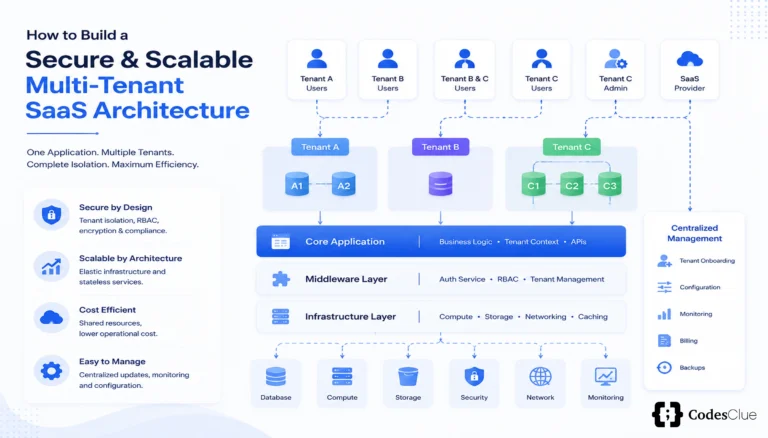
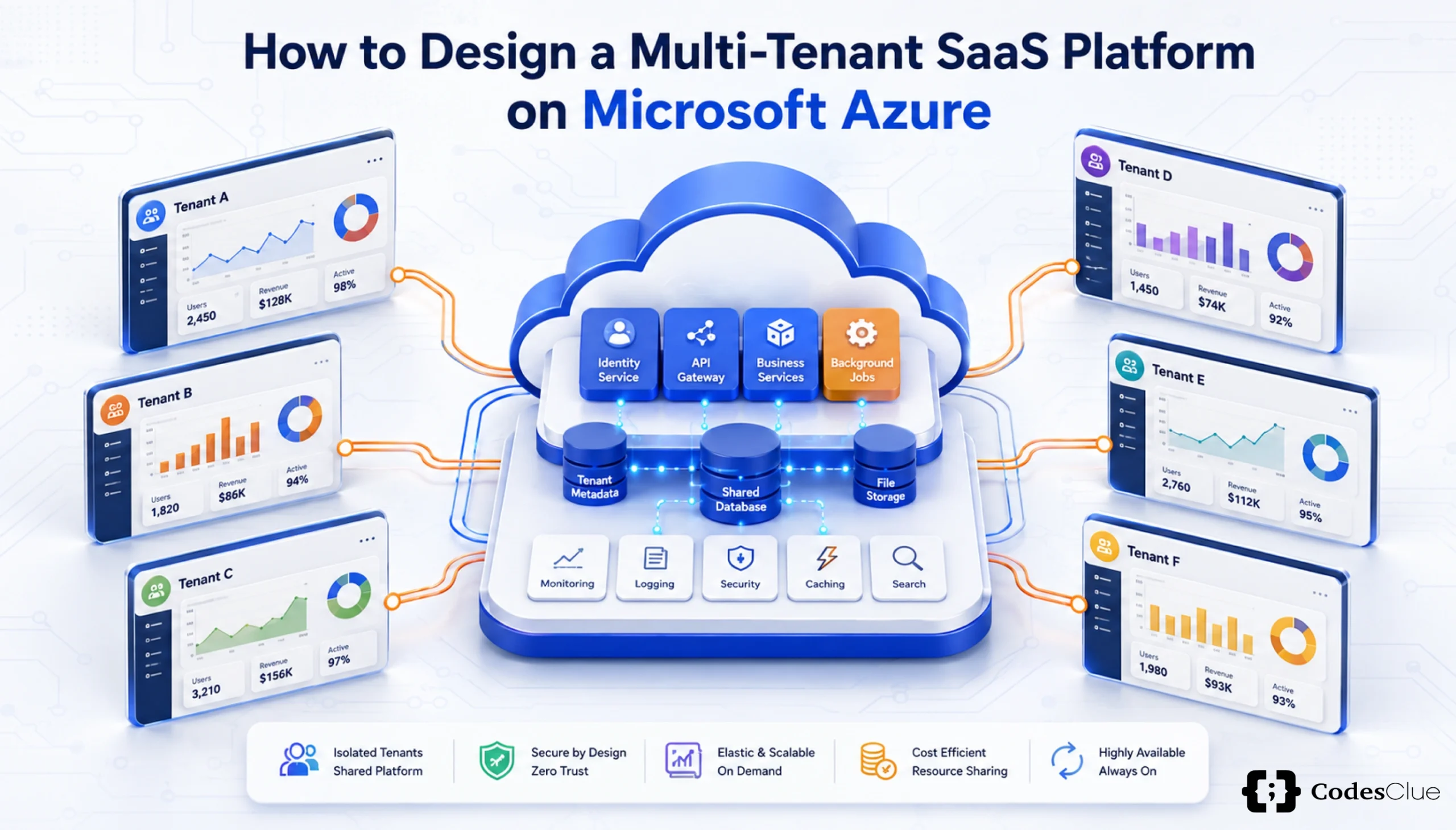
Multi-tenant SaaS architecture solves this by letting all customers share one efficient, centrally managed platform. A single codebase. One deployment. One infrastructure layer. One schema migration that updates every customer simultaneously.
According to Brightscout insights on SaaS architecture, foundational architectural decisions like multi-tenancy are critical for software success because they provide better scalability, lower infrastructure costs, and simpler operations. These design choices are considered a foundational element for modern software-as-a-service providers.
What Is a Multi-Tenant SaaS Application?
In a multi-tenant SaaS application, multiple customers called tenants use the same application instance and share the same underlying infrastructure. Their data, users, configurations, and permissions remain logically isolated and completely secure from one another. Think of it like a modern apartment building: every resident shares the same building, utilities, and maintenance services, but each lives in a private apartment with exclusive access to their own space.
By the end of this blog, you will know exactly how to choose an isolation model, design your database with bulletproof tenant filters, implement tenant routing safely, and overcome the most common advanced engineering challenges from noisy neighbors to zero-downtime migrations.
What Is Multi-Tenant SaaS Architecture?
Multi-tenant SaaS architecture is a software design approach where a single application instance serves multiple customers simultaneously. While every tenant shares the same application and infrastructure, the platform enforces complete data isolation, keeping each tenant’s business data, users, and configurations strictly separate.
This architecture forms the foundation of modern SaaS platforms because it lets businesses scale efficiently while delivering a consistent, secure user experience across every customer account.
Multi-Tenant vs. Single-Tenant: Side-by-Side Comparison
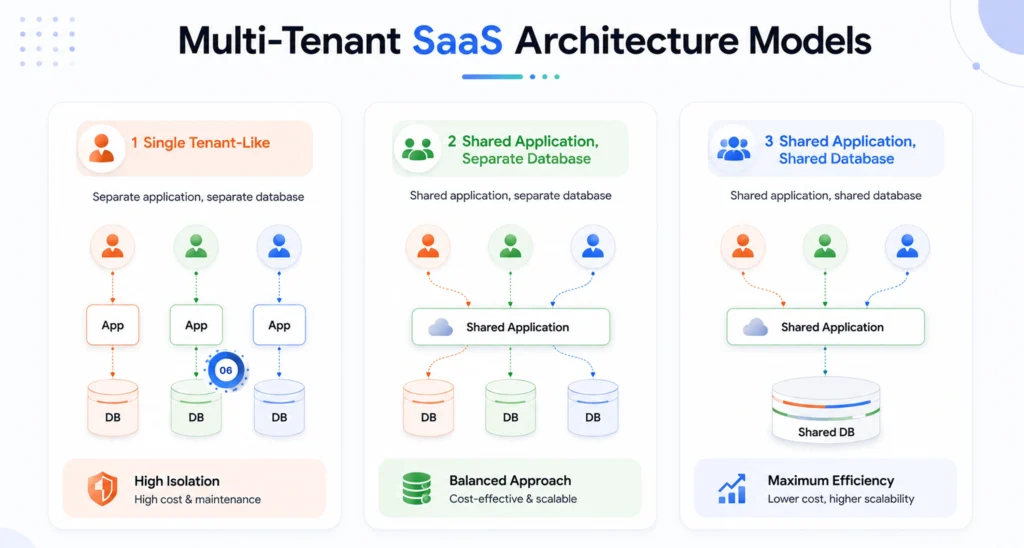
Understanding the difference between these two models is the starting point for every architectural decision you will make when building a multi-tenant software system.
| Attribute | Single-Tenant | Multi-Tenant |
|---|---|---|
| Infrastructure | Dedicated server per customer | Shared infrastructure across all customers |
| Cost per customer | High linear cost growth | Low costs shared across tenants |
| Deployment | Separate deployment per customer | Single deployment serves all tenants |
| Updates & patches | Must update each instance individually | One update applies to every tenant instantly |
| Scalability | Complex adds new infrastructure per customer | Efficiently scale one platform horizontally |
| Data isolation | Physical completely separate databases | Logical shared infra, isolated data layers |
| Customization | Unlimited per customer deployment | Controlled via config, feature flags, metadata |
| Best suited for | Highly regulated, enterprise-only products | B2B SaaS, startups, and high-growth platforms |
Bottom line: Single-tenant works for specialized, highly regulated deployments where physical isolation is non-negotiable. Multi-tenancy is the standard for any SaaS product that needs to scale efficiently, ship updates fast, and serve many customers from a single platform.
Why Multi-Tenancy Matters?
Multi-tenant SaaS architecture patterns deliver three compounding advantages:
- Lower operational overhead: One platform means one deployment pipeline, one monitoring stack, and one place to apply security patches.
- Centralized updates: Release a new feature once, and every tenant gets it immediately, with no coordinated rollout across separate environments.
- Unmatched resource efficiency: Shared infrastructure lets you serve many tenants for a fraction of the cost of running dedicated environments.
SaaS Database Isolation Models Compared
Choosing the right SaaS database isolation model is the single most consequential architectural decision in a multi-tenant SaaS system. The model you select directly determines your security posture, compliance readiness, infrastructure cost, migration complexity, and scalability ceiling. Get it wrong early, and you will pay a steep migration cost later.
The three primary models used in production SaaS platforms are:
- Database-per-tenant (physical isolation)
- Schema-per-tenant (logical isolation)
- Shared database with shared schema (row-level isolation).
Here is a full comparison across every dimension that matters:
| Architectural Metric | Database-per-Tenant | Schema-per-Tenant | Shared DB, Shared Schema |
|---|---|---|---|
| Data Isolation Level | The highest complete physical barrier | Medium separate namespaces inside one DB | Lowest data mixed in the same rows |
| Infrastructure Cost | Highest linear increase per customer | Medium bundled DB resources, high metadata overhead | Lowest maximum density and resource sharing |
| Noisy Neighbor Risk | Zero isolated computing and storage footprints | Medium shared CPU/RAM pools across schemas | The highest one tenant’s heavy query can lag the entire app |
| Migration Complexity | Highest must run updates across hundreds of databases | High must iterate through hundreds of schemas | The lowest single schema update applies to all tenants instantly |
| Cross-Tenant Leak Risk | Virtually zero physically impossible via standard queries | Low requires cross-schema query privilege errors | A single missing WHERE tenant_id clause leaks data |
| Best Suited For | FinTech, Healthcare, GovTech | Mid-market B2B SaaS needing moderate customization | Early-stage MVPs, Standard B2B/B2C SaaS platforms |
Model 1: Database-per-Tenant (Physical Isolation)
How It Works
The platform provisions a completely separate database instance for every customer. Tenant data never touches another tenant’s database. Each customer has their own dedicated connection strings, backups, and performance settings.
Pros:
- Maximum security and compliance: The gold standard for regulated industries. Each database is a physical barrier to cross-tenant data access; standard queries are virtually impossible.
- Zero noisy-neighbor impact: One tenant’s workload cannot slow down another tenant’s database performance.
- Flexible per-tenant customization: Database-level settings, backup schedules, and performance tuning apply independently per customer.
Cons:
- Highest infrastructure cost: Every new customer adds database resources and operational overhead linearly.
- Complex maintenance at scale: Schema migrations, backups, and monitoring require tooling to orchestrate across hundreds or thousands of databases.
- Difficult global analytics: Aggregating data across all tenants requires cross-database queries or ETL pipelines.
Best suited for:
FinTech, Healthcare, Government platforms, and enterprise SaaS products with strict regulatory compliance requirements.
Model 2: Schema-per-Tenant (Logical Isolation)
How It Works
All tenants share one database, but the platform provisions a separate schema (namespace) for each tenant inside that database. Every tenant gets their own isolated set of tables within the shared database server.
Pros:
- Cleaner data organization: Each tenant has fully isolated tables within its own namespace, reducing the risk of accidental cross-tenant data access compared to a shared schema.
- Lower cost than separate databases: Shared database server infrastructure reduces the total resource footprint significantly.
- Some per-tenant customization: Schema-specific modifications remain possible for tenants that need slight variations.
Cons:
- Noisy-neighbor risk persists: Tenants still share the same database server’s CPU and RAM. A heavy query in one schema can degrade performance across all schemas.
- Migration complexity grows with scale: Every schema update must iterate through hundreds or thousands of schemas. This requires robust migration tooling.
- Operational tooling becomes critical: Schema management, connection pooling, and automated migrations require more sophisticated infrastructure as tenant count grows.
Best suited for:
Mid-market B2B SaaS applications that need moderate isolation and occasional tenant-level customization.
Model 3: Shared Database, Shared Schema (Row-Level Isolation)
How It Works
All tenants share the same database and the same tables. A tenant_id column on every business table identifies which rows belong to which customer. The application enforces tenant boundaries entirely through query-level filtering.
Pros:
- Maximum cost efficiency: One database serves every tenant. Infrastructure costs stay minimal regardless of how many tenants you onboard.
- Simplest scaling model: Onboard new tenants instantly, no provisioning, no schema creation, no migrations required per customer.
- Easy global analytics: Cross-tenant reporting and insights are straightforward because all data lives in the same tables.
Cons:
- Highest code-level data leak risk: A single missing WHERE tenant_id =? clause in any query exposes another customer’s data. This is the most dangerous failure mode in multi-tenant SaaS development.
- Greatest noisy-neighbor risk: A heavy analytical query from one tenant degrades performance for every other tenant sharing the same database.
- Strong tenant isolation practices are non-negotiable: Row-level security, automated testing, and code review processes must be rigorous.
Best suited for:
Early-stage MVPs, startups, and standard B2B/B2C SaaS platforms focus on rapid growth and cost efficiency as long as the engineering team enforces disciplined tenant filtering.
Core Architectural Pillars of Multi-Tenancy
Beyond the database model, three architectural pillars determine whether a multi-tenant SaaS platform is secure, scalable, and operable at production scale. These are the building blocks that every multi-tenant SaaS architecture pattern relies on.
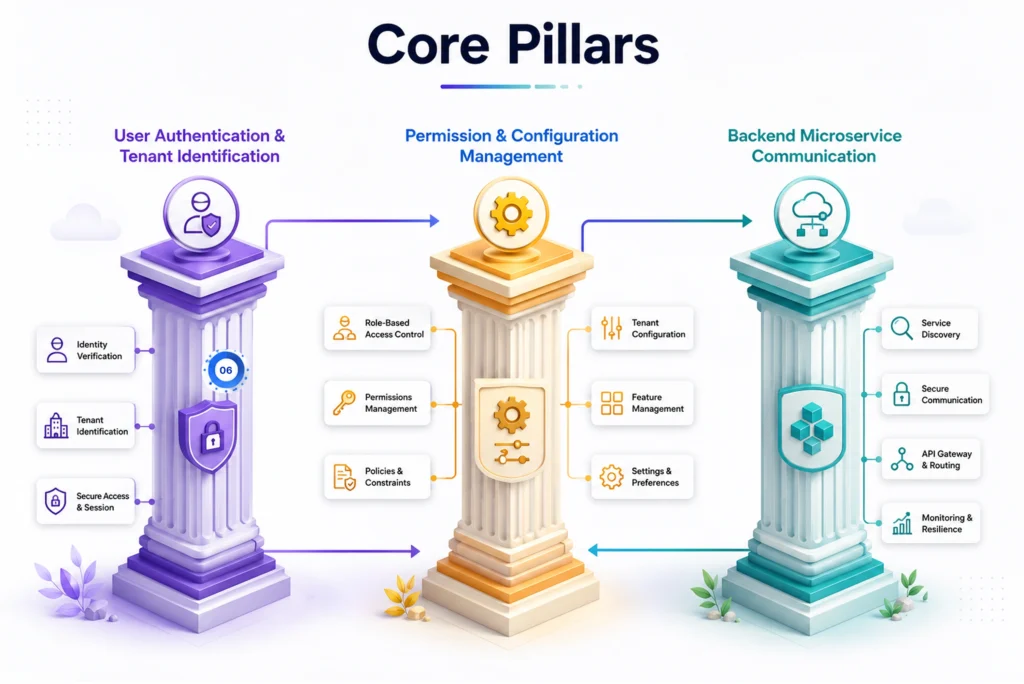
Pillar 1: Tenant Identification and Routing
Every incoming request must declare which tenant it belongs to before the application processes any business logic. The platform resolves this tenant context at the edge, before data ever touches the database layer.
Three common routing strategies cover most production use cases:
- Subdomain routing (recommended): customer.yoursaas.com clean URLs, simple tenant resolution, strong branding. The subdomain extracts directly to a tenant identifier in middleware.
- Path-based routing: yoursaas.com/customer is simpler to set up but slightly harder to parse cleanly at scale, especially in micro services architectures.
- Custom vanity domains: app.clientcompany.com. The customer brings their own domain, and the platform maps it to an internal tenant identifier. This is common in white-label SaaS products and enterprise B2B platforms where tenants want the experience to feel entirely branded.
Subdomains are generally preferred in standard B2B SaaS. Custom vanity domains add significant value for enterprise deals and white-label offerings but require a domain mapping service and SSL certificate automation (e.g., Let’s Encrypt with the ACME protocol).
Pillar 2: Tenant-Aware Authentication and Identity
Authentication must carry tenant context from the moment a user logs in. Building a multi-tenant SaaS without this principle leads to authorization bugs that are difficult to detect and catastrophic when exploited.
The key practices are:
- Inject tenant_id as a claim in JWTs: Every authenticated token carries the tenant context, so downstream services never need to look it up independently.
- Validate tenant membership on every request: Never assume the tenant in the JWT matches the resource being requested. Verify it explicitly.
- Decouple user identity from tenant identity: A user can belong to multiple organizations without duplicating their account. Model this as a many-to-many relationship between users and tenants so users can switch workspaces seamlessly.
- Separate user identity from tenant identity at the schema level: The users table stores who someone is. A memberships or tenant_users table stores which tenants they belong to and at what permission level.
This approach simplifies authorization logic while supporting modern collaboration workflows where a consultant might belong to five different client organizations under a single login.
Pillar 3: Automated Provisioning Pipelines
Manual tenant on-boarding does not scale past ten customers. The platform must automate every step of the provisioning flow so that a new tenant is fully set up the moment they complete sign-up.
A complete provisioning pipeline handles:
- Creating tenant records in the master tenant registry
- Provisioning the database, schema, or namespace depending on the chosen isolation model
- Running initial migrations against the new tenant environment
- Creating the first administrator account and assigning default roles
- Configuring feature flags and billing plan defaults
- Sending on boarding emails and triggering welcome workflows
Infrastructure-as-Code and CI/CD pipelines cut on boarding time from hours to minutes.
At scale, this pipeline becomes a core product capability, not an afterthought.
How to Implement Multi-Tenancy?
This is the hands-on section of your building a multi-tenant software guide. Follow these five steps in order; each one builds on the previous to create a layered, defense-in-depth architecture.
Step 1: Choose Your Isolation Model and Infrastructure Layer
Start by mapping your requirements against the three isolation models. Ask four questions:
- Compliance requirements: Do your customers operate under HIPAA, SOC 2, or GDPR mandates that require physical data separation? If yes, database-per-tenant is likely mandatory.
- Budget constraints: Can your current infrastructure budget support a dedicated database per customer from day one? If not, shared schema gives you the fastest path to a viable product.
- Scalability targets: Do you expect to onboard thousands of small tenants (shared schema wins) or hundreds of large enterprises (database-per-tenant wins)?
- Customization needs: Do tenants need schema-level modifications? Schema-per-tenant provides this without the full cost of database-per-tenant.
Many production SaaS platforms use a hybrid approach: shared schema for standard customers, database-per-tenant as a premium enterprise tier. Design for this possibility early.
Step 2: Implement Tenant Resolution Middleware
Tenant resolution is the gateway through which every request must pass. Centralizing this logic in a single middleware layer prevents inconsistent tenant handling across services, the most common source of subtle data leak bugs.
The middleware extracts the tenant identity from one of these sources:
- Hostname/subdomain: Parse the subdomain from the Host header tenant = Host.split(‘.’)[0]
- JWT claims: Decode the Authorization token and extract the tenant_id claim.
- Request headers: Some architectures pass X-Tenant-ID explicitly from an API gateway.
- Session variables: For server-rendered apps, store the resolved tenant_id in the session after login.
Here is a simplified Node.js/Express middleware example showing subdomain-based resolution:
// Tenant resolution middleware
app.use(async (req, res, next) => {
const subdomain = req.hostname.split(‘.’)[0];
const tenant = await Tenant.findOne({ subdomain });
if (!tenant) return res.status(404).json({ error: ‘Tenant not found’ });
req.tenantId = tenant.id;
next();
});
Every downstream service and database query now reads req.tenantId, never resolving it independently, and never trusting user-supplied tenant IDs from request bodies.
Step 3: Design the Database with Global Tenant Filters
For shared schema architectures, tenant_id must appear on every business table as a non-nullable indexed column. A single unfiltered query is all it takes to leak data across tenant boundaries.
Follow these database design rules without exception:
- Add tenant_id to every business table: No exceptions. Even lookup tables that seem “global” often end up tenant-scoped.
- Create composite indexes: Index (tenant_id, id) and (tenant_id, created_at) on every major table. Filtering by tenant_id without an index causes full table scans at scale.
- Enforce ORM-level global scopes: Configure your ORM to automatically inject WHERE tenant_id =:current_tenant into every query. In Rails, use default_scope. In Django, use a custom Manager. In Prisma, use middleware.
- Never allow queries without tenant filters: Treat an unscoped query as a critical security bug, not a performance issue.
— Every business table follows this pattern —
CREATE TABLE orders (
id UUID PRIMARY KEY DEFAULT gen_random_uuid(),
tenant_id UUID NOT NULL REFERENCES tenants(id),
customer_id UUID NOT NULL,
total NUMERIC(12,2),
created_at TIMESTAMPTZ DEFAULT NOW()
);
CREATE INDEX idx_orders_tenant ON orders (tenant_id, id);
Step 4: Configure Database Row-Level Security (RLS)
Application-level filtering is the first line of defense, but you should never rely on it as the only security mechanism. PostgreSQL Row-Level Security adds a database-native enforcement layer that blocks cross-tenant access even if application code contains a bug.
Here is how to configure RLS in PostgreSQL:
— Enable RLS on the orders table —
ALTER TABLE orders ENABLE ROW LEVEL SECURITY;
— Create a policy that restricts every query to the current tenant —
CREATE POLICY tenant_isolation ON orders
USING (tenant_id = current_setting(‘app.current_tenant_id’)::UUID);
— Set the tenant context at the start of every database session —
SET app.current_tenant_id = ‘550e8400-e29b-41d4-a716-446655440000’;
With RLS active, a query that somehow bypasses application-level filtering will still return zero rows for a different tenant; the database enforces the boundary independently of the application layer.
Step 5: Handle Tenant-Specific Configurations and Branding
The application code stays identical for every tenant. Tenant-specific behavior lives in a configuration layer that the application reads at runtime. Store these settings in a dedicated tenant_configs table or a fast key-value store:
- Visual branding: Custom color themes, logo URLs, and favicon paths.
- Feature flags: Enable or disable product features per tenant based on their billing plan or enterprise agreement.
- Language and locale preferences: Currency formats, date formats, and default language per tenant.
- Custom domains: The vanity domain mapping that routes app.clientcompany.com to the correct tenant.
- Billing plan limits: Seat counts, API rate limits, and storage quotas are defined per subscription tier.
Cache tenant configurations aggressively; they change infrequently and are read on every request. Use Redis with a tenant-scoped cache key structure (described below) and invalidate only when the configuration record updates.
Overcoming Advanced Multi-Tenant Engineering Challenges
Choosing an isolation model and implementing the basics gets you to a working multi-tenant SaaS. Solving these four challenges gets you to a production-grade one.
Challenge 1: Defeating the Noisy Neighbor Dilemma
In any shared infrastructure model, one tenant’s resource-intensive workload degrades the experience for every other tenant. A single large customer running a batch export at peak hours should never slow down your other customers’ real-time workflows.
Implement these mitigation strategies in layers:
- Token-bucket rate limiting: Each tenant gets a “bucket“ of request tokens that refills at a fixed rate. When the bucket empties, requests queue or return 429 errors. This prevents any single tenant from monopolizing API throughput. Libraries like redis-rate-limiter-flexible implement this pattern in minutes.
- Per-tenant resource quotas: Set explicit limits on database connection counts, background job queue depth, and storage consumption per tenant.
- Connection pooling: Use PgBouncer or a similar connection pooler to prevent any single tenant’s heavy query load from exhausting the database connection limit.
- Background job prioritization: Route large batch jobs to a separate low-priority queue so they never compete with real-time user-facing operations.
- Dedicated compute for enterprise customers: Offer enterprise tenants isolated compute resources as a premium tier. This also becomes a strong upsell argument during sales.
Challenge 2: Executing Zero-Downtime Database Migrations
A schema change that takes five seconds in a single-tenant environment can take hours and cause outages when it must apply across thousands of tenant databases or schemas. The solution is a migration strategy that decouples schema changes from code deployments.
Use these techniques together:
- Backward-compatible schema changes: Always make schema changes in expand-contract sequences. First, add the new column (expand). Then migrate data. Then remove the old column (contract). Never rename columns in a single deployment.
- Feature flags: Gate new behavior behind feature flags so you deploy code before the schema migration completes. The flag stays off until every tenant’s migration finishes.
- Asynchronous rolling migrations: Run migrations as background jobs across tenant databases in parallel, with concurrency limits to avoid overloading the database layer.
- Blue-green deployments: Maintain two identical environments and cut traffic over to the new version only after migrations complete and smoke tests pass.
These techniques let you update thousands of tenant databases without interrupting active users. Zero-downtime migrations become a standard part of your release process rather than a special operation.
Challenge 3: Cross-Tenant Data Leakage Prevention
Data leakage prevention requires multiple enforcement layers because any single layer can contain a bug. Defense in depth is not optional in multi-tenant SaaS architecture; it is the architecture.
- Automated adversarial integration tests: Write integration tests that intentionally try to query another tenant’s data, authenticating as Tenant A and attempting to retrieve Tenant B’s records. These tests should run in every CI pipeline and fail loudly if they ever succeed. This is the most important quality gate for multi-tenant SaaS security.
- Server-side authorization checks: Verify tenant ownership on every resource before returning it. Never trust the tenant_id supplied in a request body.
- PostgreSQL RLS: As described in Step 4, database-native policies provide a hardware-level backstop against application code bugs.
- Secure code reviews: Every pull request touching data access patterns requires a review specifically checking for missing tenant_id filters.
- Static analysis: Use linting rules or custom AST checks to flag any ORM query that lacks a tenant scope.
- Penetration testing: Run formal penetration tests against your multi-tenant isolation boundaries at least annually and after any major architectural change.
Never rely solely on frontend validation for tenant isolation. The frontend is untrusted by definition; always enforce tenant boundaries at the API and database layers.
Challenge 4: Multi-Tenant Caching Strategies
Caching dramatically improves performance, but a misconfigured cache is one of the most dangerous failure modes in multi-tenant systems. Serving one tenant’s cached data to another tenant constitutes a data breach.
The rule is simple: always scope every cache key with a tenant-specific prefix. Structure your cache keys as:
tenant:{tenant_id}:user:{user_id}:profile
tenant:{tenant_id}:config
tenant:{tenant_id}:dashboard:metrics
tenant:{tenant_id}:products:page:{page_number}
This structure ensures that cache lookups are always tenant-scoped. Never cache data without a tenant prefix and never build a cache key from user-supplied values without validating that the requested tenant_id matches the authenticated tenant in the session.
When a tenant updates their configuration, or you need to invalidate a specific tenant’s cache entirely, this key structure lets you target exactly that tenant’s cache namespace using Redis pattern-based deletion: DEL tenant:{tenant_id}:*
Real-World Case Studies: How Modern SaaS Giants Scale Multi-Tenancy
The world’s largest SaaS companies do not rely on a single multi-tenant SaaS architecture pattern. They combine tenant routing, logical isolation, distributed databases, metadata-driven customization, and horizontal scaling to serve millions of users without sacrificing performance or security.
Here are three excellent examples that illustrate different approaches to the same fundamental challenge.
Slack and Notion: Shared Infrastructure with Intelligent Tenant Routing
Slack and Notion are collaboration platforms where users routinely belong to multiple organizations or workspaces simultaneously. A single user might switch between a personal workspace, a client workspace, and a company workspace within seconds without logging into separate accounts. Designing this experience requires a fundamentally different approach to identity than traditional single-tenant applications.
Both platforms use a shared multi-tenant infrastructure with centralized identity management. Instead of creating separate user accounts for every organization, the platform links a user’s identity to one or more tenant IDs. Each incoming request carries tenant context, and the platform retrieves only the data associated with the selected workspace.
Their architecture typically includes:
- Centralized authentication: Users access multiple organizations using a single identity, no separate logins, no separate accounts per workspace.
- Tenant-aware request routing: Every API request carries the target workspace identifier, and the platform validates it against the authenticated user’s tenant memberships before processing any business logic.
- Shared backend services: Notifications, search, file storage, and messaging infrastructure run once and serve all tenants. The platform logically partitions each tenant’s data within these shared services.
- Horizontal scaling: Stateless application servers, distributed caching, and database partitioning let the platform grow concurrent user counts without architectural changes.
Key Takeaway:
Separate identity from tenancy. Design your authentication model so one user identity can securely access multiple tenants. This improves user experience and simplifies account management, critical for any collaboration SaaS where users work across multiple clients or organizations.
Salesforce: Metadata-Driven Multi-Tenancy at Enterprise Scale
Salesforce transformed enterprise SaaS by building one of the industry’s most sophisticated metadata-driven multi-tenant architectures. Rather than deploying separate application instances per customer, Salesforce runs a single codebase that all tenants share.
The platform stores every customer-specific configuration as metadata: page layouts, custom objects, workflows, validation rules, automation logic, and UI components. When a request arrives, Salesforce dynamically interprets this metadata to generate a fully customized experience for that tenant.
This architecture delivers several structural advantages:
- One codebase, zero duplication: Salesforce maintains a single application layer for thousands of enterprise customers, dramatically reducing maintenance and accelerating deployments.
- Deep customization without code changes: Customers configure their CRM experience through metadata, not by forking the codebase or requesting custom deployments.
- Centralized feature releases: Salesforce rolls out new features and security patches once, and every customer receives them simultaneously.
- Scalable request routing: The platform loads tenant configurations efficiently while enforcing strict data isolation across billions of daily requests.
Key Takeaway:
Make your application configuration-driven rather than code-driven wherever possible. Metadata enables deep customization without maintaining multiple codebases; this approach reduces technical debt exponentially as your SaaS platform grows.
Shopify: Scaling Millions of Stores Through Database Sharding
Every Shopify merchant operates an independent online store, but millions of stores run on Shopify’s shared platform. Managing this scale requires an architecture that goes far beyond standard multi-tenancy.
Instead of storing every merchant within a single database, Shopify distributes stores across multiple infrastructure clusters called pods or database shards. Each shard manages a subset of merchants while sharing the same application layer.
This sharding architecture delivers clear operational benefits:
- Workload distribution: Distributing workloads across shards prevents any single database from becoming a performance bottleneck, especially critical during peak retail events like Black Friday.
- Fault isolation: Issues affecting one shard limit their blast radius to the merchants hosted on that shard; they never cascade to the entire platform.
- Independent scaling: Shopify adds new shards as merchant growth demands without migrating the entire platform or touching existing merchant data.
- Improved operational flexibility: Smaller infrastructure segments make maintenance, backups, and upgrades significantly more manageable than a single monolithic database.
Key Takeaway:
As your SaaS platform grows beyond the limits of a single database, sharding becomes a scalability strategy rather than a database optimization. Design for data partitioning early, even if you do not implement sharding immediately; the architectural decisions you make today determine how painful it is when you eventually need it.
What These Architectures Have in Common
Although Slack, Salesforce, Notion, and Shopify serve different markets, their architectures share five common principles that define successful multi-tenant SaaS:
- One application, many tenants: None of them maintain separate application instances per customer. One codebase reduces operational complexity and accelerates deployments.
- Tenant-aware architecture throughout: Every request carries tenant context. Routing, authorization, and data access all enforce tenant boundaries consistently.
- Configuration over customization: Features are driven by metadata, permissions, and configuration, not by maintaining separate codebases per customer segment.
- Horizontal scaling from the start: Stateless services, distributed caching, and database partitioning let the platform grow without fundamental architectural changes.
- Invest in tenant isolation early: Whether through logical isolation, metadata-driven architecture, or sharding, protecting tenant boundaries is a first-class engineering concern, not a feature added later.
Building a Resilient Multi-Tenant Cloud Environment
A well-designed multi-tenant SaaS architecture is not a one-time setup; it is an ongoing engineering discipline. The threat landscape evolves, your tenant count grows, your isolation requirements change as you move upmarket into regulated industries, and your team’s ability to ship safely depends on having the right patterns in place from the start.
The SaaS tenant isolation best practices covered in this guide include choosing the right isolation model, implementing tenant-aware authentication, enforcing global query filters, configuring PostgreSQL RLS, defeating noisy neighbors, executing zero-downtime migrations, and preventing cross-tenant data leakage, forming the complete foundation of a production-grade multi-tenant platform.
Businesses that learn how to implement multi-tenancy with these patterns in place reduce infrastructure costs, ship features faster, and scale to thousands of tenants without proportional operational overhead. The multi-tenant SaaS architecture patterns used by Slack, Salesforce, and Shopify all started with the same fundamentals covered here, applied consistently at every layer of the stack.
At CodesClue, we help startups and enterprises design and build cloud-native multi-tenant SaaS platforms that are secure, scalable, and future-ready. Whether you are developing a new SaaS product or modernizing an existing single-tenant application, our team builds architectures designed to grow from your first tenant to millions of users.