
The Best SaaS Tech Stack for 2026: A Complete Guide
What is the best SaaS tech stack for 2026? Read our complete architectural guide featuring top frontend, backend, and cloud hosting tools.
Speed to market and AI integration no longer count as luxuries in 2026. They decide whether your SaaS product survives. Overengineering kills startups before they ship, while under engineering creates scaling nightmares the moment real users arrive.
The technology choices you make today will shape your product’s speed, security, maintenance costs, and ability to evolve over the next five years.
The market is moving fast. Global SaaS revenue will surpass USD 1,482.44 billion by 2034, and worldwide public cloud spending will exceed $1 trillion, reflecting the growing demand for cloud-native software and AI-powered applications.
In this guide, you will learn the absolute best SaaS tech stack combinations for scalability, cost, and speed, why these technologies lead the market in 2026, and how to pick a stack that matches your stage, whether you are bootstrapping a micro-SaaS or building an AI-native platform.
Why Does Your SaaS Tech Stack Matter?
A SaaS application carries far more complexity than a traditional website. It must support continuous growth, frequent feature releases, seamless third-party integrations, and enterprise-level security, all while delivering a consistent user experience.
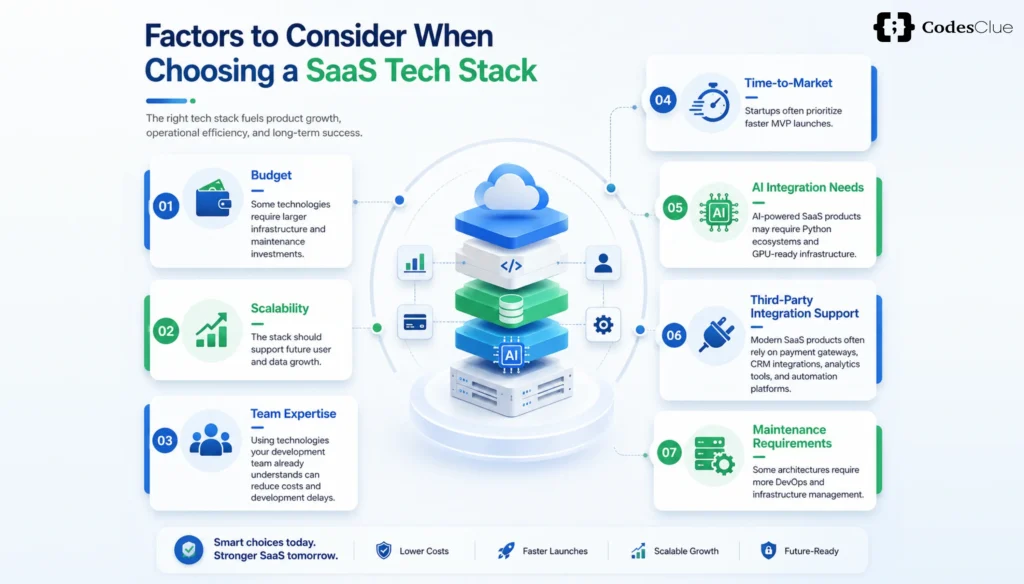
A modern SaaS technology stack should enable the following.
High scalability:
Your application should handle thousands or even millions of users without losing performance. A scalable architecture also lets infrastructure grow alongside your customer base while keeping operational costs under control.
Multi-tenant architecture:
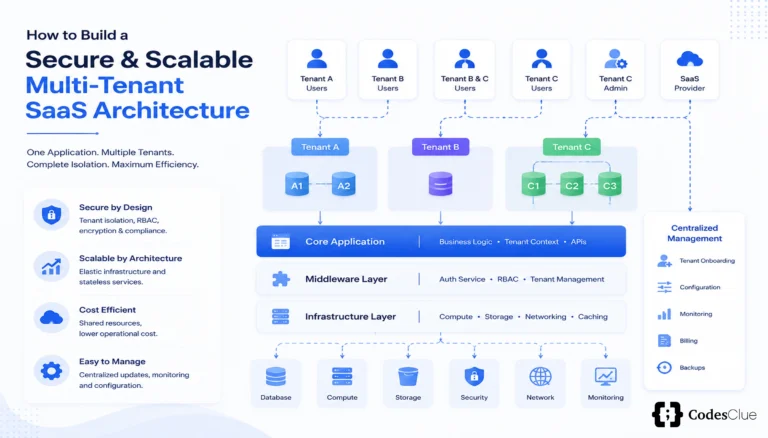
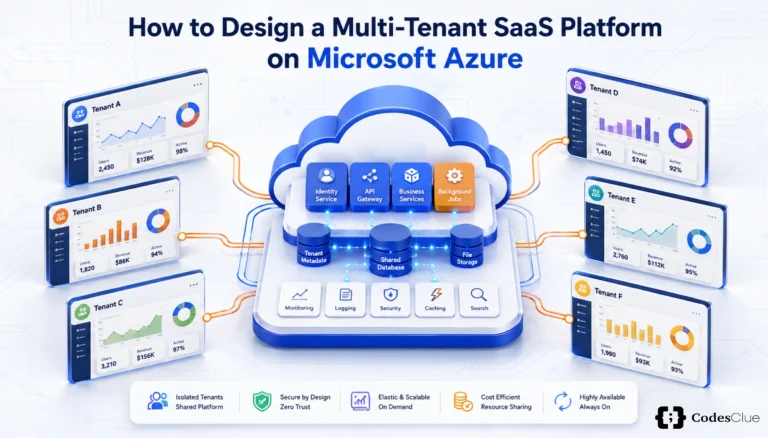
Serving multiple customers from a single application instance improves resource utilization and simplifies maintenance. Proper tenant isolation also protects data security and keeps performance consistent across users.
Continuous deployment:
Modern SaaS products release updates frequently. Automated CI/CD pipelines let development teams ship features, bug fixes, and security patches with minimal downtime and lower deployment risk.
API-first integrations:
Today’s SaaS platforms rarely operate in isolation. Well-designed APIs make it easier to connect with CRMs, payment gateways, communication tools, analytics platforms, and hundreds of third-party services.
Enterprise-grade security:
Security must run through every layer of the application. Strong authentication, authorization, encryption, monitoring, and compliance practices protect customer data and build trust.
AI readiness:
AI has become a standard expectation rather than a premium feature. Choosing technologies that integrate easily with AI frameworks and large language models keeps your product competitive as intelligent automation spreads.
Core Pillars of Modern SaaS Architecture
A strong SaaS architecture in 2026 rests on a few non-negotiable pillars. Get these right early, and you avoid the costly rebuilds that slow down most growing SaaS companies.
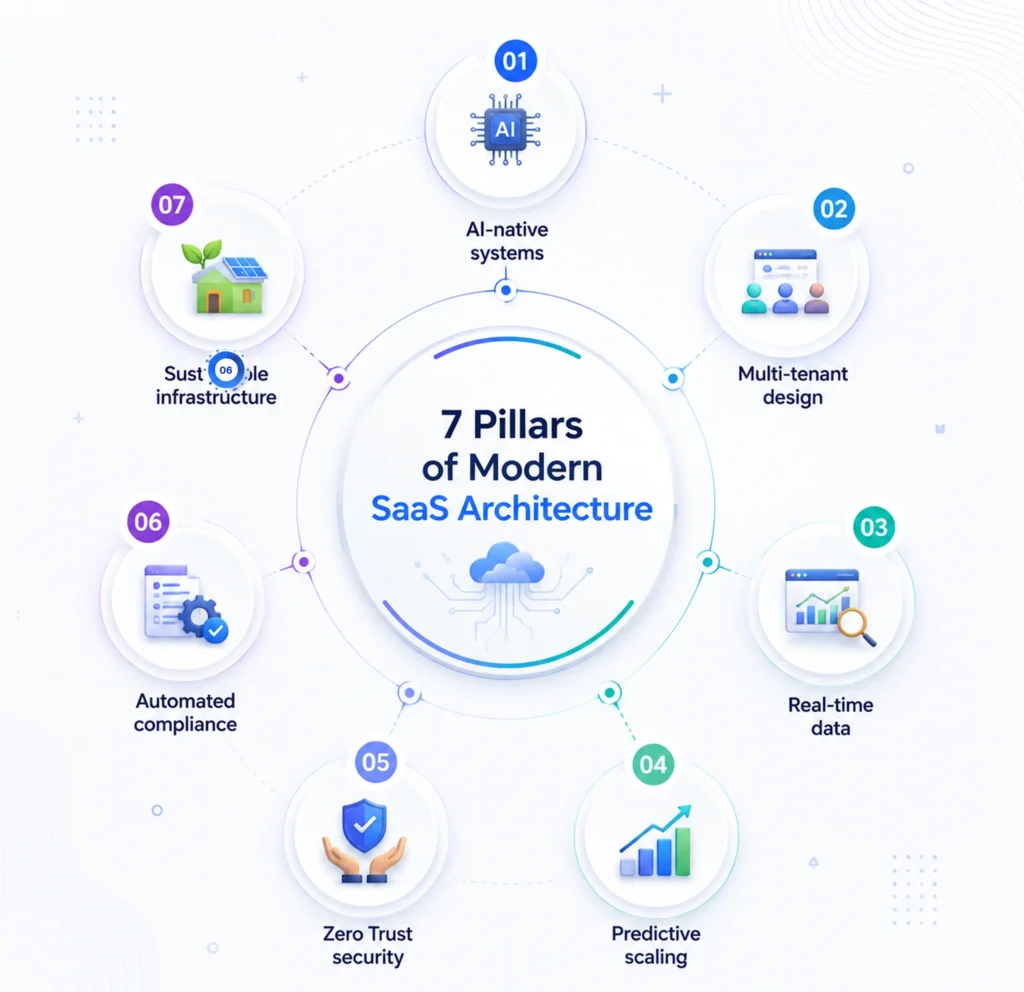
- Multi-tenancy: Isolate each customer’s data securely while sharing infrastructure efficiently.
- Scalability: Handle sudden traffic spikes without crashing or degrading performance.
- Security and compliance: Build in SOC 2, GDPR, and AI data privacy defaults from day one, not as an afterthought.
- API-first design: Make sure your SaaS product plays well with other software through clean, well-documented APIs.
The Best SaaS Tech Stack for Standard SaaS Applications
No single technology stack fits every SaaS product. However, certain technologies have repeatedly proven their ability to deliver performance, scalability, security, and developer productivity.
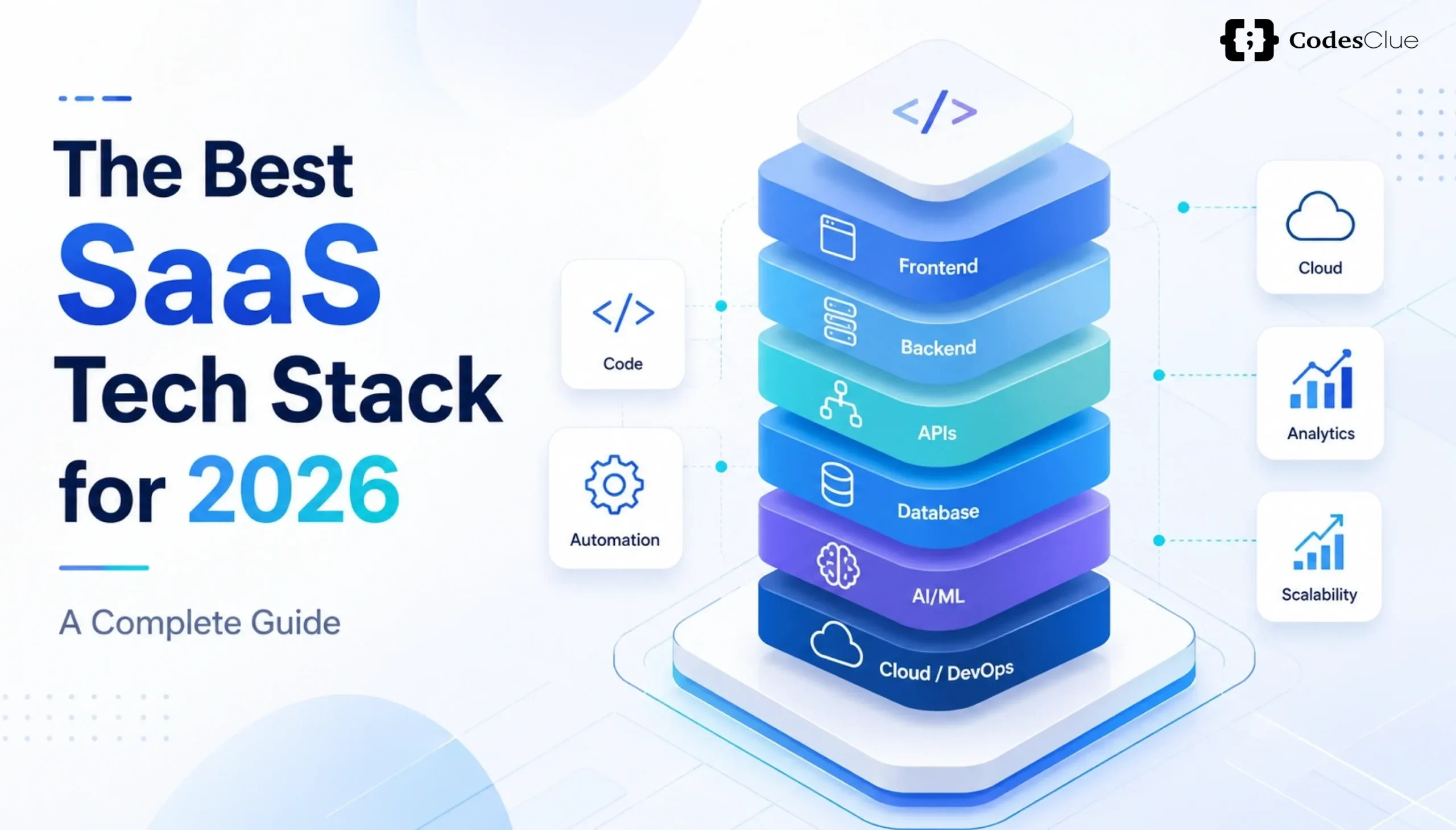
The table below breaks down the definitive, go-to components for standard SaaS application development in 2026.
| Layer | 2026 Tech Winner | Why It’s the Standard | Best Alternative |
|---|---|---|---|
| Frontend | Next.js + Tailwind CSS | Best for SEO, speed, and a massive developer ecosystem. | Remix / Vue.js |
| Backend | Node.js (TypeScript) | Unified language (JS/TS) across the entire stack. | Python (FastAPI) |
| Database | PostgreSQL | Relational, reliable, and natively handles AI vectors. | MySQL / MongoDB |
| Auth & BaaS | Supabase or Clerk | Saves weeks of building user login and database rules. | Firebase / Auth0 |
| Hosting | Vercel + AWS | Push-to-deploy for frontend; reliable scale for backend. | Render / Railway |
| Payments | Stripe | Industry standard for complex SaaS subscription tiers. | Paddle / Merchant of Record |
Frontend: Next.js + Tailwind CSS
React still dominates frontend development, and in 2026, the combination of Next.js and Tailwind CSS remains the preferred choice for building scalable SaaS applications. Next.js boosts page speed through server-side rendering, static site generation, image optimization, and efficient routing, which improves Core Web Vitals and search visibility. Tailwind CSS speeds up UI development with a utility-first approach that keeps design systems consistent as your team grows.
Backend: Node.js (TypeScript) or Python (FastAPI)
Node.js uses a non-blocking, event-driven architecture that handles large numbers of simultaneous connections efficiently, making it ideal for chat apps, collaboration platforms, and real-time dashboards. Using TypeScript across both frontend and backend lets teams share code and types, which speeds up development and cuts down on bugs.
Python earns its place when your product leans into AI and machine learning, data analytics, or high-performance APIs. FastAPI delivers excellent API performance with automatic documentation, type validation, and asynchronous request handling, so teams build modern, scalable APIs without unnecessary complexity.
Database: PostgreSQL
PostgreSQL remains the preferred database for most SaaS products because it combines enterprise-grade reliability with exceptional flexibility and scalability. Its strong ACID compliance protects data integrity, which matters most in financial systems, healthcare applications, and business software. Native JSON support lets developers work with structured and semi-structured data side by side, and built-in vector support through pgvector makes PostgreSQL a strong fit for AI-powered features without adding a separate database.
MongoDB still suits applications with highly dynamic schemas, content management systems, and rapid MVP development. As SaaS products mature and transactional requirements grow, many teams migrate to PostgreSQL for stronger consistency and long-term scalability.
Authentication and Security
Security has become a competitive advantage rather than an optional extra. Instead of building authentication systems from scratch, many SaaS companies rely on proven identity providers such as Supabase, Clerk, Auth.js, or Auth0. Strong SaaS security in 2026 layers in multi-factor authentication, role-based access control, OAuth and single sign-on, and continuous monitoring with threat detection.
The Micro-SaaS Tech Stack for Solo Devs and Bootstrappers
Solo founders and bootstrapped teams need a different micro-SaaS tech stack, one built around ultra-low cost and maximum speed rather than enterprise-scale flexibility.
The winning combination for 2026 pairs Next.js for the frontend, Supabase for the database, authentication, and backend logic, and Lemon Squeezy for payments, since it handles global sales tax and VAT automatically without extra setup.
This stack lets a single developer launch a working product in days, not months. You skip building your own auth system, your own billing logic, and your own tax compliance, all of which would normally eat weeks of solo development time. For a one-person team, every week saved on infrastructure is a week spent talking to customers instead.
The SaaS Tech Stack for AI Products
Building an AI-native SaaS product calls for a different SaaS tech stack for AI products, one designed around heavy data processing and large language model integrations rather than standard CRUD operations.
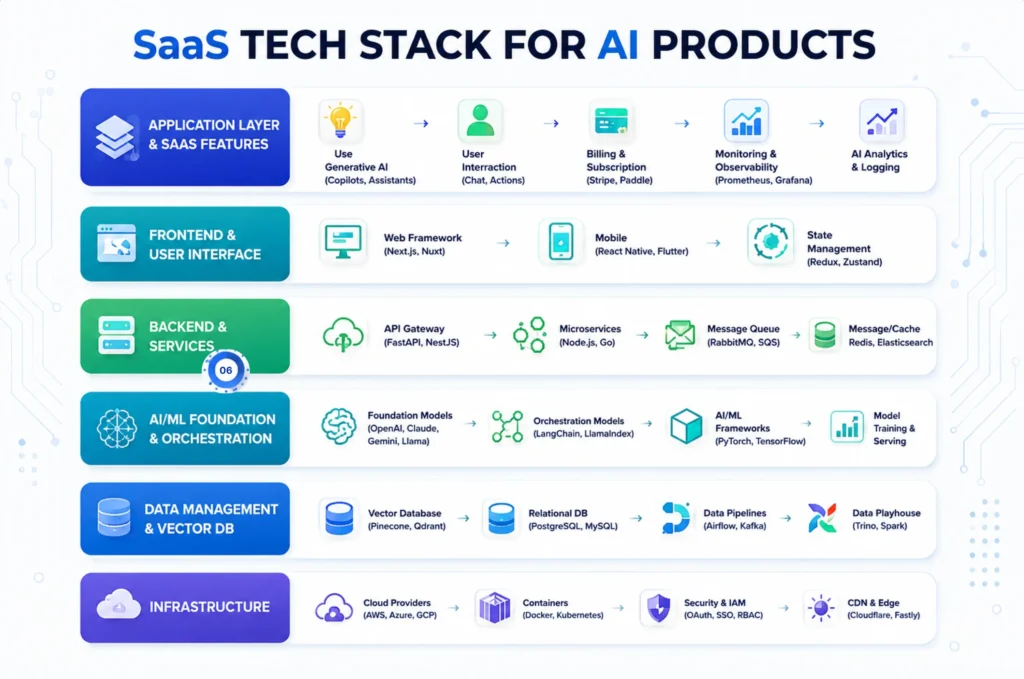
Frontend and backend:
Python (FastAPI or Django) handles AI-heavy workloads naturally, though TypeScript still works well when your AI logic lives mostly behind third-party APIs.
Vector databases:
Pinecone and Weaviate offer purpose-built vector search at scale, while pgvector lets teams who already run PostgreSQL add vector search without introducing a separate database to manage.
AI infrastructure:
LangChain and LlamaIndex simplify chaining LLM calls, managing context, and connecting models to your own data. At the same time, Ollama lets teams run open-source models locally for testing or cost control before committing to a hosted API.
This 2026 paradigm shift means AI is no longer a bolted-on feature. It shapes the entire stack, from how you store data to how you architect your APIs.
DevOps and CI/CD
Fast deployment cycles have become a competitive necessity for SaaS businesses. Automated testing catches issues before they reach production and improves software quality across every release. Continuous deployment pipelines enable faster feature releases with minimal downtime, while infrastructure as code automates provisioning and keeps environments consistent. Tools like Prometheus and Grafana give teams real-time, actionable insight into application performance and system health.
AI Is Reshaping the Modern SaaS Stack
Artificial intelligence has become a core component of SaaS platforms rather than an optional add-on. From intelligent assistants to predictive analytics, AI is changing how teams build and use software.
AI adds the most value in four places. Intelligent customer support through AI chatbots and virtual assistants delivers instant help while cutting operational costs. Workflow automation removes routine manual work and boosts productivity. Predictive analytics surfaces trends and forecasts customer behavior to support better decisions. Personalized experiences let AI power recommendations, adaptive interfaces, and smarter search that keeps customers engaged.
Recommended SaaS Tech Stack for 2026
| Layer | Recommended Technology |
|---|---|
| Frontend | React + Next.js + TypeScript |
| Backend | Node.js (NestJS/Express) or Python (FastAPI) |
| Database | PostgreSQL |
| Authentication | Clerk / Auth.js |
| Cloud | AWS, Azure, or Google Cloud |
| Containers | Docker + Kubernetes |
| Monitoring | Prometheus + Grafana |
| CI/CD | GitHub Actions |
| Payments | Stripe |
| AI | OpenAI APIs, LangChain, Python AI Ecosystem |
How to Choose Your SaaS Tech Stack: A Step-by-Step Guide
Every SaaS application carries unique technical and business requirements. Instead of chasing the latest trends, evaluate technologies against your actual constraints.
Assess your team’s skills first.
Never choose a tool your team needs months to learn when a familiar alternative ships just as well. Hiring availability matters just as much as raw technical merit.
Evaluate time-to-market next.
Boilerplates like ShipFast and SaaSPegasus let you launch in days instead of months by handling auth, billing, and basic SaaS scaffolding out of the box. For most early-stage products, speed to your first paying customer beats architectural purity.
Calculate future costs before you commit.
Watch out for serverless database bills that scale too aggressively as usage grows; a stack that looks free at launch can become expensive fast once you cross a few thousand active users. Run the numbers at 10x your current scale, not just today’s.
Factor in compliance and security requirements
If you sell to enterprise customers, SOC 2 and GDPR readiness will shape your authentication, hosting, and monitoring choices from day one.
Plan for AI integration
Even if you don’t need it at launch, retrofitting vector search or LLM infrastructure onto a database that doesn’t support it costs far more than building it in from the start.
Conclusion
Choosing the best SaaS tech stack for 2026 means building a foundation that supports scalability, security, performance, and continuous innovation, without slowing down the people who actually have to ship the product.
No single stack fits every team. A solo founder needs the speed of Next.js, Supabase, and Lemon Squeezy. An AI-native startup needs Python, pgvector, and LangChain. An enterprise SaaS company needs a full stack of React, Next.js, Node.js, PostgreSQL, and AWS, with built-in strict compliance.
The best SaaS tech stack ultimately comes down to one test: it lets you ship working code to users the fastest, without creating technical debt you can’t afford to pay off later.
At CodesClue, we help startups and enterprises design and build scalable, secure, and future-ready SaaS applications using proven technologies and industry best practices. Whether you’re building an MVP or an enterprise platform, our team can help you choose the right tech stack and turn your vision into a high-performing SaaS product.
Frequently Asked Questions
What is the best tech stack for SaaS development in 2026?
For most SaaS applications, React, Next.js, TypeScript, Node.js, FastAPI, PostgreSQL, Docker, Kubernetes, and a cloud provider like AWS, Azure, or Google Cloud deliver an excellent balance of scalability, performance, security, and developer productivity.
Which backend technology is better for SaaS: Node.js or Python?
Both work well, but your use case decides the winner. Node.js suits real-time applications and API-heavy platforms, while Python (FastAPI or Django) fits AI, machine learning, automation, and data-driven SaaS products better.
Why is PostgreSQL recommended for SaaS applications?
PostgreSQL offers enterprise-grade reliability, strong transactional support, excellent scalability, and native JSON and vector capabilities through pgvector. Its flexibility and mature ecosystem make it the preferred database for both startups and large-scale SaaS platforms.
Which cloud platform is best for SaaS development?
AWS, Microsoft Azure, and Google Cloud Platform all lead the market for SaaS development. Vercel pairs well with any of them for frontend hosting. The best platform depends on your application’s requirements, existing infrastructure, budget, and compliance needs.
What is the best tech stack for a micro-SaaS product?
Solo founders and bootstrappers get the most speed from Next.js, Supabase, and Lemon Squeezy, a combination that handles authentication, database, and global tax-compliant billing without custom-built infrastructure.
What does a SaaS tech stack for AI products need?
AI-native SaaS products need a vector database such as Pinecone, Weaviate, or pgvector, along with AI infrastructure like LangChain or LlamaIndex to manage LLM calls and context, often paired with a Python backend.
How important is AI when choosing a SaaS tech stack?
AI has become a core component of modern SaaS applications. Choosing technologies that integrate easily with AI frameworks, APIs, and automation tools lets businesses add features such as intelligent search, predictive analytics, personalized recommendations, and AI-powered customer support more efficiently.
Should startups use a microservices architecture from the beginning?
Not necessarily. Most startups build faster, maintain more easily, and spend less by starting with a well-structured modular monolith. As the product and user base grow, teams can gradually separate specific services into microservices once scalability and operational complexity justify the move.
How do I choose the right tech stack for my SaaS product?
Start by evaluating your business goals, product complexity, expected user growth, development budget, team expertise, security requirements, and future scalability needs. Choosing technologies that align with these factors reduces technical debt and supports long-term product success.