
AI Predictive Analytics for Business: Turn Data Into Smarter Decisions
AI predictive analytics for business: where it pays back, a 60-second readiness check, buy vs build, and what a first pilot costs.
You have three years of sales data, a CRM full of customer history and a weekly report that explains last month. Then the stock runs out again, a big account leaves without warning, and everyone says the signs were there.
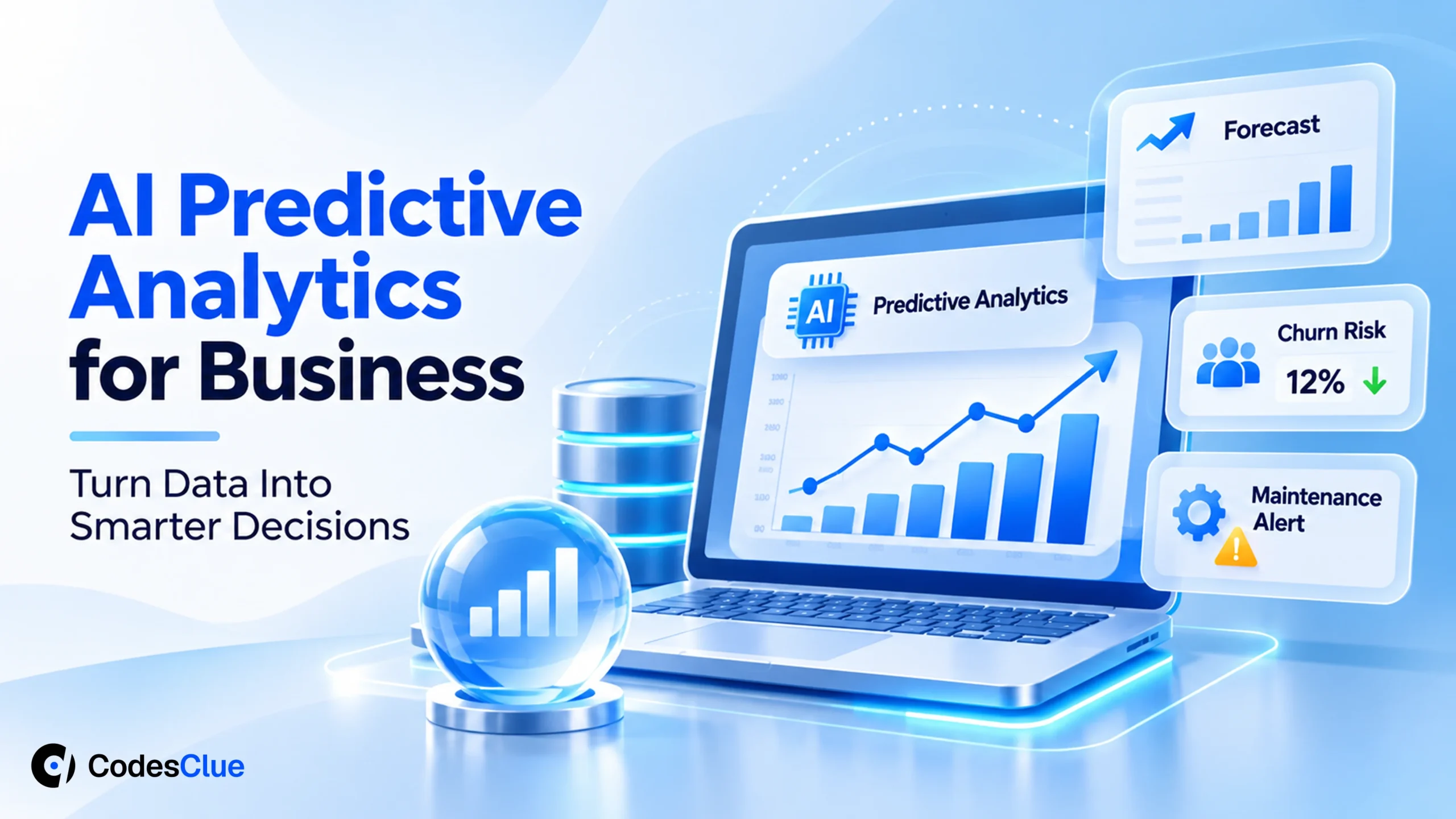
That gap is what AI predictive analytics closes. It studies the patterns in data you already own and tells you what is likely to happen next, early enough to act. This guide shows where it pays back, how to check if you are ready, which option fits your company and what a first project costs.
Key Takeaways
- AI predictive analytics starts with one costly business decision, not a big data project.
- Clean history on that one decision matters more than the model you pick.
- Most mid-size companies should pilot one use case before they buy a platform or build a team.
- A prediction only pays when a named person acts on it, inside a tool they already use.
- Models drift. Plan to compare forecasts with real outcomes and retrain on a schedule.
What is AI predictive analytics, in plain words?
AI predictive analytics uses machine learning on your historical data to estimate what will happen next. Think of which customers will leave, how much stock you need or which machine will fail. Unlike a dashboard, it looks forward. You get a probability or a number, early enough to change the outcome.
Older forecasting used fixed formulas, such as last year’s sales plus 5%. Machine learning models find patterns across many signals at once: season, price, region, support tickets, sensor readings. They also update as new data arrives.
Most guides you will find come from tool vendors. They explain the idea well and then point you to their product. This guide takes the buyer’s side. It helps you decide whether to start, where to start and with whom.
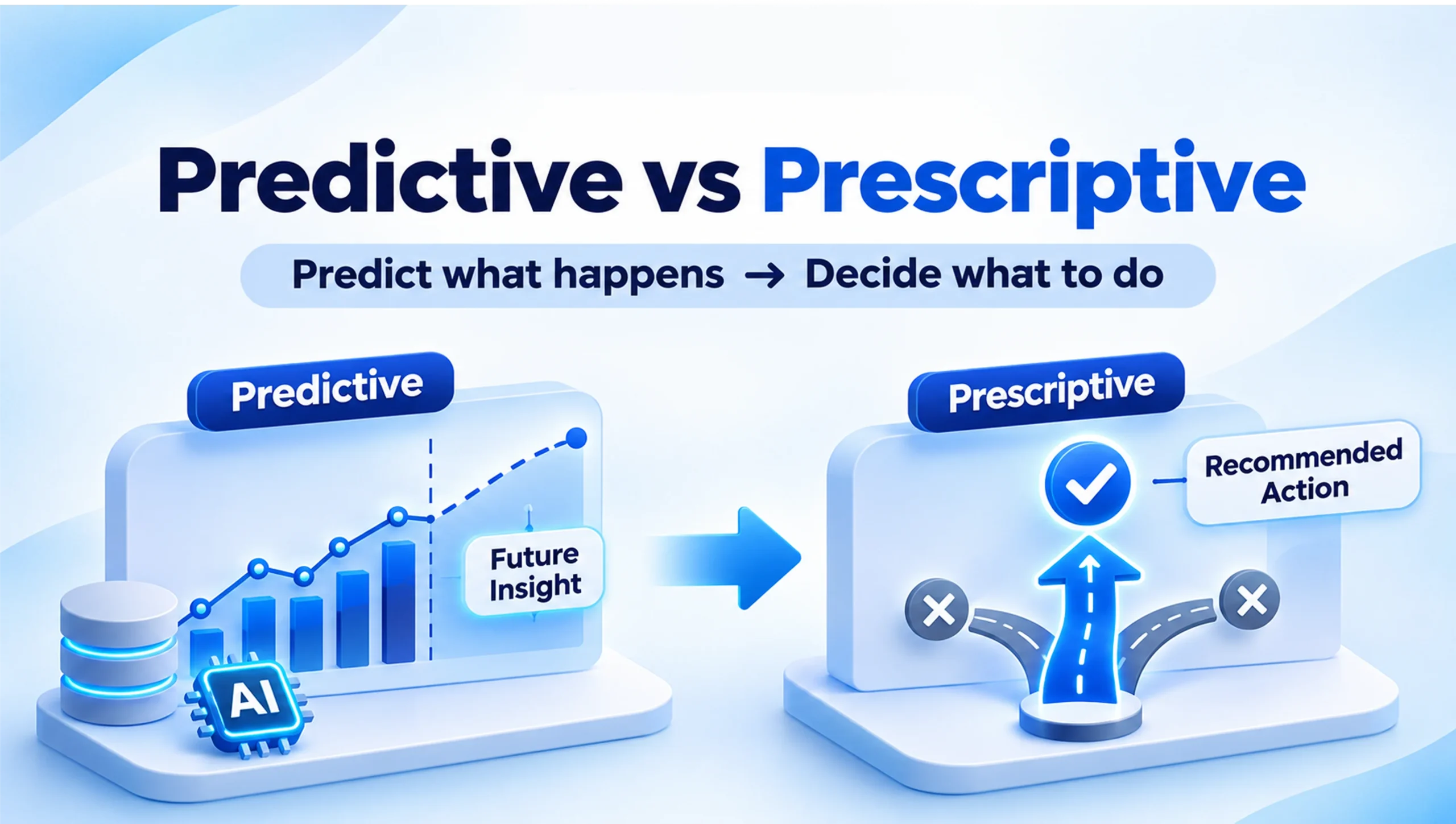
Predictive vs prescriptive analytics: which do you need first?
People mix up four kinds of analytics. The table shows the question each one answers.
| Type | Question it answers | Example output |
|---|---|---|
| Descriptive | What happened? | “Sales fell 12% last quarter.” |
| Diagnostic | Why did it happen? | “A stockout in our top region caused most of the drop.” |
| Predictive | What will happen next? | “Demand in that region will likely rise next month.” |
| Prescriptive | What should we do? | “Move 25% more stock to that region this week.” |
The difference between predictive vs prescriptive analytics is simple. One tells you what is coming. The other recommends, or takes, the next step. Start with predictions you trust. Add recommendations once your team has seen the forecasts hold up for a few months.
Pro tip: Ask your team one question before any tool demo. “Which decision do we get wrong most often, and what does each mistake cost?” The answer is your first use case.
Where predictive models pay back first
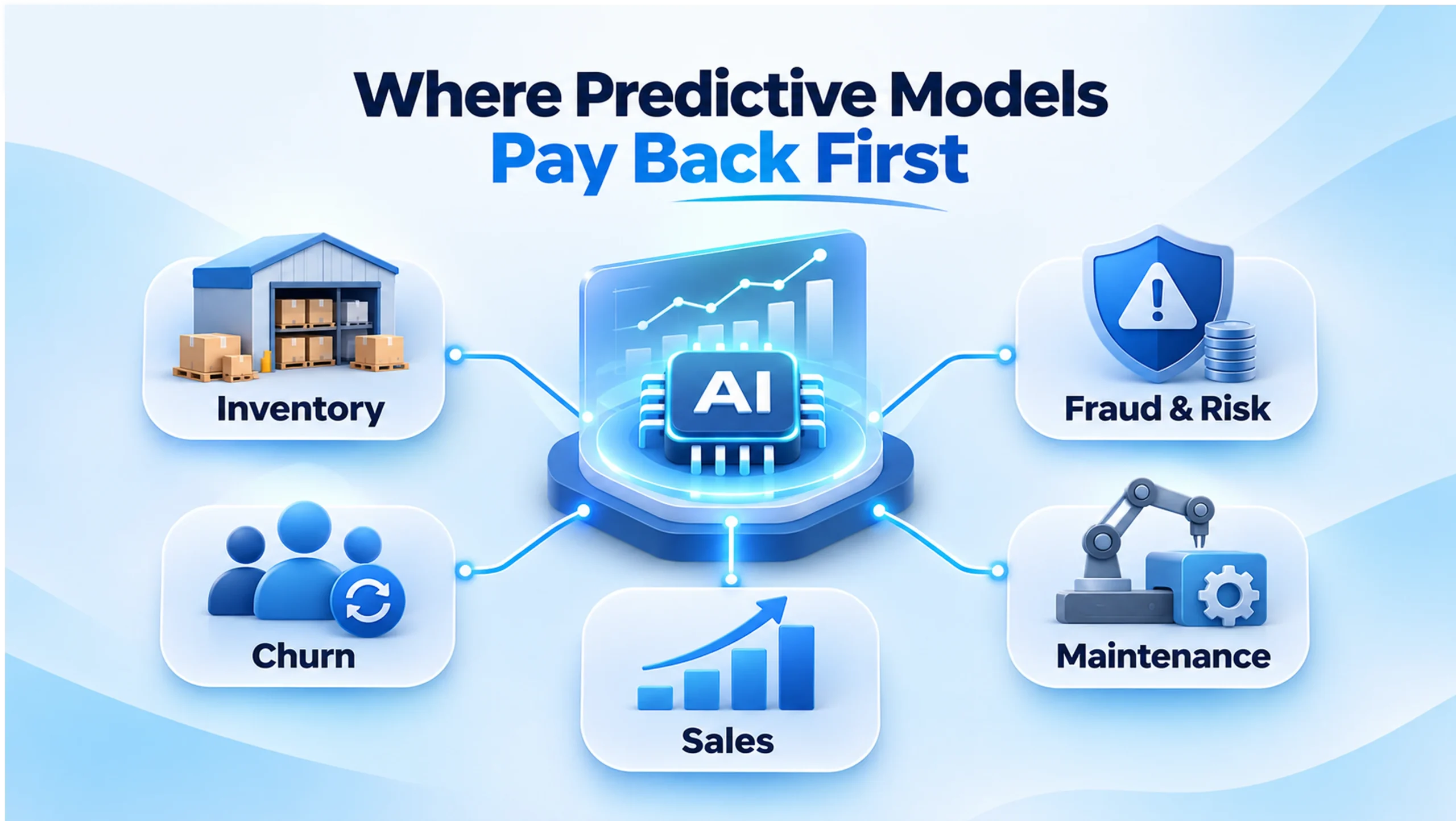
Pick a decision you make often, where each wrong call costs real money. These five areas usually qualify:
- Demand and inventory. Forecast what will sell, where and when, so you cut stockouts and overstock together.
- Customer churn. Flag accounts likely to leave while your team still has time to save them.
- Sales forecasting. Plan hiring and spend from pipeline patterns instead of gut feel.
- Fraud and risk. Score transactions or claims as they arrive, and send only the risky ones to a person.
- Predictive maintenance. Spot equipment that is wearing out before it stops a line or a service.
Supply chains often show results fastest. McKinsey reports that AI-driven forecasting can cut forecast errors by 20 to 50%. It can also reduce lost sales from missing stock by up to 65% (McKinsey, February 2022 (opens in a new tab)). Our guide to AI in logistics covers that use case in depth. For factories and stores, see predictive analytics in manufacturing and retail.
The wider market is growing fast too. Grand View Research expects the global market for predictive analytics to reach $82.35 billion by 2030 (Grand View Research, December 2024 (opens in a new tab)).
A real example: predictive maintenance in AirShield
Here is how this looks in a project we built. AirShield is an AI-powered IoT platform for air purifiers in healthcare and other regulated indoor spaces. More than 50 connected devices stream sensor data around the clock: particle levels, pathogen readings, disinfection cycles and device performance.
A machine learning layer watches device performance trends for early signs of wear. When it spots one, facility staff get a maintenance alert on their phone, in plain language, before the device crosses a critical threshold. Purification cycles also adjust to the air quality patterns the system detects.
Three lessons from that build apply to almost any predictive project:
- The data pipeline took more work than the model. Sensor data had to arrive reliably, even on restricted hospital networks.
- The alert had to make sense to maintenance staff, not engineers.
- The prediction mattered only because it reached someone who could act on it the same day.
Pro tip: Design the alert or report before you train the model. If you cannot say who receives the prediction and what they do next, the project is not ready.
The 60-second readiness check for predictive analytics for business
Answer these five questions honestly before you spend money on predictive analytics for business:
- Can you name one decision that costs you money every time it is wrong?
- Do you hold at least 12 months of reasonably clean data about that decision?
- Does one person own the outcome, not just the dashboard?
- Can your team act on a prediction within days, not quarters?
- Would a 20% better result on that one decision show up in your numbers?
Four or five yes answers: you are ready for a pilot. Two or three: fix your data or your ownership gap first. Our guide to data governance implementation shows how to do that in 90 days. Zero or one: you need a sharper business question before you need a tool.
Which option fits you: buy, build or blend?
Do not start by shopping for predictive analytics software. Start with the decision, then pick the option that fits your data, your team and the value at stake.
| Your situation | Best fit | Trade-off |
|---|---|---|
| Small team, standard use case such as churn or sales forecasts, data in one system | No-code predictive tool or the forecasting built into your CRM | Fast to start, limited control over the model |
| You already run BI dashboards and want forecasts inside them | Predictive features of your BI tool | Easy for users, simpler models |
| Data spread across several systems, or forecasts must trigger actions in your own apps | Custom model on a cloud AI service, connected to your systems | More setup, much more control |
| Prediction sits at the core of your product or operations, at high volume | Custom machine learning platform with retraining and monitoring | Highest accuracy and cost, needs ongoing care |
If your goal is better dashboards, a BI add-on may be enough. Our post on Power BI Copilot explains what that layer can and cannot do. Choose custom work when the data lives in several places, or the prediction must drive an action in your own software.
Pro tip: Ask any vendor to run a back test on your own data first. Their model predicts last year’s outcomes from older data, and you compare it with what really happened.
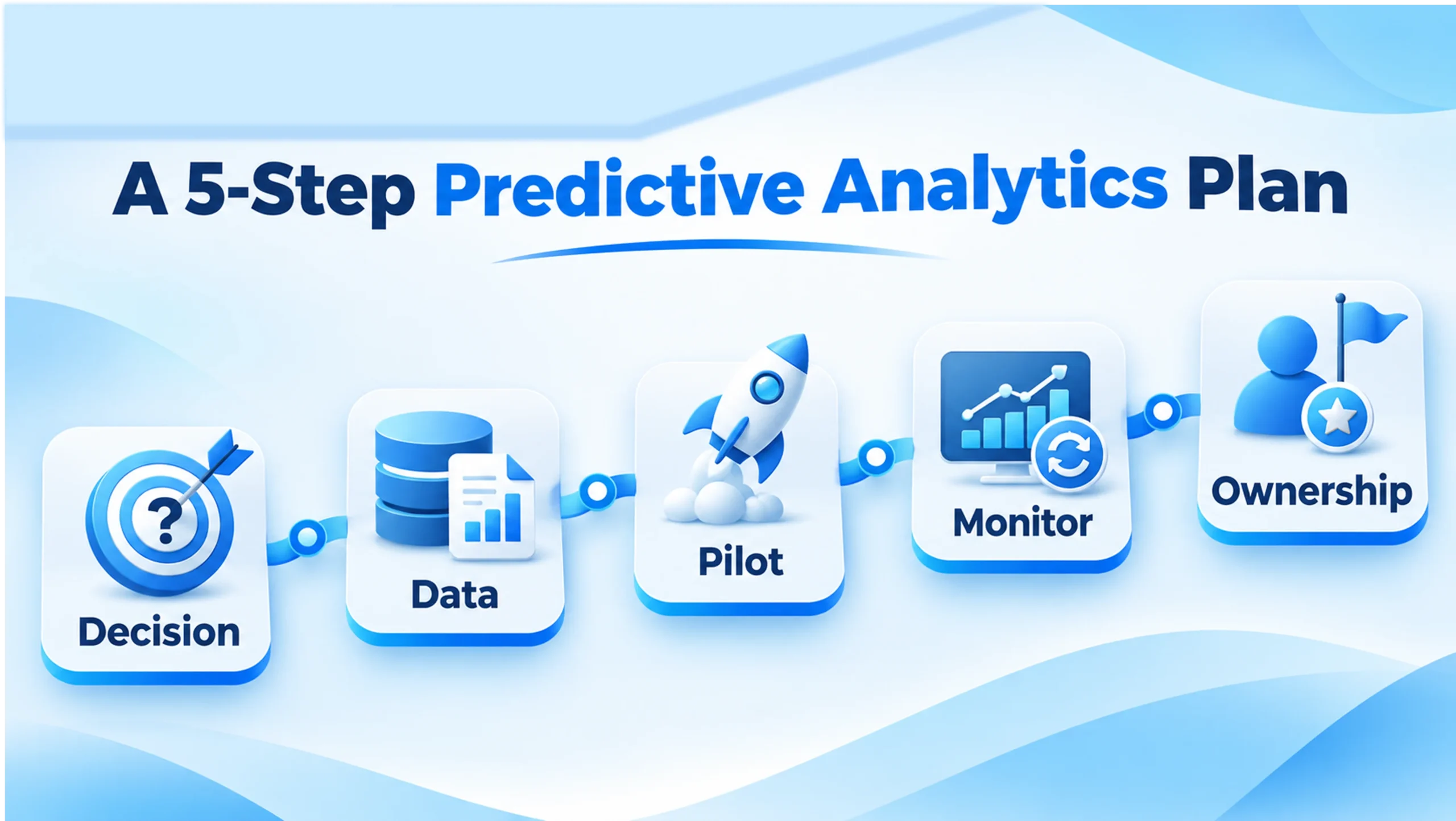
How to start: a 5-step predictive analytics plan
- Pick the decision. Write it as a question with a number, such as “Which customers will cancel in the next 60 days?”
- Audit the data. Check for missing, duplicated and outdated records in the systems behind that question. Fix the worst gaps first.
- Run a focused pilot. Build one model for one team and measure it against your current method for a fixed period.
- Close the loop. Compare predictions with real outcomes every week. Retrain when accuracy slips or the business changes.
- Name an owner. Give one person the job of acting on the predictions and reporting the result.
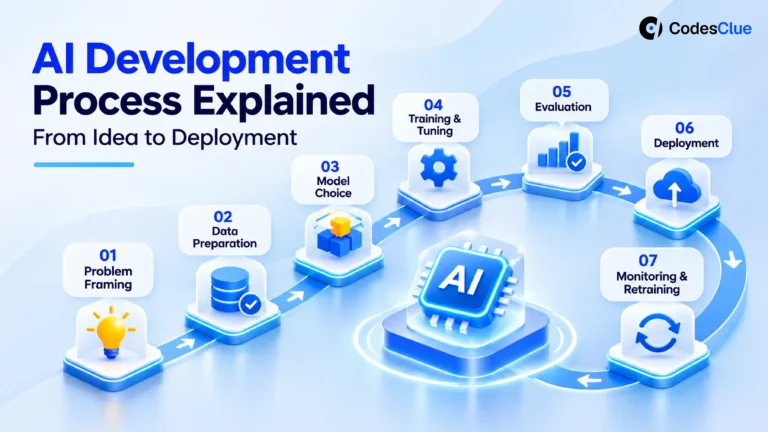
At CodesClue we run this as proof of concept, then MVP, then production, in short Agile sprints. Each stage has to earn the next one. Each of those stages is laid out, with its checks and common mistakes, in our AI development process guide.
Want a second opinion on your first use case? Tell us which decision you want to predict, and we will tell you whether your data is ready.
Common mistakes to avoid
- Skipping the data audit. Teams jump straight to modelling and find duplicate customers or missing months halfway through.
- Chasing accuracy over timing. A good-enough forecast that arrives on Monday beats a near-perfect one that arrives after the order deadline.
- Predicting everything at once. Five half-finished models deliver less than one model in daily use.
- Leaving predictions without an owner. A churn score in a spreadsheet nobody opens saves no customers.
- Forgetting drift. Prices, products and customer habits change. A model trained before a big change will slowly get worse.
What AI predictive analytics costs, and what CodesClue charges
Costs depend on how many data sources you connect, how clean they are and where the predictions need to appear. Licence fees for no-code and BI tools vary by seat and data volume, so check current pricing pages before you budget.
For custom work, our project ladder applies:
- $8K to $25K: a focused pilot on one decision, with one or two data sources and a simple report or alert.
- $25K to $70K: a production model wired into your systems, with dashboards, monitoring and a retraining routine.
- From $70K: several models or a predictive platform at the core of your product.
Short on in-house skills? You can hire data scientists or hire ML engineers from our team, and development starts within 48 hours once you approve the developer.
When predictive analytics is not the right move
We would tell you to wait in three cases. Your data on the decision covers only a few months. The outcome depends on rare one-off events, such as a single large contract. Or nobody has time to act on the forecast. In each case a clear report or a better process will help more than a model.
Pro tip: If a simple rule already gets you 90% of the way, keep the rule. Bring in machine learning for the cases the rule misses.
Getting started with AI predictive analytics
Good AI predictive analytics is narrow, owned and measured. Pick one costly decision, check your data, run a pilot and put the prediction in front of someone who acts on it.
We are an AI-first team: engineers in Ahmedabad, offices in India, the USA and Germany, and every predictive project starts as a small proof of concept. Our data analytics services and machine learning development services cover the data audit, the model and the integration into your tools. We also build the pipelines behind them through our data engineering services.
Run the readiness check above and send us your answers. We will suggest a first pilot and tell you honestly if you should wait. Talk to our data team.
FAQs
How much data do I need for AI predictive analytics?
For most business forecasts, aim for at least 12 months of history on the decision you want to predict, so the model sees a full cycle of seasons. Volume matters less than consistency. A few thousand clean, well-labelled records often beat millions of messy ones. If your history is short, start by collecting the right fields now and use simple rules until you have enough.
How accurate are predictive analytics models in practice?
Accuracy depends on the use case and the data. Repeat patterns such as demand, churn and equipment wear tend to predict well. One-off events, such as a single large deal, predict poorly. Judge a model against your current method, not against perfection. If it beats today’s spreadsheet or gut call by a clear margin over a few months, it is worth using.
Can a small business use predictive analytics without a data scientist?
Yes, for common cases. Many CRM, ecommerce and BI tools now include built-in forecasting for sales, churn or stock levels. These work well when your data sits in one system. You need a data scientist or ML engineer when data spreads across several systems, when the prediction must trigger actions in your own software, or when off-the-shelf models miss your patterns.
How often should a predictive model be retrained?
Check predictions against real outcomes every week or month, depending on how fast your business moves. Retrain when accuracy drops below the level you agreed at the start, or after a big change such as a new product line, a price change or a new market. Many teams also retrain on a fixed schedule, for example every quarter, as a safety net.